
The worst time to make a specialty decision is when you’re hurt, exhausted, and staring at a “We regret to inform you” email. But that’s exactly when most people have to decide whether to switch specialties or double down.
I’m going to be blunt: most unmatched applicants either switch too fast for the wrong reasons, or refuse to switch when the data is screaming at them. You do not want to be in either group.
Here’s how to think about this like a strategist, not like a panicked PGY-(-1).
Step 1: Get Honest About Why You Didn’t Match
You cannot answer “switch vs double down” until you know what actually went wrong.
There are only a few major buckets:
- You aimed too high for your stats/profile.
- You applied too narrow or too late.
- Your application had structural problems.
- Your interview performance hurt you.
- You’re in a hyper-competitive specialty and were below the bar.
- There are red flags (failed exam, professionalism issue, gaps).
You need specific feedback, not vibes.
Who to ask (and really ask, not hint):
- Your home program PD or associate PD in that specialty.
- A trusted faculty mentor who reviews lots of applications.
- If available, your school’s dean of students or career advisor.
What you ask:
- “If a student came to you with my exact application, would you advise them to reapply to the same specialty, or consider switching?”
- “What three things most likely kept me from matching this year?”
- “If I do a reapplication, what would need to be objectively different next year for my chances to materially improve?”
If two or three honest people say, “Your application was solid; this was bad luck / late applications / too few programs,” doubling down is likely reasonable.
If you hear phrases like:
- “Below average Step scores for this specialty”
- “Extremely competitive field”
- “Limited interviews despite broad applications”
- “Major red flags”
…you have to seriously consider switching.
Step 2: Look at the Cold, Unromantic Numbers
You’re not choosing a soulmate. You’re choosing a career path with gatekeepers and quotas.
Here’s how different situations usually shake out:
| Situation | Better Move |
|---|---|
| Competitive specialty, low scores, few interviews | Strongly consider switching |
| Competitive specialty, strong app, many interviews, no match | Reapply with surgical improvements |
| Moderate specialty, very few interviews, late apps | Reapply with broader, earlier, stronger strategy |
| Failed Step attempt or professionalism issue | Often safer to switch to less competitive specialty |
| Older grad or multiple prior attempts in same specialty | Often switch; reapp chances drop each cycle |
Some reality checks:
- Reapplicants can match into the same specialty. It happens every year. But they need a significantly better application, not just “more time passed.”
- Some specialties are brutal as a reapplicant: dermatology, plastics, ortho, neurosurgery, ENT, radiology, ophtho. If you were borderline the first time, the second time is rarely easier.
- PDs notice repeat applicants. They want to see: “What changed?” If the honest answer is “not much,” your odds are poor.
So ask yourself:
- How many interview invites did I get?
- How competitive is my specialty by average Step scores / fill rates?
- Am I getting older out of med school and starting to age out of “ideal” candidate territory?
If you had:
- 10+ interviews in a moderately competitive field → that’s usually a “fix and double down” situation.
- 0–3 interviews in a competitive field → likely “time to pivot” territory.
Step 3: Gut Check – Do You Actually Love This Specialty?
This part most people skip. Then they end up forcing a reapplication to a specialty they were never that committed to.
Ask yourself without posturing:
- If no one cared what I matched into and all salaries were identical, would I still pick this?
- Did I enjoy typical days in this specialty, or only the highlight reel?
- Was I chasing prestige, lifestyle gossip (“good hours”), or money more than the work itself?
If the honest answer is “I loved it, and I felt at home with those attendings and residents,” that matters. Strongly. You don’t walk away from that lightly.
If the honest answer is “I liked parts of it, but I could see myself happy in X, Y, or Z too,” then switching becomes a lot less tragic and a lot more strategic.
Step 4: Understand What “Doubling Down” Actually Requires
Reapplying to the same specialty is not “try again with the same thing and hope”.
It usually means:
- A dedicated gap year (or more) doing research, prelim, or a transitional year.
- One or more strong, fresh letters from people in that field.
- A very clear improvement in your CV: more publications, stronger clinical evals, higher Step 2 if Step 1 was weak.
- A wider and earlier application spread. Sometimes 80–100+ programs for competitive specialties.
- A better personal statement and more coherent story.
If you are not willing or able to do that—because of finances, geography, burnout, family—then “double down” is theoretical. On paper only.
Here’s the uncomfortable truth: repeating the exact same strategy, with the same file, is self-sabotage.
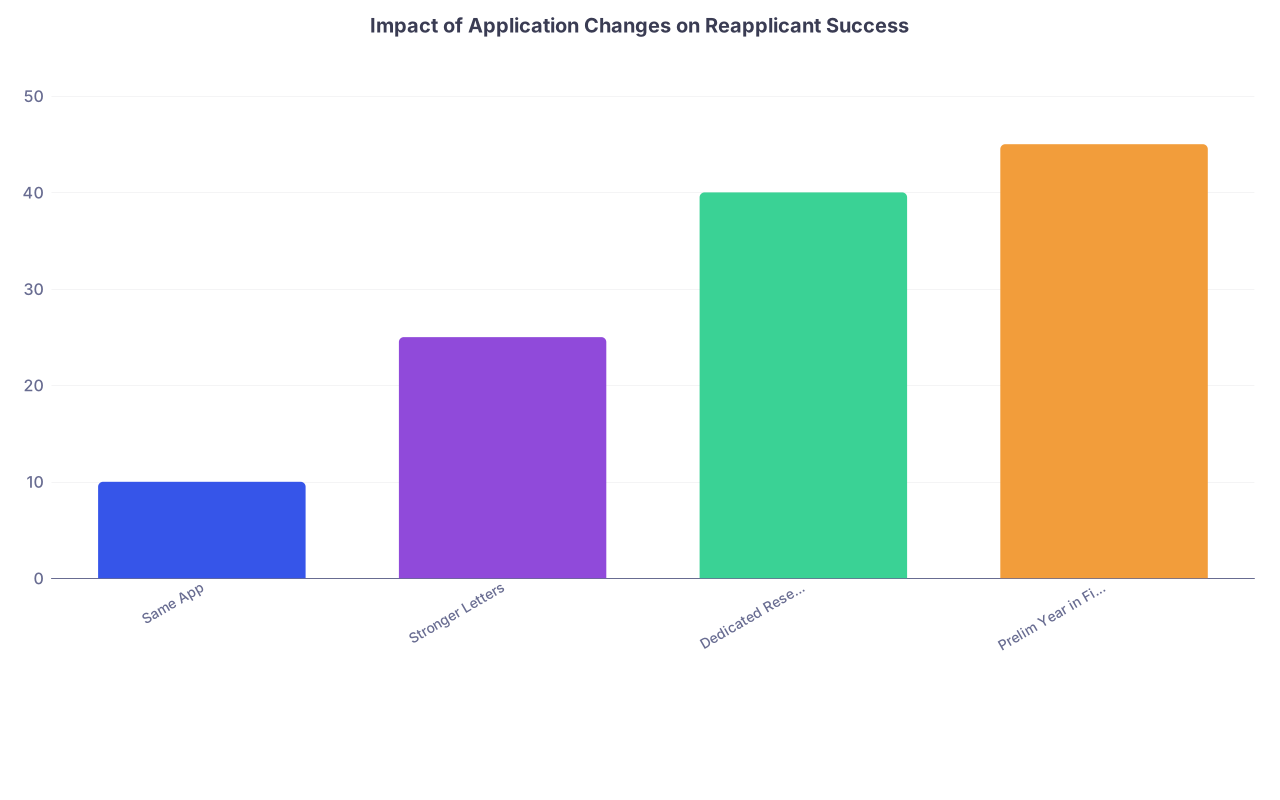
| Category | Value |
|---|---|
| Same App | 10 |
| Stronger Letters | 25 |
| Dedicated Research Year | 40 |
| Prelim Year in Field | 45 |
These percentages are illustrative, not official NRMP data—but the pattern is accurate: meaningful upgrades matter. Cosmetic tweaks do not.
So if you want to double down, make a checklist:
- What will be visibly better in my file 12 months from now?
- Who will be my new strongest letter writer in this field?
- How many more programs can I realistically apply to and interview with?
If you cannot answer those with specifics, you’re not truly doubling down.
Step 5: What Switching Specialties Really Means (Pros and Cons)
Switching is not “giving up” on medicine. It’s picking a specialty where your odds and your skills actually line up.
Who tends to benefit from switching:
- People who went for ultra-competitive fields (derm, plastics, ENT, neurosurgery, ortho, IR) with average stats and limited interviews.
- Applicants with exam failures or gaps, who need fields with a broader range of accepted stats.
- Older grads, international grads, or people with previous non-US training needing a realistic doorway into US residency.
Common options people switch to:
- Internal medicine
- Family medicine
- Pediatrics
- Psychiatry
- Neurology
- Pathology
- PM&R (variable competitiveness by year)
Notice I did not say “just go into family or psych, it’s easy.” That attitude is garbage. Every specialty has its own skill set, frustrations, and rewards.
You should not switch only because it’s “easier.” You switch because:
- The work is acceptable-to-enjoyable to you.
- Your background can be reframed to fit that field well.
- The match data and your file actually make sense together.
I’ve seen people who didn’t match ortho, switched to PM&R, and ended up doing interventional pain and procedures all day—pretty close to what they wanted in the first place. I’ve seen people go from radiology aspirations to internal medicine, then to cardiology fellowships and absolutely love it.
But I’ve also seen people bitterly switch to a field they looked down on, stay bitter, and struggle.
So if you’re going to switch:
- Shadow and rotate in the new specialty if possible (even short stints help).
- Talk to residents who actually like their jobs in that field.
- Be honest with yourself about lifestyle, patient population, and personality fit.
Step 6: A Simple Decision Framework
Here’s the stripped-down version. Answer these questions in order.
Did I get at least a moderate number of interviews (say 8–10+) in my chosen specialty?
- Yes → move to #2.
- No → you’re probably on the bubble or below. Strongly consider switching, unless there’s a clear fix (late apps, very narrow geographic preference).
Do I have at least average stats and no major red flags for this specialty?
- Yes → double down is reasonable if you materially upgrade your application.
- No → consider switching to a field whose typical matched profile looks like you.
Would I still pick this specialty if money, prestige, and social perception were identical?
- Yes → favor reapplication, but only with a realistic plan.
- No → consider switching. You may be holding onto an image, not a vocation.
Can I afford (financially, emotionally, logistically) 1–2 more years of grind to try again?
- Yes → reapply or do a structured gap year / prelim year.
- No → a clearer, more attainable specialty may protect your mental health and career.
Do at least two experienced mentors explicitly recommend reapplying to the same field?
- Yes → serious green light for doubling down.
- No or mixed → don’t ignore that. It often means they see weaknesses you’re minimizing.
Step 7: Smart Use of a Prelim Year or SOAP
If you’re considering doubling down, a prelim or transitional year can be gold—or a waste.
Good uses:
- Prelim surgery if you’re reapplying surgery or surgical subspecialty.
- Prelim medicine if you’re headed toward IM subspecialties or radiology/anesthesia.
- Doing well clinically, earning killer letters, staying in the game.
Bad uses:
- Taking any prelim just to “stay busy” while doing nothing relevant to your target specialty.
- Burning out in a toxic program, leaving you too fried to properly reapply.
SOAP is similar. You might:
- Grab a categorical spot in a different specialty you could see yourself enjoying and commit to making the most of it.
- Take a prelim/transition spot strategically aligned with your reapplication plan.
What you should not do: blindly SOAP into a field you hate and expect to be magically happy.

| Step | Description |
|---|---|
| Step 1 | Unmatched |
| Step 2 | Seriously explore switching |
| Step 3 | Reapply with gap/prelim year |
| Step 4 | Enough interviews & decent stats? |
| Step 5 | Strong passion for same specialty? |
| Step 6 | Can materially improve app? |
Step 8: How to Tell Programs Your Story (Whichever Path You Choose)
PDs care about how you think, not just what happened.
If you reapply to the same specialty, your narrative should sound like:
- “I reflected on my gaps, took concrete steps to improve them, and my commitment is stronger and more informed now.”
Example themes:
- Perseverance with growth, not stubbornness.
- Specific new skills, research, or experiences since last cycle.
- Clarity about why this specialty fits you—now with more evidence.
If you switch specialties, your narrative should sound like:
- “Not matching forced me to reassess. In that process, I realized this specialty actually aligns better with how I like to work and the patients I want to serve.”
Programs do not want to hear:
- “I’m here because my first choice didn’t work out and I need a job.”
They want:
- “I’ve thought hard about this. I understand what you do. Here is why I fit—and here is what I bring.”
Frequently Asked Questions
1. I didn’t match a competitive specialty but got several interviews. Should I reapply to the same field?
If you had a decent number of interviews (often 8–10+), that usually means programs considered you viable. That’s very different from someone who got 0–2 interviews. In your shoes, I’d:
- Get detailed feedback from at least two PDs if possible: was it interview performance, letters, or just sheer competitiveness?
- Fix something big: stronger letters, research with known faculty, better interview prep, broadened application list.
- Decide if you can handle another intense year mentally and financially.
If mentors say, “You’re close; I’d reapply,” and you still genuinely love the field, reapplying makes sense. But go in with a concrete upgrade plan, not blind optimism.
2. How many times is it reasonable to reapply to the same specialty?
Once. Maybe twice in very specific cases with massive improvement. After one unsuccessful, truly upgraded reapplication, the odds of a third attempt paying off drop hard in most fields. PDs start to wonder why so many programs passed multiple years in a row.
If you already didn’t match once, took a gap or prelim year, significantly improved your application, and still didn’t match into the same field, that’s the universe yelling at you. At that point, I generally advise switching, unless unusual circumstances exist and multiple PDs specifically encourage trying yet again.
3. Does switching specialties label me as a failure or hurt me long term?
Within your new specialty, not really—assuming you own your story and show commitment. Many PDs respect someone who can reassess, pivot, and then go all in. What does hurt you is sounding bitter or clearly treating the new field as second-class.
Long term, almost no one cares what you tried to match into as a med student. They care what kind of colleague you are. People remember: Do you show up, do you care about patients, are you reliable? If you do, your prior non-match becomes trivia, not identity.
4. I’m an IMG/older grad and didn’t match. Should I still try my original specialty?
This is where you have to be brutally realistic. If you’re an IMG or >3–5 years from graduation, your margin for error is thin. If you:
- Aimed for a highly competitive specialty,
- Got few or no interviews,
- Have any exam failures or gaps,
then doubling down in the same field is usually a low-yield plan. It’s not impossible, but you’re stacking difficulty levels.
I’d look very seriously at specialties with a track record of taking IMGs/older grads that you could see yourself doing long term. Then build a focused story and network in that new field rather than dying on the hill of a specialty that isn’t opening doors.
5. Is it better to SOAP into any spot or wait a year for a better fit?
If “any spot” means a specialty you actively dislike and cannot picture yourself in, I’d be cautious about grabbing it purely out of fear. A year of structured, intentional work (research, prelim, additional clinical experience) that leads you into a field you genuinely like can be a better move than locking yourself into a miserable path.
On the other hand, if the SOAP spot is in a field you could plausibly enjoy—and especially if it’s categorical—that’s often too valuable to pass up. Stable income, training, and guaranteed progression matter. The key question: “If this became my permanent specialty, could I build a decent life and professional identity around it?” If yes, you can probably take it and commit.
Bottom line:
- Don’t decide based on panic. Decide based on data, honest mentorship, and your actual day-to-day fit with the work.
- Doubling down only makes sense if you can materially improve your application and still truly want that specialty.
- Switching is not failure. It’s often the smartest, most adult choice you can make—if you choose a field you respect and are willing to fully commit to.