
Blunt truth: for most people, taking a solid prelim spot beats sitting out. But not always. The right answer depends on your stats, your specialty target, and how much pain you’re willing to absorb in the next 12–24 months.
Let’s walk through this like I would with a student in my office: what you want, what you actually have, and what each path really looks like when the dust settles.
First: What Are You Choosing Between Exactly?
You’re basically choosing between three versions of pain:
- Prelim year (medicine or surgery usually), then reapply
- Transitional year (if you found one) then reapply
- Sit out: research, MPH, non-clinical job, etc., then reapply
Here’s the key: you’re not choosing “good vs bad.” You’re choosing “which trade-offs screw me less for my specific situation.”
| Option | Main Benefit | Main Risk |
|---|---|---|
| Prelim Med | Strong clinical CV | Burnout, no PGY-2 |
| Prelim Surg | Looks tough/competitive | Less time to reapply |
| Transitional | Balanced lifestyle | Often more competitive |
| Gap Year | Time to fix your app | Clinical rust, questions |
When a Prelim Spot Is Usually the Better Move
If you’re in these buckets, I’d strongly lean prelim over sitting out.
1. You ultimately want internal medicine, FM, peds, psych, or neuro
If you didn’t match categorical IM/FM/psych/neuro but landed a prelim IM spot, that’s often gold.
Why a prelim year helps you here:
- You’ll get strong US clinical experience under supervision
- You can get letters from attendings who know you as a doctor, not a student
- You stay fresh clinically and don’t get rusty
- Many programs are quietly looking to “upgrade” prelims they like into PGY-2+ spots when someone leaves
I’ve watched prelim IM residents move into:
- Categorical IM at the same institution
- Categorical IM at an affiliated community program
- Psych/Neuro/FM after one prelim year with strong performance
For core specialties, being in the system usually beats being outside looking in.
2. Your scores or application are already borderline
If you have any of these:
- Step 1 fail or low pass
- Step 2 CK < 220–225 for competitive specialties, or < 210ish for core
- Limited US clinical experience (especially IMG/DO)
- Mediocre letters from medical school
Then sitting out for a pure research or “gap” year rarely fixes the core problem on its own. A solid prelim year can:
- Show programs: “Yes, my early scores weren’t great, but I function well as a resident.”
- Replace weak MS letters with strong residency letters.
- Help you avoid getting written off as “inactive” clinically.
3. You’re an IMG or DO with limited US clinical time
IMGs especially should think very hard before choosing a non-clinical gap year over a prelim spot.
Why?
Programs worry about:
- Lack of recent US clinical experience
- Ability to function in US system
- Communication and documentation
A prelim year checks all those boxes. A gap year in research doesn’t.
I’ve seen IMGs go from zero interviews → prelim IM → then 10–15 interviews next cycle because now they’re “a known clinical quantity.”
4. You can tolerate a brutal year if it clearly increases your odds
Let’s not sugarcoat it.
Prelim surgery? Often miserable.
Prelim medicine at a busy county? Also no picnic.
But if the alternative is:
- Another unmatched year
- Getting effectively “timed out” of the match
- Or drifting into permanent non-residency land
…then one hard year is often the smarter pain.
When Sitting Out (Gap Year) Might Actually Be Smarter
Now, there are real situations where I’d tell someone: I wouldn’t burn a prelim year on this.
1. You’re dead-set on a hyper-competitive specialty
We’re talking:
- Dermatology
- Plastic surgery
- Neurosurgery
- Ortho
- ENT
- Ophtho
- Urology
For these, a random prelim year often doesn’t move the needle enough by itself. What matters more:
- High-impact research in that field
- Strong specialty-specific letters
- Being physically present at a department that likes you and can pull strings
In those cases, a well-structured research year embedded in a strong department may beat a prelim year where you’re just grinding on medicine wards with no link to your desired field.
But: that only holds if you can get a legit research position with real mentorship, not just data entry in a basement.
2. Your main issue is timing or logistics, not your profile
Examples:
- You applied super late
- You botched your personal statement or specialty choice
- You had a short-term personal/health crisis during application season
- You didn’t apply broadly enough (e.g., 20 EM programs with average stats)
Here, a dedicated re-application year where you:
- Fix personal statement
- Apply early and broadly
- Do targeted away rotations or observerships
- Maybe add some research / teaching
…can be more productive than spending all your time on prelim scut with barely any bandwidth to repair the application.
3. You’re already a strong candidate who had bad luck
If you’re something like:
- US MD, solid Step 2 (240+), no red flags
- Good letters, real research
- Misalignment between your app and your rank list (e.g., all super competitive academic programs only)
You might benefit more from:
- A research or chief year at your med school
- Extra publications
- Strategic advising and better program list
Than grinding through an unrelated prelim that doesn’t add much to your narrative.
Key caveat: your med school must be very willing to advocate for you, again.
The Biggest Risks of a Prelim Year (People Underestimate These)
Taking a prelim spot isn’t a free power-up. There are landmines.
No guaranteed PGY-2. You can finish the year, get a “meets expectations” evaluation, and still have zero permanent spot.
Limited time to reapply. On busy rotations, you’ll barely have time to brush your teeth, let alone:
- Write personal statements
- Do ERAS
- Attend interviews
- Work on research
Burnout. A wrecked prelim resident doesn’t interview well. If you’re so fried you present as bitter or exhausted, it hurts you.
Being “pigeonholed” incorrectly. A prelim surgery year doesn’t magically make you a better psych applicant. If you pick a prelim that doesn’t align at all with your target specialty, you’ll need to explain that clearly.
The Biggest Risks of Sitting Out Completely
Sitting out feels safer. On paper it’s not.
You’re a year further from hands-on patient care. Programs don’t like gaps in clinical activity without a strong explanation.
You’ll get asked in every interview: “So why weren’t you in residency last year?” You need a real, coherent answer showcasing growth, not just “I was reapplying.”
You lose momentum. I’ve watched people who “just take a year” slowly drift away from medicine. They start tutoring, doing industry/tech jobs, or clinical research coordinator roles… and never get back to residency.
Your chances don’t automatically improve just because time passed. If your core problems (scores, poor letters, professionalism concern) don’t actually change, another cycle looks just like the last one.
How to Decide: A Simple Framework
Here’s the decision filter I use when advising people.
Step 1: Be brutally honest about your current competitiveness
Ask yourself:
- Did I get any interviews?
- Were my interviews all at low-tier/community or also mid/high-tier academic?
- Do I have any red flags: fails, professionalism issues, big gaps?
- Am I an IMG/DO vs US MD?
If you had:
- Zero or very few interviews → assume your app is weak or misaligned.
- Several interviews but no match → may be rank/interview skills or overreach issue.
Step 2: What’s your target specialty now?
If you’re pivoting:
- From something competitive → to IM/FM/psych/PM&R/Neuro:
- A prelim IM year is often the best move.
- Staying in the same hyper-competitive specialty:
- Strong targeted research year + networking may beat a random prelim.
Step 3: What concrete opportunity do you actually have?
You’re not choosing between “ideal prelim” vs “perfect research year.” You’re choosing between specific offers.
Compare real options:
| Option | Type | Alignment With Goal | Support Level |
|---|---|---|---|
| A | Prelim IM, busy community | High for IM/FM/psych | Low mentoring |
| B | Research year in derm dept | High for Derm only | Strong mentoring |
| C | Gap year + tutoring job | Low | None |
In that example:
- If you want Derm: B wins
- If you’ve pivoted to IM: A wins
- C is almost never the best unless forced
Step 4: Who will actively advocate for you?
This is huge and people underestimate it.
You need:
- An advisor who really knows you
- At least 1–2 attendings willing to call programs or email PDs
- A clear “story” they can pitch: “This person had X issue, fixed it by Y, and is now ready”
If your med school has checked out and your only real chance at advocacy is from new attendings during a prelim year, that pushes you toward taking the prelim.
How Programs Actually See Prelim vs Gap Years
Let me translate the subtext.
How a prelim year reads to PDs
If you perform well:
“Okay, they might have had imperfect scores or timing, but they’ve proven they can function as an intern, show up, write notes, manage patients, not be a disaster at 3 a.m. Let’s talk to them.”
If you perform poorly:
“This confirms our concerns. Hard pass.”
So your prelim year amplifies whatever you really are. If you’re hardworking and coachable, it helps. If you’re disorganized and unreliable, it exposes that.
How a gap year reads to PDs
Best case (structured, meaningful year):
“They didn’t match, reflected, took a structured path, improved themselves, and now have stronger research/letters/clarity.”
Worst case (vague, unstructured year):
“They didn’t match, then sort of floated. Why should I believe the outcome will be different this time?”
You want your gap year to look like a program of its own: clear role, supervisor, output (papers, teaching, projects), and a coherent story.
Practical Advice If You Take a Prelim Spot
If you choose prelim, don’t just survive. Use it strategically:
- Identify early which attendings you want as letter writers. Show up, be reliable, ask for feedback.
- Block off time for ERAS prep by planning ahead (get personal statement and CV drafted before July 1).
- Stay in touch with your med school’s dean’s office; don’t disappear.
- Tell your PD early—but tactfully—that you hope to match into a categorical position next year. Many will help if you’re a strong resident.
Practical Advice If You Sit Out
If you choose to sit out, it must be structured:
- Get a defined role: research fellow, instructor, clinical research coordinator with patient contact, etc.
- Work with someone who has a track record of getting people into residency. Ask directly: “Where have your past mentees matched?”
- Keep one foot in clinical work if at all possible: observerships, free clinics, shadowing, simulation teaching.
- Have a written plan for the year: goals for publications, presentations, USCE, Step 3 (if appropriate), and application improvements.
A Visual Snapshot: Risk vs Benefit
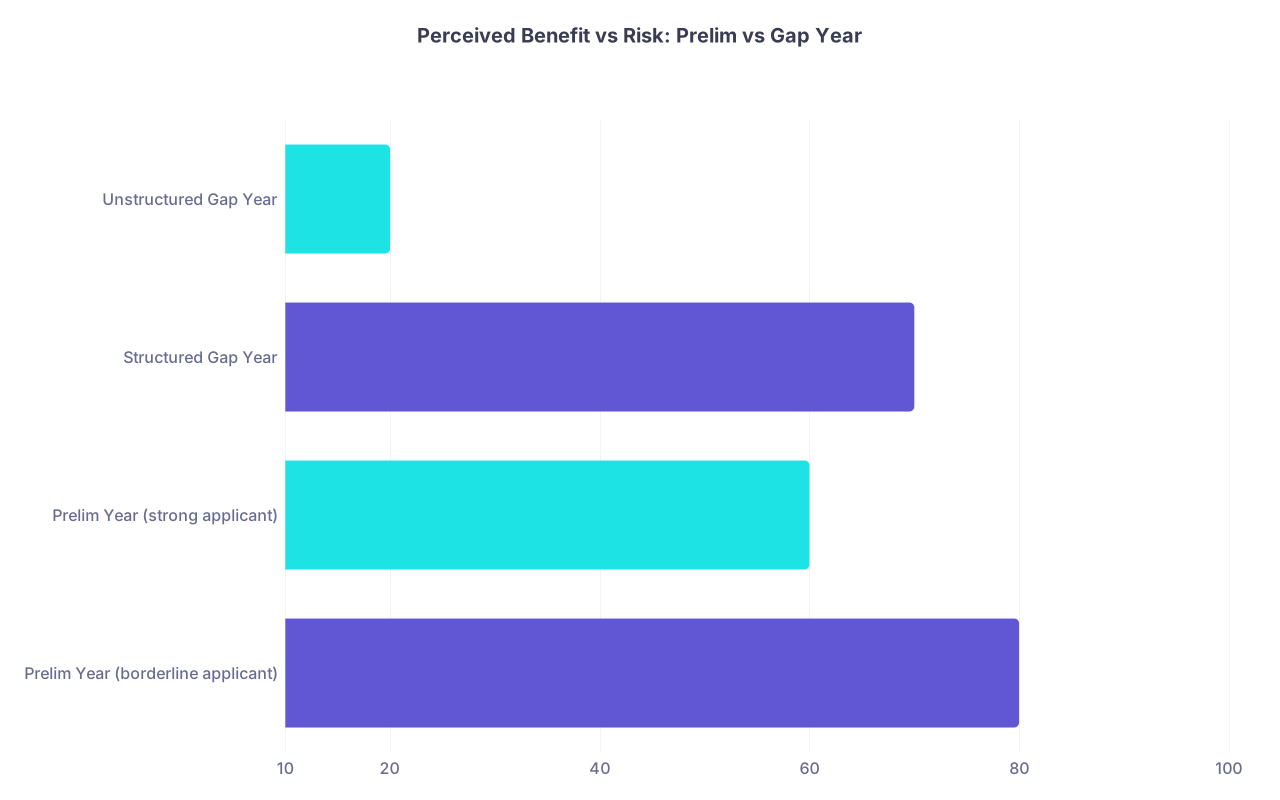
| Category | Value |
|---|---|
| Prelim Year (borderline applicant) | 80 |
| Prelim Year (strong applicant) | 60 |
| Structured Gap Year | 70 |
| Unstructured Gap Year | 20 |
Interpretation: higher number = better net move for your file. For most borderline applicants, prelim wins. For strong applicants, the gap between options is smaller and depends more on specialty.
Decision Flow: Rough Guide

| Step | Description |
|---|---|
| Step 1 | Didnt Match |
| Step 2 | Consider research/gap year |
| Step 3 | Lean toward prelim year |
| Step 4 | Prelim usually better |
| Step 5 | Take structured gap year |
| Step 6 | Strongly consider any reasonable prelim |
| Step 7 | Pursuing very competitive specialty? |
| Step 8 | Have strong research-year offer in that field? |
| Step 9 | Have solid prelim offer aligned with target? |
| Step 10 | Can you structure a strong clinical/research year? |
FAQs
1. Does a prelim year guarantee I’ll match the next cycle?
No. Not even close. It improves odds if you perform well and use it strategically, but there are plenty of prelims who finish the year without a PGY-2. Think of it as buying a much better lottery ticket, not a contract.
2. Is a prelim surgery year better than a prelim medicine year?
Only if it aligns with what you ultimately want. For most people pivoting to IM, FM, psych, or neuro, a prelim IM year is more directly useful. Prelim surg mainly impresses surgical fields and maybe EM. Doing a brutal prelim surg year when you want psych? That’s self-sabotage.
3. What if I get offered a prelim in a weak or malignant program?
Then you do a risk–benefit check. A malignant program that will wreck you and tank your evaluations may harm you more than help. But don’t confuse “busy and demanding” with malignant. Talk to current prelims, not just seniors who are miserable but surviving.
4. Should I take Step 3 during a prelim or gap year?
If your Step 1/2 are weak or you’re an IMG, a solid Step 3 can help, especially before the next application cycle. During a prelim year, Step 3 can be hard to schedule unless you plan ahead. During a gap year, it’s often easier and shows you’re still academically active.
5. Does a research year without clinical exposure hurt me?
It doesn’t automatically hurt, but if you’re already light on US clinical experience, yes, it can be a problem. Pure bench or chart-review work with zero patient contact is fine for dermatology or rads applicants with strong clinical backgrounds, but risky for IMGs or those with minimal USCE.
6. How much does being an IMG change this decision?
A lot. IMGs almost always benefit more from any legitimate US clinical role than from being off the field. A prelim IM spot with decent supervision and documentation in the US system is often massively more valuable than a non-clinical gap year, unless you already have extensive recent USCE.
7. If I sit out, how do I explain it in interviews?
You frame it as intentional, structured, and productive. Example: “I didn’t match last year, so I met with my dean and mentors, identified that I needed stronger US clinical experience and scholarly work. I took a research/clinical position in X department, where I’ve done Y and Z, and it’s confirmed my commitment to [specialty].” Never present it as drifting or just “waiting to reapply.”
Bottom line:
- Borderline applicant, non-ultra-competitive specialty, decent prelim offer? Taking the prelim year is usually the better move.
- Strong applicant or aiming at a very competitive specialty with access to a serious, embedded research year? A structured gap year can beat a random prelim.
- Whatever you choose, it has to be intentional and productive—no drifting, no vague “I’ll just try again next year” without a plan.