
It’s March. Again. You’re watching the NRMP clock tick down, again. You know before you click: no email, no match. Maybe it’s your second time in SOAP. Maybe your third. And the thought you swore you’d never consider is now sitting right in front of you:
“Is it time to give up on residency and look at non-clinical careers?”
Here’s the answer you’re actually looking for: there is a point where continuing to reapply for residency stops being rational and starts being self-punishing. That point is different for different people, but it’s not infinite. You do not owe the system endless tries.
Let’s walk through how to know when you’re at (or approaching) that point, and what realistic alternatives look like.
Step 1: Get Clear on the Facts (Not Just the Feelings)
Before you decide anything, strip it down to data. Not vibes. Not hope. Numbers and patterns.
Here are the big four that matter:
| Factor | Why It Matters |
|---|---|
| Number of prior no-matches | Each attempt usually lowers your odds |
| US vs IMG status | Baseline odds are very different |
| Exam outcomes (passes/fails) | Multiple fails are a major drag |
| Years since graduation | Older grads face steep declines in interest |
Now some hard benchmarks I use when advising people:
Attempts
- One no-match: very common, there’s still plenty of room.
- Two no-matches: yellow zone. You need serious changes, not just “try harder.”
- Three or more no-matches: red zone. You should actively and seriously consider non-residency paths, even if you try again.
Years since graduation
- 0–2 years: still fresh, programs are flexible.
- 3–5 years: significantly harder unless you’re in research, prelim spots, or strongly mentored.
5 years: most categorical programs lose interest unless there’s something exceptional backing you.
Board exams
- Pass on first attempt (USMLE/COMLEX): fine, it’s about other factors.
- Single fail: not fatal, but it pushes you to less competitive paths.
- Multiple fails or unfinished exams (never passed Step 2, for example): programs see you as risky. Past a certain point, that risk is almost impossible to overcome.
Applicant type
- US MD: longest runway, more forgiveness, more options.
- US DO: decent runway, but some specialties/programs still biased.
- IMG (US citizen or not): shorter runway, fewer attempts before the system essentially labels you “recycled” and moves on.
If you’re, say, 4 years out from graduation, have applied 3 times, never matched anywhere (not even prelim), and have at least one failed Step attempt—you are in the group where non-residency careers need to be on the table now. Not “someday.”
Step 2: Look at Your Actual Match Trajectory
Do not just count “how many times did I apply?” Look at whether your trajectory is improving or flat.
Here’s what I want to see if I’m going to tell someone, “Yes, keep pushing residency”:
- More interviews each cycle, not fewer
- Stronger letters from US clinical faculty, not the same old weak ones
- A realistic specialty shift (e.g., from Derm → FM, or Surgery → IM/psych)
- Clear, documented new strengths between attempts (research, MPH, hospitalist scribe leadership, etc.)
If your cycles look like this:
- Year 1: 1–2 interviews, no rankable options
- Year 2: 0–1 interviews, mostly auto-rejections
- Year 3: SOAP only, no serious traction
That’s not a trajectory. That’s a pattern. Programs are telling you something with their silence.
Step 3: Pay Attention to the Opportunity Cost
At some point, continuing to reapply has a real cost, not just emotional but financial and career-wise.
Here’s what I see too often:
Someone spends 3–4 years in limbo—exam tutoring, research assistant roles, observerships—barely scraping by, hoping “next year will be the year.” Meanwhile:
- Their classmates are attendings or senior residents
- Their non-med friends are managers, directors, partners
- They’re still explaining to family at Thanksgiving why there’s “no job yet”
You have to ask: what are you not building while you chase this? Savings. Experience in something else. A non-med CV. Geographic stability. A life.
Use this basic rule:
If you’ve done 3+ full cycles, made serious changes each time, and your interview numbers are flat or worse, then the opportunity cost of “just one more try” is probably too high to ignore. You can try again, but that cannot be your only plan.
Step 4: Red Flag Combinations That Strongly Point to Non-Residency Paths
I’m going to be blunt. These combinations usually mean residency is now a long-shot, not a plan:
- IMG + >3 years since graduation + multiple failed exams
- 3+ no-match cycles + no categorical interviews + no SOAP offers
- Major professionalism issue in your record (dismissal, probation) that you cannot reframe and support with powerful advocacy from faculty
- You stopped taking exams for years and are now trying to re-enter without substantial new clinical/research work
If you’re in one of these groups, you’re not “giving up” by pivoting. You’re reading the field correctly.
Step 5: How to Decide Logically (Not in a Panic Week of SOAP)
You need a framework. Here’s a simple decision flow.

| Step | Description |
|---|---|
| Step 1 | Repeated No-Match |
| Step 2 | Optimize and Reapply |
| Step 3 | Consider 1 More Targeted Cycle |
| Step 4 | Mixed Strategy: Reapply + Build Non-Residency Skills |
| Step 5 | Prioritize Non-Residency Career Path |
| Step 6 | 3+ Attempts? |
| Step 7 | Interviews Improving? |
| Step 8 | >3 Years Since Grad or Major Failures? |
The key branches:
- If you’re under 3 attempts and your profile is reasonably strong: it’s still rational to try again, but with a very targeted strategy.
- If you’re 3+ attempts in and your outcomes are static or worsening: non-residency careers should move from “backup” to “co-primary” plan.
- If you’re 3+ attempts in and 3–5+ years out from graduation and your exams or record have red flags: non-residency paths should be your default plan, and any future reapplication is a long-shot side bet, not your central life plan.
Step 6: What Non-Residency Careers Are Actually Realistic?
Let’s talk concrete options. Not the fantasy “Chief Medical Officer in 2 years without residency” kind of stuff. Realistic doors that actually open.

Here are categories where I’ve seen unmatched or no-longer-pursuing-residency grads land:
Clinical-adjacent roles (no license required)
- Clinical research coordinator or manager
- Medical science liaison (MSL) – harder to break into, but possible if you have strong communication and therapeutic-area background
- Pharma/biotech medical affairs roles
- Medical writing (regulatory, CME, pharma, health comms)
Health tech and analytics
- Product manager or clinical specialist at digital health startups
- Implementation specialist or clinical consultant for EHRs, AI tools, etc.
- Healthcare data analyst or clinical informatics roles (sometimes after a short certificate/masters)
Public health and policy
- MPH + roles in local health departments, NGOs, or federal agencies
- Program management for public health initiatives
- Global health project roles (especially if you have language skills or regional experience)
Education and content
- Test prep (MCAT, Step, USMLE tutoring, content development)
- Curriculum design for med schools, nursing, PA, or allied health
- Health communication for patient education platforms
Business and consulting
- Healthcare consulting (boutique firms or larger ones if you have strong quantitative skills)
- Operations roles in hospitals or large medical groups
- Medicare/insurance medical policy analyst or utilization review (some roles require a license; some do not)
| Category | Value |
|---|---|
| Clinical Research | 35 |
| Health Tech | 20 |
| Medical Writing | 15 |
| Public Health | 15 |
| Consulting | 15 |
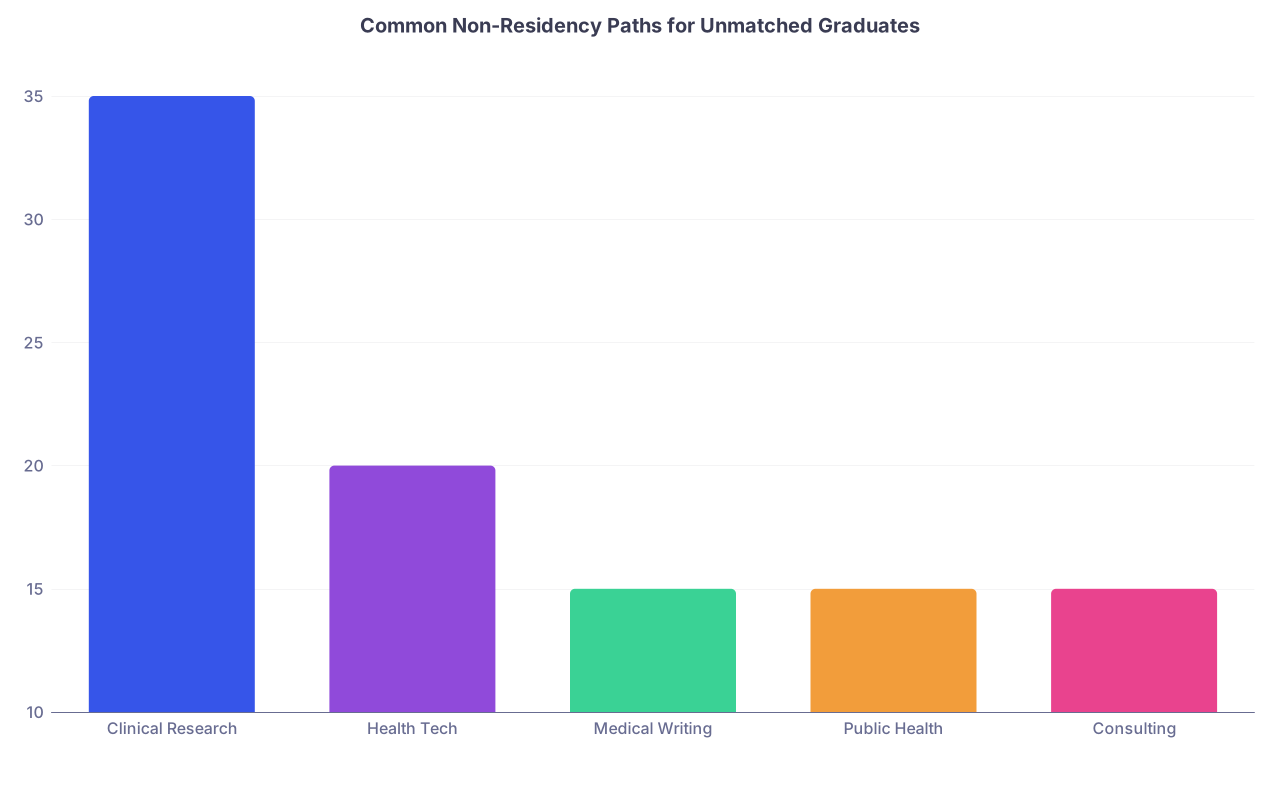
This chart is roughly what I see in the real world: research and health tech absorb a lot of people, then writing, public health, and consulting follow.
Step 7: When to Pivot Your Primary Identity (This Is the Emotional Part)
There’s a difference between “I’m a future resident who’s working in clinical research until then” and “I’m a clinical research professional who has an MD.”
That identity shift is brutal for a lot of people. It feels like failure. Like a downgrade. Like you wasted your 20s.
Here’s the truth: the degree is not wasted. But you can waste more years clinging to a single narrow outcome.
You’re not just deciding, “Do I click ERAS again?” You’re deciding:
- Do I continue to orient my entire life around an outcome that repeatedly has not happened?
- Or do I choose a path where I can actually build seniority, reputation, and stability?
I usually tell people this:
If thinking about being 40 years old, still applying to residency, terrifies you more than the idea of being 40 with a solid non-clinical career and no MD after your name on a clinic door—then you already know the answer.
Step 8: A Practical Pivot Plan (12–18 Months)
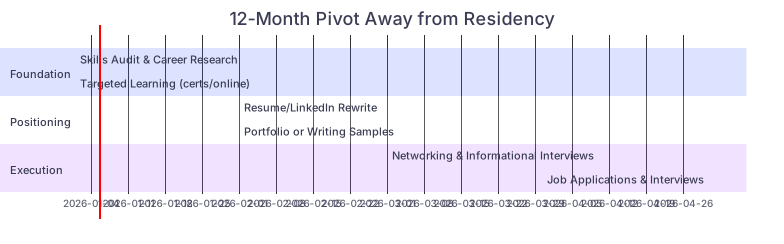
If you decide it’s time to seriously consider non-residency careers, do not drift. Make an actual plan.
| Task | Details |
|---|---|
| Foundation: Skills Audit & Career Research | a1, 2026-01, 1m |
| Foundation: Targeted Learning (certs/online) | a2, after a1, 3m |
| Positioning: Resume/LinkedIn Rewrite | b1, 2026-02, 2m |
| Positioning: Portfolio or Writing Samples | b2, after b1, 3m |
| Execution: Networking & Informational Interviews | c1, 2026-03, 6m |
| Execution: Job Applications & Interviews | c2, 2026-05, 8m |
Key moves in that year:
- Pick 1–2 target fields, not 7. Example: “clinical research + medical writing” or “health tech product + data analytics.”
- Translate your background into that field’s language. No one in health tech cares about your OSCE score; they care that you understand users deeply and can manage complex projects.
- Build real artifacts: writing samples, GitHub projects (if data/tech), slide decks, trial summaries, etc.
- Network like it’s your job—for a while, it is.
If you still want to take one last swing at residency during this pivot year, fine. But treat residency as the side bet, not the main bet. Applications go out; you do not pause your non-residency plan to “wait for interviews.”
Common Mistakes That Keep People Stuck
I see the same traps over and over:
- Applying to the same specialty at the same programs with the same CV, expecting a miracle
- Refusing to consider primary care, psych, or IM when your profile frankly cannot support surgery, ortho, or derm
- Saying “I’ll just do some research for a year” with no strategy, then ending up in limbo with poster #12 and no new doors opened
- Treating anything non-residency as “temporary” for years, which sabotages your progression and income in that path
You cannot hedge everything forever. At some point you choose a lane and push hard.
FAQs: Non-Residency Careers After Repeated No-Match
How many no-match cycles is “too many” before I should pivot?
For most people, three full cycles is the point where you must seriously question continuing, especially if your interview numbers are not improving. If you’re an IMG, two failed cycles with flat or shrinking interviews is already a warning sign. It does not mean a fourth try is impossible, but it does mean it should not be your only plan.Does doing an MPH or another degree meaningfully improve my match chances?
An MPH or similar degree can help if it:- Keeps you clinically relevant and active
- Provides U.S.-based mentors who will strongly advocate for you
- Aligns with a more realistic specialty (FM, IM, psych, preventive)
But no degree will magically erase multiple exam failures, long gaps, or professionalism issues. If you’re doing it as a delay tactic because you cannot accept moving on, that’s the wrong reason.
Is there any point applying to super-noncompetitive specialties instead, like FM or psych?
Yes, if you’re still early in the process (1–2 no-match cycles) and your main problem has been unrealistic specialty choice. Swapping from ortho to FM with a strong rework of your narrative and letters can absolutely change your fate. But if you’ve already tried these less competitive specialties multiple times and still gotten no traction, then changing specialties again is not going to save this.Can I work in a clinical role without residency in the U.S.?
Generally, no, not as a physician. There are limited edge cases (research roles with some patient interaction, certain telehealth or overseas arrangements, a few state-dependent transitional roles), but a full independent clinical practice in the U.S. requires residency and licensure. That’s why non-residency careers are usually non-clinical or clinical-adjacent, not direct patient care as “doctor.”Will employers outside medicine look down on the fact that I didn’t match?
Most will not care. Some will actually respect the grit it took to get through med school and then reinvent yourself. Outside of healthcare, “residency” is not a concept people deeply understand. What does matter is how you frame it: “After completing my MD, I chose to pursue X because I realized I’m best at Y,” not “I failed at matching, please hire me.”Can I ever come back to residency later if I pivot now?
It’s possible but uncommon. Every year out from graduation without strong clinical activity makes re-entry harder. If you switch to a non-clinical path and stay there 5–7 years, matching later would require a very compelling story, updated exams (or equivalents), and usually substantial fresh clinical exposure. If there’s even a 10–20% chance you’ll want to try again, keep some thread to clinical medicine alive (per diem research with clinical exposure, adjunct teaching, etc.), but do not live in limbo “just in case.”
Bottom Line: When Is It Time to Consider Non-Residency Careers?
Three points and then I’m done:
- Multiple no-matches with flat or worsening interview numbers, especially combined with years since graduation or exam failures, are a clear sign you should move non-residency careers from backup plan to serious option.
- You are not “wasting” your MD by pivoting; you are wasting your potential if you stay frozen in endless reapplication cycles with no clear improvement.
- Picking and committing to a non-residency path for 12–18 months will do more for your career, income, and sanity than yet another half-hearted “maybe this year” ERAS run.
You can still grieve the residency dream and build a solid, meaningful career. Those two things are not mutually exclusive.