
It’s Wednesday of Match Week. You didn’t match. You’re staring at a short list of SOAP offers that don’t line up with what you imagined for yourself. Everyone around you is yelling: “Take something, anything!” And in the back of your mind is the quiet question you’re afraid to say out loud:
“Should I accept any SOAP offer…or gamble, walk away, and reapply next year?”
Here’s the decision guide I’d want in front of me if I were in your chair right now.
Step 1: Get Very Clear on Your Actual Options
Before you get tangled in emotions, you need a brutally honest snapshot of reality.
Your real options this week are usually:
- Accept a SOAP offer (maybe not ideal specialty/location)
- Don’t accept, graduate, and reapply next cycle
- Don’t accept, do a structured gap year (prelim, research, MPH, etc.), then reapply
- For some IMGs: return to home country practice or non‑US route
The trap is thinking #2 is a “reset button.” It’s not. Next cycle you’re a reapplicant, post‑SOAP, with a red flag in the file. That doesn’t mean you’re doomed—it just means you need a strategy, not vibes.
So first: write down what’s actually on the table right now vs hypothetical “maybe I’ll be a neurosurgeon next year if I just reapply.”
Then move to the hard questions.
Step 2: Ask the Single Most Important Question
If you ignore everything else, answer this:
Am I fundamentally competitive for my dream specialty, or is that dream out of sync with my application profile?
Be honest about:
- USMD vs DO vs AMG vs IMG
- Step 1 (pass), Step 2 CK score, failed attempts
- Class rank, AOA, remediation history
- Research and letters in the specialty you want
- How many programs you applied to and where
Here’s why this matters:
- If your numbers and profile are solid for your target field and you just applied too narrowly or got unlucky: waiting and reapplying could be reasonable.
- If your profile is objectively weak for that specialty across the board (e.g., low Step 2, no meaningful letters, late application) and you already broadened a lot: turning down SOAP to chase the same dream may be self‑sabotage.
Your future self will care far more about “Am I board certified and employable?” than “Did I match my dream PGY‑1 specialty right away?”
Step 3: Understand the Risk of Saying No to SOAP
Let me be blunt: turning down SOAP is a high‑risk move.
Here’s what you’re up against if you walk away:
- You’ll be a reapplicant with a prior SOAP/no‑match on record
- Program directors absolutely notice that
- Your application needs to be meaningfully stronger next time, not just “same thing, try again”
- Visa issues and graduation date can get in the way (especially for IMGs)
- Some specialties are basically once‑in‑a‑lifetime unless your profile changes drastically (think derm, plastics, ortho)
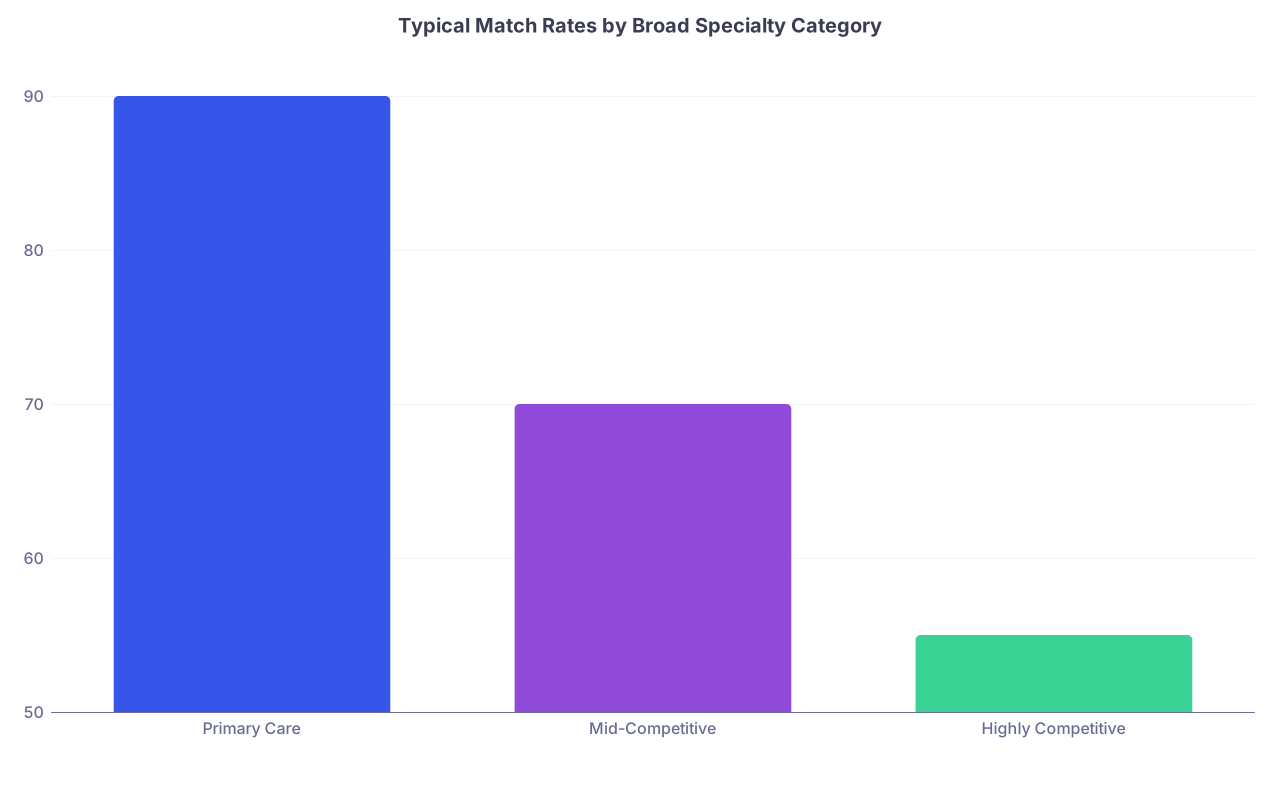
| Category | Value |
|---|---|
| Primary Care | 90 |
| Mid-Competitive | 70 |
| Highly Competitive | 55 |
If you’re considering turning down SOAP, you should only do it if you can crisply answer:
- What will be different about my application next year?
- How exactly will I fix my main weaknesses?
- Do I have a concrete plan (not wishful thinking) and support from advisors/PDs?
If you’re hand‑waving those questions, you probably shouldn’t say no.
Step 4: Decide What Kind of SOAP Offer You’re Looking At
Not all SOAP offers are created equal. Roughly, they fall into four buckets:
- Prelim year in medicine/surgery with a realistic shot at reapplying
- Categorical spot in a field reasonably aligned with your goals
- Categorical spot in a field you strongly dislike but that still leads to board certification and a career
- Prelim or transitional year with no clear path, weak program reputation, or documented toxicity
You don’t treat these the same.
When SOAP Is Usually a Smart “Yes”
You should strongly consider accepting if:
- It’s a categorical spot in:
- Internal medicine
- Family medicine
- Pediatrics
- Psychiatry
- Neurology
and you can see any version of yourself having a career there.
or
- It’s a prelim medicine/surgery year at:
- A stable program
- With decent support
- In a place where people actually re‑match into other fields sometimes (ask around—this matters)
Even if it’s not your dream, a completed, clean PGY‑1:
- Keeps your clinical skills fresh
- Gets you US GME experience
- Gives you attendings who can vouch for you
- Lets you pivot to other fields (hospital medicine, urgent care, outpatient clinics, etc.) if the reapplication doesn’t pan out

When SOAP Might Be Okay to Refuse
There are scenarios where declining is reasonable:
- The only offers are:
- Known malignant programs (high attrition, public reputational problems)
- Extremely unstable (on probation, losing accreditation, massive leadership turnover)
- The specialty is something you truly can’t tolerate long term (e.g., you get panic‑level dread just thinking about it, not mild dislike)
- You have:
- Very strong metrics
- Clearly fixable application flaws (e.g., applied late to too few programs)
- Trusted faculty telling you you’d be competitive with a proper plan next year
- A structured, funded gap plan (research year, MPH, chief year, etc.)
Even then, this is a calculated risk. Not a casual “I’ll just try again.”
Step 5: Use This 7‑Question Filter
Use this as your quick SOAP decision framework. If you answer “yes” to ≥5 of these, you should almost certainly accept a reasonable SOAP offer.
| Question # | Key Decision Question |
|---|---|
| 1 | Am I unlikely to dramatically improve my application in 1 year? |
| 2 | Is this SOAP spot ACGME-accredited and stable? |
| 3 | Can I see at least a plausible, tolerable career from this specialty? |
| 4 | Would being board certified in this field still give me a livable career? |
| 5 | Do advisors/mentors recommend I accept SOAP? |
| 6 | Do I have financial or visa pressures that make waiting risky? |
| 7 | Does my current profile make re‑matching in a more competitive field improbable? |
If you’re mostly answering “no,” then maybe waiting and reapplying with a real plan is on the table.
But if you’re mixing 3 “yes,” 2 “no,” and 2 “I don’t know”… you probably don’t have enough information. Call your dean’s office, a trusted PD, or a faculty mentor and force them to give you a non‑sugar‑coated opinion.
Step 6: Think Hard About Long‑Term Career vs Short‑Term Ego
Here’s the ugly part no one likes to say:
A lot of people turn down SOAP offers for ego, not strategy.
The story in their head is “I’m better than family med in the Midwest” or “I didn’t go to med school to be a psychiatrist.” Then they spend a year out, reapply, and land in… family med in the Midwest. Or they never match at all.
You owe it to yourself to separate:
- “This is genuinely a bad career fit” from
- “This specialty/location doesn’t match the image I had of myself”
Being a board‑certified physician in any core specialty beats being a perpetual applicant with a perfect fantasy plan.
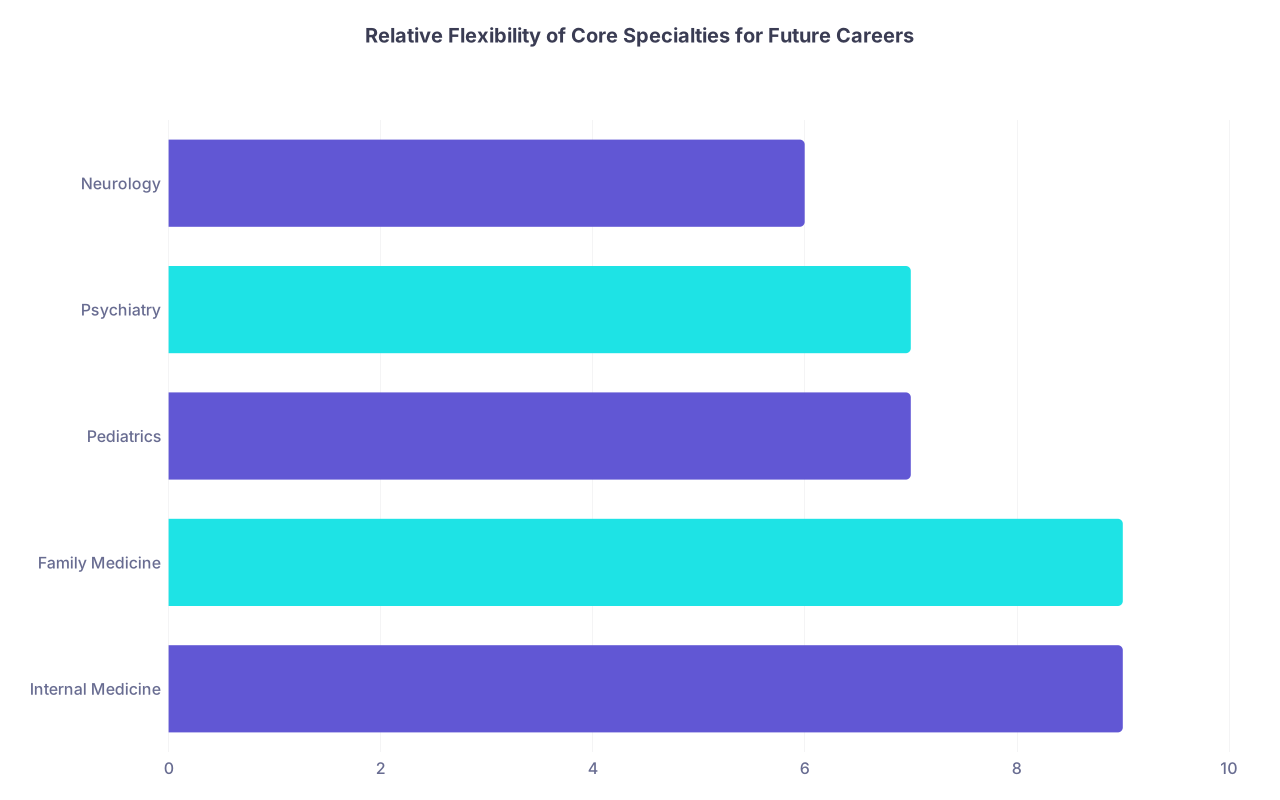
| Category | Value |
|---|---|
| Internal Medicine | 9 |
| Family Medicine | 9 |
| Pediatrics | 7 |
| Psychiatry | 7 |
| Neurology | 6 |
(Scale here is a rough “career flexibility” score out of 10—IM and FM are especially versatile.)
Many people SOAP into IM/FM, then carve out careers that are unrecognizable from the stereotype they feared: academic subspecialty, outpatient concierge medicine, telemedicine, hospitalist in a major city, etc.
Step 7: Special Cases You Need to Consider
If You’re an IMG
I’ll be direct: if you’re an IMG and you get any decent SOAP offer, you should almost always take it.
Reason:
- Reapplying as an unmatched IMG is brutally hard
- Graduation year gets older
- Visa issues get worse with time
- Programs have endless options; you fall down the stack quickly
Exception: truly malignant programs or specialties you absolutely can’t do. But your threshold for “I’ll wait and try again” needs to be extremely high.
If You Have Significant Red Flags
Failed Steps, leaves of absence, professionalism issues—these don’t magically disappear with time. You need a rehab story:
- Research year with stellar productivity
- Strong clinical references from a prelim year
- Documented remediation and growth
In those cases, a SOAP prelim year at a solid program can be your lifeline. Turning it down means you’re betting on someone accepting the same red flag with no new counter‑evidence next year. That’s…unlikely.
If You’re Chasing a Hyper‑Competitive Field
If you went all‑in on derm, plastics, ortho, ENT, or neurosurgery, and now you’re staring at SOAP offers in IM or FM, read this twice:
Most people in your situation do not magically match your dream field next year without huge, concrete changes: top‑tier research, personalized advocacy, an extra degree, and sometimes still no luck.

| Step | Description |
|---|---|
| Step 1 | No Match in Competitive Field |
| Step 2 | Board Certified Physician |
| Step 3 | Reapply or Transition Fields |
| Step 4 | Gap Year + Reapply |
| Step 5 | Possible Match |
| Step 6 | High Risk of No Match Again |
| Step 7 | SOAP Offer? |
| Step 8 | Application Stronger? |
Taking a categorical IM/FM/Psych/Peds SOAP spot is not failure. It’s securing a real career and leaving doors open: fellowships, subspecialty, academics.
Step 8: If You Decide to Accept a SOAP Offer
Once you say yes, commit. Stop doom‑scrolling Reddit threads about “my life is over, I SOAPed into X.”
Your job for the next year:
- Be relentlessly dependable
- Get strong letters
- Be the intern attendings trust
- If you still want to reapply, make that a quiet, strategic plan—not your entire personality on day 1
Plenty of people pivot during or after residency. They do fellowships. They switch to more procedural clinics. They build portfolio careers. But first they finish something.

| Step | Description |
|---|---|
| Step 1 | Accept SOAP Spot |
| Step 2 | Complete PGY-1 |
| Step 3 | Finish Residency |
| Step 4 | Board Certification |
| Step 5 | Subspecialty or Practice |
| Step 6 | Reapply or Transfer |
| Step 7 | New Residency Path |
| Step 8 | Happy in Specialty? |
Step 9: If You Decide to Walk Away and Reapply
If, after talking with real humans (dean, advisors, PDs), you still believe rejecting SOAP is your best move, then you need a specific plan, not vague intention.
You should be able to answer:
- What am I doing for the next 12 months?
- Who is supervising me and willing to write detailed letters?
- How many programs will I apply to next year, and in which tiers?
- What is my realistic “floor specialty” I’d accept if my dream still doesn’t pan out?
And then you execute like it’s a full‑time job.

Quick Reality Check Summary
Here’s the core of it:
- A stable, accredited SOAP spot in a core specialty you can tolerate is usually worth accepting.
- Walking away from SOAP only makes sense if:
- Your application can be truly improved
- You have a structured plan
- Trusted advisors think reapplying is reasonable
- Ego and fantasy are terrible decision‑makers. Long‑term board certification and employability are not.
FAQ: SOAP vs Reapply – 6 Common Questions
1. Is it true that turning down any SOAP offer blacklists me forever?
No, you’re not blacklisted. But you are a reapplicant with a prior unmatched/SOAP outcome, which is a real red flag. Programs will ask—explicitly or silently—“What changed?” If the answer is “nothing except time passed,” your odds drop.
2. If I take a SOAP prelim year, can I definitely reapply into something better?
No guarantee. A prelim year gives you clinical credibility and letters, but you still need a realistic target. Many prelims end up:
- Matching categorical IM/FM later
- Staying as hospitalists after another year
- Occasionally sliding into their original dream field with exceptional performance + advocacy
Use your PGY‑1 to crush the basics and get PDs on your side—but don’t assume it’s an automatic ticket.
3. Will I be stuck forever in the specialty I SOAP into?
Usually no, but your options narrow with time. Categorical IM/FM/Peds/Psych give you a lot of lateral moves via fellowship or niche practice. SOAPing into something you mildly dislike can still lead to a career you’re okay with if you’re strategic later. That said, if you truly hate the specialty, don’t bank on magically loving it in 3 years.
4. How much does location matter in SOAP decisions?
Less than you think. A safe, accredited program in a “meh” city is almost always better than holding out for a perfect coastal dream that may never come. You can move after residency. You can’t practice independently without completing residency. Sacrificing 3 years of geography for 30+ years of career isn’t a bad trade.
5. My advisors are split—some say take SOAP, others say wait. Who do I listen to?
Prioritize:
- People who know your full file (scores, narratives, professionalism notes)
- Program directors in your target or alternative fields
- People who don’t sugar‑coat feedback
If the most honest, experienced people are leaning “take SOAP,” I’d listen hard. If multiple PDs independently say you’re a strong candidate with a fixable strategy for next year, then maybe reapplying isn’t insane.
6. I feel like taking a SOAP spot means I failed. How do I get past that?
You didn’t fail. You took a non‑linear route in one of the most competitive systems in medicine. Match outcomes are brutal and often random. The physicians you’ll work with don’t care how you got there—only whether you’re competent and safe. In 5–10 years, nobody will introduce you as “This is Dr. Smith, they SOAPed into IM.” They’ll just say, “This is Dr. Smith, one of our hospitalists.”
Bottom Line
If you remember nothing else:
- A stable SOAP spot in a core specialty you can live with is usually a yes.
- Saying no to SOAP is a high‑risk move that only makes sense with a specific, realistic plan and strong advisor support.
- Board certification and long‑term employability matter far more than matching your dream on the first try.