

You did not “just fail the Match.” You got a brutally clear diagnostic test on your specialty choice and timing—after which you changed your mind. That’s different. And it’s fixable if you move fast and stop lying to yourself.
You’re in a very specific (and very common) mess:
- You applied in Specialty A
- You didn’t match
- Only after that did it finally click: “I do not want this. I actually want Specialty B.”
Now you’re staring at a lost year, a different specialty, and no idea how to pivot without looking flaky or destroying your future.
Here’s how to handle it, step by step.
Step 1: Get Extremely Clear On What Actually Changed
You need a clean story—for yourself first, then for programs.
Right now your brain is swirling with:
- Shame about not matching
- Panic about time lost
- New excitement (or fear) about a different specialty
You cannot build a strategy on that chaos.
Sit down and answer these, in writing, in one sitting. No editing, no polishing.
Why did I pick my original specialty?
- Be honest: prestige, lifestyle, one mentor, Step score, “everyone said I’d be good at it,” etc.
When did I first suspect it might not be right?
- Third-year clerkships? Sub-I? Mid-ERAS? After interviews when you envied other people’s choices?
What specific experience made the new specialty click?
- A patient you remember, a rotation that felt easy even when it was hard, a day where 12 hours flew by.
What exactly feels wrong about staying with the old specialty?
- Procedures, culture, pace, call, patient population, long-term lifestyle, identity mismatch.
What exactly draws you to the new one?
- Not vague “I like continuity of care.” I mean “I found myself reading about X late at night” or “I loved family meetings on heme-onc but hated the OR.”
If your answers are vague or generic, you’re not ready to pivot. Programs will smell that.
If they’re specific and a little bit painful to read, good. That’s where your new narrative will come from.
Step 2: Diagnose Your Actual Position (Not The One In Your Head)
Before you start sending desperate emails, you need a hard reality check: what are you selling?
Look at these buckets:
| Factor | Strong Position | Weak Position |
|---|---|---|
| US vs IMG | US MD/DO | Non-US IMG |
| Scores | Step 1 pass + Step 2 ≥ 240 (USMLE equiv) | Step 2 below specialty norms |
| Clinical evals | Strong narrative comments, honors in core | Mostly passes, no stand-out feedback |
| Research | Specialty B-related or at least clinical | None, or only in unrelated basic science |
| Networking | Known by faculty in new specialty | No real connections in new field |
Be brutally honest. You’re not presenting this to anyone; you’re using it to determine your tactics.
Because here’s the uncomfortable truth:
A pivot from no-match EM to IM with 245 Step 2 and good letters is one situation.
A pivot from no-match derm to anesthesia as a non-US IMG with 220 Step 2 is a different one.
Both can be worked with. But the route changes.
Step 3: Decide Your Immediate Status: SOAP, Gap Year, or Both
You’re usually in one of these timing scenarios:
- You already went through SOAP and still didn’t get a position
- You’re pre-SOAP and just realized you want Specialty B
- Match/SOAP is done, you’re in the gap between cycles
Let’s break each.
A. If you’re pre-SOAP and just realized this
You have hours to days. Not weeks.
Decide if you’re willing to pivot specialties right now in SOAP
- If yes: filter for open PGY-1/TY/prelim positions in your new specialty or adjacent ones (IM, TY year, prelim surgery/anesthesia depending on your target).
- If no relevant PGY-1 spots exist: consider a transitional year, prelim IM, or a categorical in a field that still keeps doors open (often IM). You’re buying time and clinical currency.
Immediately email your new specialty department at your home institution
- Subject: “Recent No Match / SOAP – Interest in [Specialty] and Available Positions”
- Ask for:
- Quick phone/Zoom conversation with PD or APD
- Advice on whether to target SOAP in that field now or rebuild for next cycle
- Keep it to one page. They’re drowning this week.
-
- If you’re lost and panicking, a solid prelim or TY year is better than forcing a categorical slot you already know you’ll hate.
- But if there’s a categorical in your new dream field and you have any shot, you go all in.
B. If SOAP is over and you have no position
Different game. Slightly less frantic, more strategic.
You now need a 12–18 month pivot plan:
- What will you do next year (job/role)?
- How will that role point clearly toward your new specialty?
- How will you explain all of this in a way that makes PDs trust you?
We’ll build that plan in the next sections.
Step 4: Choose Your Bridge Year Wisely (This Is Where Most People Blow It)
This is where people make the “I’ll just do anything clinical or research and apply again” mistake. That’s lazy and it shows.
Your bridge year should prove 3 things to your new specialty:
- You understand what they do
- You can function at or above an intern level in that environment
- You’re not just running from your old specialty—you’re running toward this one
Here are your real options:
1. Prelim Year / Transitional Year
Best if:
- You can still secure a prelim IM, surgery, or TY position off-cycle or for the coming July (late swaps, last-minute vacancies, etc.).
- Your new specialty values prior clinical experience (IM, anesthesia, radiology, EM, PM&R, etc.).
How to make it count:
- Get on rotations aligned with your target: ICU for anesthesia, cardiology for cards-leaning IM, ED time for EM, etc.
- Crush PD-level impressions: show up early, take extra calls, be teachable. You need 1–2 people to say, “I’d rehire this person in a heartbeat.”
- Ask for explicit “career change” mentorship from an attending in the new field.
2. Dedicated Research Year in New Specialty
Best if:
- You’re aiming for a moderately or highly competitive field (radiology, anesthesia, EM, some IM subspecialty paths).
- Your clinical record is okay but not amazing; you need a differentiator and advocates.
What this should look like:
- Title could be “clinical research fellow,” “postdoctoral research associate,” or just “research assistant,” but the key is immersion.
- You attend their conferences. You present at their M&Ms. You’re “part of the department,” not a remote data monkey.
- You get at least one strong letter from a recognizable PI or division chief in that specialty.
Red flag: generic bench lab work in something unrelated with no patient contact. That’s not helping your specialty switch unless you’re going into something ultra-academic.
3. Hospital-Based Clinical Job Plus Structured Shadowing
Sometimes you cannot get a prelim/TY or formal research spot. You’re not dead. You just have to be more intentional.
Roles that can work:
- Hospitalist scribe or advanced MA in your target specialty’s clinic
- Clinical documentation specialist roles where you’re tethered to teams
- Full-time clinical research coordinator embedded in that specialty
Rules:
- No random urgent care jobs with zero relation to your desired field.
- Build a weekly schedule where you:
- Work 30–40 hours
- Shadow or attend conferences 4–8 hours
- Carve out 5–10 hours to work on small side projects (QA audits, chart reviews, case reports).
Step 5: Build a Clean, Credible Narrative (So You Don’t Look Fickle)
Program directors are not allergic to career change. They’re allergic to chaos and poor judgment.
Your story must cover:
- Why you chose the original specialty
- What you learned during that journey
- The specific experiences that shifted your path
- How your old preparation actually strengthens you for this new field
- Why this won’t happen again in 2 years
Here’s a skeleton you can adapt:
Opening:
“I entered medical school convinced I wanted to be a [original specialty]. I was drawn to [2–3 specific aspects]. My clerkship and sub-internship experiences in [original specialty] reinforced that interest enough that I applied in [year].”What changed:
“During my fourth-year electives, particularly [specific rotation in new specialty or related field], I noticed something unsettling: the parts of my day I looked forward to most were [X, Y, Z]—elements that aligned more closely with [new specialty] than with [old specialty]. At the time, I was already deep into the application cycle and did not fully trust this realization.”The break point:
“After not matching, I finally had to confront that mismatch honestly. In reviewing my experiences, I saw a consistent pattern: [concrete examples]. Those were not isolated moments; they reflected a better fit with [new specialty’s] patient population, team structure, and day-to-day work.”How you acted on it:
“Rather than immediately reapply in a field that no longer felt right, I chose to spend this year in [research/clinical/TY role] within [new specialty], to test that fit in a more sustained way. Over the past [X] months, I have [what you actually did]. These experiences have confirmed that [new specialty] is where I’m at my best.”Reassurance:
“This path has made me more deliberate, more self-aware, and more committed. I am not running from [old specialty]; I am choosing the field where my strengths—[list]—match the work. I’m ready to bring that clarity and humility to residency training.”
You’ll slice that across:
- Personal statement
- ERAS experiences descriptions
- Interview responses (“Walk me through your application history”).
Step 6: Fix The Weak Spots You Can Actually Fix
You cannot rewrite Step scores or your school. You can fix these over 6–12 months:
Letters of Recommendation
- You need at least 2 strong letters in the new specialty.
- They should explicitly mention your prior path and endorse the switch: “I am aware Dr. X initially pursued [old specialty]; having worked with them closely in [new specialty] for the past [time], I strongly support this pivot.”
Specialty-Linked Experiences Don’t pad your CV with random fluff. Pick 2–4 meaningful things:
- One sustained research or QA project
- One teaching/mentoring role (students, nurses, patients)
- One leadership or systems improvement thing if possible (clinic workflow, patient education program, etc.)
Application Strategy (where people get lazy)
- You probably need to apply more broadly. Yes, more than you wanted.
- Don’t pretend you’re competitive for all the same programs as people who’ve been straight-arrow IM or anesthesia since MS2.
- Mix safety, solid mid-tier, and a few reach programs where your story + letters might carry weight.
Step 7: Get Ahead of the “You Didn’t Match” Stigma
People will ask:
- “So…you didn’t match. What happened?”
- “If we invest in you, how do we know you won’t change your mind again?”
Here is how you answer without groveling.
On “Why didn’t you match?”:
- Own what you can control, don’t invent drama
- Example:
“I applied to [old specialty], which is particularly competitive at my score range. My application had strengths—[X]—but also clear weaknesses—[Y, usually late decision, lack of home program, not enough audition rotations]. I got [number] interviews and simply did not match. That forced me to reassess whether repeating the same thing made sense, especially as my clinical interests were shifting toward [new specialty].”
On “How do we know this won’t happen again?”:
- Emphasize the deliberate testing period
- Example:
“That concern is fair. The difference now is that I’ve spent a full year embedded in [new specialty]—attending clinics, participating in [X meetings], working on [Y projects]. This was my chance to prove or disprove the fit before asking any program to invest in me. The more exposure I get, the more I see this is the work I want long term, and I’ve aligned my entire last year with that.”
Programs don’t need perfection. They need stability and evidence.
Step 8: When To Not Switch Specialties (Yes, Sometimes You Shouldn’t)
I’m going to be blunt: some people should not pivot after a no-match.
You probably shouldn’t switch if:
- Your scores, evals, and performance are below average across the board and trending down. That’s not a specialty issue; that’s a readiness issue.
- You’re switching purely for perceived lifestyle or income without any real exposure or evidence.
- You haven’t actually spent time in the new specialty outside one rosy 2-week elective.
In those cases, your first job is to become a clearly solid trainee somewhere—even if it’s not perfect—before thinking about another move.
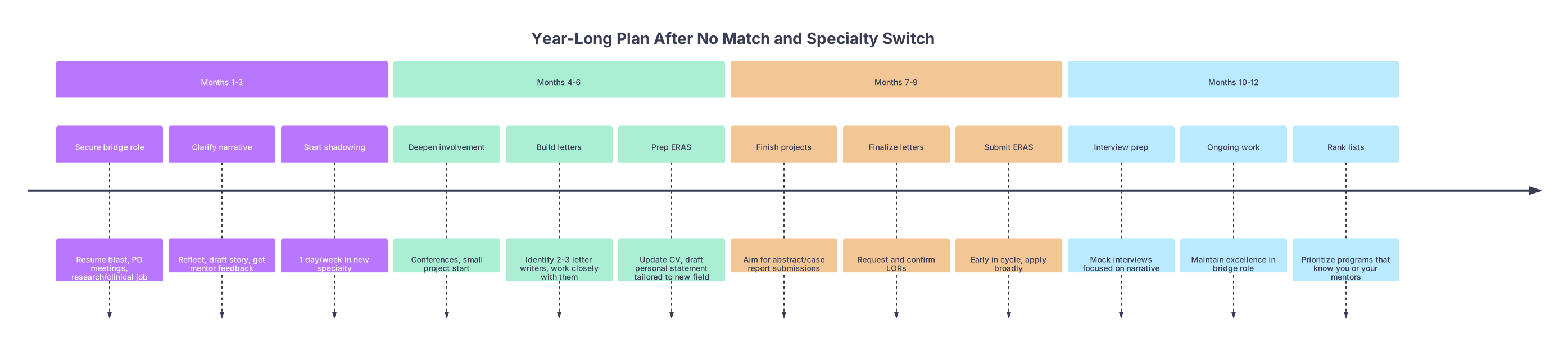
Step 9: Concrete 12-Month Action Plan Template
Here’s what a smart, realistic year can look like if SOAP is over and you’re starting fresh:
| Period | Event |
|---|---|
| Months 1-3 - Secure bridge role | Resume blast, PD meetings, research/clinical job |
| Months 1-3 - Clarify narrative | Reflect, draft story, get mentor feedback |
| Months 1-3 - Start shadowing | 1 day/week in new specialty |
| Months 4-6 - Deepen involvement | Conferences, small project start |
| Months 4-6 - Build letters | Identify 2-3 letter writers, work closely with them |
| Months 4-6 - Prep ERAS | Update CV, draft personal statement tailored to new field |
| Months 7-9 - Finish projects | Aim for abstract/case report submissions |
| Months 7-9 - Finalize letters | Request and confirm LORs |
| Months 7-9 - Submit ERAS | Early in cycle, apply broadly |
| Months 10-12 - Interview prep | Mock interviews focused on narrative |
| Months 10-12 - Ongoing work | Maintain excellence in bridge role |
| Months 10-12 - Rank lists | Prioritize programs that know you or your mentors |
You can compress or stretch pieces depending on when in the year you’re starting, but the structure holds.
Step 10: Protect Your Head While You’re Doing All This
Let me be direct: this period is brutal psychologically.
Common mental traps:
- “I’ve ruined my career.”
- “Everyone else is moving on without me.”
- “No one will want someone who already failed once.”
Reality:
- Plenty of residents in every specialty have a no-match story or a field switch buried in their path. They just don’t lead with it.
- Programs care much less about the embarrassment you feel and much more about: “Are they safe? Are they hardworking? Are they stable enough to finish our program?”
What helps:
- One brutally honest mentor in your new specialty who’ll tell you when you’re over- or under-estimating yourself
- A small group of peers who know the full story so you don’t have to fake everything
- Real structure: if your whole week is “study and maybe research,” you’ll spiral. You need schedule, obligations, and deliverables.
| Category | Value |
|---|---|
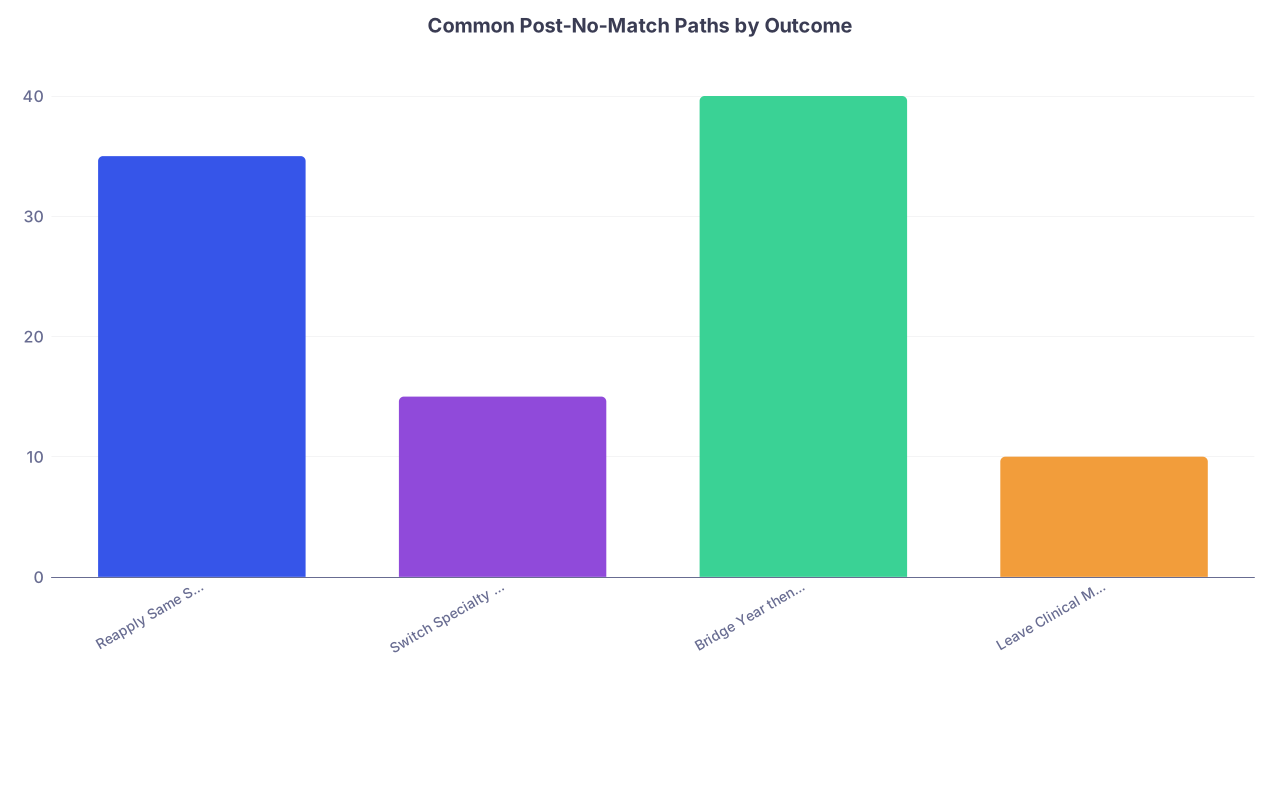
| Reapply Same Specialty | 35 |
| Switch Specialty Immediately | 15 |
| Bridge Year then Switch | 40 |
| Leave Clinical Medicine | 10 |
FAQs
1. Should I reapply to my original specialty and the new one in the same cycle?
Generally no. It makes you look unfocused and forces you into dishonest personal statements and interviews. Pick the field you’re prepared to commit to and align everything with that. The only exception is very closely related fields where a strong, honest narrative can connect both (for example, IM and neurology), but even then, it’s risky.
2. Is it worth doing another full year of research if I already have decent research in my old specialty?
Only if the research is directly tied to your new specialty and will generate strong letters and visible output within one year. If your prior research is already decent and your bigger problem is lack of clinical exposure or weak letters, another year of bench work is just hiding from the real issue.
3. What if my school doesn’t have a strong department in the specialty I want to switch into?
Then you lean heavily on external options: away rotations (if still possible), research fellowships at other institutions, or hospital jobs that place you near those teams. You also network aggressively through conferences, cold emails to faculty in your target programs, and mentors who can introduce you to people in that field.
4. How many programs should I apply to after a no-match and specialty switch?
More than you’re comfortable with. You’re now a non-traditional applicant. For moderately competitive fields, 60–100+ programs is not crazy. For less competitive ones, 40–60 can be reasonable, favoring community and mid-tier academic sites that actually read applications carefully and value your bridge-year work.
5. How do I explain this to family or friends who don’t understand the system?
Keep it simple and controlled: “I applied for a very competitive field, didn’t get a spot, and realized in the process that another specialty fits me better. I’m spending this year working in that new field to make myself a stronger candidate, and I’ll be applying again.” They don’t need the inside baseball about SOAP and score cutoffs unless they’re genuinely supportive and curious.
If you’re walking away with only three things, let them be these:
- A no-match plus a specialty change is not the end—it’s a call to be brutally honest and intentional.
- Your bridge year must prove your commitment to the new specialty, not just keep you busy.
- Programs will forgive the detour if you show clarity, evidence of fit, and the kind of work ethic that makes them glad you got a second chance.


