The way most people drift through an unmatched gap year is a quiet disaster. You cannot afford that.
You have twelve months to prove to residency programs that last March was a fluke, not a verdict. That means structure. Deadlines. Quarterly milestones. If you treat this like “time off,” you will be unmatched again. If you treat it like a 12‑month, full‑time job to become a stronger applicant, your odds improve dramatically.
I will walk you quarter by quarter, then month by month, with concrete “at this point you should…” checkpoints. Assume a typical cycle where you went unmatched in March and will reapply to the next ERAS cycle in September.
Quarter 1 (March–May): Stabilize, Autopsy, and Rebuild the Foundation
At this point you should not be making big life decisions. You should be gathering data and stabilizing your situation.
Week 1–2 after Match Week (mid–March)
Your priorities in the first two weeks:
Emotional triage
- You are not objective right now. No one is.
- Take 3–7 days to vent, grieve, and step away from forums and gossip.
- Tell 3–4 key people (mentor, PD, close friend, family) what happened so you are not hiding it.
Immediate logistics
- Confirm your graduation status (especially if you are an IMG or had remediation).
- Check visa timelines if you are non‑US and need work authorization or observership eligibility.
- Preserve access to:
- School email and EMR systems (if possible for future letters and documentation).
- Faculty and PDs who will matter later.
By the end of Week 2 you should:
- Have told your dean’s office you went unmatched.
- Have a meeting date scheduled with someone in advising (dean of students, career office, or trusted faculty).
Weeks 3–4 (late March): Brutal Application Autopsy
Now you switch into analysis mode. Feelings are secondary. Facts lead.
Sit down with:
- Your school’s student affairs dean or advising office
- A trusted faculty mentor in your specialty (or a related one)
- If possible, a Program Director (PD) or APD who will be honest, not polite
You want a clear answer to: “Why did I not match?” Not the sugar‑coated version.
At this point you should:
Collect hard data
- USMLE/COMLEX scores
- Clerkship grades and narrative comments
- MSPE (Dean’s letter)
- Number and types of programs applied to (academic vs community, region)
- Interviews received vs declined
- Any red flags:
- Failed exams or repeats
- Extended graduation
- Probation / professionalism incidents
- Poor evaluations / comments
Categorize your deficits
| Profile Type | Primary Issue |
|---|---|
| Strong scores, few interviews | Poor letters / weak personal app |
| Below-average scores | Competitiveness / screening |
| Red flag history | Trust / reliability concerns |
| Overreached on programs | Unrealistic list strategy |
| Career switchers | Limited specialty-specific proof |
Commit this in writing: 3–5 specific reasons you were not competitive. If your mentor cannot say them out loud, push: “If I were your child, what would you say?”
By the end of March you should:
- Have a written “problem list” for your application (just like a patient).
- Decide whether you are:
- Reapplying to the same specialty, or
- Pivoting to a more attainable one (FM, IM, psych, prelim, etc.).
If you are still undecided on specialty by April 1, that is a problem. Resolve it with your mentors quickly. You cannot plan a useful gap year without this decision.
Quarter 2 (June–August): Build Credibility and Output Before ERAS Opens
This quarter is about documented activity that programs will see when ERAS opens and interviews get decided. You need currency: recency, letters, output, and service.
April: Secure Your Position(s) for the Year
At this point you should be applying aggressively for anything that keeps you clinically or academically relevant.
Your main options:
Clinical roles
- Research fellow in a department related to your target specialty.
- Full‑time research assistant with some clinical exposure (chart review, clinic).
- Paid clinical work (scribe, clinical assistant, MA) if relevant and realistic.
- U.S. clinical experience / observerships (especially for IMGs).
Academic / quality roles
- QI projects embedded in a department (mortality reviews, readmission projects).
- Education roles (tutor for Step, OSCE, anatomy, etc.)—especially useful for weaker scores to show later mastery.
Backup option
- If you cannot start a solid role by July 1, line up short‑term observerships and 2–3 concrete research projects you can realistically push to submission by fall.
By end of April you should:
- Have at least one formal position or commitment for July–June (12 months).
- Have 2–3 specific projects identified with named supervisors.
May: Set Measurable Goals and Repair Weaknesses
Now you convert vague “I will do research” into something trackable.
At this point you should:
Define your gap‑year deliverables
- Example targets:
- 1–2 first‑author abstracts or posters submitted by October.
- 1–3 co‑author manuscripts submitted by December.
- 1 new strong specialty‑specific letter from a US faculty member.
- 1–2 QI projects with clear outcomes (reduced wait times, improved follow‑up, etc.).
- Example targets:
Tackle exam or red flag issues
- If you have low Step 1/2 or COMLEX scores:
- Plan for Step 3 (if timing and visa status allow). Best taken:
- Dedicated study: June–July
- Exam: August–September (so score is back by mid‑October)
- Plan for Step 3 (if timing and visa status allow). Best taken:
- If you have professionalism concerns:
- Create a clear remediation narrative with your dean or PD:
- What happened.
- What you did to change.
- How supervisors have confirmed the change.
- Create a clear remediation narrative with your dean or PD:
- If you have low Step 1/2 or COMLEX scores:
Build your weekly structure
Your schedule should look like a full‑time job:
- 30–40 hours / week: research / clinical / QI role
- 10–15 hours / week: ERAS–related work
- Updating CV
- Drafting personal statement
- Target program list development
- Board prep (if taking Step 3)
By June 1 you should:
- Know what your workweek will look like from July–September.
- Have a rough Step 3 study plan (if doing it).
- Have an initial, ugly draft of your updated CV.
Quarter 3 (September–November): ERAS Execution and Active Visibility
This is the quarter where people either look “actively engaged and improving” or “floating for a year.” Your job is to be obviously the former on paper and in reality.
June–July: Pre‑ERAS Prep (Yes, this is still Q2 on the calendar, but Q3 in application terms)
At this point you should be in your role and settling into a rhythm.
June
Lock in mentors:
- Identify 1–2 faculty who:
- See your work weekly.
- Are likely to write strong, detailed letters.
- Tell them explicitly:
- “I plan to reapply to X this ERAS. My goal this year is to show Y. Can you help me by giving feedback and possibly writing for me if I earn it?”
- Identify 1–2 faculty who:
Start Step 3 study if relevant.
- Baseline self‑assessment.
- 1–2 question blocks daily on UWorld or equivalent.
July
ERAS opens for applicants in early July. You cannot submit yet, but you can fill everything.
At this point you should:
Draft your ERAS content
- Update all experiences with:
- Clear roles
- Measurable outcomes
- Supervisor names
- Prioritize:
- Your current gap‑year role
- Any new research / QI activity
- Rewrite your personal statement:
- You cannot reuse last year’s essay unchanged. Programs will notice.
- Directly and briefly acknowledge being unmatched, then pivot to:
- What you learned.
- What you did about it.
- Why you are stronger now.
- Update all experiences with:
Nail down your letter writers
- Ask explicitly by late July:
- 1–2 gap‑year supervisors (clinical / research).
- 1–2 prior attendings who still know you well.
- For those writing again, ask them to update the letter to include your new work.
- Ask explicitly by late July:
By the end of July you should:
- Have 80–90% of ERAS filled.
- Have 3–4 committed letter writers.
August: Final Application Build and Step 3 (if applicable)
This month is about tightening and testing.
At this point you should:
Refine program list
- Be ruthless. You no longer get to apply only where you “really want to live”.
- Use data:
- Past match lists from your school.
- Interview history last year.
- PD comments from mentors.
- Strategy:
- Mix academic and community.
- Favor programs with history of taking reapplicants / IMGs (if that is you).
- Add prelim or backup specialty programs if needed.
Polish and pressure‑test your narrative
- Practice a 30–60 second answer:
- “Walk me through your application since last year.”
- “Tell me about your gap year and why you did not match.”
- Run this answer by your mentor. If it sounds like an excuse, rewrite it.
- Practice a 30–60 second answer:
Step 3 exam (if doing it)
- Ideal window: late August–early September.
- You want scores back by mid‑October when many programs are screening.
By September 1 you should:
- Have a final personal statement draft.
- Have a final program list, even if you tweak a few later.
- Be ready to submit when ERAS opens for submission.
Quarter 4 (December–February): Interview Season, Plan B, and Next Cycle Insurance
This quarter is about execution in real time. Some of it will not be under your control, which is why the structure matters even more.
September: ERAS Submission and Immediate Follow‑through
At this point you should submit on the earliest reasonable day. Not 3 weeks later.
Submission
- Submit ERAS as early as allowed in September.
- Confirm all letters uploaded.
- Double‑check program requirements (Step 2/3, specific documents).
Signal your activity
- Have your current gap‑year supervisor email:
- A brief note to select PDs where you are a strong fit:
- “This candidate worked with us on X, showed Y, and I think they are well‑suited for your program.”
- A brief note to select PDs where you are a strong fit:
- Have your current gap‑year supervisor email:
Communication strategy
- Create a simple spreadsheet to track:
- Programs applied
- Response status
- Any contacts / emails sent
- Interview invites and dates
- Create a simple spreadsheet to track:
By the end of September you should:
- Have ERAS submitted and verified.
- Have an organized tracking system in place.
October–November: Interview Invites and Real‑Time Adjustments
This is where your efforts pay off—or where you realize you need to pivot again.
At this point you should:
Monitor invite patterns
- By mid‑October:
- Some specialties send early waves of invites.
- If you have zero invites by late October in a competitive field, you must talk to your mentor again about:
- Signaling interest (emails to PDs).
- Applying to more community or backup programs if still open.
- By mid‑October:
Continue active work
- Keep pushing:
- Manuscript submissions
- Abstracts for upcoming meetings
- QI milestones
- You want to be able to say in interviews:
- “Since submitting in September, I have done X, submitted Y.”
- Keep pushing:
Interview prep
- Do at least:
- 2–3 mock interviews (with faculty or residents).
- Focus on:
- Explaining the unmatched year.
- Showing maturity and insight.
- Avoiding bitterness or blame.
- Do at least:
By December 1 you should:
- Have a realistic sense of how the season is going.
- Have at least a skeleton answer for “If this does not work, what is your plan?”
Bridging into the Next Year: Protecting Against a Second Unmatch
Let us zoom back out and look at your full unmatched year as a timeline.
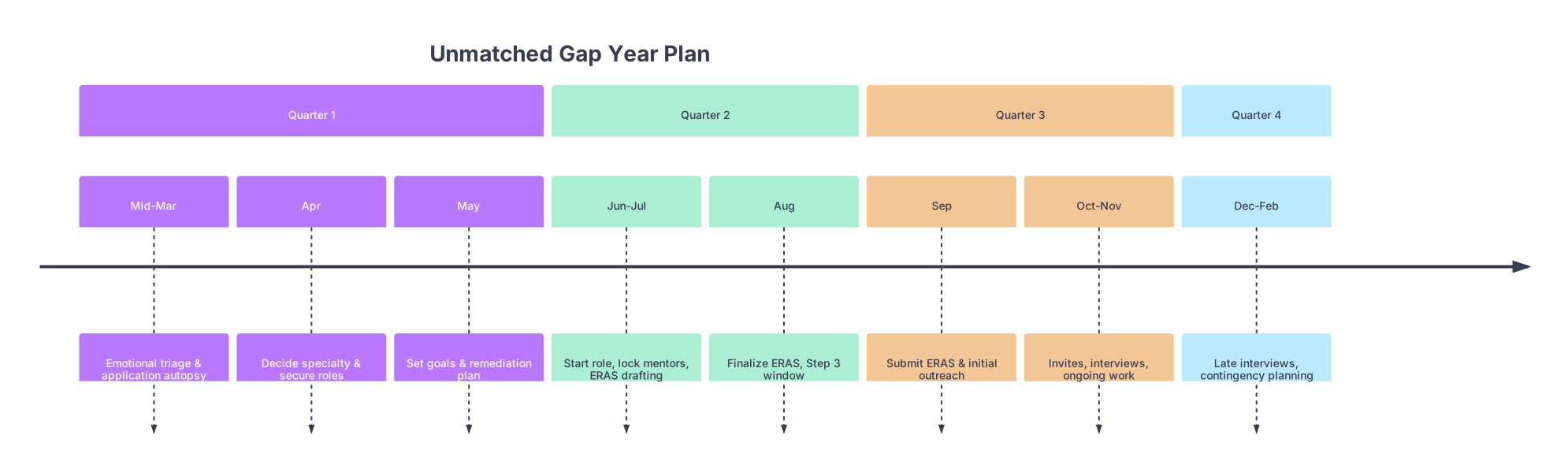
| Period | Event |
|---|---|
| Quarter 1 - Mid-Mar | Emotional triage & application autopsy |
| Quarter 1 - Apr | Decide specialty & secure roles |
| Quarter 1 - May | Set goals & remediation plan |
| Quarter 2 - Jun-Jul | Start role, lock mentors, ERAS drafting |
| Quarter 2 - Aug | Finalize ERAS, Step 3 window |
| Quarter 3 - Sep | Submit ERAS & initial outreach |
| Quarter 3 - Oct-Nov | Invites, interviews, ongoing work |
| Quarter 4 - Dec-Feb | Late interviews, contingency planning |
Whatever your invite count is by January, you should not be idle. The worst mistake I see: people pause their efforts while they “wait to see.” Then they get bad news in March with nothing new to show.
December–January: Dual‑Track Thinking
At this point you should be running two tracks in parallel:
Track A: Current Cycle
- Attend every reasonable interview.
- Send thoughtful, concise post‑interview thank‑you emails if appropriate for your specialty.
- Refine your rank list with mentors’ input (not random Reddit advice).
Track B: Insurance for Next Year
- Continue your projects as if you will need another cycle:
- Aim to get something accepted or in press between December and April.
- Deepen relationships:
- Take on “extra” work that shows commitment.
- Offer to help with teaching, resident education, or clinic workflows.
- Continue your projects as if you will need another cycle:
By the end of January you should:
- Have ongoing work that will still look good even if you match.
- Have a credible story for “what you are doing now” if you do not match again.
February–Early March: Ranking and Preparing for Outcomes
At this point you should:
Finalize rank list
- Rank programs in the order you want to train. Not in the order you think you are most likely to match. The algorithm rewards honesty.
- Discuss worst‑case scenarios:
- “If I match at X far‑away community program, will I actually go?” If not, do not rank them.
Prepare for both results
- If you match:
- Plan an orderly transition out of your role (you want these people as lifelong references).
- If you do not match:
- You should already have:
- New output (papers, abstracts, QI results).
- Stronger relationships with faculty.
- A clear understanding of what to adjust next cycle (program list, specialty, exam plan).
- You should already have:
- If you match:
How Your Time Should Look Across the Year
Let me simplify this into a time‑allocation snapshot. This is roughly how a productive unmatched year tends to distribute your effort:
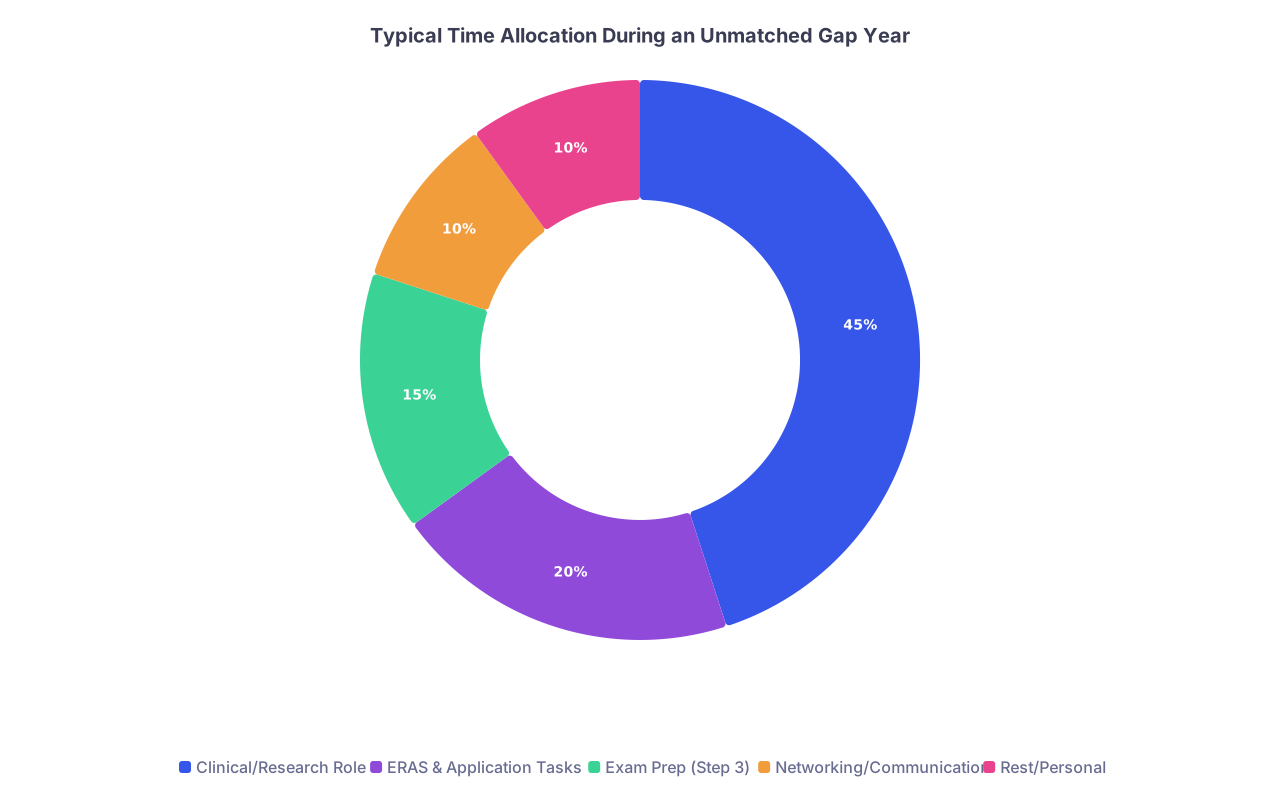
| Category | Value |
|---|---|
| Clinical/Research Role | 45 |
| ERAS & Application Tasks | 20 |
| Exam Prep (Step 3) | 15 |
| Networking/Communication | 10 |
| Rest/Personal | 10 |
Notice what is not on there: long periods of “job hunting” or aimless volunteering. You commit to something early and go deep.
Red Flags I See in Bad Gap Years
I am going to be blunt. These patterns almost always end badly:
- No clear job or role by July 1. “I am still looking” three months into your gap year is not a good look.
- Random, short observerships with no continuity. Ten 2‑week observerships in different cities is not better than one solid 3‑month rotation with a letter.
- No new letters. Reusing the same three letters as last year with nothing fresh tells programs nothing has changed.
- No change in strategy. Same specialty, same program list, same personal statement, same outcome.
- Social media / Reddit driven decisions. If you are trusting anonymous posters more than your dean or PD contacts, that is your choice—but it is not a wise one.
Two Non‑Negotiables for Your Unmatched Gap Year
Let me end this cleanly.
You must be visibly doing something substantial in medicine for the entire year.
A continuous, documented role with clear supervisors and outcomes. Not scattered shadowing. Not “independent study.”You must be able to tell a tight, specific story of growth by the next ERAS.
By the time you submit again, you should be able to say, in one short paragraph:- Why you did not match.
- What you did about it for 12 months.
- How that makes you a better, safer, more reliable intern than you were a year ago.
If you can hit those two milestones, quarter by quarter, you are not just “filling a gap year.” You are building the version of yourself that programs will finally be willing to trust with a spot.