
The most dangerous thing an unmatched graduate can do between Match Week and July 1 is drift.
You do not have time to drift.
Below is the real timeline: what actually happens, and what you should be doing week by week and month by month if you leave Match Week without a PGY‑1 spot.
Big Picture: Your Calendar From Match Week to July 1
First, understand the spine of the timeline. Everything else hangs on this.
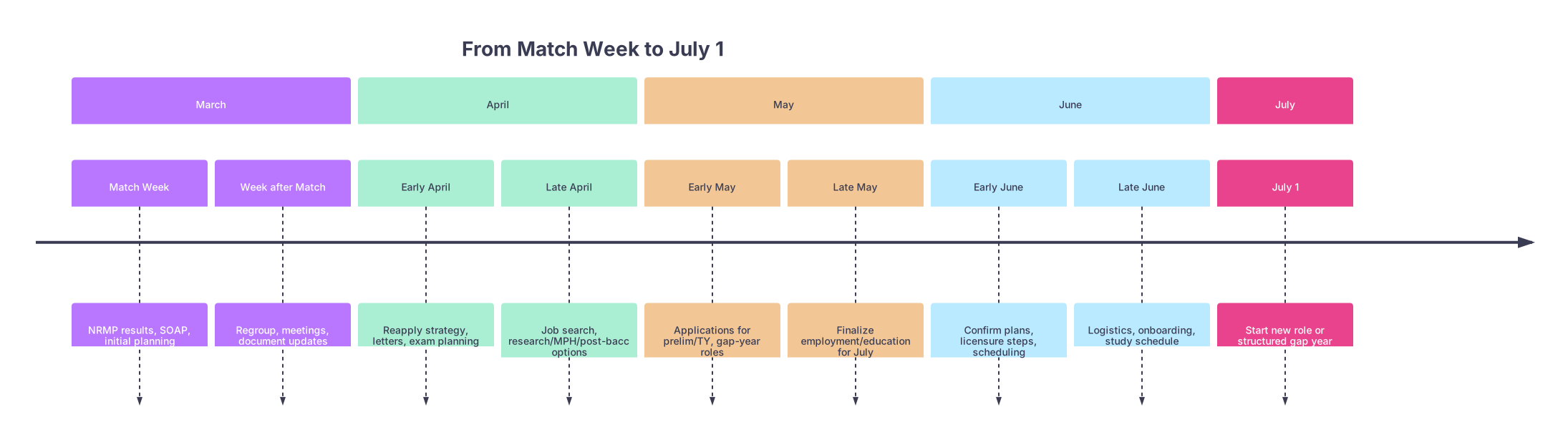
| Period | Event |
|---|---|
| March - Match Week | NRMP results, SOAP, initial planning |
| March - Week after Match | Regroup, meetings, document updates |
| April - Early April | Reapply strategy, letters, exam planning |
| April - Late April | Job search, research/MPH/post-bacc options |
| May - Early May | Applications for prelim/TY, gap-year roles |
| May - Late May | Finalize employment/education for July |
| June - Early June | Confirm plans, licensure steps, scheduling |
| June - Late June | Logistics, onboarding, study schedule |
| July - July 1 | Start new role or structured gap year |
Now let’s move chronologically.
Match Week (Mid-March): The Shock, The SOAP, The 72-Hour Sprint
At this point you should:
Confirm your actual status
- Did you:
- Not get any interviews and therefore never enter the Rank List?
- Rank but go completely unmatched?
- Partially match (e.g., advanced but no prelim)?
- Your exact status affects options (especially for prelim/TY spots).
- Did you:
Handle SOAP with ruthless efficiency (if eligible)
During SOAP (Mon–Thu of Match Week), every unmatched graduate should:Day 1 (SOAP list release)
- Download the unfilled positions list immediately from NRMP.
- Sort by:
- Specialty
- Program type (categorical vs prelim vs TY)
- Visa friendliness (if relevant)
- Drop pride. Programs do not care how “prestigious” your interview list was last month.
Same day: Fix the ERAS you actually send via SOAP
- Rewrite your personal statement in a few hours:
- SOAP version should be concise, focused, and clearly explain your interest in ANY program you are applying to (often IM/FM/prelim).
- Update CV experiences quickly:
- Remove irrelevant fluff, fix obvious errors.
- Confirm transcripts, MSPE, Step scores are uploaded and released.
- Rewrite your personal statement in a few hours:
Days 1–3: SOAP application rounds
- Target 20–45 programs depending on specialty breadth.
- Communicate with your dean’s office:
- They should be ready to advocate for you.
- Ask them explicitly: “Who can call programs for me this afternoon?”
- Do not spam programs directly unless they explicitly invite contact. Follow instructions.
SOAP interview blocks
- Keep your phone and email on 100% of the time.
- Answer unknown numbers. Every. Single. Time.
- Be ready with:
- 30-second intro
- Why this specialty
- Why this specific program
If SOAP fails (Thursday of Match Week)
By Thursday afternoon you know: you have no position for July 1.That day and the next 48 hours you should:
- Schedule urgent meetings with:
- Dean / advising office
- Specialty advisor
- Ask three hard questions:
- “Am I realistically re-matchable in this specialty in 1–2 years?”
- “What are my options for July 1 this year?”
- “What are my Step/COMLEX and academic liabilities that must change before next cycle?”
Your goal by end of Match Week:
You must have a draft plan for the next 12–18 months. Not perfect. But real.- Schedule urgent meetings with:
Week After Match Week (Late March): Stabilize, Assess, Decide Direction
At this point you should stop flailing and start planning.
Emotional triage (1–2 days, but not more)
- You are allowed to be upset. You are not allowed to stay paralyzed.
- Tell 3–4 key people (family, trusted friends) what happened so they stop asking vague future questions.
Technical autopsy of your application (3–4 days) Sit down with:
- ERAS application
- Score reports
- Dean’s letter / MSPE
- Interview list
And answer blunt questions:
- Were your Step 1 / Step 2 CK or COMLEX scores below common cutoffs?
- Any exam failures? (USMLE/COMLEX or school exams).
- Any professionalism issues in MSPE?
- Too few programs applied to? Too competitive a specialty?
Write a one-page honest assessment. No excuses. Just causes.
Decide your main strategic direction by end of March Most unmatched graduates fall into one of these tracks:
Common Tracks for Unmatched Graduates Track Main Goal Typical Duration Immediate reapply same specialty Strengthen application and re-enter next cycle 1 year Pivot to less competitive specialty Rebrand and reapply quickly 1 year Academic repair (exams/failures) Fix red flags before any reapply 1–2 years Non-residency clinical/research gap Stay clinically relevant and productive 1–2 years You do not have to lock in a specialty pivot yet. But you do need to decide:
- Am I reapplying this coming ERAS cycle (September)?
- Or do I need more than one year of repair?
Late March – Early April: Build the Scaffold for the Next Application
At this point you should create structure: mentors, documents, and a realistic calendar.
Form your “core advising team” (over 1–2 weeks) You want:
- 1 dean-level advisor (knows national patterns, NRMP data)
- 1 specialty mentor in the field you want (or think you want)
- 1 practical attending who can actually give you work / projects
Set explicit expectations:
- “I am unmatched. Target is ERAS submission this September. I need help with X, Y, Z.”
Update all written materials
- ERAS CV:
- Fix formatting issues and vague bullet points.
- Convert passive fluff into clear accomplishments.
- Personal statement(s):
- Start drafts now, not in August.
- If pivoting specialties, you will need completely different statements.
- ERAS CV:
Plan your exam timeline (very important) At this point you should create a calendar that includes:
- If Step 2 CK not yet taken → schedule by late May or June at the latest.
- If a failure on any Step/COMLEX → schedule retake with 3–4 months of real prep, not a rushed attempt.
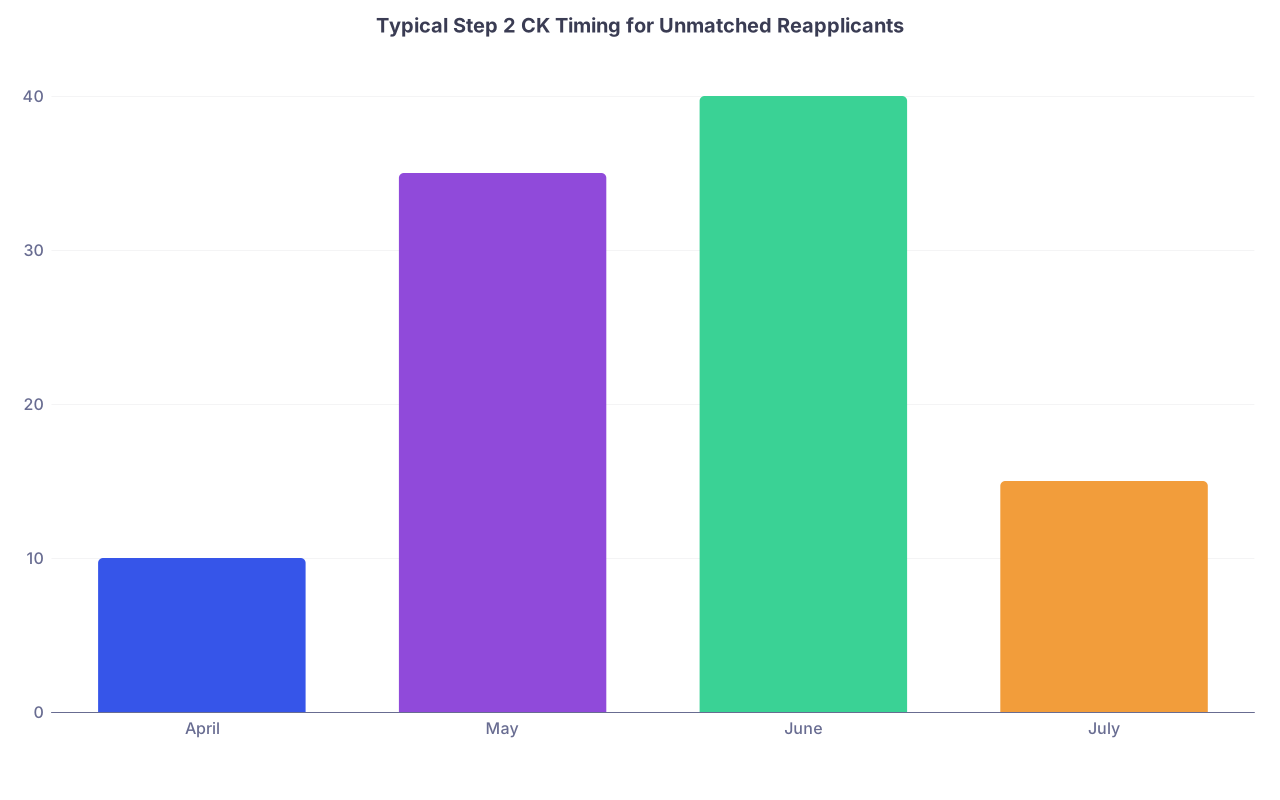
Typical Step 2 CK Timing for Unmatched Reapplicants Category Value April 10 May 35 June 40 July 15 Programs will want to see an upward trend. A rushed retake that barely passes is worse than a delayed strong performance.
Start hunting for July 1 roles (yes, this early) Your options include:
- Research positions (paid if possible, volunteer if desperate)
- Clinical research coordinator roles
- Postdoctoral fellow (for MD/PhD or research heavy)
- Teaching positions (anatomy TA, physiology lecturer at undergrad / post-bacc programs)
- Scribe roles (not ideal, but better than “nothing” if well framed)
- MPH or other graduate programs (only if they clearly strengthen your CV)
Your goal by early April: have 10–20 active leads (emails sent, applications submitted, conversations started).
Mid–Late April: Converting Options into Concrete Plans
By mid-April you cannot stay purely in “planning” mode. You need commitments.
At this point you should:
Lock in at least one anchor activity for July 1
- “Anchor activity” = a role that:
- Starts by July or August
- Runs at least 9–12 months
- Gives you:
- A supervisor who can write a strong letter
- Concrete output (papers, presentations, teaching evaluations, patient contact)
- “Anchor activity” = a role that:
Targeted email campaign to faculty and programs Your subject line should be specific, e.g.:
- “Unmatched 2026 MD seeking 1-year research position in cardiology”
- “Graduate seeking gap-year clinical research role; plan to reapply IM this cycle”
In the body:
- 3–4 sentence summary of:
- Your school and year
- Your match outcome
- Scores (briefly)
- Clear ask: “I am looking for X starting by July 1 for one year; happy to work on nights/weekends, statistics, manuscripts, etc.”
Investigate off-cycle PGY‑1 opportunities Most off-cycle PGY‑1 positions appear:
- April–August
- From programs that lost residents unexpectedly (illness, visa, personal reasons).
Where to watch:
- AMA FREIDA updates
- State and regional GME office postings
- Specialty-specific listservs and societies
- Your school’s GME office emails—ask to be included
Reality check: These are rare and competitive. But people do land them. You must be ready with:
- Updated ERAS or CV
- Letters that can be sent quickly
- Step scores and transcripts on hand
May: Deadline Month for Gap-Year Structure and Exam Scheduling
By May, the fog should be clearing. You are now in execution mode.
Early May (Weeks 1–2)
At this point you should:
Finalize your primary July 1 plan
- Confirm start dates and salary (if paid).
- Get the offer in writing (email is fine, contract is better).
- Clarify:
- Expected hours
- Location (remote vs in-person)
- Potential projects (research, QI, teaching)
Set a realistic weekly schedule Block off:
- Work hours
- Study time for any upcoming Step/COMLEX
- Time for ERAS prep (statements, program list, letters)
Your life now needs a calendar, not vibes.
Confirm exam dates and dedicated study windows
- Step 2 CK or COMLEX Level 2:
- Ideally taken by end of June if you want scores back before mid-August.
- If retaking a failed exam, you must ensure:
- At least 6–8 weeks of focused prep
- A question bank fully cycled
- At least 3 practice exams with upward trend
- Step 2 CK or COMLEX Level 2:
Mid–Late May (Weeks 3–4)
At this point you should:
Lock in your letter writers You will need:
- 2–3 strong clinical letters in your target field
- 1 academic / research letter (if research heavy)
- 1 “character” letter (dean or advisor)
Have explicit conversations:
- “I am reapplying this fall. Would you feel comfortable writing a strong letter for me?”
Draft program list for next cycle Start a spreadsheet:
- Columns:
- Program name
- Location
- Specialty
- Cutoffs (if public)
- Visa policies (if relevant)
- Past match outcomes from your school (if available)
- Target:
- If previously applied to 30 programs → consider 60–80 next time depending on specialty competitiveness.
- Columns:
If considering alternate specialties, start shadowing/PD conversations You cannot pivot from, say, radiology to family medicine with zero actual exposure. You will sound fake.
A few half-days with FM/IM attendings, plus one or two PD meetings, will give you:- Language and perspective for your new personal statement
- Potential new letters aligned with your pivot
June: Final Prep for July 1 and ERAS Launch Positioning
By June, the panic should be gone. You are now setting up a strong launch point for the coming ERAS cycle.
Early June (Weeks 1–2)
At this point you should:
Confirm logistics for your July 1 (or early July) role
- Housing
- Transportation
- Work schedule
- Badges / onboarding timeline
Clean up any licensure or paperwork tasks Depending on your planned role and your state:
- Create or update your Federation of State Medical Boards (FSMB) profile.
- Some research or teaching roles may need:
- Institutional credentialing paperwork
- Background checks
- Immunization verification and fit testing
Solidify your ERAS story Write a one-paragraph narrative that explains your year succinctly:
- “I did not match in March 2026 and chose to spend the following year working as a clinical research coordinator in cardiology, focusing on X and Y, while strengthening my knowledge and retaking Step 2 CK.”
This will go into:
- Personal statement
- Interviews
- Any PD emails
Mid–Late June (Weeks 3–4)
At this point you should:
Begin or finalize your dedicated Step/COMLEX study (if exam in July/August)
- At least:
- 40–60 questions per day
- 1 practice NBME/COMSAE every 1–2 weeks
- Track scores in a simple log so you can see objective improvement.
- At least:
Prepare ERAS application skeleton Even before the application officially opens you can:
- Outline your experiences section
- Decide which 10 experiences are “Most Meaningful”
- Draft 3–4 versions of your personal statement:
- Primary specialty
- Backup specialty (if doing a two-specialty strategy)
- SOAP version (shorter, more general)
Do one last scan for off-cycle PGY‑1 opportunities Places to check weekly:
- Program-specific websites
- National GME clearinghouse postings
- Specialty society job boards
If something appears:
- Email immediately with attached CV + brief interest note.
- Notify your dean / advisor same day so they can call.
July 1: The Day You Start Moving Forward Again
This day matters psychologically more than legally. You are not “behind.” You are just on a different path.
On or around July 1 you should:
Start your new role like it is a residency
- Show up early, stay engaged, act like a junior colleague.
- Ask for:
- Defined projects
- Regular feedback
- Opportunities to present at lab meetings, conferences, or teaching sessions
Tell your supervisor your residency goal explicitly within the first 2 weeks Something like:
- “My plan is to reapply to internal medicine this September. I hope to get involved in 1–2 projects where I can be productive before then, and I will need a letter from you if that goes well.”
Create your week-by-week ERAS preparation plan (July–September) From July 1 you have roughly 8–10 weeks until ERAS submission opens and programs begin reviewing.
A simple weekly structure:
- 1–2 evenings per week:
- ERAS sections (certifications, experiences, work descriptions)
- 1 evening per week:
- Personal statement refinements
- Weekends:
- QI or research tasks
- Exam prep (if applicable)
Keep a running list of:
- New responsibilities
- Any patient contact or teaching
- Micro-achievements (posters submitted, abstracts accepted, internal presentations)
These micro-achievements become bullet points and interview talking points.
- 1–2 evenings per week:
FAQ (Exactly 2 Questions)
1. What if I still do not have any job, research, or formal role confirmed by July 1?
Then your July task becomes brutally simple: find meaningful structure within 4–6 weeks. You cannot afford to list “unemployed” for an entire year on ERAS. While you continue applying to roles, create interim structure:
- Structured Step/COMLEX study with clearly documented hours and resources.
- Volunteer clinical work (free clinics, community health projects) with a supervising physician who can eventually write a letter.
- Short-term research or quality improvement projects, even if unpaid.
You need two things by the time you submit ERAS:
- A coherent explanation for how you used the year.
- At least one supervisor who has seen you work consistently and can vouch for reliability, professionalism, and growth.
2. Is it smarter to wait a full extra year before reapplying rather than rush back into the next Match?
Sometimes yes. If your barriers are severe—multiple exam failures, very low Step scores, professionalism concerns, prolonged leaves—one gap year may not be enough to reverse program skepticism. A rushed reapplication that still looks weak simply brands you as “chronically unmatched,” which can be harder to repair later.
A good rule: you are ready to reapply when you can demonstrate at least two of the following:
- Concrete improvement in exam performance (higher scores, successful retakes).
- Substantial new clinical or research productivity with strong letters.
- A more realistic specialty and program list aligned with your track record.
If your advisors consistently say, “Another year of strong work would change how PDs see you,” listen carefully. One powerful, well-used extra year is far better than two mediocre, panicked reapplications.
Key points:
- By the end of Match Week, you must have a provisional 12–18 month plan, not just disappointment.
- By May, you should have your July 1 role essentially locked and your exam / ERAS timeline mapped.
- By July 1, you are no longer “unmatched and waiting”; you are working on the next application with structure, purpose, and a story that will make more sense to program directors next cycle.