
The worst SOAP weeks are chaotic. The best ones are scripted by the hour.
If you go into SOAP week “seeing how it goes,” you will lose to the people who walk in with a clock, a script, and a call list.
Below is that script.
Big Picture: The 4–Day SOAP Clock
First, orient yourself. SOAP is not “a few days to figure it out.” It is a rigid, unforgiving schedule.
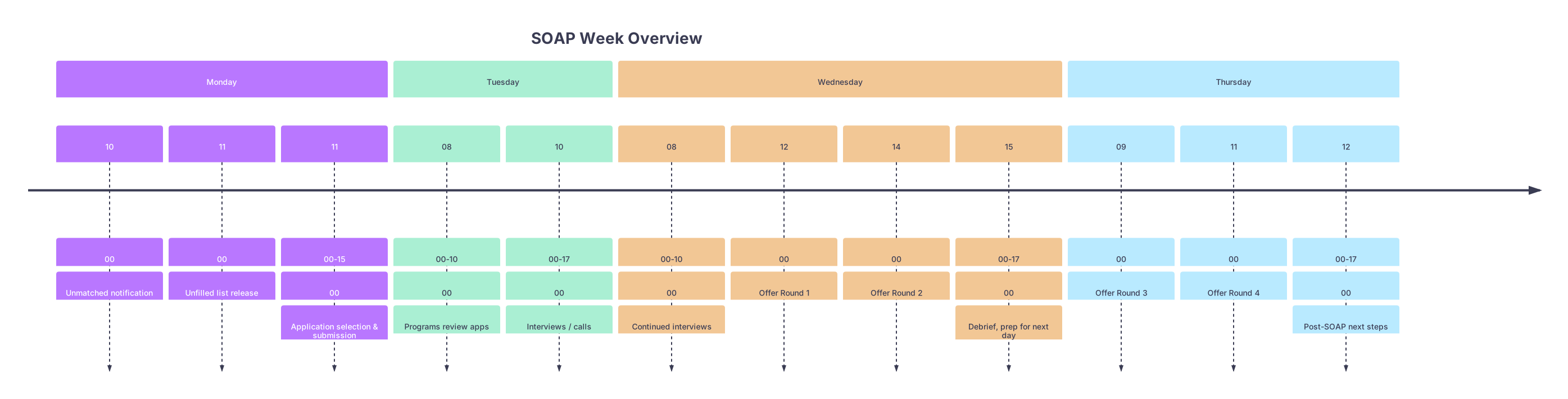
| Period | Event |
|---|---|
| Monday - 10 | 00 |
| Monday - 11 | 00 |
| Monday - 11 | 00-15 |
| Tuesday - 08 | 00-10 |
| Tuesday - 10 | 00-17 |
| Wednesday - 08 | 00-10 |
| Wednesday - 12 | 00 |
| Wednesday - 14 | 00 |
| Wednesday - 15 | 00-17 |
| Thursday - 09 | 00 |
| Thursday - 11 | 00 |
| Thursday - 12 | 00-17 |
Details vary slightly by year and time zone, but the pattern is stable:
- Monday: List + applications
- Tuesday: Pure outreach and interviews
- Wednesday–Thursday: Four offer rounds, 2 hours apart
We will walk through Monday morning to Thursday afternoon, hour by hour, with explicit “at this point you should…” guidance.
Monday: Unmatched → Application List Lock
This is the most important 4–5 hour block of your life so far. Treat it that way.
Monday 09:00–09:59 — Shock Management and Team Assembly
At this point you should:
- Acknowledge what just happened. You are unmatched. Say it once. Then switch to execution.
- Get your team on a single communication channel:
- Group text or WhatsApp with: you, your dean’s office / student affairs contact, your main advisor, maybe one trusted friend.
- Open:
- Laptop 1: ERAS
- Laptop 2 / screen: NRMP SOAP info + Excel/Sheets for tracking
- Hard rule: No doom-scrolling, no group chats full of drama. Mute everything not directly related to SOAP.
Your goals this hour:
- Confirm your SOAP eligibility on NRMP.
- Re-read your own ERAS application with cold eyes:
- Where are your strengths? (scores, clinical honors, research, language skills)
- Where are the red flags? (fails, LOA, poor narratives)
- Decide your primary and secondary specialties for SOAP.
- Example: Primary – IM categorical + prelim; Secondary – FM or transitional year.
You cannot chase everything. Programs smell desperation and lack of focus.
Monday 10:00 — Unmatched Notification
NRMP tells you: “You did not match.”
You already knew this was likely, so you do not waste time.
At this point you should:
- Take 5 minutes. Bathroom. Water. One deep breath outside if you can.
- Send a single update message to your support team: “Unmatched. Moving into SOAP plan now.”
Then sit back down.
Monday 11:00–11:20 — Unfilled List Drop
The NRMP releases the List of Unfilled Programs. This is where people panic and blow the week.
At this point you should:
- Download the unfilled list immediately.
- Copy it into your own spreadsheet, add these columns:
| Column | Purpose |
|---|---|
| Program Name | Identification |
| ACGME Code | For quick searching |
| Specialty | Sort/filter by specialty |
| Categorical/Prelim | Track position type |
| State/City | Geography fit |
| Number of Positions | Prioritize larger spots |
| Priority (1–3) | Your personal ranking |
Do not start “researching” each program yet. First pass is triage.
Monday 11:20–12:00 — First Pass Filter (Brutal but Necessary)
You have a cap: 45 programs total (ERAS SOAP cap). Blowing those on long-shot reach programs is a classic mistake.
At this point you should:
- Filter by your chosen specialties only. Delete the rest.
- Immediate hard filters:
- Visa status issues (if you need a visa and they clearly do not sponsor, delete).
- Categorical vs prelim: Align with your real goal.
- DO-friendly vs MD-only: Use your knowledge of programs and last year’s NRMP data.
- Quickly mark:
- Priority 1: Strong fit / odds (your stats in range, connected to your school, geographic flexibility)
- Priority 2: Acceptable but less ideal (location, schedule, slightly below ideal specialty).
- Priority 3: Backup of backups.
You are not ranking for “dream” here. You are ranking for “highest probability of training job that does not make you miserable.”
Monday 12:00–13:30 — Deep Dive on Top 60–70 Programs
You will over-identify now, then trim.
At this point you should:
- Sort by Priority, then by number of positions available.
- For each Priority 1 and high-yield Priority 2 program:
- Spend no more than 3–4 minutes per program:
- Check their website: mission, resident profile, typical scores, DO/IMG presence.
- Google “[Program name] residency Reddit” or SDN if you are desperate. Scan, do not dwell.
- Ask:
- Would they likely auto-screen out my scores?
- Does my story fit their vibe? (Community vs academic, safety-net vs boutique).
- Spend no more than 3–4 minutes per program:
- Create a short annotation column:
- “Community IM, many IMGs, visa OK, midwest.”
- “FM, heavy OB, rural, strong DO presence.”
Aim to narrow to ~60 realistic options during this block. You will cut to 45 later with your advisor.
Monday 13:30–14:00 — Lunch + Strategy Reset
You are no good if you crash mid-afternoon.
At this point you should:
- Eat something with protein and carbs. Real food, not just coffee.
- Step away for 15–20 minutes. No screens.
- Send an updated spreadsheet link to your advisor / dean with:
- Highlighted 60 programs you are seriously considering.
- A one-line summary of your priorities.
Tell them explicitly: “Need help trimming to 45 by 3 pm.”
Monday 14:00–15:00 — Final 45 and Application Customization
This is your last hour before applications lock. You must be decisive.
At this point you should:
- On a quick call or Zoom with your advisor, do the ruthless cut:
- Remove programs where:
- Your scores are clearly below their public ranges and you have no hook.
- Your personal deal-breakers are obvious (location you truly cannot live in, etc.).
- Remove programs where:
- Lock in your 45 programs across 1–2 specialties and position types.
Now, content:
You cannot rewrite your entire application, but you can:
Update Personal Statement(s)
- Create one PS per specialty you are applying into.
- In each, emphasize:
- Why this specialty specifically.
- Your real-world experiences that match what SOAP-heavy programs care about: work ethic, patient load tolerance, underserved care, teamwork.
Program Signaling (Very Light)
- For 5–10 absolute top-choice programs, consider micro-tweaks in:
- Experiences emphasized in ERAS “most meaningful” sections.
- A single sentence in the PS aligning with region/type (but do not name programs unless you are sure).
- For 5–10 absolute top-choice programs, consider micro-tweaks in:
You will not have time for perfection. Clarity beats poetry.
Monday 15:00–16:00 — Application Submission and Confirmation
NRMP / ERAS will have a hard deadline (often 3 pm Eastern) for program selection.
At this point you should:
- Double-check:
- Correct PS attached to each specialty.
- Your contact info, phone number, and email are current. Voice mailbox is not full.
- Submit. Then take screenshots or PDF exports of:
- List of programs applied to.
- PS versions you used.
Once submitted, you cannot add more. Do not waste energy regretting.
The rest of Monday is prep for interviews.
Monday 16:00–20:00 — Interview and Call Prep
Programs can review applications but cannot contact you until Tuesday. Use this quiet time well.
At this point you should:
Build your SOAP call log:
- Spreadsheet columns:
- Program
- Contact person (if known)
- Phone / email
- Time contacted
- Response
- Notes
- Spreadsheet columns:
Draft your email + voicemail scripts for Tuesday:
- Email script: 3–4 sentences:
- Who you are (name, school, specialty).
- One sentence of connection / fit.
- One sentence highlighting key strength (Step/COMLEX, honors, unique skill).
- Explicit interest: “I would be honored to be considered for an interview.”
- Voicemail script: 20–25 seconds, practiced out loud.
- Email script: 3–4 sentences:
Prepare your interview answers:
- “Why this specialty now?”
- “What happened in the Match?”
- “Tell me about a time you handled a heavy workload / conflict.”
- “Where do you see yourself after residency?”
Do 1–2 mock phone interviews:
- Have someone call you. You answer professionally. No “uhhhhh” first 10 seconds.
Then sleep. You will need it.
Tuesday: Contact and Interviews All Day
Tuesday is controlled aggression. Programs can now reach out. You can also express interest appropriately.
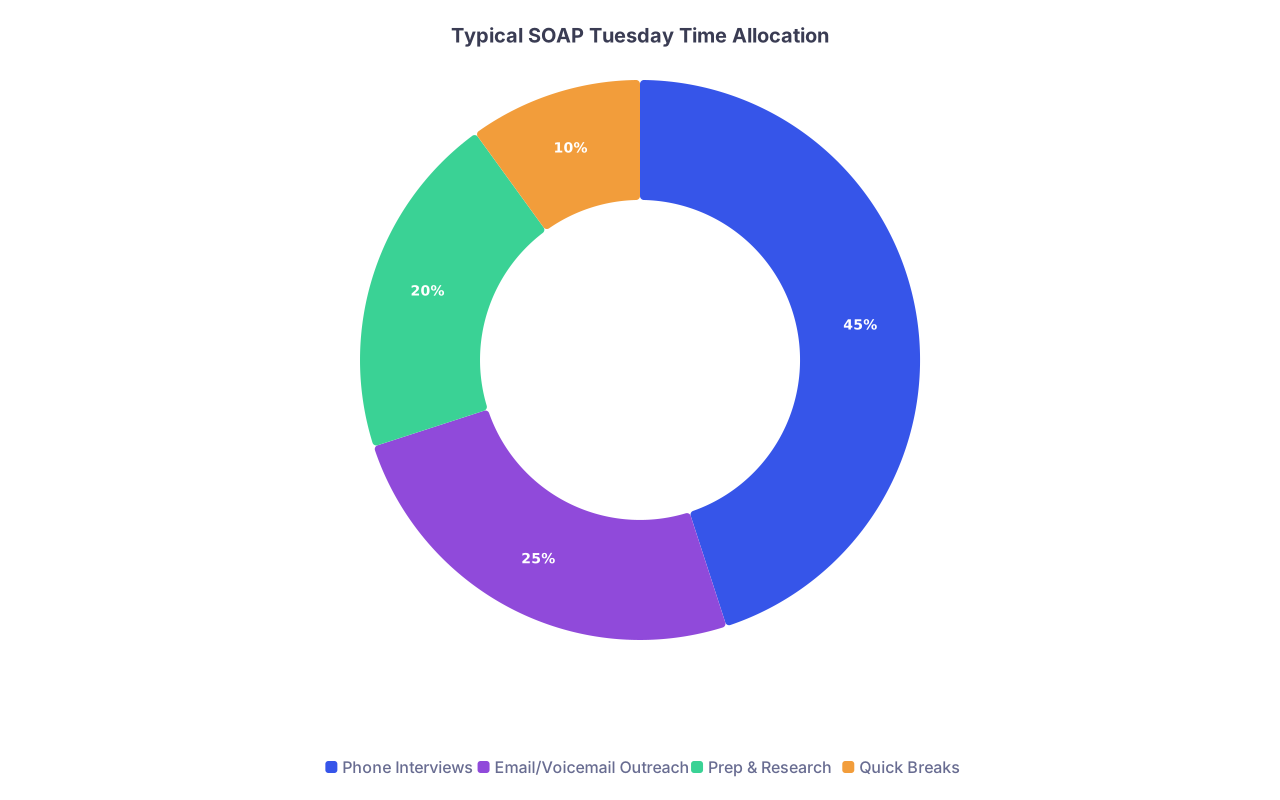
| Category | Value |
|---|---|
| Phone Interviews | 45 |
| Email/Voicemail Outreach | 25 |
| Prep & Research | 20 |
| Quick Breaks | 10 |
Tuesday 07:00–08:00 — Morning Systems Check
At this point you should:
- Confirm:
- Phone charged, on loud.
- Voicemail greeting professional and clear.
- Email open on laptop, notifications on for interview invites.
- Quick review of:
- Top 20 programs you’re most likely to hear from.
- Your talking points for each specialty.
No workouts, no long showers. You are “on call” all day.
Tuesday 08:00–10:00 — First Calls and Emails
Programs start screening their lists, some begin calling early.
At this point you should:
- Answer every call from unknown numbers.
- Quiet room.
- Notepad ready with program list printed.
- After each call:
- Log: time, program, who you spoke with, impression.
- During lighter moments:
- Begin sending targeted emails:
- Start with your Priority 1 programs that have not contacted you yet.
- Do not spam every program at once; stagger throughout the day.
- Begin sending targeted emails:
If you bomb a call, shake it off. There will be more.
Tuesday 10:00–12:00 — Peak Interview Window #1
Phone and Zoom interviews cluster here.
At this point you should:
Block this window for interviews only. No outreach calls unless you have a gap.
For each interview:
- 5 minutes beforehand:
- Skim their website (again).
- Choose 1–2 specific questions to ask:
- “How do your residents balance inpatient and clinic?”
- “What kind of graduates do best in your program?”
- 5 minutes beforehand:
During:
- Frame your SOAP status honestly but constructively:
- “I applied broadly, mostly to academic IM. My Step 1 pass and lower Step 2 made some programs nervous, I think. I want to train in a program where hard work and growth matter more than perfect numbers.”
- Frame your SOAP status honestly but constructively:
No rambling about unfairness. Program directors have heard every story.
Tuesday 12:00–13:00 — Quick Lunch, Update Log
At this point you should:
- Eat while updating your call log:
- Which programs have interviewed you?
- Any strong positive signals?
- Send a brief update to your advisor:
- “Spoken with: A, B, C. No contact yet from: D, E, F.”
Do not chase “thank-you emails” for every SOAP interview. You do not have that kind of time. If one felt particularly meaningful, you can send a 3-line note later in the day.
Tuesday 13:00–17:00 — Peak Interview Window #2 + Final Outreach
At this point you should:
- Continue taking every call.
- Use any 30–60 minute quiet block for:
- Calling program coordinators (if appropriate in that year’s rules – check NRMP guidance) once to express interest.
- Sending emails to remaining Priority 2 programs.
You are not begging. You are offering a clear, concise pitch:
- “I am very interested in your community-based IM program. I have strong clinical evaluations, experience in safety-net hospitals, and I am eager to work hard. I would be grateful for consideration for an interview.”
End your day by 20:00 if you can. Your brain will be fried.
Wednesday: Offers Rounds 1–2
Now the timeline becomes brutally specific. Offer windows are fixed and short. You must be ready.
How the Offer Rounds Generally Work
- You can receive multiple offers in a round.
- You can accept only one.
- Once you accept an offer in any round, you are done with SOAP. You are committed to that program.
- Unaccepted offers expire at the end of the round.
Typical structure (check the year’s NRMP schedule):
| Round | Approx Time (ET) | Key Action |
|---|---|---|
| 1 | Wed 12:00 | Initial offers released |
| 2 | Wed 14:00 | Second wave offers |
| 3 | Thu 09:00 | Third wave offers |
| 4 | Thu 11:00 | Final SOAP offers |
Wednesday 08:00–10:00 — Last-Minute Interviews + Ranking
Some programs still scramble to talk to candidates before Round 1.
At this point you should:
- Take any remaining interviews seriously; late does not mean low-quality.
- Build your personal rank list:
- A simple numbered list of all programs that might offer you.
- Include: program name, type, city, and a 1–line “why.”
This rank list is your anchor when panic hits at noon.
Wednesday 10:00–11:45 — Offer War Room Setup
At this point you should:
- Sit in a quiet room with:
- Laptop logged into NRMP.
- Phone fully charged.
- Your printed rank list in front of you.
- Confirm again:
- You understand: accepting an offer ends SOAP.
- You know your bottom line (programs you would actually rather not train at vs taking a research year or reapplying).
No last-minute “maybe I should switch specialties.” That ship sailed Monday.
Wednesday 12:00–12:30 — Round 1 Offers
This is where people freeze. You cannot.
At this point you should:
- The second offers appear:
- Look at the highest-ranked program on your personal list that has offered you.
- Ask yourself one question: “If this is the only offer I ever get, am I at peace training there?”
- If the answer is yes: accept immediately. Do not wait for Round 2 fantasy options.
- If the answer is no, and you genuinely have strong signals from higher programs (e.g., PD said “you are ranked highly, expect an offer if spots open”): you may hold and decline. This is rare and risky.
From experience: Most unmatched students who “hold out” for something better end up with nothing. Take a solid program when it is in front of you.
Wednesday 12:30–13:59 — Debrief and Mental Reset
If you accepted in Round 1:
- You are done with SOAP.
- At this point you should:
- Notify your dean / advisor, thank those who helped.
- Start gathering housing / relocation info quietly.
If you did not accept in Round 1:
- Update your rank list (remove programs that filled).
- Talk with your advisor. Honestly. Did you overestimate your chances?
Wednesday 14:00–14:30 — Round 2 Offers
Same drill, higher stakes.
At this point you should:
- If you get any offer from a program you ranked as acceptable:
- Accept. Full stop.
- The only justifiable reason to decline in Round 2:
- The program is truly unsafe or unworkable for you (major health/family constraint, or you know the environment is toxic in a way you cannot tolerate).
Round 2 is where most remaining spots vanish.
Wednesday 15:00–17:00 — If You Still Have No Offer
Hard space to be in. You are not alone.
At this point you should:
- Meet (virtually or in person) with your dean / advisor:
- Review: which programs were realistic misses vs long shots.
- Discuss Thursday rounds but also contingency plans:
- Research year.
- Another degree (MPH, MBA) with reapplication.
- Different specialty strategy for next cycle.
You still show up prepared for Thursday. But you start thinking beyond SOAP as well.
Thursday: Last Chance Rounds 3–4 and Aftermath
Thursday 08:00–08:59 — Final Rank Check
At this point you should:
- Update your list based on:
- Programs that definitely filled.
- Any last-minute information from coordinators.
- Draw a literal line on your paper:
- Above the line: Programs you would accept if offered.
- Below the line: Programs you would not accept, even as last resort.
You need that clarity before your emotions argue otherwise at 09:00.
Thursday 09:00–09:30 — Round 3 Offers
Fewer offers, but they still matter.
At this point you should:
- If any offer is above your line:
- Accept. End of SOAP for you.
- Do not try to “game” for Round 4 except in bizarre edge cases your advisor specifically endorses.
Thursday 09:30–10:59 — Breather and Reality Check
If still unmatched:
- You are now in the smallest pool. Programs are nearly full.
- At this point you should:
- Talk with your advisor about whether Round 4 changes anything about your “line.” Sometimes it does.
Thursday 11:00–11:30 — Final Round 4 Offers
Last official SOAP chance.
At this point you should:
- Accept any offer that:
- Is above your line, and
- Does not violate your real non-negotiables (visa impossibility, major health barrier, etc.).
If nothing comes:
You are officially SOAP-unmatched. Devastating, yes. But you now shift into long-game planning.
Thursday Afternoon: Post-SOAP Moves (Matched or Not)
If You Matched Through SOAP
At this point you should (Thursday 12:00–17:00):
- Email:
- Program coordinator: thank them, confirm receipt, ask about next steps and paperwork.
- Your letter writers and mentors: short, sincere thanks.
- Start a basic relocation / housing timeline:
- Move-in timing.
- Licensing and paperwork deadlines.
- Debrief with yourself:
- What went wrong in the main Match?
- What worked in SOAP?
You will use these lessons later when you are advising others, whether you want to or not.
If You Did Not Match Through SOAP
The day feels endless. Give yourself a defined window.
At this point you should (Thursday 12:00–17:00):
- Allow 1–2 hours to just feel angry, sad, numb. Honestly.
- Then, with your advisor:
- Build a 12-month recovery timeline:
- Clinical work: prelim year, research position, or clinical fellowship that keeps you in the game.
- Exam retakes or Step 3 (if helpful for your specialty).
- Application rebuild: LORs, new clinical experiences, narrative rework.
- Build a 12-month recovery timeline:
- Identify one immediate action:
- Email a department chair about a research position.
- Reach out to alumni who did a research year before matching.
- Schedule a dedicated planning meeting for early next week.
You are not starting over. You are re-routing.
Final Move: Script Your Own Week Now
Do not wait until Monday of Match Week to figure this out.
Open a blank document or spreadsheet right now and:
- Create four sections: Monday, Tuesday, Wednesday, Thursday.
- Under each, write time blocks (hour-by-hour) and fill in:
- “At this point I should…” tasks for:
- List triage
- Application updates
- Call and email scripts
- Interview prep
- “At this point I should…” tasks for:
- Save it as “SOAP Week Playbook – [Your Name].”
Then share it with your advisor and ask:
“What would you change in this plan to make sure I do not waste a single hour?”