
It is Monday of Match Week, 10:59 a.m. Eastern.
You are staring at your email. Your phone. NRMP’s screen.
10:59 flips to 11:00.
The subject line hits:
“Did Not Match to Any Position.”
Your stomach drops. Your brain goes static. People told you “it will be okay” all year. Right now it is absolutely not okay.
This is where the next 72 hours decide whether you salvage a training spot this year, set yourself up for a strong reapplication, or drift for months in panic and denial.
Let’s walk the clock.
Hour 0–2: The Shock Window (Monday, 11:00–13:00 ET)
At this point you should:
Confirm your status.
- Log into NRMP and ERAS yourself. Do not rely only on the email subject line someone forwarded.
- Verify:
- Did you fully not match?
- Or partly match in a prelim / transitional year but not in advanced? (Very different action tree.)
Tell exactly three parties. No more (for now).
- Your:
- Dean’s office / Student Affairs or GME office
- Primary specialty advisor or mentor
- One personal support person (partner / close friend / family)
- Script it. You do not need a therapy session right now, you need clarity:
- “I did not match. I am calling to ask what immediate resources the school has and when we can talk about SOAP strategy.”
- Your:
Stop the doom scroll.
- Do not:
- Post on social media.
- Start explaining to your entire class group chat.
- Text 30 people a half-story.
- Your emotional energy is a finite resource. You will need it for the next 3 days.
- Do not:
Get the exact SOAP schedule in front of you.
- Go to NRMP and your school’s SOAP guidance page.
- You need:
- When the List of Unfilled Programs releases.
- When you can start sending applications.
- The rounds of offer times.
- Put these into your calendar with alerts. This is now your job.
At this point, the goal is not “feeling better.” The goal is: you are oriented, you know the rules of engagement, and you have your core support people alerted.
Hour 2–6: Triage and Game Plan (Monday Early Afternoon)
Now you move from “why did this happen?” to “what options do I still have?”
At this point you should:
Get a brutally honest assessment of your file.
Quick, efficient reality check with someone who has actually sat on a rank committee.Ask them specifically:
- Step/COMLEX scores and attempts
- Class rank / failures / professionalism flags
- Strength / weakness of letters
- Breadth and logic of your original application list
Your goal: Fit yourself roughly into one of these buckets:
Applicant Buckets After Not Matching Bucket Snapshot Profile A: Close Miss Decent scores, solid evals, maybe applied too narrowly / very competitive specialty B: Borderline Average scores, some gaps, maybe weak letters or poor interviewing C: Red Flag Failed exams, professionalism issue, major gap year with no activity D: Catastrophic Fit Aiming way above profile, almost no interview invites, unrealistic list Why this matters: Bucket A behaves differently from C. You cannot “positive mindset” your way around data.
Clarify your non-negotiables. You do not have days to soul-search. You have hours. So draft a quick, honest list:
- Geographic:
- “I will literally move anywhere.”
- Or: “Partner locked into a job in X city, I can accept within 3–4 hours.”
- Specialty:
- “I just want a residency this year, any field.”
- Or: “I will pivot to another specialty but not to X.”
- Visa / funding status (if applicable):
- J-1 vs H-1b possibilities
- Need for IMG-friendly programs
The more flexible you are, the more SOAP is actually an opportunity. Rigid preferences in SOAP are how you stay unmatched.
- Geographic:
Notify your letter writers in a targeted way. Send a very short, professional email:
- State that you did not match.
- State you will be participating in SOAP / considering reapplication.
- Ask if they are open to:
- Updating the letter quickly if you pivot to another specialty.
- Taking a brief call later in the week.
Do not write paragraphs of apology. Stay logistical and forward-facing.
Stabilize your basic needs for the week.
- Cancel non-essential commitments.
- Plan:
- Sleep schedule (yes, actually plan it).
- Food (pre-order or prep so you are not living on vending machines).
- A quiet workspace for the SOAP calls / offers.
You are building the mental and logistical scaffolding for a truly insane week. Treat it like a high-acuity call shift: you set up before the traumas roll in.
Hour 6–24: Pre-SOAP Preparation (Monday Late Afternoon–Night)
This phase is where most people either get organized or spiral.
At this point you should:
Clean and branch your ERAS application.
- Fix obvious cosmetic issues:
- Typos.
- Awkward phrasing in the personal statement.
- Outdated experiences.
- Then build pivot versions:
- Version 1: Original specialty (e.g., Internal Medicine) with refined PS.
- Version 2: Backup core specialty (e.g., Family Med, Peds, Psych) with a new PS.
- Version 3 (if needed): Prelim-only / Transitional with a PS focused on being a solid team player, adaptable, open to advanced placement later.
Do not send a Surgery-heavy statement to a Psych program. Yes, programs notice.
- Fix obvious cosmetic issues:
Draft new personal statements fast and good enough. These do not need to be poetic. They need to be:
- Coherent.
- Specialty-specific.
- Honest about your interest without oversharing about failing to match.
Template:
- Paragraph 1: Why this field actually makes sense for you (1–2 clinical stories).
- Paragraph 2: Your strengths and training background, linked to that field.
- Paragraph 3: What you want from a residency and what you offer.
Leave out:
- Graphic descriptions of your emotional devastation today.
- Excuses for application weaknesses that sound defensive.
Build your target SOAP list from last year’s data. You do not have this year’s unfilled list yet, but you do have:
- Last year’s unfilled programs by specialty.
- NRMP Charting Outcomes and Program Director Survey data.
Use this to pre-build:
- A “core” list: programs that routinely take IMGs / DOs / lower scores.
- A “reach” list: stronger programs that sometimes appear in SOAP.
You want a spreadsheet with:
- Program name / ACGME code
- City / state
- Type (university vs community)
- Historically IMG / DO friendly? (Y/N)
- Your likelihood (High / Medium / Low)
This way, the moment the new unfilled list drops, you are not starting from zero; you are cross-referencing and updating.
Get your phone and email SOAP-ready.
- Set a professional voicemail greeting. Absolutely no music, jokes, or “I never check this.”
- Ensure:
- Voicemail box is not full.
- Phone numbers in ERAS are correct.
- Create a clean email signature with:
- Your name, degree.
- Medical school.
- Phone number.
Programs will call and email in clusters. You do not want to be triaging basic tech failures.
Plan your communication chain with your school.
- Who is your point person on SOAP?
(Dean, GME office, match coordinator.) - How often will you check in?
- Will they advocate for you with particular programs?
Schools vary wildly here. Some are proactive warriors for their unmatched students. Others…are not. Know which you have and plan accordingly.
- Who is your point person on SOAP?
At this point your goal is simple: by Monday night, you are emotionally bruised but operationally ready.
Day 2 (Tuesday): SOAP Starts – Precision and Volume
SOAP mechanics change slightly year to year, but the pattern is stable:
Tuesday is applications day.
Tuesday Morning: Unfilled List Drop
At this point you should:
Download and scan the unfilled list immediately.
- Sort by:
- Specialty.
- State.
- Identify:
- Your original specialty slots (if any).
- Realistic backup specialties.
- Prelim / TY spots that could keep you clinically active.
- Sort by:
Make three priority tiers. Fast. Tier 1: Programs you would genuinely be happy to join and for which you are competitive.
Tier 2: Programs that are acceptable and realistic.
Tier 3: Programs you would accept if nothing else comes through.Be honest. SOAP is not the time to pretend you are above community programs in states you cannot spell.
Match your ERAS versions to these tiers.
- For each specialty:
- Assign the correct personal statement.
- Make sure the right experiences are highlighted (e.g., Psych-focused rotations for Psych applications).
Do not get cute with customization at the individual program level. You do not have time. Specialty-level tailoring is sufficient here.
- For each specialty:
Tuesday Midday: Submitting SOAP Applications
You have a capped number of programs you can apply to during SOAP. Use them aggressively, not recklessly.
At this point you should:
Fill the cap. Seriously.
- If you are unmatched and not a superstar, applying to 10 programs in SOAP because you “want to be selective” is delusional.
- Move toward the cap with a heavy bias toward:
- Backup core specialties.
- Programs known to be IMG/DO friendly if you are one.
- Prelim/TY if you have any realistic shot at an advanced re-entry later.
Check every application twice before sending. Quick checklist:
- Correct personal statement attached?
- No obvious wrong specialty language?
- Contact info correct?
Coordinate with your dean if they are contacting programs.
- Provide them a short list (5–10 program names) for targeted advocacy.
- Do not expect them to call 40 places. They will not.
Once you submit, the waiting starts. This is the worst part. But there is work to do.
Day 2 Afternoon–Night: Interview Readiness & Contingency Planning
At this point you should:
Prepare for rapid-fire SOAP interviews.
- Many will be:
- 10–20 minute video calls.
- Minimal notice.
- Very straightforward.
- Have:
- One neutral, quiet background for video.
- Professional attire ready.
- Practice answers to:
- “Why did you not match?”
- “Why this specialty if you applied somewhere else originally?”
- “Why our program / location?”
Keep answers short and factual. No long confessionals.
- Many will be:
Draft your narrative about not matching. You will repeat this many times. Keep it:
- Honest.
- Non-defensive.
- Focused on growth.
Example:
- “I applied primarily to Dermatology this cycle and ultimately did not match. During the year, I realized that what I enjoyed most was longitudinal patient care and internal medicine-style decision making. That is why I am excited about the opportunity to train in Internal Medicine, where I can build those skills while bringing strong clinical performance and work ethic from my rotations.”
Start sketching the “if SOAP fails” plan. You do this now, not Thursday afternoon when you are emotionally destroyed.
High-level branches:
- Reapply next year to:
- Same specialty with bolstered CV.
- Different specialty better aligned with your profile.
- Enter a research year or non-ACGME fellowship.
- Work in a clinical extender role (scribe, clinical research coordinator) and rebuild.
Just outline paths. You do not commit yet. You commit after SOAP outcomes are clear.
- Reapply next year to:
Day 3–4 (Wednesday–Thursday): SOAP Offers and Final Moves
These two days are chaotic but structured. Offer rounds come in bursts, with strict rules about acceptance.
At this point you should:
Know the offer round times cold. Put them in bold on your calendar. Set alarms 10 minutes before each.
Stay glued to your phone and email during rounds.
- Keep your schedule clear.
- No driving, no long errands, no flights.
Have predefined acceptance rules. When a SOAP offer hits, you have very little time to accept or decline. This is not when you want to start asking 10 people for advice.
Before the round, write your rules:
- “I will accept any categorical Internal Medicine or Family Medicine position I receive.”
- “I will accept prelim Surgery only if I have at least X number of advanced Surgery programs that have expressed interest for next year.”
- “I will not decline an offer in hopes of getting something slightly better in a later round. Any categorical spot in a core specialty is a ‘yes.’”
People lose perfectly good positions because they are chasing an ideal program that never calls.
Use each round to update your expectations.
- If you are getting interviews but no offers:
- Ask directly, “Are there concerns about my application that I could address?”
- If you are not getting any interview requests:
- Mentally shift weight toward “SOAP unlikely, focus on reapplication plan.”
- If you are getting interviews but no offers:
Do not burn bridges in interviews. Even if a program sounds miserable:
- Be polite.
- Be engaged.
- You can always decline an offer you truly cannot accept, but do not make enemies. PDs talk.
If You Reach Hour 72 Still Unmatched
It is now end of Thursday or early Friday. SOAP is over or essentially functionally over. Your emotional tank is empty.
At this point you should:
Take one day completely off from active planning. Yes, I am telling you to stop. One day.
Sleep. See friends. Cry. Walk. Whatever resets you to a base level of human functioning.Schedule three concrete follow-up meetings for the next week:
- With your dean / match advisor.
- With at least one program director or faculty mentor in:
- Your original specialty, or
- A realistic target specialty for reapplication.
- With financial aid / personal finance support if you are carrying significant debt and need to adjust plans.
Gather hard data on your application performance.
- How many interviews did you receive?
- How many ranked you (if shared)?
- Any feedback from programs that almost ranked you but did not?
This is where you stop guessing and actually analyze. I have seen people repeat the exact same doomed strategy 2–3 cycles because no one forced this step.
Choose a direction within 2–3 weeks, not 6 months. Long, drawn-out limbo kills motivation and CV credibility.
Broadly, you are choosing:
- “I will reapply, and here is how I will fix my profile.”
- “I will pivot to another field / role where I can thrive without residency.”
That decision does not have to be perfect, but it does need to be intentional.
Visual: Emotional and Operational Load Across 72 Hours
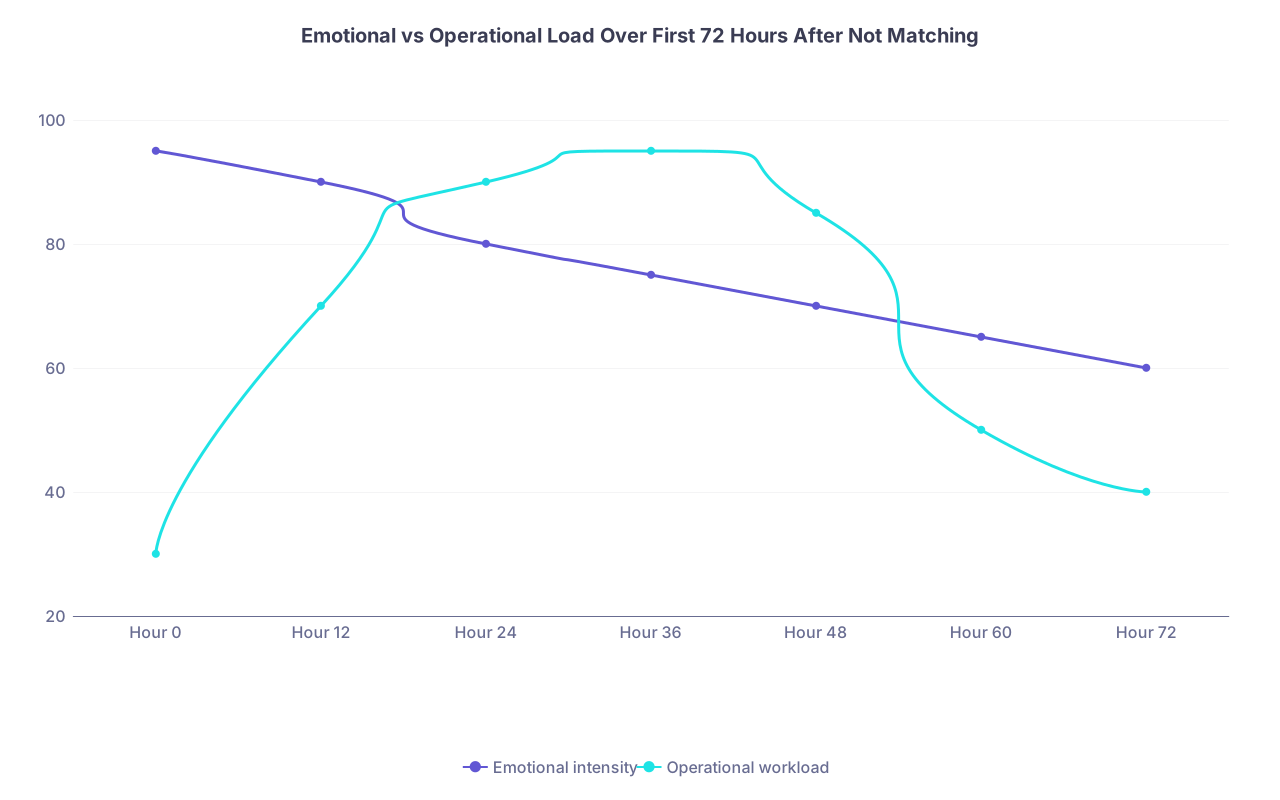
| Category | Emotional intensity | Operational workload |
|---|---|---|
| Hour 0 | 95 | 30 |
| Hour 12 | 90 | 70 |
| Hour 24 | 80 | 90 |
| Hour 36 | 75 | 95 |
| Hour 48 | 70 | 85 |
| Hour 60 | 65 | 50 |
| Hour 72 | 60 | 40 |
You start with emotional overload and low structure. By mid-SOAP, the workload peaks. Planning around that curve is the whole game.
Process Snapshot: Your 72-Hour Response Path
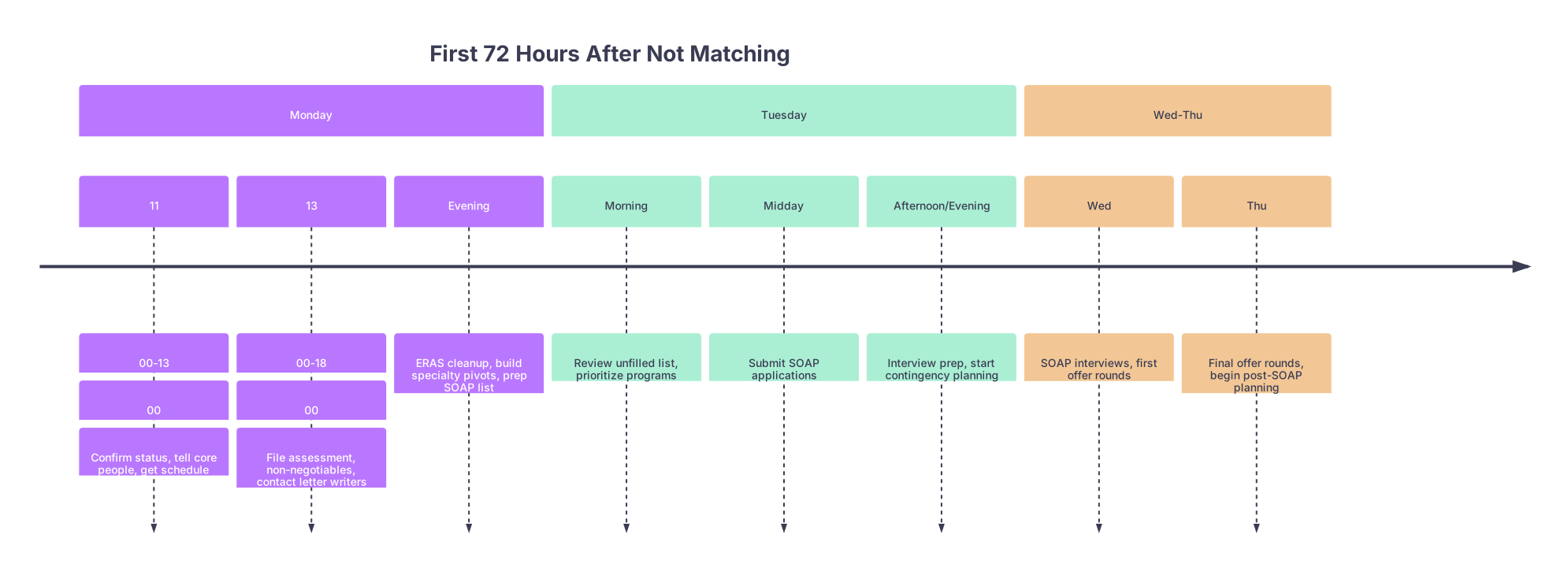
| Period | Event |
|---|---|
| Monday - 11 | 00-13 |
| Monday - 13 | 00-18 |
| Monday - Evening | ERAS cleanup, build specialty pivots, prep SOAP list |
| Tuesday - Morning | Review unfilled list, prioritize programs |
| Tuesday - Midday | Submit SOAP applications |
| Tuesday - Afternoon/Evening | Interview prep, start contingency planning |
| Wed-Thu - Wed | SOAP interviews, first offer rounds |
| Wed-Thu - Thu | Final offer rounds, begin post-SOAP planning |
Three Things To Remember
- The first 24 hours are about orientation and preparation, not solving your entire career.
- SOAP rewards flexibility, speed, and volume, not pride and perfectionism.
- If you are still unmatched at 72 hours, you have not “failed permanently.” You have entered a longer game that you can still win with a clear plan and honest feedback.