
The worst mistake after going unmatched is pretending you have more time than you do. You do not. Your reapplication timeline started the minute you saw “We are sorry, you did not match.”
This is your month‑by‑month roadmap from Unmatched Week through the next ERAS submission. No fluff. No “stay positive” platitudes. At each point: here is what you should be doing and what must be finished before you move on.
To keep this concrete, I will assume:
- You just went unmatched in March.
- You plan to reapply in the very next Match cycle.
- You are either a graduating MS4 or recent graduate.
Adjust by a year if you are taking a longer gap, but the sequence stays the same.
Big‑Picture Year Timeline

| Period | Event |
|---|---|
| Spring (Mar-Jun) - Unmatch Week | March |
| Spring (Mar-Jun) - Post-Match SOAP / scramble | March |
| Spring (Mar-Jun) - Reality check + strategy meetings | Apr |
| Spring (Mar-Jun) - Secure gap-year position | Apr-May |
| Spring (Mar-Jun) - Start structured clinical/research work | May-Jun |
| Summer (Jul-Sep) - Clinical productivity + letters | Jul-Aug |
| Summer (Jul-Sep) - Personal statement drafts | Jul |
| Summer (Jul-Sep) - Program list+ERAS build | Aug |
| Summer (Jul-Sep) - ERAS submission | Sep |
| Fall (Oct-Dec) - Interview season | Oct-Dec |
| Fall (Oct-Dec) - Ongoing updates & communication | Nov-Dec |
| Winter (Jan-Mar) - Rank list strategy | Jan-Feb |
| Winter (Jan-Mar) - Final communication with programs | Feb |
| Winter (Jan-Mar) - Match Week again | March |
March: Match Week and Immediate Aftermath
At this point you should not be making long-term plans. You should be putting out fires.
Match Week (Unmatched + SOAP)
Days 1–2 (Monday–Tuesday)
If you are partially or completely unmatched:
Meet with your dean / student affairs immediately.
- Ask bluntly:
- How did my application compare to matched students here?
- Where did they see red flags?
- Was the problem scores, grades, specialty choice, late ERAS, poor letters, or all of the above?
- Ask bluntly:
-
- Decide fast: Will you SOAP into a different specialty or prelim year?
- You cannot “sort of” SOAP. You either fully commit, or you do not SOAP at all and plan a clean reapplication.
- Do not chase a random spot just to avoid feeling unmatched. A toxic prelim or an off‑trajectory specialty can make you less competitive next cycle.
Document everything.
- List programs that interviewed you.
- Any feedback you got during the season.
- Which advisors you spoke to and what they said.
Days 3–5 (SOAP outcome known)
If you SOAP into something acceptable (e.g., prelim IM if you want categorical IM next year):
- Your reapplication strategy is now a “bridge year” path. You will be working as a resident while reapplying.
- Start planning how to:
- Find mentors at your SOAP institution.
- Get at least 1–2 strong letters from this year.
- Protect some time for ERAS and interviews next season.
If you do not SOAP:
- Accept you are taking a non‑residency year.
- Your top priority this month: secure a 12‑month position that:
- Is clinically relevant to your chosen specialty.
- Puts you in daily proximity to attendings who can write letters.
- Does not look like hiding (I have seen “MCAT tutoring year” with no clinical contact absolutely tank applications).
April: Brutal Autopsy and Strategy Reset
At this point you should be done grieving and squarely in analysis mode.
Step 1: Define Your Target Specialty (or Change It)
If you went unmatched in a highly competitive specialty (Derm, Plastics, Ortho, ENT, Rad Onc) with:
- Step 2 < 240, or
- No strong research, or
- Weak letters from big names
…you need a serious conversation about switching. Not a soft “maybe.” A clear yes/no.
Have these meetings in April:
- Specialty advisor in your original specialty.
- Specialty advisor in a more attainable field (IM, FM, Psych, Peds, Neurology, Anesthesia, etc.).
- Dean / career advising.
Walk away with:
- One primary specialty you will apply into.
- Possibly one secondary / backup specialty (but only if you have a real story and letters for both).
Step 2: Diagnose Why You Did Not Match
Make a table. Do not hand‑wave.
| Profile Type | Likely Issues | Priority Fix During Gap Year |
|---|---|---|
| Low Step/COMLEX scores | Automatic filters, few interviews | Strong clinical year, narrative about growth, strong letters |
| Average stats, few interviews | Late ERAS, bad personal statement, poor program fit | Apply earlier, overhaul application materials, expand program list |
| Many interviews, all rejections | Poor interviewing, red flags in letters, professionalism concerns | Formal interview coaching, different letter writers, address professionalism |
| IMG with no US experience | No US letters, no familiarity to PDs | US clinical experience, US mentors, research in US setting |
| Trying for uber-competitive specialty | Field mismatch, underpowered CV | Switch specialty or invest 2+ years in elite research and networking |
You should have a specific written answer to:
“I did not match because ___.”
If you cannot fill that blank in April, you are not ready to reapply intelligently.
Step 3: Start the Job Hunt (Immediately)
You need a position locked down by end of May.
Prioritize:
- Clinical research fellow in your specialty (IM cardiology lab, neuro stroke research, EM clinical research).
- Full-time clinical role:
- Surgical / medical assistant in academic center.
- Hospitalist extender roles that accept MD/DO grads.
- Post‑MD “junior resident” / “clinical fellow” roles some departments quietly create.
Avoid:
- Purely remote non-clinical jobs.
- Full-time test prep tutoring as your main activity unless your application is otherwise bulletproof.
May: Lock the Gap Year and Start Producing
At this point you should have accepted an offer or have serious leads with start dates in May/June.
Weeks 1–2: Finalize Position and Expectations
Once you secure a role:
Clarify:
- Who will directly supervise you?
- Are they willing to mentor and potentially write a letter by August?
- What concrete outputs are possible by September (abstracts, case reports, QI projects)?
Send a short introductory email to your future supervisor:
- Reintroduce yourself.
- Share your goal: “I will be reapplying in [specialty] this September; I hope to strengthen my application and earn a strong clinical letter.”
That line matters. It focuses them.
Weeks 3–4: Start Building “Letter‑Worthy” Work
You are not just clocking in. You are auditioning all year.
From day 1:
- Show up early, leave late. Yes, cliché. Still non‑negotiable.
- Volunteer for:
- Extra clinic days.
- Weekend calls, if allowed.
- Teaching med students.
You want your future letter writer to think:
- “This person works like a PGY‑1 already.”
- “We would be happy to have them in our program.”
Start a running document:
- Patient encounters (types, complexity).
- Procedures you observed or helped with.
- Any teaching, presentations, or projects.
You will use this in your personal statement and ERAS update emails later.
June: Build Momentum and Map Your Application
At this point you should be functioning smoothly in your role and ready to shift some attention to the upcoming ERAS.
Early June: Confirm Application Logistics
USMLE/COMLEX status
- If Step 2 CK is weak (< 230 for US MD in competitive specialties; < 220 for most IMGs in any field), you may need:
- A retake (if allowed) or
- A higher‑yield focus on everything but the score (clinical excellence, letters, fit).
- If Step 2 CK is weak (< 230 for US MD in competitive specialties; < 220 for most IMGs in any field), you may need:
MSPE and transcripts
- Check with your med school:
- Who updates your MSPE (if at all)?
- Can they add a short addendum about your current role?
- Check with your med school:
ERAS account
- Create or re-activate.
- Confirm that prior LoRs can be reused and how many new ones you will target (aim for 2–3 fresh letters).
Late June: High‑Level Program List Draft
Rough sketch only, but do not skip this.
Use your last cycle data:
- Where did you get interviews?
- Where did you get no response?
- Which regions seemed more open?
Aim for:
- A larger list than last time unless you overapplied hugely.
- A realistic spread of program tiers. If you matched at zero university programs last year, doubling down on top 20 only is fantasy.
July: Rewrite Your Application Story
At this point you should be deep in narrative work. You are not “updating” your old personal statement; you are killing it and starting over.
First Two Weeks: Personal Statement and CV Overhaul
Personal statement (PS) Your old PS did not do the job. Treat it as evidence.
This version must:
- Explicitly address the gap year and unmatched cycle without sounding defensive.
- Show growth:
- “During this past year working as a clinical research fellow in the heart failure clinic, I learned ___, and it confirmed my interest in ___.”
Structure:
- Why this specialty (now, with concrete stories).
- What went wrong / what changed (brief, factual).
- What you did in the gap year that makes you ready.
- What you want in a program and what you offer.
CV / Experiences
- Add all new activities with:
- Concrete numbers: “Assisted with care of ~20 stroke admissions per week.”
- Impact: “Developed a stroke education handout now used in clinic.”
Second Half of July: Targeted Letters of Recommendation
By late July you should:
- Identify 2–3 letter writers from your gap‑year role or new mentors.
- Schedule brief meetings (in person or Zoom).
In those meetings:
- Bring:
- Updated CV.
- Draft PS.
- One‑page summary of your work with them (specific cases, projects).
- Ask directly:
- “Would you feel comfortable writing a strong, supportive letter for my [specialty] application this year?”
If they hesitate, thank them and move on. A lukewarm letter hurts.
August: Tighten, Finalize, and Build Your Program Strategy
At this point you should be in full pre‑ERAS mode.
Early August: Program List Finalization
You now build your real list.
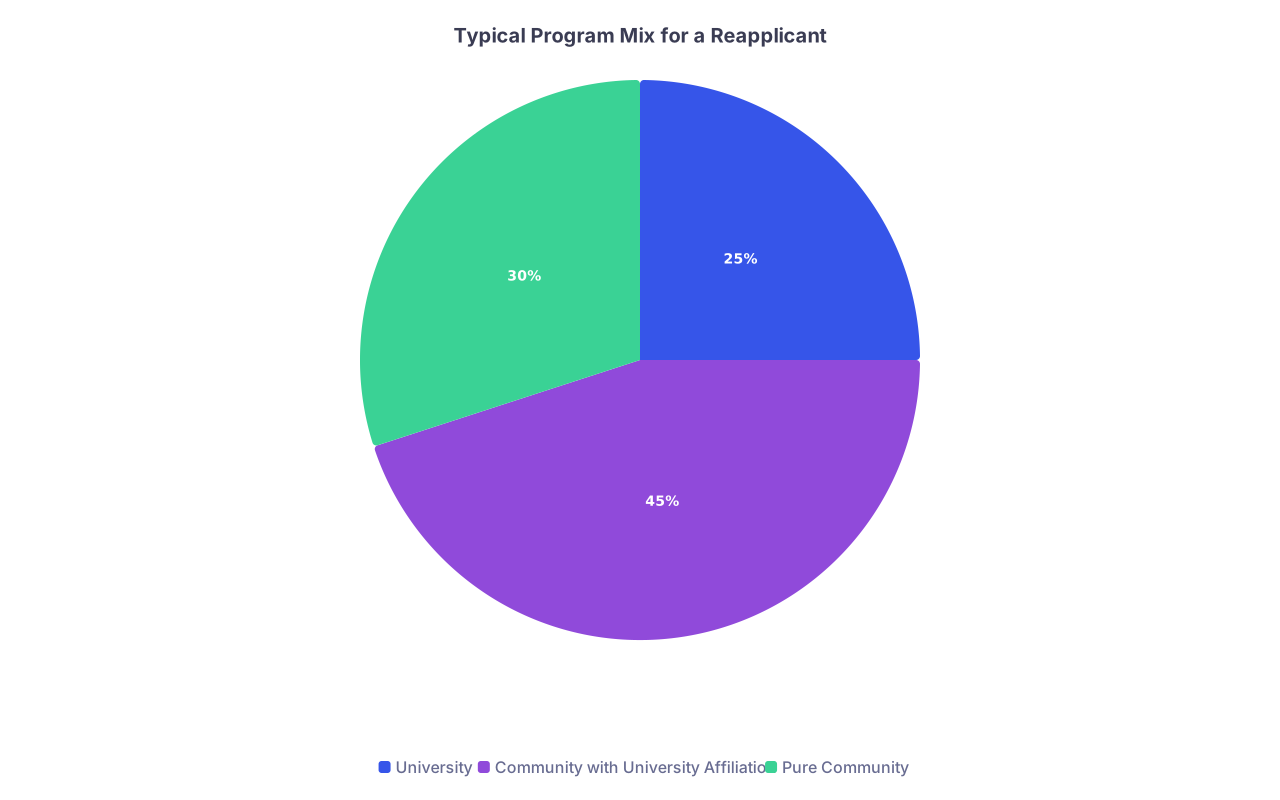
| Category | Value |
|---|---|
| University | 25 |
| Community with University Affiliation | 45 |
| Pure Community | 30 |
Rules:
- Reapplying to previous programs: Yes, if:
- You interviewed there and it was not a glaring mismatch.
- You have something genuinely new to show.
- Adding more community programs: Usually necessary.
- Geographic ego: Drop it. Many unmatched applicants never widen their map enough.
Aim for:
- MD/DO US grads in moderate competitiveness specialty: 60–100 programs.
- IMGs and non‑US grads: Often 120+ programs, but still targeted, not blind mass‑mailing.
Mid‑August: ERAS Polishing
You should now:
Finalize:
- PS (one main version, maybe a second for backup specialty).
- Experiences descriptions.
- Work/Gap explanations written clearly:
- “After not matching in 2024, I began working as a clinical research fellow in the neurology stroke clinic at X Medical Center, where I ___.”
Upload:
- All available letters (remind writers of deadlines).
- Correct transcripts and exam reports.
Have 1–2 brutally honest people (advisor, chief resident, recent successful reapplicant) read:
- Your PS
- A few experience entries
- The explanation of your unmatched year
If they do not say “This is much stronger than last year,” go another round.
Late August: Interview Readiness (Yes, Already)
Start:
Practicing answer sets:
- “Why did you not match?”
- “What did you do this year?”
- “Why should we believe this cycle will be different?”
Doing several mock interviews:
- With faculty who will not sugar‑coat feedback.
- Record at least one and watch yourself. Brutal but necessary.
September: Submission and Immediate Follow‑Through
At this point you should be submitting ERAS as early as it opens. No “waiting to tweak one more sentence.” You already had months for that.
Week 1: Submit
- Submit ERAS on day 1 or within the first few days.
- Double‑check:
- All programs selected.
- Correct specialty tracks (categorical vs prelim).
- Letters assigned correctly.
Weeks 2–4: Strategic Communication
Once programs can start downloading applications:
You may send very short intro emails to:
- Programs where you have a direct connection:
- Your gap‑year institution’s program.
- Locations where you did strong away rotations.
- Programs where your mentors know the PD/PC personally.
These emails:
- 3–5 sentences.
- Include:
- Who you are.
- Your current role.
- Your interest in their specific program.
- A line acknowledging you are a reapplicant and how you have grown.
Skip mass‑mailing 200 programs the same generic message. Program coordinators can smell that a mile away.
October–December: Interview Season as a Reapplicant
At this point you should be working full-time and reapplying at the same time. Gets exhausting. Plan for it.
When Invitations Start (Oct–Nov)
As invites appear:
- Respond quickly. Same day.
- Be flexible with dates. Reapplicants do not get to be overly picky.
Ongoing during this period:
- Continue excelling in your job. Your current attendings might be contacted informally.
- Keep a document with:
- Programs that invited you.
- Interview dates.
- Notes on each interaction.
Interview Day: How Your Story Changes
Every interviewer will see you are a reapplicant or gap‑year candidate. Many will ask directly.
Your answer must:
- Accept responsibility without self-flagellation.
- Show specific growth.
- End on a confident, forward‑looking note.
Rough pattern:
- “Last cycle, I received [X] interviews but did not match. In reviewing my application with my advisors, we realized ___ was a weakness. This year I have focused on ___, and through my work at ___, I have been able to ___. It confirmed for me that [specialty] is exactly where I belong, and I feel much more prepared to be an excellent resident now.”
No rambling about unfairness. No blaming specific programs.
January–February: Rank List and Final Push
At this point you should have a clearer sense of where you fit.
January: Post‑Interview Communication
For programs you are genuinely interested in:
- Send a concise thank‑you / update email:
- Brief gratitude.
- Short reminder of your fit: (“My ongoing work on [X] makes your focus on [Y] especially appealing.”)
- One sentence about continued enthusiasm.
If there is a true #1 program:
- One “you are my top choice” email is fine, preferably in February.
- Do not send that line to multiple programs. PDs talk.
February: Rank Strategy as a Reapplicant
Your rank list should:
- Include all programs where you would be willing to train. Do not play games with “I would rather go unmatched than go there,” unless the program is truly unsafe or toxic.
- Lean slightly generous—reapplicants cannot be hyper-selective.
Keep working hard in your current job. Do not coast; end‑of‑year impressions still matter, especially if your mentors are talking to PDs.
If You Go Unmatched Again
It happens. I have seen excellent people miss twice. If March comes again without a match:
- You cannot run the same playbook a third time.
- You must:
- Reconsider specialty more seriously.
- Consider longer‑term research tracks or non‑clinical careers.
- Get unfiltered feedback from PDs you interviewed with.
But that is a different roadmap.
Key Takeaways
- Reapplying after an unmatched cycle is not about “trying again.” It is about proving, month by month, that you are a different, stronger candidate than last year.
- The most critical windows are April–August: securing a high‑yield gap‑year role, earning fresh letters, and rewriting your narrative with ruthless honesty.
- At every stage—SOAP, job choice, program list, interviews—you must act like time is short and impressions are cumulative, because they are.