
The worst mistake formerly unmatched applicants make is waiting until ERAS opens to get serious. By then, the cycle has already decided what kind of candidate you are.
You have six months. Treated correctly, that is enough time to look like a different applicant on paper and in interviews. Treated casually, it is just enough time to repeat the same outcome.
I am going to walk you month by month, then week by week as ERAS approaches, through what you should be doing. Not vague “reflect and improve” advice. Concrete, time‑stamped tasks.
Big Picture: Six-Month Overhaul Plan
At six months before ERAS opens, your priorities are simple:
- Diagnose why you did not match.
- Fix what can actually be fixed in six months.
- Rebuild your narrative, strategically and honestly.
- Execute on letters, experience, and application logistics early.
Here is the rough structure of what the next half‑year should look like:
| Month Range | Primary Focus |
|---|---|
| Month -6 | Root-cause analysis, specialty choice, mentor team |
| Month -5 | CV repair: clinical work, research, USCE |
| Month -4 | Letters of recommendation, exam/score planning |
| Month -3 | Personal statement and ERAS skeleton, program list draft |
| Month -2 | Finalize documents, program list, interview prep |
| Month -1 | Polish, sign-offs, backup plans, readiness check |
We will assume ERAS “opens” (you can start working) in early June and “submission” is in early–mid September. Adjust exact dates for the year, but keep the intervals.
Month -6: Stop Guessing Why You Did Not Match
At six months out, you are not yet fixing things. You are diagnosing. At this point you should be brutally honest and data‑driven.
Week 1–2: Hard Audit Of The Last Cycle
Sit down with:
- Your prior ERAS application.
- Your interview list (or lack of one).
- Any post‑match feedback from programs, if they gave it.
- Your USMLE/COMLEX transcript and grade reports.
You are answering three questions:
- Was I competitive on paper for my specialty?
- Did I apply broadly enough and strategically?
- Did I underperform on interviews, or never get to that stage?
Common culprits I see (and people love to deny):
- Step 1/COMLEX 1 fail or very low pass.
- No Step 2 CK/Level 2 at time of application.
- Chronic red flags: professionalism issues, leaves of absence, multiple failed rotations.
- Anemic clinical experience in the specialty you applied to.
- Weak or generic letters (“this student was present and completed tasks”).
- Laughably short program list (applying to 25 IM programs as an average IMG, for example).
- Unrealistic specialty choice (Derm, Ortho, Plastics) without matching-level metrics.
Write this down. Not in your head. On paper. One page: “Why I did not match” with 3–5 clear causes.
If you cannot do this alone, that is your next step.
Week 3–4: Build A Mentorship Triangle
At this point you should have three categories of people in your corner:
One specialty insider
- A faculty member or PD/APD in your target specialty (or realistic backup specialty).
- Role: Honest assessment of your competitiveness, what matters for their programs.
One application strategist
- Could be a student affairs dean, advisor, or experienced recent grad who matched after being unmatched.
- Role: Application numbers, program list build, narrative repair.
One truth-teller peer
- Someone who will read your materials and say, “This line sounds desperate” or “You are not owning the failure.”
By the end of Month -6, you should:
- Have had at least one 30–60 minute meeting with a faculty mentor to review your prior application.
- Have a preliminary decision:
- Reapply to the same specialty
- Pivot to a more attainable specialty
- Build a dual‑application strategy.
This month is primarily thinking and deciding. Do not “start a research project” yet if you have not fixed your direction.
Month -5: Fix Your CV Where It Is Weak
Now you correct course. At this point you should have clear target(s): for example, Internal Medicine only, or Pediatrics + Family Medicine, etc.
Week 5–6: Lock In Your Clinical/Research/Work Plan
You have roughly 5 months to add meaningful lines to your CV that scream “I stayed in the game” instead of “I went home and sulked.”
Options that actually matter:
Transitional roles
- Prelim year spot (if you secured one after SOAP or off-cycle).
- Non‑categorical surgical year.
- Research fellowship with clinical exposure (e.g., cardiology research in an IM department).
- Hospitalist scribe or clinical assistant with serious physician interaction (better than nothing).
USCE for IMGs or those with big time gaps
- Observerships or hands-on externships in your target specialty.
- 1–3 month blocks are ideal; cobbled-together 1-week experiences are less convincing but still better than nothing.
By the end of Month -5 Week 2 you should:
- Have at least one secured position (research, clinical, or both) that runs through the ERAS season.
- Have dedicated days blocked in your schedule for:
- Data collection/abstract writing.
- Reading and summarizing key specialty literature.
- Shadowing/clinic days (if possible) with letter-writing attendings.
Week 7–8: Start Producing Evidence Of Engagement
You do not have to publish a first‑author NEJM paper in five months. That fantasy kills momentum. Aim for:
- Case reports or small series in your specialty.
- Quality improvement projects (chart audits, process design) with realistic completion.
- Posters for local or national meetings (many accept submissions into late spring).
Your goal this month: have at least 1–2 projects underway, with a clear timeline and faculty sponsor who knows your name and your story (“formerly unmatched, working hard, applying again”).
Month -4: Secure Letters And Address Exam/Score Issues
Month -4 is where many repeat applicants fall behind. They focus on polishing old personal statements instead of addressing the things that actually blocked them.
Week 9–10: Letters Of Recommendation – This Time, On Purpose
At this point you should be structuring your life around strong letters.
You want:
- 3 solid specialty letters (for your main specialty).
- 1 additional letter (could be medicine sub‑internship, research mentor, or prelim year PD).
Checklist this month:
Identify 4–5 attendings who:
- Supervised you directly on wards, clinic, or research.
- Saw you after your unmatched year (shows recent performance).
- Understand your story and are not afraid to comment positively on your resilience and growth.
Have explicit conversations:
- “I did not match last cycle. I am reapplying to X. I am working on Y and Z to improve. If you feel you can write a strong letter reflecting this improvement, I would be very grateful.”
If someone hesitates or gives a neutral reply (“I can write a letter”), that is often code for weak. Do not rely on them as a primary writer.
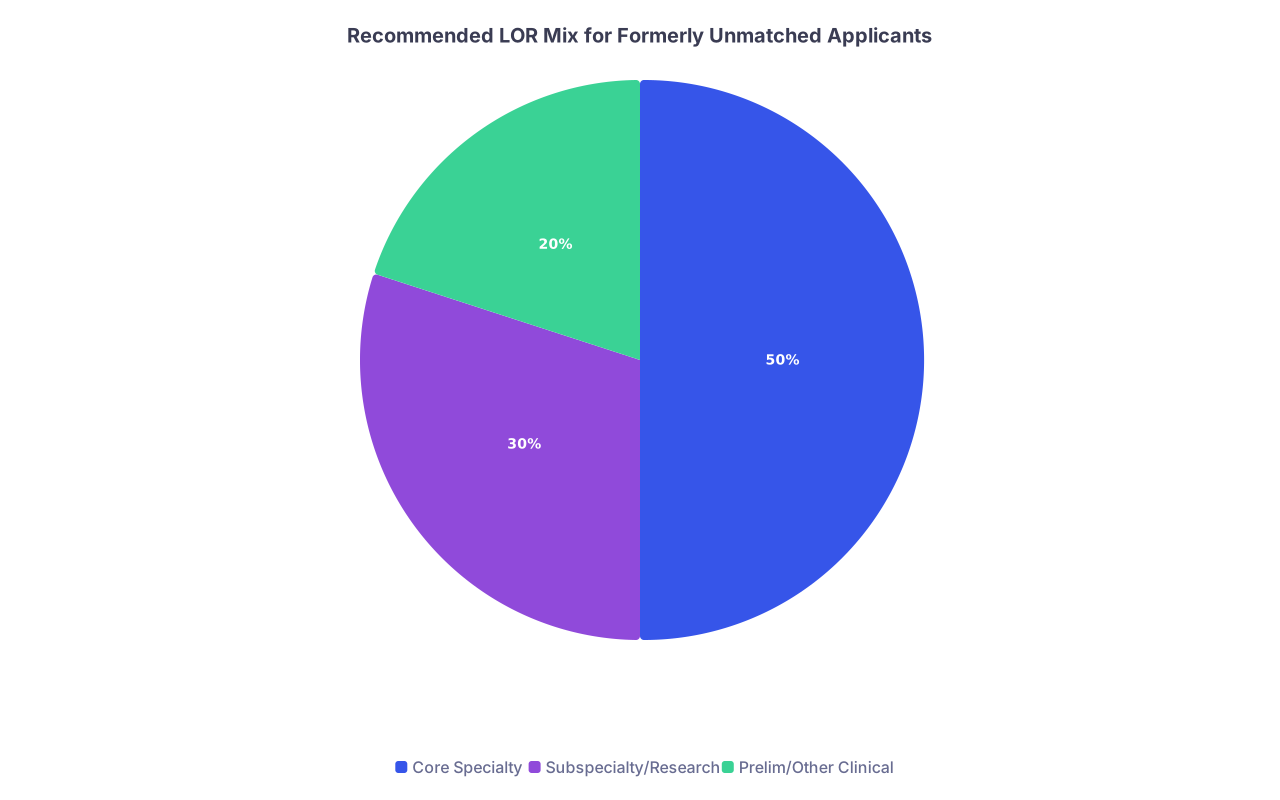
| Category | Value |
|---|---|
| Core Specialty | 50 |
| Subspecialty/Research | 30 |
| Prelim/Other Clinical | 20 |
Week 11–12: Score Repair Or Confirmation
If exams helped sink you, Month -4 is your last realistic window to address it.
Scenarios:
No Step 2 CK/COMLEX Level 2 last cycle
- At this point you should schedule it so you have a strong, available score before ERAS submission.
- Build a 6–8 week focused study calendar, integrated into your clinical schedule.
Low Step 2 CK
- For specialties that still care heavily about Step 3 (some IM, FM, psych programs), taking and doing well on Step 3 can help slightly.
- Do not take Step 3 if you are unprepared; a second weak score is worse than no Step 3.
Failed exam previously
- You must be ready to talk about this concisely and own it.
- Also, your recent performance (clinical, research, retaken exams) needs to clearly show that version of you is gone.
By the end of Month -4 you should:
- Have exam dates set or already completed (ideally).
- Have confirmed which exam narrative will appear in your application (“Step 2 now strong and passed on first attempt after earlier Step 1 failure,” etc.).
- Have 2–3 faculty already committed to letters, with a timeline for them to write (ideally by late July).
Month -3: Rebuild Your Application Narrative
Now the attention shifts to what you actually submit: your ERAS content. At this point you should be moving from “what went wrong” to “this is the revised story.”
Week 13–14: Personal Statement Version 1.0
Your personal statement as a formerly unmatched applicant is not the same as a typical MS4.
It must:
- Acknowledge the gap briefly.
- Emphasize specific growth and actions, not self‑pity.
- Showcase continuity in your specialty interest.
Structure I have seen work:
- A present-tense clinical moment from your current role (research fellow seeing patients, prelim intern on night float, etc.).
- A concise paragraph on your path, including not matching, framed as a turning point.
- Concrete evidence of what you did after: additional rotations, research, exam improvement, teaching.
- A clear, forward‑looking close: how you will contribute as a resident now.
Do not:
- Write three paragraphs about how devastating not matching was.
- Blame others (“my school did not support me,” “COVID ruined everything”) without owning your part.
- Pretend it never happened. Programs read your timeline.
By the end of Week 14 you should:
- Have a full draft of your primary specialty personal statement.
- Have identified how you will alter or rewrite for any backup specialty (do not reuse 90% word-for-word if you dual apply).
Week 15–16: ERAS Skeleton And Experiences Cleanup
This is where chaos kills repeat applicants. They procrastinate because they “already did ERAS before.” That is exactly why you must start early.
At this point you should:
- Log into ERAS the first week it opens.
- Start populating:
- Education and training (with updated roles).
- Experiences (new positions; update old ones with clearer, more outcome-based descriptions).
- Awards, presentations, publications (anything from the last year).
For each experience, especially post-unmatched ones, use bullet‑style content that shows:
- Responsibility: “Led weekly teaching sessions for rotating students.”
- Impact: “Reduced clinic no‑show rate by 15% through reminder system.”
- Commitment: months, hours/week, supervisor.
Month -2: Program List, Strategy, And Interview Readiness
If you wait until August to think about where you are applying, you are already behind. At this point you should be forcing yourself into uncomfortably realistic territory.
Week 17–18: Build A Ruthlessly Honest Program List
You are not the same as a first‑time applicant. Some doors are harder to open. You must offset this with volume and strategy, not magical thinking.
Key axes:
Program type
- University vs. community vs. hybrid.
- Academic powerhouses are rarely your friends right now unless you have a major hook.
Geography
- Prior clinical experience in a region boosts your odds there.
- Home state programs are still your best bet if you are a US grad.
IMG‑friendliness / prior unmatched acceptance
- Look for programs that:
- Take IMGs if you are one.
- Have a track record of taking prelims into categorical spots.
- Have hired former unmatched applicants (you will hear these stories locally).
- Look for programs that:
You should end up with tiers:
- “Reach but rational” programs.
- “Solid realistic” programs.
- “Safety” programs (yes, they still exist, especially in FM, psych, IM in some regions).
| Tier | Number of Programs | Typical Profile |
|---|---|---|
| Reach | 15–20 | University, moderate competitiveness |
| Realistic Core | 40–60 | Community + hybrid, IMG-friendly |
| Safety/Backup Spec | 20–30 | FM or transitional year programs |
By the end of Week 18 you should have:
- A preliminary list with at least 60–100 programs for core IM/FM/Peds/Psych if you were previously unmatched.
- A sense of how many you can financially afford to apply to and interview with.
Week 19–20: Interview Story Rehearsal
Not interview “practice.” Story rehearsal.
Every former unmatched applicant gets asked some version of:
- “Walk me through what happened last cycle.”
- “What did you do in the interim year?”
- “Why should we believe this time is different?”
Your answers must be:
- 60–90 seconds.
- Specific, not vague (“I grew a lot personally” is fluff).
- Blame-minimized, responsibility-maximized.
Example skeleton:
“I applied into internal medicine last cycle while still waiting on my Step 2 score and without any recent US experience because of timing issues. I received a small number of interviews but did not match. After that, I took a position as a research fellow in [department], where I have been on the wards weekly, co‑authoring [projects], and working closely with [attending]. I also focused on my Step 2 performance, scoring [x] on my second attempt. The year has clarified that I want to train in a program where I can [specific goals], and I feel much better prepared to contribute from day one now.”
By the end of Month -2 you should:
- Have 3–4 key “mini‑stories” rehearsed:
- Why you did not match.
- What you did about it.
- Why this specialty and this time.
- How you handle setbacks.
Month -1: Finalization, Safety Nets, And Mental Prep
The last month before ERAS submission is not for reinventing. It is for tightening.
Week 21–22: Lock Down Documents And Letters
At this point you should:
- Confirm all letters are uploaded or in progress with specific dates.
- Do a final, line-by-line review of:
- Personal statements.
- ERAS experiences.
- CV, publications, and abstracts for accuracy.
Email your mentors:
- Thank them for their support.
- Send them your final personal statement and CV so the narrative is consistent with their letters.
This is also when you quietly ensure:
- No unexplained gaps in your timeline.
- No conflicting dates, positions, or exam entries (programs notice).
Week 23–24: Contingency Planning And Emotional Readiness
Harsh truth: even with a perfect six months, outcomes are probabilistic, not guaranteed. At this point you should:
Have a SOAP strategy already in your head:
- Which specialties you will target if you do not match again.
- Which mentors will help with rapid LOR and application tweaks in March.
Decide if you will:
- Apply to a backup specialty this year.
- Consider prelim or transitional positions again if categorical fails.
You also need to be functional when interviews hit. That means:
- Clear work schedules or call swaps for expected interview season.
- Budgeting for travel or tech if interviews are virtual but require good environments.
Final 2 Weeks Before ERAS Submission: No Surprises
Timeline compression makes people sloppy. Do not be one of them.
At this point you should:
- Do a “mock submission”:
- Walk through every ERAS page as if submitting.
- Check for typos, weird spacing, and incomplete entries.
- Have one trusted person (not you) proofread both:
- Your primary specialty personal statement.
- Your experiences section for redundancy and inconsistency.
Then stop rewriting every day. Last-minute changes often introduce errors.
Visualizing Your Six-Month Plan
Here is how this all lines up over time:
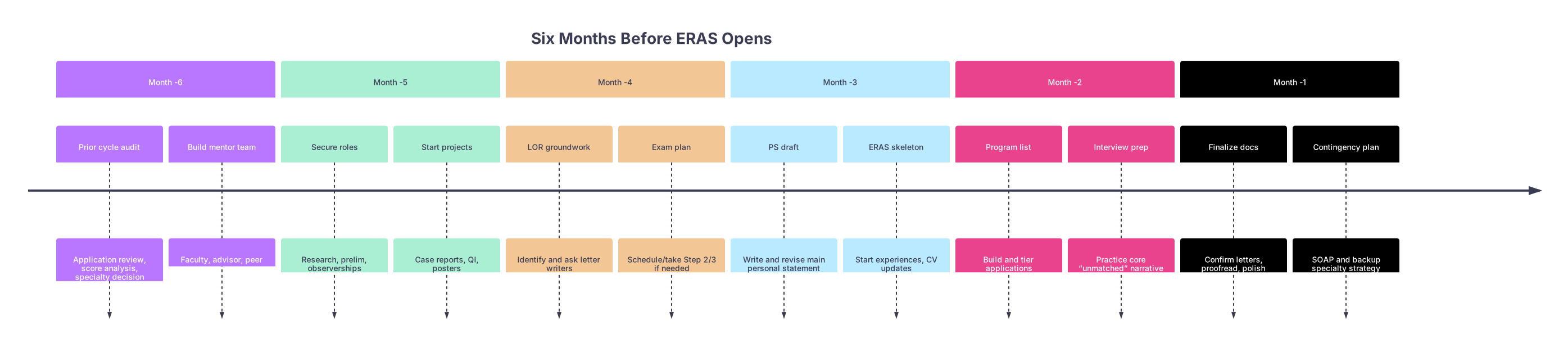
| Period | Event |
|---|---|
| Month -6 - Prior cycle audit | Application review, score analysis, specialty decision |
| Month -6 - Build mentor team | Faculty, advisor, peer |
| Month -5 - Secure roles | Research, prelim, observerships |
| Month -5 - Start projects | Case reports, QI, posters |
| Month -4 - LOR groundwork | Identify and ask letter writers |
| Month -4 - Exam plan | Schedule/take Step 2/3 if needed |
| Month -3 - PS draft | Write and revise main personal statement |
| Month -3 - ERAS skeleton | Start experiences, CV updates |
| Month -2 - Program list | Build and tier applications |
| Month -2 - Interview prep | Practice core “unmatched” narrative |
| Month -1 - Finalize docs | Confirm letters, proofread, polish |
| Month -1 - Contingency plan | SOAP and backup specialty strategy |
You are not starting from zero. You are starting from experience, including a hard one most people will never face. Programs are not allergic to formerly unmatched applicants. They are allergic to applicants who look identical to last year and try to pretend nothing happened.
Your next step today: pull up your last ERAS application and a blank page. Write, in bullet points, the 3–5 most likely reasons you did not match and what you will do in the next six months to counter each one. If you cannot fill that page honestly, that is your signal to book a meeting with a mentor this week.