Should You Record Lectures or Just Use Boards Resources Instead?
Are you sitting in lecture wondering, “Should I bother recording this… or just go home and watch Boards and Beyond / Sketchy / Pathoma instead?”
Here’s the blunt answer: for most modern med students, boards-style resources beat recorded lectures the majority of the time. But not always. And not for everyone.
Let me walk through when recording lectures is smart, when it is a complete waste of time, and how to build a system that does not bury you in 200 hours of unwatched videos by Week 6.
The Core Question: What Actually Moves the Needle?
Stop thinking in terms of “What should I do?” and instead ask, “What actually improves my scores and sanity?”
There are three main buckets of content in preclinical med school:
- School lectures (live or recorded by the school)
- Your own recorded lectures (screen/audio capture you make yourself)
- Boards resources (videos, Qbanks, Anki, etc.)
You don’t have time to go deep on all three. If you try, you will end up doing shallow work on everything and mastering nothing.
Here’s the hierarchy I’ve seen work for most students:
| Priority | Resource Type |
|---|---|
| #1 | Question banks (UWorld, AMBOSS) |
| #2 | High-yield boards videos (B&B, Sketchy, Pathoma) |
| #3 | Targeted school content for testable specifics |
Where do your recorded lectures fit? Usually below all three—unless you use them surgically.
If you’re spending hours recording, organizing, and re-watching full lectures instead of doing board-style questions and high-yield resources, you’re trading A+ value tasks for C- value tasks.
When Recording Lectures Makes Sense
Recording lectures is not automatically dumb. It’s just usually misused.
Recording can be useful if:
- Your exams are heavily lecture-based and not board-aligned
- A specific lecturer is extremely high-yield and moves fast
- You need accommodations or learn better with replay + pausing
- English is not your first language and you benefit from repeating complex explanations
- You use recordings only as targeted backup, not your main study method
So ask yourself:
- Are school exams mostly straight from slides and what the professor says?
- Do they test details that are not in Boards and Beyond/First Aid?
- Do your classmates say “You can’t pass without going through Dr. X’s lectures”?
If yes, some recording (or using the school’s own posted recordings) is justified.
But even then, you don’t need to watch everything at 1x in real time. That’s where people dig a hole they can’t climb out of.
Use recordings for:
- Clarifying 1–2 tricky lectures per week
- Replaying complex physiology/path if the professor explains it better than B&B
- Getting specific testable phrases or emphasis your professor loves
Not for:
- Rewatching every lecture “just in case”
- Making recordings you never watch
- Pretending recording is the same as studying
Why Boards Resources Usually Beat Recorded Lectures
Boards-focused resources exist to compress, distill, and filter. Your school lectures usually do the opposite.
Here’s why relying on boards materials tends to win:
They’re designed backwards from the exam.
USMLE/COMLEX → high-yield concepts → short targeted teaching. Your school might do 2 hours on glycogen storage diseases. Boards resources give you what shows up in questions.They have better integration with Qbanks and Anki.
B&B + UWorld + Anki = clean system. Professor’s stories about a patient from 1998 do not map neatly to anything.They’re standardized.
Your boards resources are not dependent on whether Dr. Smith had coffee that morning. Your lecture quality is.They’re much more time-efficient.
Most students can run boards videos at 1.5–2x, follow along with notes, then reinforce with questions. Two hours of lecture becomes 40–60 minutes of focused, tested content.
Put simply: if your goal is to crush Step/Level and be prepared for shelf exams, you will get more ROI from boards materials than from rewatching lectures.
A Simple Decision Framework: Record vs Boards
Use this framework every block. Not once a year. Every block.
Ask 5 questions:
How board-aligned are my school exams?
- Very aligned → lean hard into boards resources
- Not aligned → mix in more school-specific coverage
Are school recordings automatically provided?
- Yes → don’t make your own unless there’s some niche reason
- No → consider recording only selected lecturers
Do I realistically rewatch recordings I already have?
- No → stop recording. You’re lying to yourself.
- Yes → how many hours/week? Is it crowding out Qbank/boards time?
What’s my main weakness right now?
- Conceptual gaps → boards videos help
- Memorizing professor-specific details → targeted recording/review helps
- Application/analysis → Qbanks help most
How many “content hours” can I truly handle per day?
If you’re in class 6 hours, then “planning” to rewatch those 6 hours plus boards videos and do questions… that schedule is fake. Don’t build fake schedules.
Practical Systems That Actually Work
Let’s make this concrete. Here’s how to combine things without drowning.
System 1: Boards-First, Lectures-Light (most Step-focused)
Best for schools where exams are reasonably board-style and recordings are available.
Daily structure:
- Attend lecture or watch school recording at 1.5–2x for only the trickiest courses OR skip and use syllabus/notes
- Main content learning via:
- Boards and Beyond / Sketchy / Pathoma mapped to your block
- Annotate into a single core resource (e.g., First Aid or a digital notebook)
- Then heavy Qbank time (school-provided, AMBOSS, UWorld)
Use recordings rarely:
- When a prof is notoriously exam-heavy and confusing on slides
- When class gave you 50 “WTF” moments in one topic (e.g., renal phys) and you want their explanation again
System 2: Exams-First, Boards-Integrated (detail-heavy schools)
Best for schools where professors write weirdly specific exams off their own slides.
Daily structure:
- Quickly pass through lecture slides before class or just after (15–20 min max)
- Flag any lectures with:
- Tons of “this will be on your exam” comments
- Unique diagrams, charts, pathways not seen in boards resources
For those flagged lectures:
- Skim recording at 1.5–2x focusing on where the prof stressed details
- Capture bullet points into your own outline or Anki
Then:
- Map each block topic to a boards equivalent (e.g., your renal week → B&B Renal + relevant Sketchy + a Qbank block).
- Do boards content AFTER you’ve covered enough school material to know the basics.
System 3: Targeted Recording for Weak Foundations
If your undergrad background is shaky (e.g., limited biochem, no physiology major), some professors will actually teach foundational concepts better than boards videos for you.
In that case:
- Identify 1–2 “anchor” professors per term whose explanations click
- Intentionally record and rewatch only their sessions at higher speed
- Treat those recordings as your main “textbook,” then layer boards resources on top
But still:
- Don’t record everything
- Don’t commit to rewatching full lectures when you really just needed 15 minutes of a tricky explanation
How to Use Recorded Lectures Without Wasting Time
If you do choose to record or rewatch:
- Always watch at increased speed (1.5–2x) if you can still comprehend.
- Don’t passively sit there. Take actionable notes:
- “Exam tip: Dr. X loves mechanism diagrams”
- “Pathoma different here → add slide detail”
- Set a hard cap: e.g., no more than 3 hours/week of rewatching.
- Use timestamps. If your software allows, star key moments so you can jump back before exams instead of rewatching the whole thing.
If you constantly find yourself with a backlog of 15 “to watch” lectures, that’s your signal: your system is broken. Time to cut.
What Top Students Actually Do (Pattern I Keep Seeing)
Students who end up with strong Step/Level scores and good mental health tend to:
- Use school lectures as a guide to what topics are fair game, not as their only content source
- Lean heavily on boards-style resources to build conceptual frameworks
- Start Qbanks early, even if they feel “not ready yet”
- Use lecture recordings only when there’s a very specific reason (complex concept, exam-specific hints, or missed class)
They do not:
- Record every lecture “just in case”
- Fall into the trap of thinking “watching lectures = studying”
- Spend evening after evening “catching up on lectures” instead of doing active practice
Example: You vs. Two Study Plans
To make this even clearer, here’s a simple comparison.
| Time Block | Lecture-Heavy Student | Boards-Heavy Student |
|---|---|---|
| 8–12 | Live lectures | Live lectures (only for key courses) |
| 1–3 | Rewatch morning lectures at 1x | Boards videos mapped to today’s topics |
| 3–5 | Try to summarize lectures | Qbank blocks + review |
| Evening | “Catch up” on older lectures not yet watched | Light review, Anki, or rest |
Who’s more prepared for boards six months from now? The boards-heavy student. Consistently. I’ve seen this pattern play out for years.
Legal, Ethical, and Practical Notes on Recording
Quick but important:
- Some schools ban personal recording or require explicit permission. Don’t be the person who gets called to the dean’s office.
- Never share recordings outside your class (seriously—many schools treat this as an honor code violation).
- Use reliable tools: built-in Zoom/Teams recording (if given), OneNote audio, Notability, or screen recorders your IT approves.
If recording feels like you’re “getting away with something,” you’re probably doing it wrong or against policy.
How to Decide for Yourself in 10 Minutes
Grab a piece of paper. Answer these in writing:
How many hours/week am I currently spending
- In live lecture?
- Rewatching lectures (school or self-recorded)?
- On boards resources?
- On Qbanks?
What are my next two biggest goals?
- Pass classes?
- Score 240+/250+?
- Have nights/weekends mostly free?
Does my time breakdown actually match those goals?
If you’re spending 80% of study time inside the lecture ecosystem and say you care most about Step/Level, your actions don’t match your priorities.
Then decide:
- One thing I’ll stop: e.g., recording all lectures by default
- One thing I’ll start: e.g., 20 questions/day from AMBOSS
- One thing I’ll keep: e.g., rewatching only physio lectures from Dr. Y at 1.75x
Try that for 2 weeks and adjust.
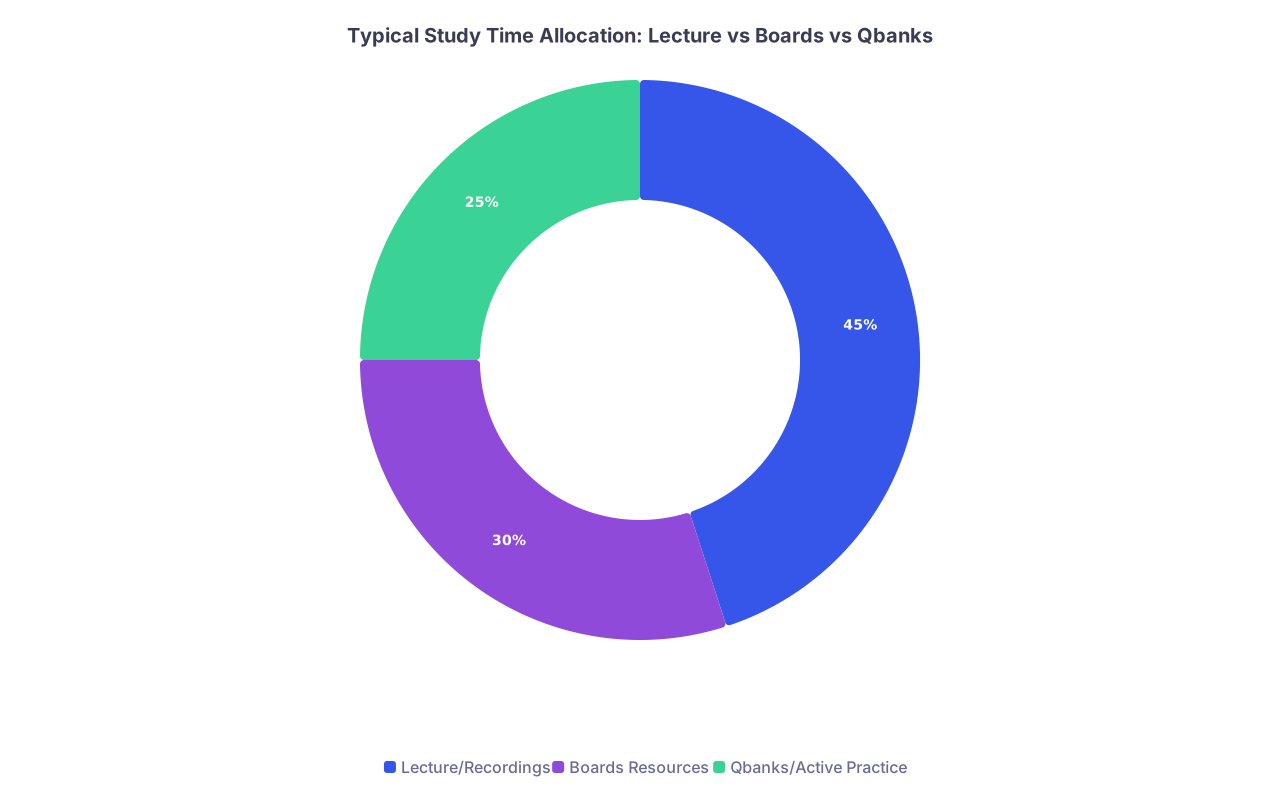
| Category | Value |
|---|---|
| Lecture/Recordings | 45 |
| Boards Resources | 30 |
| Qbanks/Active Practice | 25 |

| Step | Description |
|---|---|
| Step 1 | New Block Starts |
| Step 2 | Use lectures as primary for exam |
| Step 3 | Use boards as primary |
| Step 4 | Targeted rewatch at 1.5-2x |
| Step 5 | High risk of backlog |
| Step 6 | Map block topics to boards videos |
| Step 7 | Start Qbank early |
| Step 8 | Reduce recording to essentials |
| Step 9 | School exams lecture-heavy? |
| Step 10 | Record lectures? |
FAQs
1. If my school already records all lectures, should I still go to class?
Maybe, but not automatically. If being physically present helps you focus and you actually engage, go. If you’re just scrolling on your phone and planning to “rewatch later,” you’re wasting time twice. Many strong students attend selectively: anatomy lab, mandatory sessions, and the 1–2 lecturers who are genuinely excellent, then watch or skip the rest.
2. Can I do only boards resources and skip lectures entirely?
At some schools, yes, and people do. At others, you’ll get destroyed on exams because professors test pet details. The only honest way to know: look at upperclass advice and past exams. If people say, “UWorld + B&B was enough to pass,” you can lean heavily that way. If they say, “Dr. Z tests off her exact slides,” you ignore that at your own risk.
3. Is it okay to have lecture recordings playing in the background while I do Anki?
No. That’s noise, not studying. You’re trying to cheat your brain into thinking you’re multitasking. You’re not. If you’re using recordings, they deserve focused, time-limited attention. Otherwise, drop them and do your cards or questions with intention.
4. What if I feel lost in lecture but boards videos also feel too fast?
That usually means your foundation is weak, not that you need more sources. Pick one primary explainer—either your best professor or a boards series like B&B—and stick with it until topics click. Slow playback speed is fine early on, but you should gradually wean toward more efficient study and then reinforce with lots of questions.
5. How do I stop feeling guilty about not rewatching every recorded lecture?
Reframe the guilt. You’re not “skipping” work; you’re reallocating time to higher-yield work. Set clear priorities (e.g., “Qbank > boards videos > key lecture bits”). When recordings pile up, explicitly delete or ignore them. Make a conscious choice: “I’m choosing to do 40 questions instead of rewatching this 2-hour lecture.” That’s not laziness; that’s strategy.
Key takeaways:
- For most students, boards resources and Qbanks give far better returns than rewatching full lectures.
- Use recorded lectures surgically: only for specific professors, tricky concepts, or exam quirks.
- If your schedule is dominated by lectures and recordings, but your goals are boards and sanity, your plan needs to flip.