

The biggest myth about clinical trials tech is that software engineers will “fix” clinical research if you just give them enough data. They will not. The teams that actually change this space have one thing in common: a physician who understands both the clinic and the code base, and is willing to get uncomfortably close to the business side.
You want to build a physician-led clinical trials technology company after residency. Good. The timing is actually favorable. Sponsors are desperate for better site performance, regulators are forcing electronic systems into every gap, and sites are drowning in fragmented tools that do not talk to each other.
Let me walk you through this in the way I wish someone had done for several physician-founders I have worked with: concept to product, regulatory landmines, business model, team structure, and brutally honest go/no‑go criteria.
1. Start With the Narrowest Possible Problem
If your “idea” is “improve clinical trials” you are not ready. Clinical research is a collection of specific bottlenecks, not a monolith.
You need a problem that is:
- Painful enough that someone is already throwing money or staff time at it
- Narrow enough that you can be clearly better than the status quo
- Concrete enough that you can demonstrate ROI within 3–6 months at a pilot site
Look at where money and time are actually burning:
- Patient recruitment and retention
- Data capture and quality at the site level
- Site-Sponsor communication and monitoring
- Protocol adherence and visit scheduling
- Regulatory and documentation overhead (source, consent, deviations)
Translate that into a pointed problem statement. For example:
- “Phase II oncology trials at community sites are losing 30–40% of randomized patients before primary endpoint due to visit complexity and poor navigation. CRCs are manually calling, texting, printing calendars, and still missing windows.”
- “Cardiology practices with 3–5 concurrent trials are re-entering the same vitals, meds, and labs from the EHR into eSource / EDC systems, burning ~1 FTE in transcription.”
Those are real, solvable problems. Now you can design tech around them.
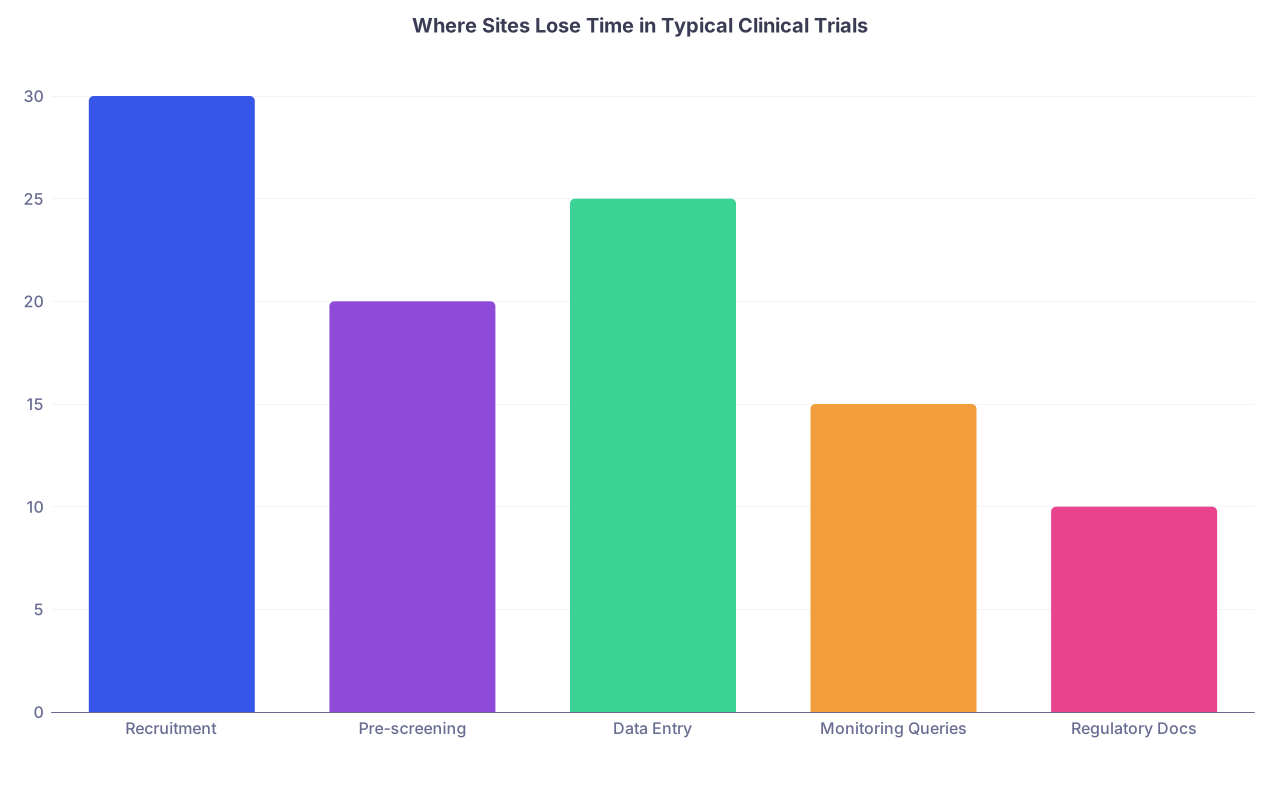
| Category | Value |
|---|---|
| Recruitment | 30 |
| Pre-screening | 20 |
| Data Entry | 25 |
| Monitoring Queries | 15 |
| Regulatory Docs | 10 |
Keep your first wedge specific:
- Specialty: oncology, cardiology, rheumatology, etc.
- Trial type: device vs drug, interventional vs observational
- Site type: academic center vs private practice vs DCT vendor
- Function: recruitment, eSource, scheduling, consent, data quality, etc.
You are not “building a platform” yet. You are building a wedge that earns you the right to expand.
2. Decide What Kind of Clinical Trials Tech Company You Are
“Clinical trials technology” is not one category. It is several, each with different buyers, regulatory burdens, and competition.
At a high level:
| Type | Primary Buyer | Regulatory Burden | Sales Cycle |
|---|---|---|---|
| Site workflow (eSource, CTMS-lite, recruitment tools) | Sites / PI groups | Moderate | Short-Medium |
| Sponsor/CRO tools (EDC, ePRO platforms) | Pharma / CRO | High | Long |
| Patient-facing (eConsent, engagement apps) | Sites / Sponsors | Moderate-High | Medium |
| Data infrastructure (EHR-to-EDC, interoperability) | Sponsors / Networks | High | Long |
| Decentralized trial services & tech | Sponsors / Biotech | High | Long |
As a post-residency physician, you have an advantage in two segments:
- Site-facing workflow and data capture
- Patient-facing engagement and adherence
Why? Because you know, in your bones, where the friction lives: the 45-minute “consent” where the patient signs but understands nothing; the CRC with 20 sticky notes on her screen; the investigator meeting where everyone nods at the protocol but knows half the visit windows are unrealistic.
Let me be blunt:
- Going head‑to‑head with Medidata, Oracle, Veeva on core EDC as your first product is almost always suicidal.
- Building yet another “generic patient engagement app” with no deep integration into visit schedules, endpoints, and real trial workflows is pointless.
Your edge is in designing tools that sit where current systems do not: between the clinic’s messy reality and the sponsor’s rigid data model.
3. Use Your Clinical Insight to Design the Product Core
This is where being a physician actually matters. Your value is not “I know how doctors think” in some abstract way. Your value is that you can encode very messy clinical process into product logic.
You should be writing:
Detailed user stories:
“For a phase II heart failure trial at a community cardiology clinic with one CRC, what exactly happens from referral to randomization? Who clicks what, when?”Concrete workflows:
“Patient misses visit window by 2 days. What does the CRC see? What warning did they get? How is the deviation logged? How is the PI notified? How is the sponsor informed?”“Impossible” corner cases (the ones that break naive products):
Rescue meds, dose holds, pregnancy tests, optional substudies, unscheduled visits, overlapping protocols.
If your first product is, say, a scheduling and visit‑window engine for multi‑visit oncology studies, you should design:
- Protocol model: visits, windows, conditional branches, required vs optional procedures.
- Patient status engine: what visit they are on, what windows are open, what labs are pending.
- Role‑specific interfaces: CRC view, PI oversight view, patient-facing reminders (optional).
This is not generic project management. It is protocol logic. That is exactly where most generic startups fail: they treat a phase III immunology trial like a dentist appointment scheduler.
4. Sequence vs Parallel: How to Build While You Still Work
You are post‑residency. You may have:
- Attending job with some flexible time
- Academic appointment with research exposure
- Loans that will not magically hold themselves
You do not need to jump off a cliff on day 1. But you do need ruthless structure.
A practical path I have seen work:
Phase 1 – Problem and prototype (6–9 months, part-time)
- Lock in one–two specific high-value problems at actual sites you have access to.
- Shadow CRCs, research nurses, and PIs for full days. Not half an hour. Full days.
- Map every step of the workflow you are trying to fix.
- Wireframe or build a clickable prototype (Figma, basic web mockups).
- Get 5–10 real users to click through and critique it brutally.
- Decide your technical co-founder / build strategy.
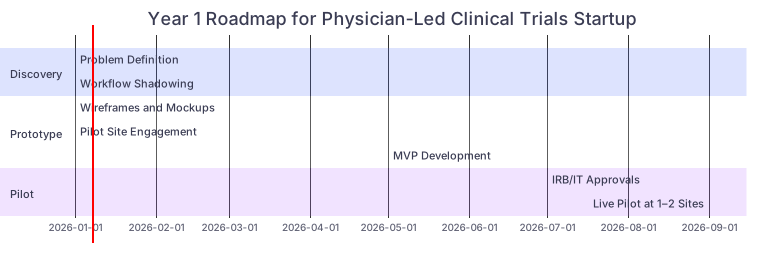
| Task | Details |
|---|---|
| Discovery: Problem Definition | a1, 2026-01, 2m |
| Discovery: Workflow Shadowing | a2, 2026-01, 3m |
| Prototype: Wireframes and Mockups | a3, after a1, 2m |
| Prototype: Pilot Site Engagement | a4, after a2, 2m |
| Prototype: MVP Development | a5, 2026-05, 4m |
| Pilot: IRB/IT Approvals | a6, 2026-07, 2m |
| Pilot: Live Pilot at 1–2 Sites | a7, 2026-09, 3m |
Phase 2 – MVP and pilot (6–12 months, mixed time)
Once you have a technical path:
- Build the minimum set of features needed to run a live workflow in one trial at one site.
- Secure letters of intent (LOIs) or pilot agreements from 1–3 trusted PIs or site networks.
- Negotiate limited-scope pilots: 1 protocol, 1 site, clearly defined metrics.
- Get through the approvals gauntlet (more on that later).
This is the phase where you start pulling back clinically. Go 0.5–0.8 FTE if you can. If not, you risk burning both the company and yourself.
Phase 3 – Data and decision (6 months)
At the end of 1–2 pilots, you should have hard numbers:
- Time saved per patient / per visit
- Reduction in deviations, missed visits, or recruitment bottlenecks
- Revenue impact (more screen‑fails prevented, more visits completed)
If you cannot show quantifiable improvement on something that matters to your buyer, raise a red flag. You may have built something “nice” instead of something essential.
5. Regulatory, Privacy, and Compliance: Do Not Hand-Wave This
You are playing in a regulated sandbox whether you like it or not. But do not let this scare you out of building. Understand the buckets.
Are you a medical device (SaMD) or not?
If your software:
- Just organizes workflow (visits, tasks, documents)
- Helps capture data that is already clinically ordered
- Provides visibility and tracking but not treatment decisions
Then you are likely not a medical device in most jurisdictions.
If your software:
- Provides trial- or patient-specific treatment recommendations
- Interprets signals and changes dosing
- Automates eligibility decisions using algorithms
You might cross into Software as a Medical Device (SaMD) territory. That is a different game: IEC 62304, 21 CFR Part 820, potentially 510(k) or de novo processes. Some companies go there. Most first-timers should not.
Be ruthless: strip out any “decision support” language in your V1 marketing deck. Stay on the right side of “workflow support” versus “clinical decision-making” until you have the resources to do SaMD correctly.
Data protection: HIPAA, GDPR, and friends
You will likely be a Business Associate under HIPAA if:
- You handle PHI on behalf of covered entities (sites, hospitals).
This means:
- BAAs with each covered entity
- Strong access controls, encryption in transit and at rest
- Proper audit logging and incident response plan
If you ever touch EU data (or UK data):
- GDPR / UK GDPR comes into play
- You need a lawful basis (usually “public interest in the area of public health” or “scientific research”), a DPA, and likely a DPO role at some stage
Design your architecture with data minimization:
- Store only what you must
- Pseudonymize where possible (use study IDs instead of MRNs)
- Isolate PHI-heavy modules from analytics modules via clear interfaces
Trial-specific regulations
You will hear about:
- 21 CFR Part 11 (electronic records and signatures)
- ICH GCP E6 and E8
- EMA/ICH eSource guidance
For a physician-founder, here is the distilled version:
- If your tool is capturing data that will go into the trial record or EDC, you need:
- User authentication and role management
- Date/time stamps and audit trails for changes
- Validation that the system does what it claims (IQ/OQ/PQ style, even if lightweight at first)
You do not need a 200-page SOP binder on day 1, but you do need:
- A written validation / testing plan and report for each release
- Version control and documented change management
- SOPs for user account management, incident reporting, and backup/restore
Skipping this will kill you in two ways:
- Sponsors / CROs will not touch you.
- Auditors will make your pilot site shut the system off mid-study.
6. Selling into Clinical Research: Who Pays You and Why
Physicians routinely underestimate how messy the buyer landscape is here. You must be explicit about who writes checks and what budget line you tap.
Your main options:
Site-paid model
- Customers: private practice sites, SMOs, academic sites with discretionary funds
- Value props: staff time saved, ability to take on more trials, fewer deviations
- Pros: shorter sales cycles, clear pain at the front lines
- Cons: small budgets, fragmented, price sensitivity, need many customers
Sponsor-paid model
- Customers: pharma/biotech clinical operations, innovation teams, digital teams
- Value props: faster enrollment, fewer amendments or deviations, higher data quality
- Pros: large budgets, big contract sizes
- Cons: 12–24 month sales cycles, procurement hell, heavy validation and security requirements
Hybrid / pass-through models
- Sponsor pays per‑patient or per‑site license as part of the trial budget; you implement at sites
- Often run in partnership with a CRO or network of sites
For a first‑time physician founder, starting site-first often makes more sense:
- You can get 10 sites to pay you $10–50k/year faster than one Big Pharma to cut you a $500k check.
- The feedback loop is tighter. CRCs and PIs will tell you the truth in a way sponsor procurement never will.
Your pricing should reflect clear ROI, not wishful thinking.
If your tool saves each CRC 10 hours/month, and their fully loaded cost is ~$60–80/hour, that is roughly $7–10k/year of value per CRC. If you can show increased randomizations or retained patients, the numbers jump much higher.
Very rough benchmark:
- Simple SaaS workflow tools for small sites: $500–$2,000 per month per site
- More critical infrastructure or specialized tools: $2,000–$8,000 per month per site, or per‑study pricing
- Sponsor-side per‑patient fees: $100–$1,500 per patient, depending on impact
Do not underprice just to “get in the door.” Underpricing makes procurement suspicious and locks you into weak positioning (“nice to have toy”) instead of “critical infrastructure.”
7. Building the Team: Where the Physician Actually Fits
Read this twice: you are not the CEO just because you have MD after your name. You can be. But you need to earn it with skills, not credentials.
Core early team roles:
- Product / domain lead – often the physician founder
- Technical lead – experienced software engineer or CTO
- Implementation / ops – someone who knows how to launch and support at sites
- (Later) Sales / BD – someone who can run a proper sales process
Your role as physician-founder should cover:
Domain authority
- You own the mapping from messy clinical workflows to product requirements.
- You police clinical nuance that non-clinicians will happily bulldoze for “simplicity.”
Product judgment
- You decide which features reflect meaningful clinical outcomes versus vanity.
- You write or review the first dozen PRDs, user flows, and edge case documents.
Relationships and credibility
- You get the first few sites to take a risk on you.
- You present at investigator meetings, site network gatherings, specialty society sections.
If you also want to be CEO, then you need to grow into:
- Fundraising: pitching angels/VCs, owning the deck, keeping a board.
- Hiring and firing: building a cross-functional team, not just other physicians.
- Go‑to‑market strategy: deciding which segment to pursue and when.
I have seen successful patterns where:
- Physician-founder is CEO from day 1, but consciously upskills on business with a strong COO/CTO partner.
- Physician-founder is CPO (Chief Product Officer) and brings in a non-MD CEO with proven startup execution chops.
The bad pattern is obvious: physician-founder insists on CEO title but refuses to learn business basics, and the company dies under the weight of “vision” with no execution.
8. Funding Reality: Angels, Non-Dilutive, and When to Talk to VCs
Clinical trials tech sits in a strange middle ground:
- It is too niche and regulated for many generic SaaS angels.
- It is not as “sexy” as AI diagnostics.
- But when it works, it has strong, sticky B2B revenue and real defensibility.
Sequence that actually works:
Step 1 – Grants and non‑dilutive
If you are in the US:
- SBIR/STTR (NIH) mechanisms exist specifically for clinical research innovation.
- Some disease foundations (e.g., oncology, rare disease) fund better trial infrastructure.
If you are academic-affiliated:
- Internal translational grants, digital health innovation funds, etc.
Do not build your entire plan around grants. But a $150–300k Phase I SBIR can easily fund your MVP and first pilot.
Step 2 – Angels and physician networks
Your first $250–750k is likely from:
- Physician angels who have personally suffered through bad trials
- Local angel networks
- High‑net‑worth individuals in healthcare
They care less about 10x fantasies and more about “does this obviously need to exist, and are you the right person to build it.”
Come prepared with:
- Domain-specific clarity
- First LOIs or pilot agreements
- Credible technical plan
Step 3 – Seed VC (if it fits)
You talk to institutional seed investors after:
- You have pilots completed or strongly underway
- You have initial revenue or clear signed contracts
- You can articulate a wedge → platform story
Sample wedge → platform narrative:
- Wedge: protocol-accurate scheduling and visit management for oncology community sites.
- Next: add recruitment, screening, and consent tools for same sites.
- Platform: the operating system for “community oncology as trial sites,” then other specialties.
If your idea does not have a plausible path from niche to broader platform over 5–7 years, venture capital might not be the right fit. That is fine. You can build a profitable, smaller company with less dilution.
9. Integration with EHRs and Existing Systems: The Painful Truth
Everyone loves saying “we integrate with Epic and Cerner.” Most of them are exaggerating at best.
You have three main integration realities:
Zero integration (V1)
- User manually enters or copies data
- You focus on workflow, scheduling, reminders, and documentation
- Fastest to market, lowest IT friction
Light integration
- Use FHIR APIs where available to pull demographics, meds, labs
- Single sign-on (SSO) with hospital identity systems
- Possibly embed your app within EHR via SMART on FHIR
Deep integration
- Bidirectional data exchange with EHR and EDC
- Automated cohort discovery, screening lists
- Complex security and IT review, often months of work
For an early-stage trials tech startup, the sane progression is:
- Prove value with minimal or zero integration first.
- Use value (measurable site time saved, better trial performance) to justify deeper integrations later.
You, as the physician-founder, will need to mediate constant tension:
- Engineers want elegant, fully integrated systems.
- Sites want something they can get approved and use this year.
- Sponsors want data reliability and performance.
Favor “ugly but used” over “elegant and blocked by IT for 18 months.”
10. Avoiding the Classic Physician-Founder Traps
Let me just list them, because I see the same mistakes on loop.
The “Platform from day 1” delusion
You promise eSource, CTMS, eConsent, recruitment, and AI predictive analytics in your first deck. No you won’t. Pick one.Designing for the academic ivory tower
You build for the quaternary center with 20 CRCs and a dedicated IT integration team. Then realize 80% of trials happen in understaffed community sites.Ignoring actual budgets
You build something that “clinically makes sense” but sits in a budgetary no-man’s‑land. Site cannot pay. Sponsor does not see direct value. CRO is indifferent.Overcomplicating regulatory posture
You label yourself “decision support AI” in marketing because it sounds sexy, then trigger SaMD scrutiny you are not ready for. Resist ego. Stay safe.Underestimating implementation
You think software deployment is clicking “deploy” on AWS. On the ground, implementation is:- Creating training materials
- Holding lunch-and-learns with skeptical staff
- Sitting in on the first 10 patient visits to debug your own product
If you will not do this, you should not build in this space.
Refusing to leave medicine mentally
You keep one foot in five different worlds: full-time clinic, some research, startup on nights/weekends. That is not a company. That is a hobby.
At some point you have to commit: this is your primary professional focus.
11. Concrete Example: A Physician-Led Trials Tech Wedge That Actually Works
To make this less abstract, let me sketch a realistic path I have seen variations of.
Scenario:
- You are a heme/onc fellow finishing training at a large academic center, moving to a hybrid academic/community role.
- You have watched community sites constantly miss accrual targets on complex immunotherapy trials.
You define the wedge:
- Product: protocol-aware visit and task management tool focused on IO trials at community sites, with patient messaging and CRC workflow.
- Users: CRCs and PIs; patients optionally via SMS/web.
Pilot plan:
- One community oncology practice, 3 IO trials, 2 CRCs.
- Your tool manages:
- Eligibility checklist at screening
- Visit window tracking
- Labs, imaging, and concomitant med checks
- Automated reminders to CRC when windows are at risk
- Optional SMS reminders to patients
Metrics:
- Baseline: number of missed visits, out-of-window visits, unplanned deviations over last 2 trials.
- Intervention: same metrics on new IO protocol using your tool.
You implement:
- Cloud-based web app, no EHR integration at V1.
- BAAs, simple validation plan, documented procedures.
- Weekly office hours with CRCs for first 2 months.
Six months later:
- Out-of-window visits drop from 18% to 5%.
- Screened-to-randomized ratio improves modestly because eligibility logic is enforced.
- CRCs report saving ~3–4 hours/week per trial.
You turn that into:
- Case study deck.
- Sponsor-facing narrative: “Our sites using [product] hit your recruitment and protocol adherence targets more reliably.”
Now you have something real. Something fundable. Something you can extend:
- Add recruitment prescreening module.
- Expand from IO to broader oncology.
- Go from site-paid to sponsor-subsidized model.
That is how you build an actual company, not just a pitch.
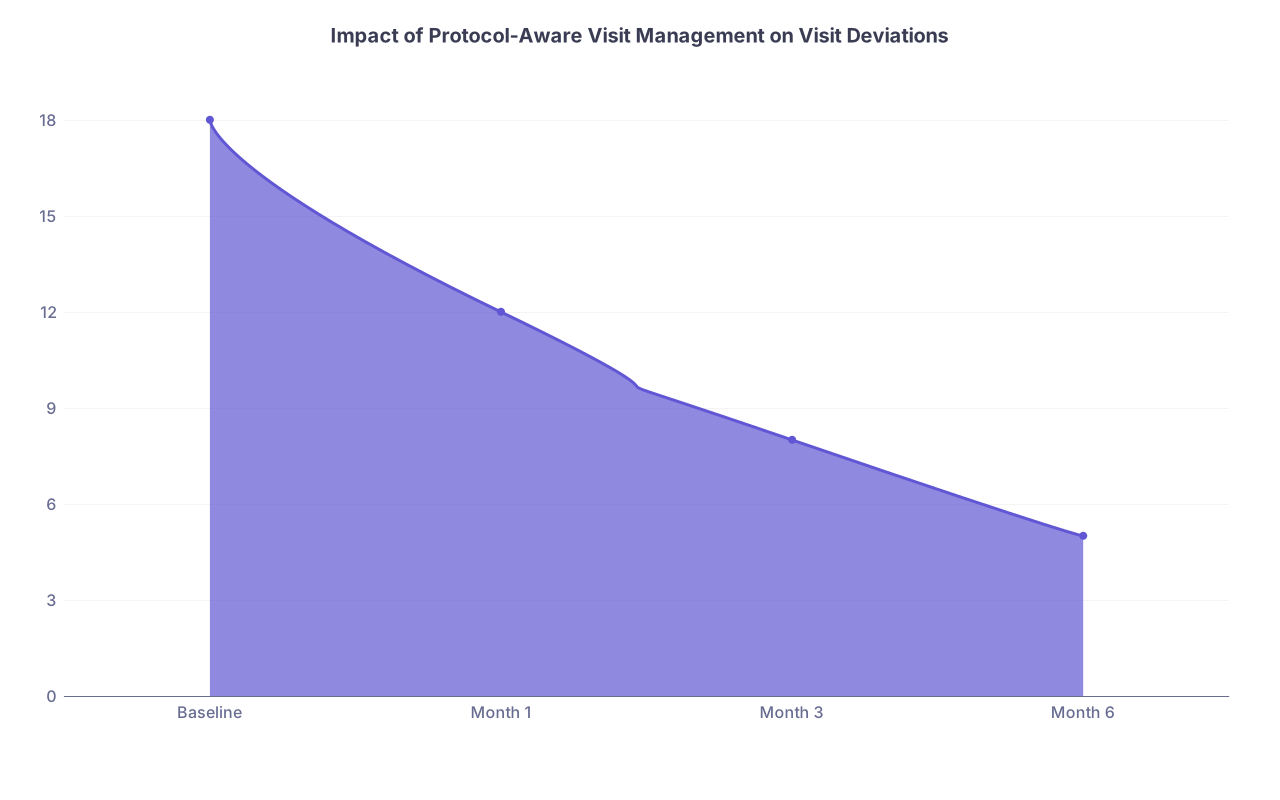
| Category | Value |
|---|---|
| Baseline | 18 |
| Month 1 | 12 |
| Month 3 | 8 |
| Month 6 | 5 |
12. When You Should Not Do This
You probably expect endless encouragement here. I will not do that.
You should not try to build a clinical trials tech company if:
- You are fundamentally uninterested in the business part. You hate pricing, contracts, HR, and talking to non-clinicians. That is most of the job.
- You want a lifestyle job with predictable hours and low stress. Startups are the opposite.
- You are building this purely because you “don’t like clinic.” Disliking clinic is not a vision.
- You are unwilling to move off the clinical fast track (tenure, partnership) for several years.
On the other hand, you probably should seriously consider it if:
- You have already been the unofficial “fixer” in research projects and enjoy the process part more than the clinical note-writing.
- You get more satisfaction from making a system work for 1,000 patients than from being the hero for one patient.
- You are willing to be very wrong, publicly, and iterate.

13. Practical Next Steps in the Next 90 Days
If you want this to be real, give yourself a 90-day sprint with very concrete outputs.
By day 90, you should have:
A one-page problem statement that names:
- Specific specialty, setting, and trial type
- Exact users (CRC, PI, patient)
- Current workflow steps with time estimates and pain points
Three to five 45–60 minute calls or in-person sessions with:
- CRCs at two different institutions
- One sponsor-side person (clinical ops, medical monitor, or CRA) if you can reach them
Wireframes or a basic clickable prototype of:
- The main user journey you are targeting (e.g., from screening to Visit 3)
At least one PI or site leader who says:
- “If you build this and get it through our IT/IRB, we will pilot it on this trial.”

If you cannot get those four things in 90 days while still working clinically, you have a signal. Either the problem is not acute enough, your approach is off, or your access to the ecosystem is weaker than you thought. Better to learn that now.
If you can, then you are not “thinking about a startup” anymore. You are running one.

Key Takeaways
- Successful physician-led clinical trials tech companies start with a brutal, narrow problem at the site or patient level, not with a vague “platform” vision.
- Your clinical edge is in encoding messy protocol and workflow nuance into product logic, then proving measurable ROI at real sites under real trials.
- Treat regulatory, data protection, and implementation as core product constraints, not afterthoughts, and be honest about whether you are willing to do the non-glamorous business work that actually builds a company.


