

The most dangerous time to start a company is “when things finally calm down.”
You are finishing fellowship, lining up a job offer, maybe already signed. The default path will eat the next decade of your life if you are not brutally deliberate in the next 24 months. This is your transition window. You either use it with precision, or you wake up as a permanently “entrepreneurial” section chief who never built anything.
I am going to walk you month‑by‑month through a 24‑month path from fellow to founder. Not theoretical. This is what actually works for physicians who want to move from clinical employment to a real medical startup without blowing up their career or their finances.
High‑Level 24‑Month Map
At this point, you need to see the full arc before we zoom in.
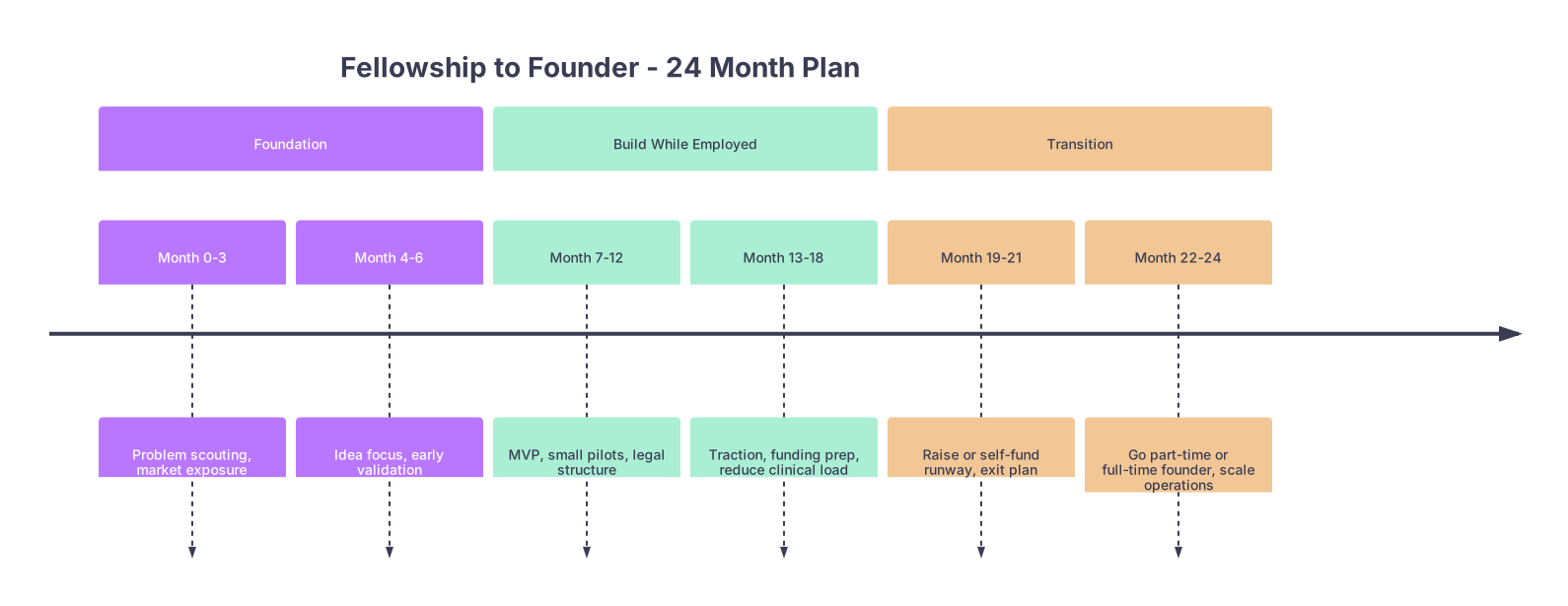
| Period | Event |
|---|---|
| Foundation - Month 0-3 | Problem scouting, market exposure |
| Foundation - Month 4-6 | Idea focus, early validation |
| Build While Employed - Month 7-12 | MVP, small pilots, legal structure |
| Build While Employed - Month 13-18 | Traction, funding prep, reduce clinical load |
| Transition - Month 19-21 | Raise or self-fund runway, exit plan |
| Transition - Month 22-24 | Go part-time or full-time founder, scale operations |
Keep that structure in mind. Now we go quarter by quarter, then month by month.
Months 0–3: Finish Training, Scout Problems, Protect Options
You are still in fellowship or just exiting. At this point you should stop fantasizing about “ideas” and start cataloging problems.
Month 0: Reality check and constraints
At this point you should:
- Write down your hard constraints:
- Minimum monthly living cost (no fluff).
- Debt obligations and when they hit.
- Contractual obligations from any signed job offers.
- Decide your risk envelope:
- Are you willing to delay attending‑level income for 12–18 months later?
- How much of your own cash will you put at risk? Put a number on it.
Get concrete. I have seen fellows who thought they were “all in” balk at a $15k legal bill. Do not pretend you are a founder if you are not willing to spend more than you do on a vacation.
Months 1–2: Structured problem scouting
During this window, your clinical time is a goldmine of insight. Do not waste it.
At this point you should:
- Keep a “friction log”:
- Every shift, write down 3–5 things that are inefficient, dangerous, or obviously stupid.
- Force yourself to differentiate: workflow problem, data problem, access problem, reimbursement problem.
- Talk to 10–15 people per month outside your own narrow lane:
- Nurses, front desk, coders, care managers.
- Ask one question: “What is the most broken part of your day that no one is fixing?”
- Tag every problem you log with:
- Stakeholder harmed (patient / clinician / admin / payer).
- Frequency (daily / weekly / rare).
- Economic signal (does it currently cost anyone money?).
By the end of Month 2 you should have a list of 30–50 specific problems with tags. If you do not, you are not paying attention.
Month 3: Narrow to 2–3 serious problem spaces
At this point you should stop hoarding problems and start focusing.
- Pick 2–3 problem spaces that meet all of these:
- Frequent.
- Painful.
- Someone with a budget cares.
- For each, sketch a rough “who pays” hypothesis:
- Hospital? Health system? Self‑insured employer? Payer? Patient out‑of‑pocket?
You are not choosing your company yet. You are choosing which rooms to stay in long enough to see clearly.
Months 4–6: Commit to a Direction, Validate Hard, Design the MVP
Now you move from “I notice problems” to “I might solve this one.”
Month 4: Deep market interviews
At this point you should run actual customer discovery. Not hallway chats.
Aim for 20–30 structured interviews this month, focused on your 2–3 problem spaces.
For each conversation:
- Ask:
- “Walk me through the last time this problem happened.”
- “What did it cost you—in time, dollars, or risk?”
- “What have you already tried to fix it?”
- Listen for:
- Repeated phrases: “We just work around it,” “We cannot get IT resources,” “Compliance shot it down.”
- Decision‑makers: who actually says yes to buying things?
Document everything. Names, titles, exact language.
Month 5: Choose one problem and define a testable solution
By now patterns should be obvious. At this point you should:
- Pick one problem space to pursue.
- Write a 1‑page problem‑solution narrative:
- Who has the problem?
- What do they do today?
- What your solution does differently (in plain English).
- Why it is viable now (regulatory, tech, reimbursement tailwinds).
Then, define your Minimum Viable Product (MVP):
- If software/data:
- Define the one narrow workflow you will improve.
- Define minimum integrations (if you say “we integrate with every EHR” at this stage, you are already lost).
- If device:
- Define what must exist for a clinician to safely use a prototype.
- If service model (e.g., virtual clinic):
- Define your smallest end‑to‑end workflow from patient intake to payment.
Month 6: First pre‑selling attempts
This is where most physician “startups” die quietly. They build before they sell.
At this point you should:
- Go back to at least 5–10 of your best interviewees and pitch the proposed solution:
- Not slides. A 5–10 minute verbal walkthrough or simple mockups.
- Try to secure one of the following:
- A letter of intent (LOI) for a pilot.
- A signed email from a decision‑maker committing to run a pilot if you build X.
- A paid pilot agreement draft, even if not yet signed.
If nobody is willing to put anything in writing, you do not have a company yet. You have a hobby. Either refine the problem or choose a different one.
Months 7–12: Build While Employed, Form the Company, Run a Real Pilot
This is the “double life” phase: you are an attending by day, founder by night. Intense, but doable if you plan it instead of winging it.
Legal / structural setup (Month 7–8)
At this point you should:
- Form an entity (usually a Delaware C‑Corp if you want venture funding later):
- Get a competent startup attorney, not your cousin.
- Deal with your employment contracts:
- Review non‑compete and IP clauses.
- If you are building in the same general clinical area, get clarity on IP ownership before you write any code or create protocols on hospital time.
- Decide founder equity and roles:
- If you bring in a technical co‑founder, do vesting over 4 years with a 1‑year cliff. No exceptions.
| Role Mix | Founder MD | Technical Co-founder | Third Partner |
|---|---|---|---|
| MD + single technical partner | 60% | 40% | — |
| MD + tech + operations | 45% | 35% | 20% |
| MD w/ strong tech contractor | 80% | 0% (pay cash/equity) | 20% advisor |
These are starting points, not gospel. But if you are giving away 50% to a dev shop, you are getting taken.
MVP build and early design (Months 7–9)
At this point you should:
- Convert your MVP definition into a ruthless scope:
- One core workflow.
- One primary user type.
- One environment for first deployment.
- Choose build strategy:
- No‑code/low‑code for v0 if it gets you to revenue faster (Airtable, Retool, Bubble, etc.).
- Custom dev only where you need performance, integrations, or IP.
Time block your life:
- 0.5 day per week for founder work on clinic days (early morning / evening).
- 1 full day per week fully protected (negotiate this up front with your group if you can).
Pilot readiness (Months 9–10)
At this point you should lock a real pilot.
Steps:
- Finalize pilot design with one site:
- Duration (e.g., 8–12 weeks).
- Success metrics (time saved, revenue captured, reduced no‑shows, etc.).
- Access requirements (EHR access, device placement, etc.).
- Clarify risk/IT/compliance:
- If handling PHI, make sure you have:
- BAA in place.
- Basic security controls documented.
- Clear data retention and access policy.
- If handling PHI, make sure you have:
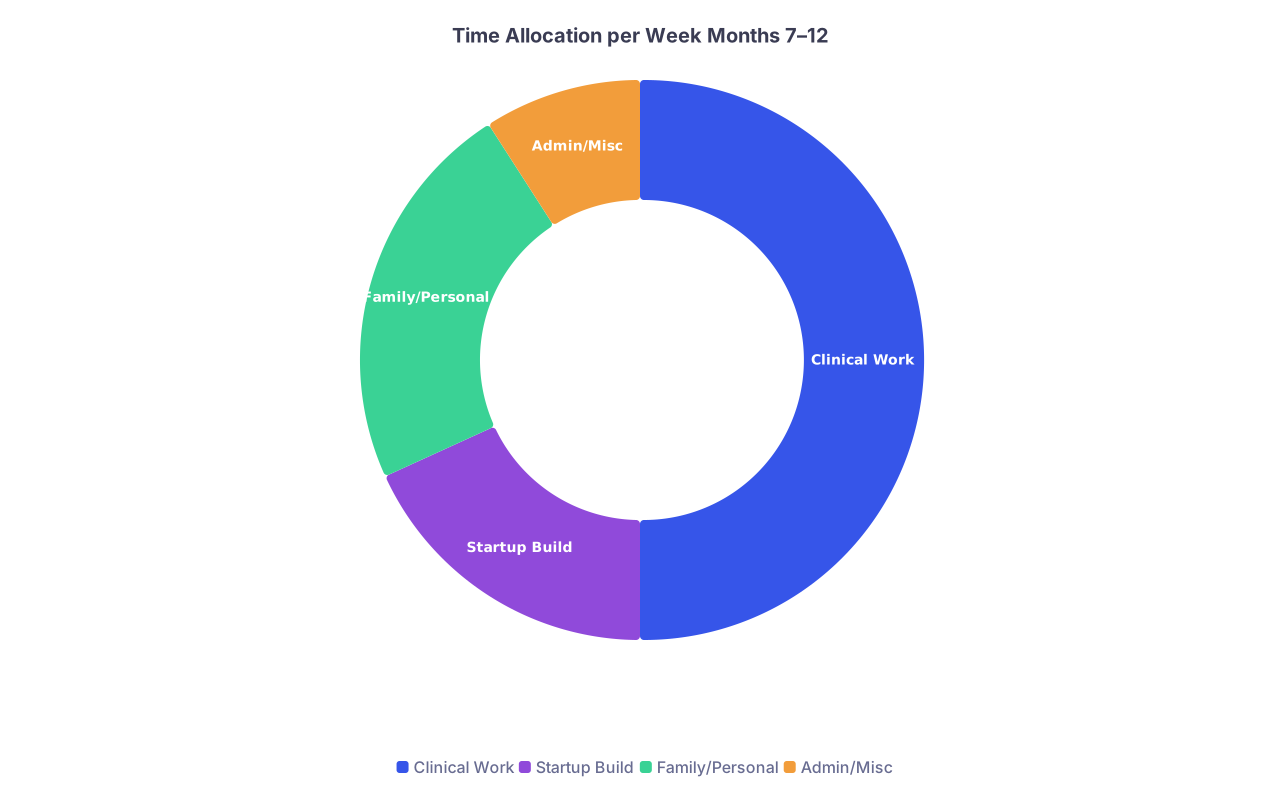
| Category | Value |
|---|---|
| Clinical Work | 55 |
| Startup Build | 20 |
| Family/Personal | 25 |
| Admin/Misc | 10 |
These numbers are typical for an ambitious attending‑founder. If your startup slice is under 10 hours/week, your 24‑month plan quietly turns into 60 months.
Run the first pilot (Months 11–12)
At this point you should:
- Deploy the MVP to the pilot site.
- Be physically present (or tightly engaged) for the first week:
- Sit with users.
- Watch exactly where they get stuck.
- Capture objections.
Collect data:
- Quantitative:
- Baseline vs post‑implementation metrics.
- Qualitative:
- “What is annoying?”
- “What is surprisingly helpful?”
End Month 12 with:
- One of:
- A paying customer (pilot converts to paid contract).
- Or strong pilot outcomes and explicit interest from 2–3 more sites.
If the pilot fails, that is not fatal. Pretending it succeeded is.
Months 13–18: Traction, Funding Prep, and De‑Risking the Leap
You are now in the gray zone: enough progress to be dangerous, but not enough to quit blindly.
Months 13–14: Tighten value proposition and pricing
At this point you should:
- Analyze pilot results in concrete economic terms:
- “We reduced no‑shows by 25%, equivalent to $X per month per site.”
- “We cut chart completion time by 15 minutes per clinician per day.”
- Turn that into simple pricing:
- Per provider per month.
- Per site per month.
- Or clear ROI‑anchored pricing (“we capture 10% of reclaimed revenue”).
You must know, by now, how you will charge. If your pricing deck still says “TBD,” you are not ready for anything.
Months 15–16: Line up more customers and warm investors
At this point you should:
- Convert your best pilot to a paying customer.
- Sign 2–5 more as:
- Paying pilots, or
- LOIs contingent on features you are already planning.
Start investor conversations before you quit:
- Target the right type for your stage:
- Angel physicians.
- Healthcare angels.
- Pre‑seed funds that already have portfolio companies in your domain.
Your goal in this period:
- Build a list of 30–40 potential investors.
- Actually meet 10–15 of them.
- Hear their objections while you still have a paycheck.
Month 17: Decide your runway strategy
At this point you should choose between three paths:
- Self‑fund + part‑time clinical
- Angel/pre‑seed funded + reduced clinical
- Full‑time founder with minimal locums
Do the math:
- Personal runway = savings + committed income (spouse, part‑time work) – monthly burn.
- Company runway = cash in bank + realistic revenue – company burn.

| Category | Value |
|---|---|
| Self-Funded + PT Clinical | 18 |
| Small Angel Round | 24 |
| No Funding, Full-Time Founder | 6 |
If your personal runway is under 9–12 months, you have no business burning bridges yet.
Month 18: Formalize your transition plan with your employer
This is where many people screw it up emotionally. Do not blindside your group.
At this point you should:
- Decide exact timeline to reduce hours or leave (3–6 months notice is reasonable).
- Have a clear story:
- “I am building X, we have Y pilots/customers, my plan is to shift to Z clinical load over 6 months.”
- Negotiate:
- Part‑time role.
- Locums flexibility.
- Or a clean exit with a defined end date.
Document everything. Friendly conversations fade quickly when schedules and RVUs are on the line.
Months 19–21: Raise or Lock Runway, Build the Team, Formalize the Leap
This is where you stop playing startup and actually become a founder.
Month 19: Close initial funding or secure 12+ months of personal runway
At this point you should:
- If raising:
- Convert warm investor conversations into real commitments.
- Be explicit: “We are raising $X on a SAFE at $Y valuation, to fund Z months of runway and these 3 milestones.”
- If not raising:
- Lock in:
- Part‑time clinical schedule.
- Budget for the company for the next 12 months.
- Lock in:
Raise only enough to hit the next clear milestone (e.g., 10 paying sites, FDA submission, etc.). Anything else just dilutes you and adds pressure.
Month 20: First key hires
At this point you should not be the only one doing everything.
Prioritize:
- If product heavy:
- Dedicated engineer or product lead (not a random freelancer).
- If sales heavy:
- Someone who can own outbound, demos, and follow‑ups.
You keep:
- Clinical credibility.
- Product direction.
- Key relationships.
Other people can schedule demos and push code.
Month 21: Operationalize the new version of your life
At this point you should:
- Lock your weekly schedule:
- Clinical days.
- Startup days.
- Non‑negotiable rest/family time.
- Put in place basic company operations:
- Payroll and accounting.
- Cap table tracked (Carta, Pulley, or even a structured spreadsheet initially).
- Monthly metrics review (MRR, churn, active users, sales pipeline).
You are not just “trying something.” You are running a business now. Act like it.
Months 22–24: Execute the Transition to Founder, Scale What Works
This is the tipping point. You either become a founder with a side clinic, or a clinician with a side project. You cannot be both forever.
Month 22: Drop to target clinical load
At this point you should:
- Move to the clinical load you planned in Month 18–19:
- Common patterns:
- 0.2–0.4 FTE clinical.
- 1 week/month inpatient blocks.
- Pure locums with intentional gaps.
- Common patterns:
- Communicate clearly with everyone:
- Patients (if continuity matters).
- Partners.
- Family.
If you do not follow through here, the rest of the plan is fiction.
Month 23: Double down on sales/implementation
With real time freed, at this point you should:
- Spend at least 50% of your work hours on:
- Talking to customers.
- Closing deals.
- Overseeing deployments.
- The rest on:
- Product decisions.
- Team leadership.
- Capital planning.
Think in weekly sprints:
- Each week:
- 1–2 key customer outcomes (demo, contract, go‑live).
- 1–2 key product outcomes (bug fixes, new feature for retention).
- 1 internal process improved (onboarding, metrics, etc.).

Month 24: Reassess honestly and commit to a path
At this point you should run a brutal 24‑month retrospective.
Look at:
- Customers:
- Paying sites / users.
- Renewals vs churn.
- Net promoter type feedback.
- Financials:
- Monthly recurring revenue.
- Burn rate.
- Runway remaining.
- Personal:
- How sustainable is your current life?
- Are you energized or dreading founder days?
Decide among three paths:
Scale up commitment
- Metrics trending up, real revenue, clear demand.
- Drop clinical to minimal levels. Focus full‑time on the startup.
Maintain hybrid honestly
- Some traction, but not enough to bet everything.
- Keep a steady 0.4–0.6 FTE clinical and treat startup as a long‑term build, not a rocket ship.
Shut down or pivot hard
- Weak traction, tepid customer interest, no credible path to meaningful scale.
- Shut it down cleanly or pivot to a clearly better problem, using what you have learned.
Pretending is the only wrong answer here.
Visualizing the 24‑Month Focus Shift

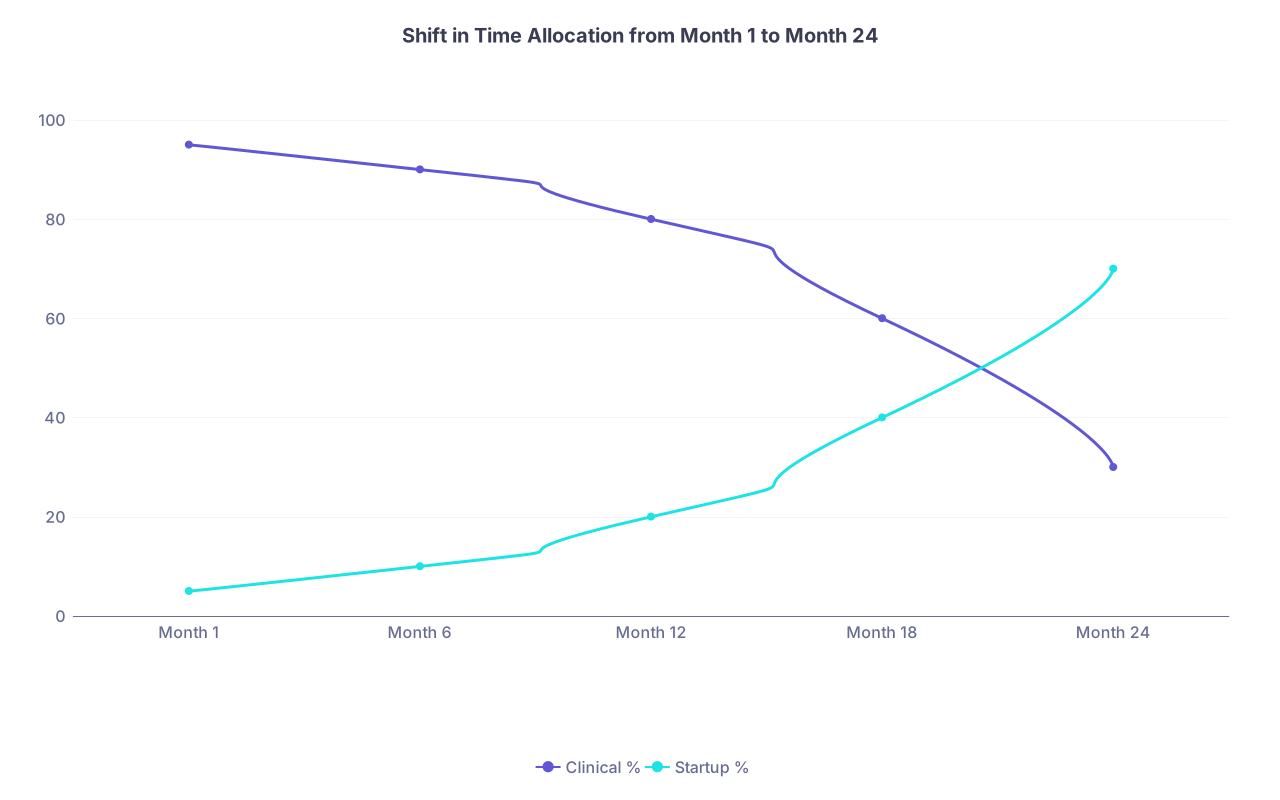
| Category | Clinical % | Startup % |
|---|---|---|
| Month 1 | 95 | 5 |
| Month 6 | 90 | 10 |
| Month 12 | 80 | 20 |
| Month 18 | 60 | 40 |
| Month 24 | 30 | 70 |
The point is not the exact percentages. The point is directionality. If your startup commitment line is not clearly rising over these 24 months, you are not transitioning. You are just adding more work.
Condensed Checklist by Phase
Use this as a quick audit against your own timeline.
Months 0–6: Foundation and Validation
At this point you should have:
- A written list of 30–50 real problems from your own training environment.
- 20–30 structured interviews with stakeholders.
- One chosen problem space with clear economic buyer.
- A defined MVP and at least a couple of serious pre‑commitments (emails, LOIs) to pilot.
Months 7–12: Build + First Pilot
At this point you should have:
- A formal company entity and clean IP situation.
- A basic MVP live in at least one site for a time‑boxed pilot.
- Clear pilot metrics, and results you can summarize in one slide.
- Your weekly schedule carved to give you 10–20 focused startup hours.
Months 13–18: Traction + Runway
At this point you should have:
- At least one paying customer or strong evidence the pilot will convert.
- Simple, defensible pricing tied to clear value.
- A mapped runway (personal + company) for the next 12–18 months.
- A negotiated plan with your employer to reduce or restructure clinical work.
Months 19–24: Founder Transition
At this point you should have:
- Either early funding closed or a credible self‑funded plan.
- 1–2 key hires in place for product or sales.
- Clinical work reduced to intentional, sustainable levels.
- A brutally honest Month‑24 assessment and a clear decision: scale, sustain hybrid, or pivot/stop.
Three Things to Remember
- The transition is not an event; it is a series of commitments. Your calendar and your bank account will show what you actually chose.
- You must sell before you build. Pilots, pre‑commitments, and paying customers matter more than your slide deck or your code.
- The 24‑month window after fellowship is leverage. Use it deliberately, or the default clinical track will quietly erase your founder ambitions.


