
The brutal truth: most “startup ideas” from doctors are actually policy complaints with a software costume.
You’re not crazy. Your pain is real. But if you confuse “this hospital should change its policy” with “this is a venture-backable startup,” you will waste years and burn out faster than residency ever did.
Let’s fix that.
This is the line you need to draw:
A startup idea changes behavior across organizations.
A policy idea depends on a specific organization changing its rules.
Everything else is just decoration.
The Core Test: Who Has to Change for This to Work?
Here’s the first filter I’d use with any post-residency “idea” you’re thinking about.
Ask yourself two questions:
If my hospital’s leadership woke up tomorrow and actually cared,
could they solve this with:- a new policy
- reassigning staff
- tweaking the EHR
- enforcing existing rules
If yes, would their solution look roughly like what I’m trying to build?
If both are yes, you don’t have a startup. You have a policy wish list.
The inverse is the startup zone:
- Your solution still works even if:
- leadership is slow, political, or resistant
- every hospital does things slightly differently
- Value is created for more than one stakeholder group:
- not just your department
- not just your specialty
- not just those who share your exact workflow
Simple rule:
- Needs the blessing and compliance of one specific institution to work → Policy problem.
- Works across many institutions with different policies and creates pull from multiple buyers → Startup problem.
If your idea dies the moment your CMO says “no thanks,” it’s not a company. It’s a suggestion.
The 5-Box Diagnostic: Startup vs Policy
Use this like a checklist. Be ruthless.
| Dimension | Startup Idea | Policy Idea |
|---|---|---|
| Scope | Many orgs, many settings | One org, one system |
| Buyer Type | Market category (e.g., hospitals) | Specific leadership chain |
| Dependence | Works despite bad policy | Requires policy change |
| Value Proof | Measurable ROI in $ or time | Mostly satisfaction/compliance |
| Scale Path | Productized, repeatable deployment | One-off, local implementation |
If you’re mostly in the right column, you’re trying to repair your workplace. That’s fine. Just do not call it a startup.
Concrete Examples: Let’s Call Things What They Are
You’ll recognize some of these from your own rotations or job.
1. Resident Scheduling Hell
Problem: Your residency schedule was chaos. Swaps in WhatsApp, nobody knows who’s on call, night float coverage always a mess.
Your thought: “I’ll build a better resident scheduling platform/app.”
Reality check:
- Could your GME office fix 80% of this by:
- Choosing an off-the-shelf scheduler
- Assigning one person to own it
- Creating clear rules and enforcing them
Yes. Very likely.
That means your specific pain was mostly:
- bad process
- unclear ownership
- weak enforcement
Policy problem, not a startup problem.
Startup version of this idea would sound like:
- “We’re building an intelligent scheduling engine that:
- can ingest constraints from any residency program
- auto-optimizes for ACGME rules + wellness + continuity
- integrates with existing hospital systems
- works across hundreds of programs with minimal customization
- and proves it reduces admin FTEs by X%”
That’s a market product with:
- clear buyer (GME offices / health systems)
- clear ROI (fewer admin hours, fewer duty hour violations)
- cross-institution value.
Your station-specific gripe about last-minute night float swaps? That’s local policy.
2. Discharge Chaos and Readmissions
Problem: Discharge is a mess. Patients get confused, follow-up is unclear, meds are wrong. You watch the same trainwreck every week on your hospitalist shifts.
Idea: “A better discharge template and checklist in the EHR.”
That is a policy/process intervention:
- redesigning standardized instructions
- training staff
- building EHR templates
- QA dashboards
Startup version?
- A discharge platform that:
- plugs into any major EHR
- validates med reconciliation automatically
- texts and calls patients with teach-back, reminders, symptom checks
- feeds risk data back to hospital
- shows a provable drop in readmissions and penalties
Key difference:
Your solution is independent of any one hospital’s policies. It changes behavior at scale and proves financial value.
If your “product” is just “Epic, but with more sensible defaults,” that’s an internal QI project, not a company.
The Money Question: Who Actually Pays, and Why?
You’re post-residency now. You should stop thinking like a trainee and start thinking like someone who can be fired for spending money.
Here’s the filter I want you to run:
- Who would cut a check for this?
- What budget line would it come from?
- What metric would they use to defend paying you instead of hiring another nurse, scribe, or PA?
If the honest answer is:
- “They should do this because it’s safer/better/less annoying”
- “This would make clinicians happier”
- “Patients would really appreciate this”
Then you’re still probably in policy territory.
Startup buyers write checks for:
- Reduced length of stay
- Reduced readmissions
- Increased revenue capture
- Faster throughput (OR, ED, imaging)
- Lower staff turnover or overtime
- Higher patient acquisition or retention
The more your idea ties to those, in measurable, repeatable ways, the more it smells like a startup.
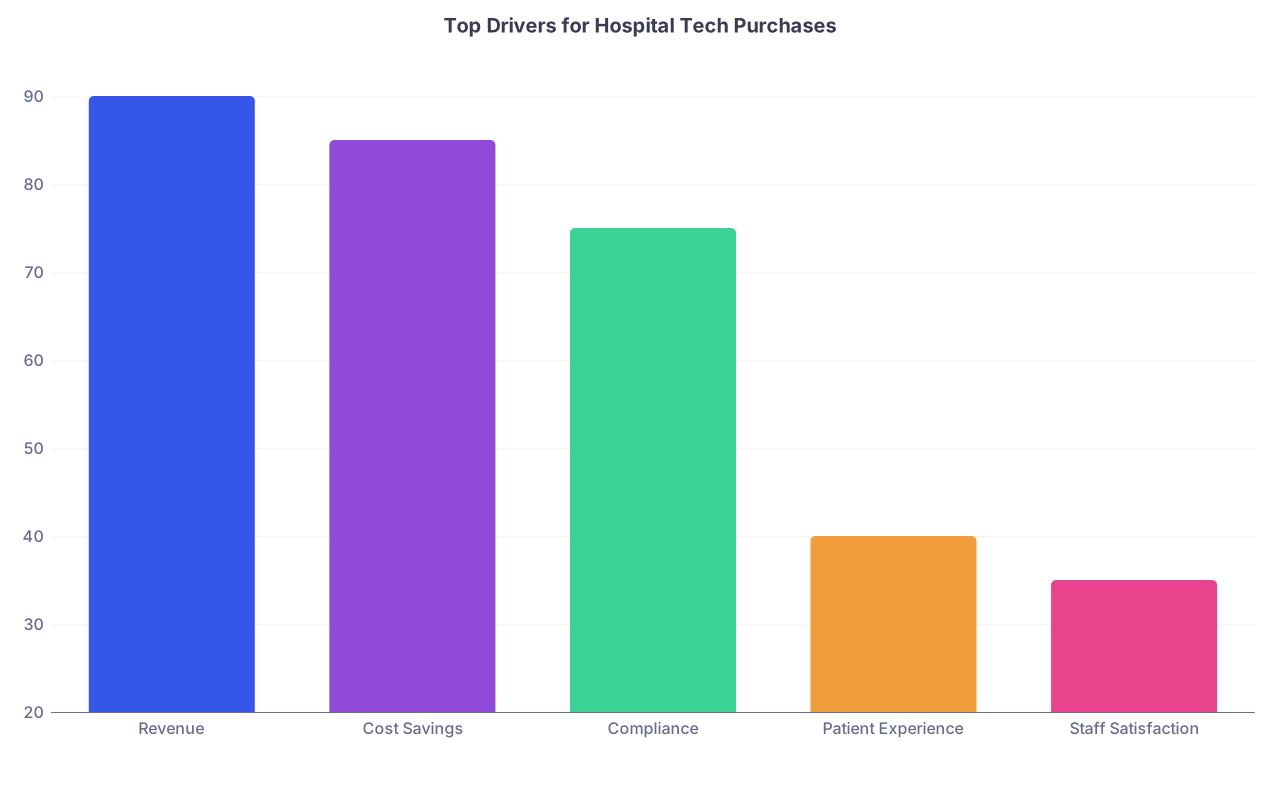
| Category | Value |
|---|---|
| Revenue | 90 |
| Cost Savings | 85 |
| Compliance | 75 |
| Patient Experience | 40 |
| Staff Satisfaction | 35 |
If your pitch leads with “clinician satisfaction,” you’re already losing. Clinician happiness matters, but it almost never pays.
A Simple Framework: 4 Quadrants of Your Idea
Here’s how to categorize what you’re thinking of building.

| Step | Description |
|---|---|
| Step 1 | Start - Your Idea |
| Step 2 | Policy Fix Only |
| Step 3 | QI Project First |
| Step 4 | Service Business |
| Step 5 | Potential Startup |
| Step 6 | Needs single org policy change? |
| Step 7 | Value proven beyond this org? |
| Step 8 | Works across many orgs? |
Quick breakdown:
Policy Fix Only
Local pain, solved by local rule/process/EHR tweaks.- Example: “Our sign-out template is terrible.”
- Action: Do a QI project, publish it, move on.
QI Project First
Starts local, but potentially generalizable.- Example: “Our cross-cover workflow is unsafe; I can redesign it and measure errors.”
- Action: Run the project in your hospital. Get data. See if others care. You might discover a productable pattern. Or not.
Service Business
Your expertise, sold as consulting or done-for-you service.- Example: “I know how to fix ED throughput, I’ll consult for hospitals.”
- Might be lucrative.
- Not a tech startup unless you gradually codify it into software or tooling.
Potential Startup
Works across many orgs, independent of one policy, quantifiable ROI.- Example: “Platform that uses claims + EHR data to predict avoidable readmissions and automates post-discharge outreach.”
You’re aiming for quadrant 4 if you’re talking about a real startup.
The Tech Illusion: Software ≠ Startup
This trips up a lot of post-residency docs.
You think: “If I add an app, it becomes a startup.”
No. That’s just a digital form of a policy.
Signs you’re just wrapping policy in code:
- Your “platform” is basically:
- one hospital
- one workflow
- one EHR
- Features are all custom to your current job:
- the labels, roles, steps, and data fields only make sense there
- To sell it anywhere else, you’d have to:
- rebuild 50% of the logic
- beg IT for custom support
- convince them to fight their own internal politics to use your thing
That’s custom software, not a scalable product.
True startup software abstracts the messy local policy into a reusable pattern that:
- other orgs can adopt with minor tailoring
- still delivers most of the value without rewriting everything
If you can’t sketch what your product looks like in:
- a small community hospital
- a large academic center
- an outpatient multi-specialty group
…then you’re still at the “better policy for my environment” stage.
Three Hard Tests Before You Call It a Startup
Here’s what I’d actually do if you called me with your idea.
I’d pressure test it with these three questions:
1. Show Me Three Very Different Customers
Can you list (without hand-waving):
- one academic center
- one community hospital or large group
- one completely different system (telehealth, SNF network, ASC chain)
…where the problem exists in a similar-enough way that your solution is recognizable and useful?
If your descriptions sound like:
- “Well, in my hospital, the nurse manager does X…”
- “But in that place, the case manager would own it instead, so we’d need a different workflow…”
You’re not at startup level yet. You’re still mapping local politics.
2. Show Me the Line Item
For each potential customer, answer:
- Which VP or C-level owns this problem?
- Which existing vendors are they using today instead of you?
- What budget would your fee come from?
If you can’t answer that without guessing, go talk to those people before you write more code. You may discover your “idea” is already in the RFP your CIO wrote last year.
3. Make It Work on Paper—Financially
Back-of-the-envelope:
- What do you charge per site per year?
- What measurable change do you claim to create?
- What is that worth, roughly, in dollars?
If you’re charging $50K/year and saving them $20K/year in staff time, this is DOA. Nobody buys negative ROI software on purpose.
Startup vs Advocacy: Which Game Are You Actually Playing?
Some problems should be solved by advocacy and policy, not by startups.
Examples:
- Unpaid prior auth time
- RVU games that punish cognitive care
- Unsafe nurse staffing ratios
- Insane documentation requirements for low-value billing
You might use software or data to support advocacy. But the lever is:
- regulation
- reimbursement policy
- accreditation standards
- union or professional society pressure
Not sales and implementation.
If success for your idea looks like:
- “Medicare changes how it pays for X”
- “The state mandates minimum Y”
- “Joint Commission requires Z”
You’re not building a company. You’re leading a campaign.
Nothing wrong with that. Just be honest with yourself about the play.
How to Turn a Policy Problem Into a Real Startup (If It Can Be)
Let’s say you start with a local frustration. Here’s how you pressure-cook it into something more.
Strip out your hospital’s quirks.
Rewrite the problem as if you were explaining it to a completely different system in another state.Find the underlying pattern.
Ask: what’s universally true here?- Human limitation?
- Information gap?
- Incentive misalignment?
- Regulatory requirement?
Design around constraints, not wishes.
Assume:- policies will stay bad
- staffing will stay tight
- EHR will stay clunky
Your solution has to work despite that, not only if it gets fixed.
Talk to 10 people outside your system.
Not your co-residents. Not your buddies at fellowship.
Different orgs. Different states. Different sizes.
If they don’t see the problem immediately, step back.Prototype the outcome not the interface.
Before building software, see if:- manual process
- spreadsheet
- basic script
- off-the-shelf tools
…can create the same measurable outcome at 1–2 external sites. If they will not use a low-tech workaround that saves them money and time, they will not buy your high-tech version either.
One Page You Should Write Tonight
You want something actionable? Do this.
Open a doc and write:
The problem in one sentence, with a metric.
“Hospitalist discharges are so fragmented that 18% of our CHF patients are readmitted within 30 days.”The current workaround.
Be specific to your site. Who does what? When?The “magic wand” version.
If you controlled policy, staffing, and IT, how would you fix it? Describe that.Now cross out everything that depends on:
- hiring more people
- rewriting major hospital policy
- praying for Epic/Cerner to cooperate
What’s left?
That leftover piece is where a startup might live.
Or you’ll discover there’s nothing left—and that what you actually want is better leadership, not a company.
Do that before you talk to another developer or sketch another screen.
FAQ (exactly 7 questions)
1. Can something start as a policy fix and eventually become a startup?
Yes, but only if you can extract a generalizable pattern from your local fix. Example: you redesign discharge at your hospital, prove a 15% readmission drop, then realize you can package the workflows, protocols, and some tooling into a product that other hospitals can adopt with modest changes. The evolution is: local QI → multi-site pilot → productization. Most ideas die because they never jump from “it works here with our people” to “it works there with their people.”
2. Do I need to write code myself to build a real startup?
No. In fact, many physician-founders should not code. Your edge is clinical understanding, access to users, and credibility with buyers. What you absolutely must own is: the problem definition, the outcome metrics, and the ruthless focus on what actually moves those metrics. You can hire or partner for engineering. You cannot outsource understanding of the workflow.
3. How do I know if my idea is too small to be a startup but still viable as a business?
If your idea clearly helps a niche (say, nephrologists in dialysis centers) and they’d pay a few hundred to a few thousand dollars a year for it, you might have a solid small SaaS or consulting business. It may never be “venture scale” and that’s fine. The test: can you realistically see 50–200 paying customers without rewriting the thing each time? If yes, you may have a lifestyle or “calm” business—not a rocket ship, but still meaningful.
4. What if my idea depends heavily on changing reimbursement rules?
Then you’re playing two games at once: startup and policy. Very few people pull this off. If your product only makes sense “once CMS changes X,” you’re effectively building on quicksand. Better: design something that creates value under current rules and becomes even more valuable if rules improve. If your entire thesis is “this will be huge when the government finally does the right thing,” that’s not a startup plan—it’s a prayer.
5. How many hospitals or groups should I validate with before committing?
Aim for 10–15 serious conversations across different org types: academic, community, private groups, maybe a payer or two if relevant. “Serious” means they’re willing to walk you through current workflow, costs, and constraints—not just nod and say, “Yeah, that’s a problem.” If, after those calls, you still hear the same pain in the same words, and they ask, “When can we try this?” then you might be onto something.
6. What’s the biggest red flag that my idea is just a personal annoyance?
If your pitch relies on phrases like “people just need to” or “if only they would,” you’re probably trying to will a culture change into existence. Startups shouldn’t require everyone to suddenly care more, be more disciplined, or act against their own incentives. Good products fit human laziness and institutional inertia. If your solution starts with “do a training” or “make a policy,” that’s your signal.
7. What should I do tomorrow if I’m serious about turning my problem into a startup?
Pick two hospitals or groups not connected to your training program. Cold email or warm-intro your way to a VP-level leader related to your domain (CMO, CNO, CMO of a group, VP of population health, etc.). Ask for 20 minutes to understand how they handle [your problem] and what they’ve tried. Do not pitch. Just diagnose. If you cannot get those conversations, you do not have the access you’ll need to sell later—fix that first.
Open a fresh page and write out your “problem” and “magic wand” fix right now. Then cross out everything that depends on better policy or more staff. What survives on that page—that stubborn, policy-resistant core—is either the beginning of a real startup idea…or proof that you were just angry at your hospital all along.