

Only 11% of digital health companies selling to payers report that their contracts are primarily value‑based rather than fee‑for‑service. Yet almost every pitch deck is packed with “value‑based care” language.
If you are post‑residency, clinically credible, and building a chronic disease platform, this gap is both your biggest risk and your clearest opportunity. Most founders talk value. Very few structure contracts that actually move dollars based on outcomes.
Let me break this down specifically.
1. The Harsh Reality: Why Chronic Disease Startups Struggle To Get Paid
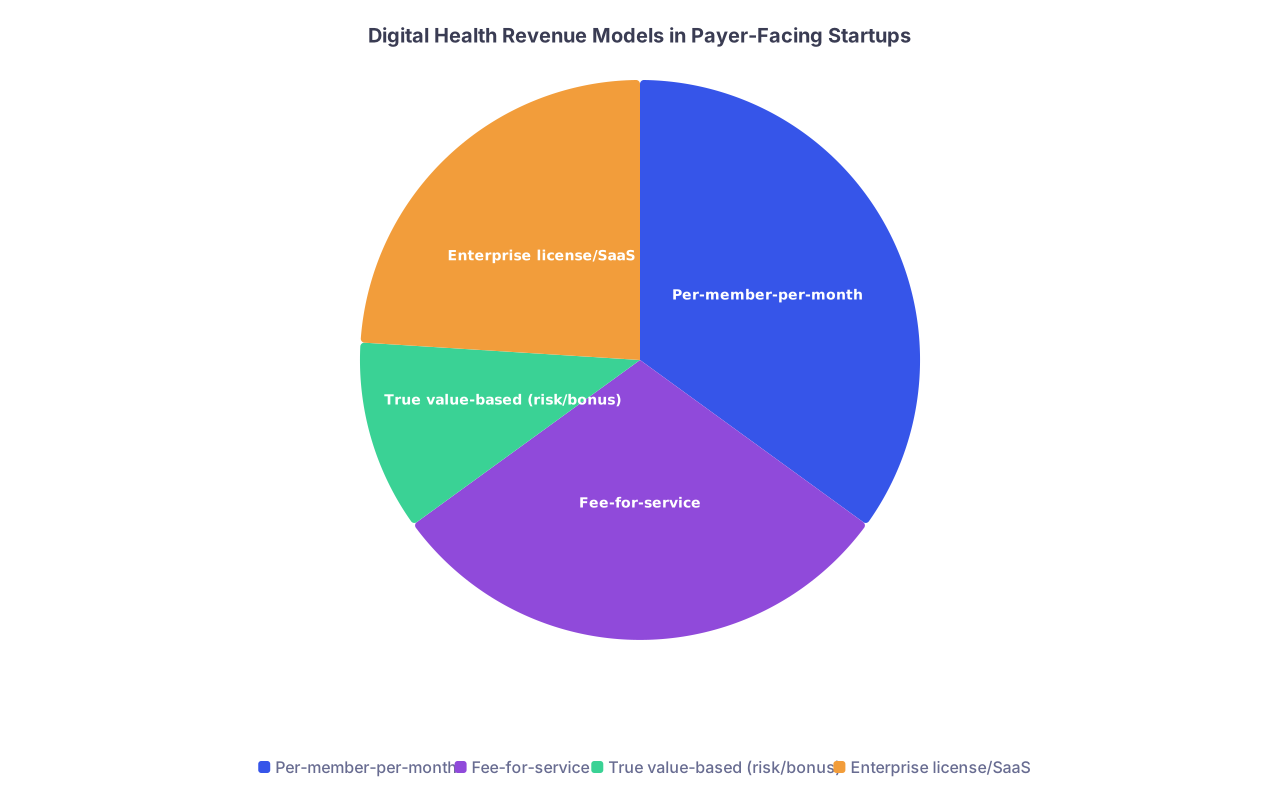
| Category | Value |
|---|---|
| Per-member-per-month | 35 |
| Fee-for-service | 30 |
| True value-based (risk/bonus) | 11 |
| Enterprise license/SaaS | 24 |
I have sat in payer meetings where clinically strong chronic disease products died in 20 minutes. Not because the product was bad. Because the monetization story was weak, fuzzy, or naive.
The three blunt truths you are up against
Health plans and large systems are flooded
Every week: another type 2 diabetes app, another remote monitoring “platform,” another “AI‑driven” care navigation tool. From their point of view, 90% are indistinguishable.Your clinical logic does not equal their financial logic
“We lower A1c by 1.2 points at 6 months” is clinically meaningful. To a payer CFO, that is an intermediate marker. They care about:- Fewer ED visits
- Fewer admissions/readmissions
- Cheaper sites of care
- Lower total cost of care (TCOC) in 12–24 months
Most “value‑based” decks fall apart at contract redlines
Slides say: “We align incentives with value‑based pricing.”
Legal redlines say: “$X PMPM, 12‑month term, 60‑day out, no downside risk.”
If you want to monetize chronic disease platforms through value‑based contracts, you must build around hard outcomes and dollars. Not vibes. Not “engagement.” Not “digital front door” nonsense.
2. First Principles: What “Value‑Based” Actually Means in a Contract

Strip the buzzwords. In a contract, “value‑based” reduces to one core idea:
Your revenue is contingent on delivering predefined, measurable financial or quality outcomes.
Everything else is detail.
Four actual contract levers (not marketing slogans)
Most real value‑based agreements use some combination of these:
Shared Savings
You reduce total cost of care (TCOC) for a defined population, against an agreed baseline or trend. You get a percentage of the savings.
Typical structure:- Attribution: defined member cohort (e.g., 5,000 MA lives with CHF)
- Baseline: prior 12–24 months PMPM cost, risk‑adjusted
- Threshold: minimum savings (e.g., 3–5%) before sharing kicks in
- Split: 20–50% of “net savings” to you, with caps
Outcome‑Based Bonuses (Pay‑for‑Performance)
You receive bonuses tied to hitting specific utilization or quality targets:- 15% reduction in all‑cause 30‑day readmissions
- 20% reduction in diabetes‑related ED visits
- Improvement in HEDIS or STAR measures (A1c control, blood pressure control)
At‑Risk PMPM (Partial Risk)
Base PMPM fee plus performance adjustment:- $6 PMPM base for enrolled members
- Up to +$4 PMPM bonus or –$2 PMPM penalty based on outcomes
This is where you start shifting from “talking value” to actually sharing risk.
Full‑Risk, Capitation‑Like
Rare for early‑stage startups. You take on a fixed PMPM for a chronic cohort and own most or all cost savings or overruns. If you are just out of residency, do not pretend you are ready for this unless you have serious actuarial and capital backing. This can sink a young company.
A simple example: CHF platform contract
Imagine you built a heart failure remote management platform (BP, weight, diuretics titration, nurse oversight).
A basic value‑based structure with a Medicare Advantage plan might look like:
- Population: 3,000 MA members with CHF (NYHA II–IV)
- Baseline: $1,800 PMPM TCOC, 1.8 admissions/member/year
- Target: 15% reduction in CHF‑related admissions and 5% reduction in TCOC at 12 months
- Payment:
- $8 PMPM base for actively enrolled members
- 20% share of TCOC savings above 3% threshold
- Additional performance bonus of $200 per member if 30‑day readmissions drop by ≥20%
Now you are not just a software license. You are a care delivery lever with measurable financial impact.
3. Translating Chronic Disease Outcomes Into Dollars (The Non‑Negotiable Step)
If you cannot do this well, you have no business talking about value‑based contracts. Harsh, but accurate.
Step 1: Pick the chronic condition and narrow the use case
Do not start with “all chronic disease.” Pick one or two:
- Type 2 diabetes
- Heart failure / cardiometabolic bundle
- Severe asthma / COPD
- CKD stage 3–4
- Obesity with cardiometabolic risk
Then pick your value lever:
- Preventing exacerbations (ED/inpatient events)
- Moving care to cheaper sites (e.g., outpatient infusion vs inpatient)
- Preventing disease progression (CKD stage progression, amputations)
- Closing gaps that drive bonuses (HEDIS, STAR, quality pools)
Step 2: Convert clinical wins into utilization deltas
Let’s use a diabetes platform as a concrete example. Your pilot shows:
- Average A1c reduction: 1.0 point at 12 months
- 25% reduction in diabetes‑related ED visits
- 20% reduction in all‑cause admissions among engaged users
- 40% adherence to statins and ACEi/ARB vs 25% baseline
Nice clinical outcomes. But they are still meaningless to a CFO without utilization and cost.
You need to say something like:
- Baseline diabetes‑related ED visits: 200 per 1,000 members/year
- Post‑intervention: 150 per 1,000 → 50 avoided ED visits per 1,000 members
- Baseline all‑cause admissions: 250 per 1,000 → 200 per 1,000 → 50 avoided admits
Step 3: Attach realistic cost assumptions
You do not need to be an actuary, but you do need plausible, conservative numbers. Use Medicare or large‑payer public data as a starting point.
Let’s say:
- Average ED visit cost: $1,400
- Average medical admission: $14,000
For 1,000 members:
- 50 avoided ED visits → $70,000 saved
- 50 avoided admissions → $700,000 saved
- Rough savings: $770,000/year per 1,000 members
Now sanity‑check. You will not capture all of that. There are confounders, regression to the mean, coding intensity, etc. So discount.
Say you conservatively claim $400,000 attributable savings per 1,000 members per year as your modeled impact.
Step 4: Back into a contract range that makes sense
Let’s put this into contract math.
- Modeled savings: $400,000 per 1,000 members
- Population: 5,000 members
- Total modeled savings: $2,000,000/year
Reasonable value‑based structure:
- Base fee: $10 PMPM for enrolled members
- For 5,000 members: $10 × 5,000 × 12 = $600,000/year
- Shared savings: 25% of validated TCOC savings above 3% threshold
If the plan validates $2M savings:
- First 3% may be excluded as threshold; beyond that, say $1.5M is “shareable”
- 25% of $1.5M → $375,000 potential upside
Total annual revenue potential: $600,000 base + $375,000 upside = $975,000
For a platform that actually moves the needle, this is both fair and sellable.
4. Contract Archetypes That Actually Get Signed (and That You Can Survive)
| Model Type | Startup Risk | Payer Appeal | Typical Use Case |
|---|---|---|---|
| Flat PMPM (no risk) | Very Low | Low | Early pilots, RFP add-ons |
| PMPM + Outcome Bonus | Low–Medium | Medium–High | Diabetes, CHF remote management |
| Shared Savings Only | Medium | High | Mature platforms with strong data |
| PMPM + Shared Savings | Medium | Very High | Larger, multi-condition programs |
| Full Risk / Capitation | Very High | Very High | Rare, usually with big partners |
You do not need to jump to full‑risk contracts on day one. In fact, you probably should not. The art is choosing a structure that is:
- Meaningful enough for the payer to care
- Safe enough that a few bad quarters do not kill your company
- Simple enough that it can get through legal and actuary review before you run out of runway
Model 1: PMPM + outcome bonus (the “starter” value‑based deal)
Probably the most realistic first step for a chronic disease startup.
Structure:
- Base: $6–$15 PMPM for active enrolled members
- Outcome bonus: $100–$300 per member per year for hitting composite metrics (e.g., reduced utilization + A1c control)
- No downside risk, but bonus is reasonably material
Works well when:
- You have early but not long‑term data
- You are working with 1–2 conditions, clean cohorts
- Payer is new to digital value‑based contracting and wants training wheels
Model 2: PMPM + shared savings (the “serious” contract)
Here you start to look like an actual care delivery partner.
Structure:
- $8–$20 PMPM for engaged members
- 20–40% share of validated savings above a threshold
- May have small downside: e.g., PMPM at risk if metrics missed by a large margin
Use this when:
- You have at least 12–24 months of data, either from pilots or published outcomes
- Your platform drives hard utilization outcomes (ED, admissions, LOS)
- You can attribute impact reasonably well and have some internal analytic muscle
Model 3: Shared‑savings only (higher risk, high leverage with ACOs / systems)
You paginate off care management budgets and bet entirely on savings. Risky, but I have seen this close faster than complex PMPM constructs when the buyer is an ACO, CIN, or risk‑bearing provider group.
Structure:
- No base fee or a very low one
- 30–50% of validated savings, with caps
- Clear, aggressive performance guarantees
Only go here if:
- You can identify and engage high‑risk patients very effectively
- You either own or tightly integrate with care teams (NPs, RNs)
- You are dealing with a risk‑bearing entity (ACO, large IPA, capitated group)
5. Data, Attribution, and Measurement: Where Most Startups Get Crushed
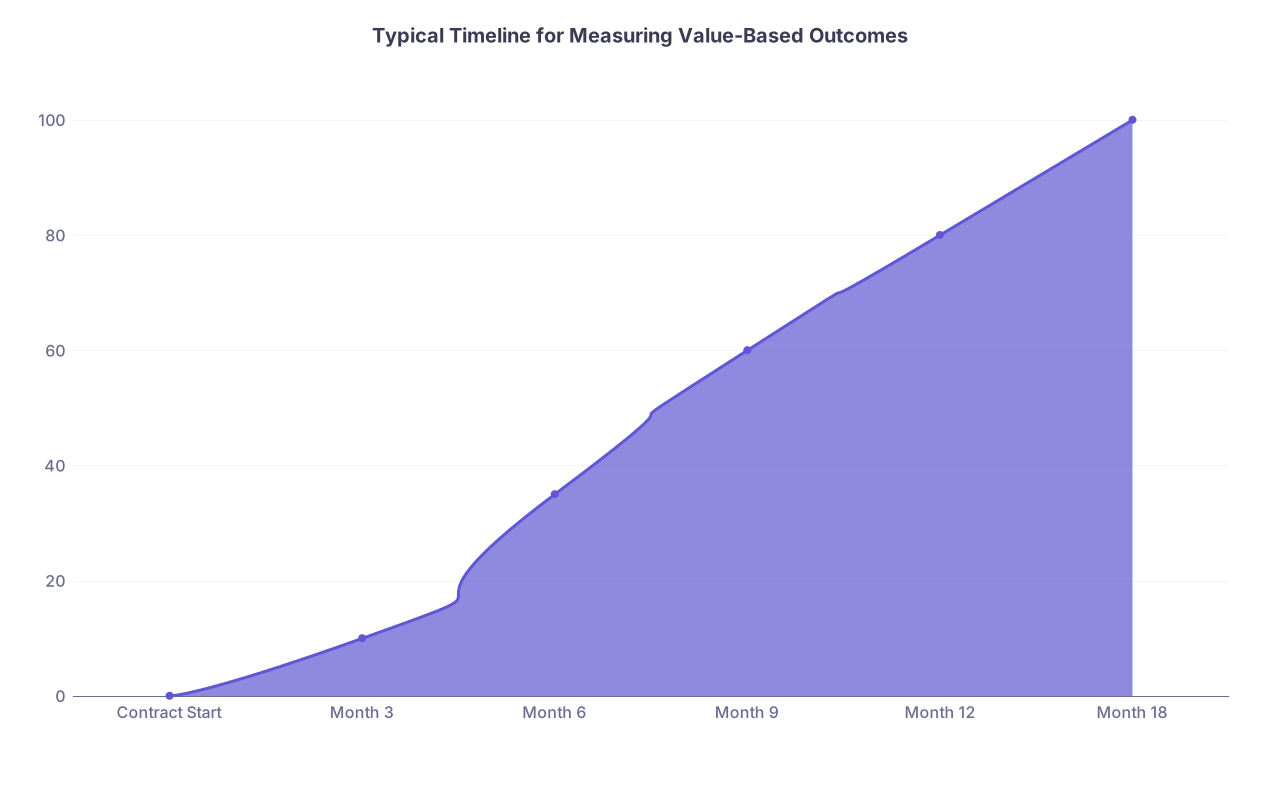
| Category | Value |
|---|---|
| Contract Start | 0 |
| Month 3 | 10 |
| Month 6 | 35 |
| Month 9 | 60 |
| Month 12 | 80 |
| Month 18 | 100 |
By the time you are talking value‑based contracts, the technical problem is not your app. It is your data and measurement story. This is where many clinically smart founders get blindsided.
You need answers to five non‑negotiable questions
How are members attributed to your program?
- Opt‑in enrollment? Claims‑based attribution? PCP panel‑based?
- What happens when they churn plans or PCPs?
- How do you handle partial‑year enrollment?
What is your comparison group?
- Pre/post (same members vs their own baseline)?
- Risk‑matched controls?
- Synthetic controls based on historical data?
If you have nothing here, actuaries will quietly end the conversation.
What data sources are you using?
- Claims only (lagging but comprehensive)?
- EHR data (more real‑time but fragmented)?
- RPM / device data (proximal, but not $$)?
The buyer will not accept outcomes that cannot be tied back to claims‑validated utilization and cost.
What is the measurement window?
- Quarterly reporting vs annual settlement
- Minimum enrollment duration (e.g., member must be engaged for 90 days to count)
- How you handle partial periods and late adopters
How do you account for regression to the mean and secular trends?
If you only target the sickest, a naive pre/post will always look great. They know that game. You must speak their language: risk adjustment, trend normalization, control cohorts.
Build a basic outcomes measurement spine early
Post‑residency founders often under‑invest here at the seed stage. That is a mistake. By Series A, you should have:
A clean member‑level data model that can ingest:
- Eligibility files
- Claims (medical + pharmacy)
- EHR events (if accessible)
- Your platform events (enrollment, engagement, interventions)
A reproducible outcomes measurement plan, including:
- Cohort definition (ICD‑10 codes, risk bands, geography, payor line)
- Primary endpoints (e.g., all‑cause admissions per 1,000, ED visits per 1,000, TCOC PMPM)
- Secondary endpoints (HbA1c, BP control, medication adherence)
- Statistical methods for comparison (even if simple at first)
If this sounds too “researchy,” that is the point. Payers trust numbers that look like they came out of a health services research group, not a marketing team.
6. Who Actually Buys This: Segments and How To Pitch Them

Not all customers want the same flavor of value‑based contract. Or the same risk. Or the same proof.
Segment 1: National and large regional health plans
Examples: UHC, Anthem, Humana, Blue plans.
Motivations:
- Control TCOC for high‑cost chronic populations
- Improve STAR/HEDIS for Medicare Advantage and Exchange lines
- Show shareholders they are “innovating”
What they care about most:
- Actuarial rigor, risk adjustment, scalability across markets
- Ability to plug into existing care management and UM workflows
- Compliance, data security, boring but essential vendor credentialing
Contract pattern:
- Pilot RFPs at PMPM with light outcomes bonuses
- Scale to PMPM + shared savings for well‑performing programs
You must walk in with a clear understanding of their line of business: MA vs commercial vs Medicaid. Each has different economics and levers. A 0.5 STAR bump in MA is worth more than 1,000 prevented ED visits in some contracts.
Segment 2: Health systems and IDNs
Examples: Kaiser, Intermountain, Geisinger, large IDNs with CINs.
Motivations:
- Reduce readmissions and capacity strain
- Improve quality scores tied to bonuses and risk contracts
- Avoid penalties (readmission penalties, quality withholds)
What they care about most:
- Integration into EHR and clinical workflows
- Provider buy‑in, low documentation burden
- Local, condition‑specific outcomes
Contract pattern:
- Departmental budgets at first (still FFS or license‑like)
- Transition to value‑linked when tied to their ACO contracts or bundled payments
You should frame yourself as an accelerator for their existing VBC contracts. Not a random digital layer.
Segment 3: ACOs, IPAs, and risk‑bearing provider groups
These are often your best early value‑based customers.
Motivations:
- They already take risk. They feel financial pain directly.
- Want tools that make their existing care teams more effective.
What they care about most:
- Fast, local ROI for
my patients in this geography - Clear mapping to their specific contracts (MSSP ACO, NextGen, direct‑to‑employer deals)
- Ease of deployment; they do not have armies of analysts
- Fast, local ROI for
Contract pattern:
- Shared‑savings‑heavy deals, often without big base PMPM
- Faster cycles from pilot to full deployment
Here you can often get cleaner attribution and more direct experimental designs. You may start with one practice, one chronic cohort, and scale.
7. Designing Your Internal Capabilities To Actually Survive Value‑Based Deals
This is where a lot of post‑residency founders underestimate the work. You are not just building software. You are building an outcomes‑driven service organization.

| Step | Description |
|---|---|
| Step 1 | Clinical Protocols |
| Step 2 | Product and Workflow |
| Step 3 | Data and Analytics |
| Step 4 | Contracting and Pricing |
| Step 5 | Monitoring and Performance Management |
| Step 6 | Renegotiation and Scale |
Clinical: Protocols that stand up to scrutiny
You need repeatable, documented protocols, not “we nudge people with messages.”
Examples:
For heart failure:
- Specific titration protocols for diuretics
- Escalation parameters for weight gain, dyspnea, BP changes
- Integration with cardiology and PCP follow‑up schedules
For diabetes:
- Clear insulin adjustment algorithms
- Structured medication intensification workflows
- Referrals for GLP‑1/SGLT2 when indicated, with cost considerations
These protocols become your defense when utilization results are audited.
Analytics: Build or buy a spine, not a Frankenstein
At minimum, you need:
- A data engineer or strong analyst who understands payer data
- A standard schema for:
- Member identifiers and eligibility
- Conditions and comorbidities
- Events: ED, inpatient, SNF, outpatient
- Pharmacy claims
Then you need a basic outcome analysis stack: Python/R scripts, reproducible pipelines, dashboards that can actually be shown in a QBR without embarrassing yourself.
Contracting: Someone must speak payer
Do not send a purely clinical founder alone into a contract negotiation without support. Patterns I have seen work:
- Early on: founder + external consultant who has done payer/ACO contracts
- By Series A/B: internal “payer strategy” or “value‑based contracting” lead
They need to be comfortable with:
- Medical loss ratio (MLR) language
- Stop‑loss, risk corridors, caps
- Attribution models and quality withholds
You do not want to discover what a “clawback” clause really means after a bad flu season blows your numbers.
8. Common Pitfalls and How To Avoid Looking Amateur
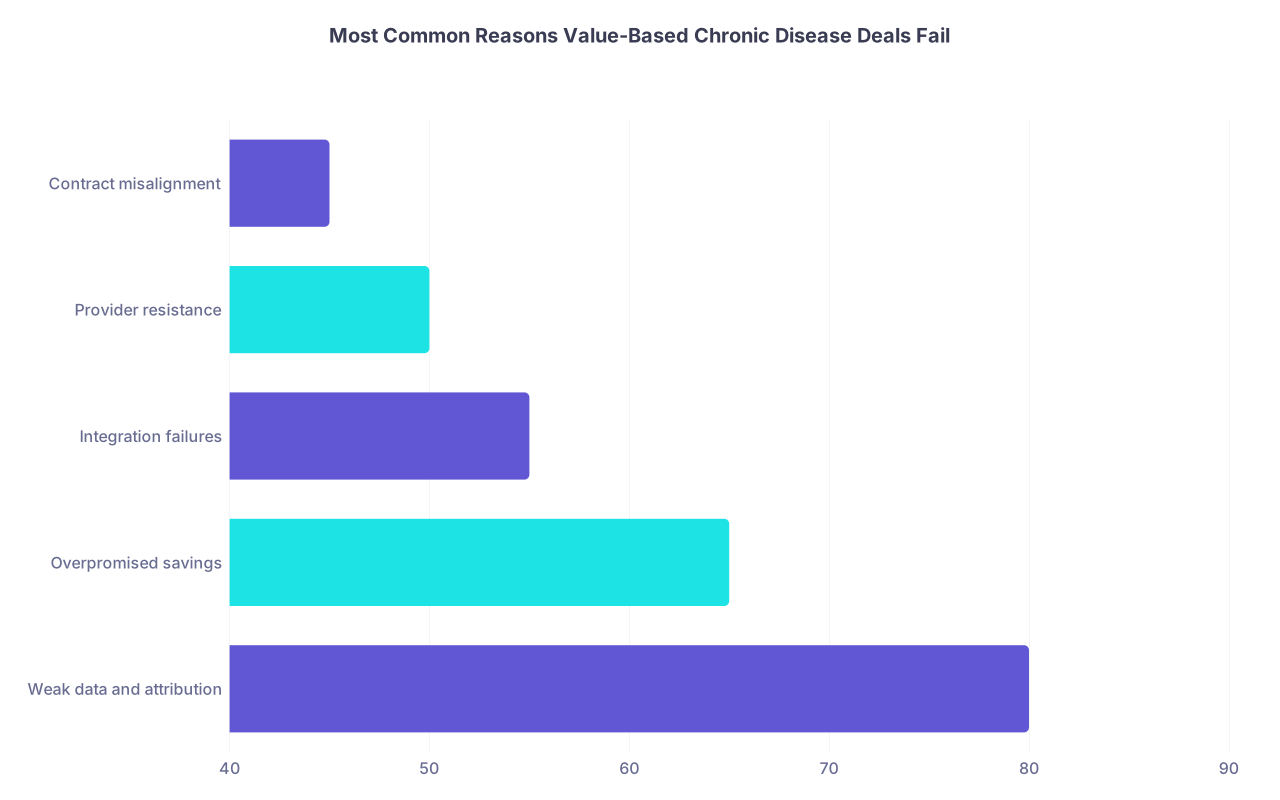
| Category | Value |
|---|---|
| Weak data and attribution | 80 |
| Overpromised savings | 65 |
| Integration failures | 55 |
| Provider resistance | 50 |
| Contract misalignment | 45 |
I have seen the same mistakes repeat across different companies, specialties, and markets.
Pitfall 1: Leading with engagement metrics
“No one cares that 70% of users open the app weekly” unless you can show that leads to fewer admissions or lower TCOC. Engagement is a process measure. Fine for product meetings. Not enough for contracts.
Fix: Translate engagement into clinically meaningful actions and then into utilization.
Example: “70% weekly engagement leads to 45% higher medication adherence and 20% fewer hospitalizations vs matched non‑users.”
Pitfall 2: Overpromising savings without a plausible mechanism
Claiming “30–40% TCOC reduction” with a light‑touch educational app? That just signals you have no idea how this works. Seasoned payers will quietly pass.
Fix: Anchor your claims:
- Start at 5–10% achievable TCOC savings for targeted high‑risk cohorts
- Show mechanism: fewer exacerbations, more primary care, fewer avoidable admissions
- Use pilot data, benchmarks, or literature, and show you understand confounders
Pitfall 3: Ignoring the cost of operating your own risk
If you take on downside risk, you are now an insurer‑lite. You must hold capital, run scenarios, and withstand variance. Few early‑stage startups appreciate how volatile small population outcomes can be.
Fix: For your first 2–3 value‑based contracts:
- Cap downside explicitly
- Use risk corridors (e.g., your upside/downside is limited to ±X% of fees)
- Avoid pure downside early; combine with PMPM or fixed fees
Pitfall 4: Selling directly to plans but deploying through angry clinicians
You close a plan contract. Then the local PCPs and specialists who must actually change behavior had zero input. They are annoyed, overworked, and see you as just more work.
Fix:
- Before signing a multi‑region payer deal, get at least one provider group or system in that plan’s network enthusiastic about your solution
- Ops must include training, co‑design of workflows, clear benefit for clinicians (not just admin)
9. A Concrete Roadmap: From Pilot to Scaled Value‑Based Revenue
Let me give you a pragmatic path you can actually follow.
Phase 0: Design with value measures in mind (pre‑revenue)
- Pick 1–2 chronic conditions and 1–2 primary utilization endpoints (e.g., admissions, ED).
- Build minimal data infrastructure to link platform use → clinical actions → claims‑level outcomes.
- Start collecting structured baseline and follow‑up data even in free pilots.
Phase 1: Early pilots on simple PMPM or license
- Work with an ACO, progressive health system, or small plan.
- Focus on deployment, workflow integration, and early signal of utilization impact.
- Publish or at least whitepaper your first outcomes (even if modest).
Phase 2: First value‑linked contract (PMPM + modest bonus)
- Negotiate 1–2 metrics with low‑risk upside bonus.
- Use this to refine your attribution and measurement playbook.
- Have quarterly outcomes reviews; learn what the buyer’s actuaries trust or reject.
Phase 3: Shared‑savings hybrid deals
- Once you have 12–24 months of credible data, push for shared‑savings components.
- Start with partial shared savings and low caps while you learn the variance.
- Deploy in a few markets with claims‑level access and strong provider partners.
Phase 4: Multi‑condition bundles and scaled value‑based portfolio
- Only after you can reliably run one condition should you bundle (e.g., cardio‑metabolic suite).
- Negotiate portfolio‑level metrics: composite TCOC reduction across several chronic cohorts.
- At this stage you can entertain more meaningful risk‑sharing, with proper capital and reinsurance conversations.
Key Takeaways
- “Value‑based” only matters when it is codified in contracts with clear, dollar‑linked outcomes, not as slideware.
- To monetize chronic disease platforms this way, you must convert clinical effects into utilization and cost, with an attribution story payers’ actuaries respect.
- Start with low‑to‑moderate risk models (PMPM + bonuses or limited shared savings), build your measurement spine, and only then escalate to heavier risk and multi‑condition bundles.


