

You are here
You just signed the employment contract with your first attending job. The ink is barely dry. Your inbox has a “welcome to the team” email, and next to it: a draft pitch deck for your medical AI startup.
You have a prototype model. You have a few Kaggle-grade ROC curves. Maybe even a retrospective paper under review. But one uncomfortable question keeps coming up when you talk to serious investors or hospital CMOs:
“Where is your outcomes data?”
Not AUROC. Not F1-score. Actual clinical outcomes. Fewer readmissions. Lower mortality. Shorter length of stay. Dollars saved.
You know you need an outcome trial. You probably have some vague idea of “we’ll do a randomized trial at my hospital.” But how do you structure it in a way that:
- Is realistic in a busy clinical environment
- Satisfies IRB and legal
- Generates data that a health system CFO and an FDA reviewer both respect
- You can actually pull off while starting a new attending job
Let me break down a practical model for you.
Step 1: Define the business question before the trial design
Most physician-founders start with: “We built an AI that detects X with AUROC 0.92.” That is not a trial question. That is a performance metric.
For an outcome trial, your core question must be something a payer or hospital executive cares about. Very concrete. For example:
- “Does our AI triage tool reduce average ED length of stay by at least 60 minutes for CT-PE workups?”
- “Does our sepsis early warning system reduce hospital mortality for septic patients by 15%?”
- “Does our AI discharge risk model reduce 30-day readmission rates for CHF by 20%?”
That phrasing matters. It gives you:
- A population
- An intervention
- A comparator
- A primary endpoint
- A magnitude that is commercially meaningful
If your startup’s value proposition is “better detection of X,” force yourself to rewrite it as “better outcomes in Y way.” Detection is only intermediate. Outcomes are where reimbursers live.
| Weak Question | Strong Outcome-Focused Question |
|---|---|
| Does our AI detect pneumonia better? | Does our AI reduce 30-day pneumonia readmissions by 15%? |
| Is our stroke model accurate? | Does our AI cut door-to-needle time for tPA by 10 minutes? |
| Can we predict ICU transfer? | Does our AI reduce unplanned ICU transfers by 25% on general wards? |
| Is the algorithm helpful to clinicians? | Does our AI reduce unnecessary imaging orders for low-risk PE by 30%? |
If you cannot state a strong question like this, pause. You are not ready to design an outcome trial. You are still in “feature demo” territory, not “clinical product” territory.
Step 2: Choose the right trial structure for a real-world hospital
You are not a pharma company with a $20M RCT budget. You are an early-stage startup with limited runway and a finite amount of goodwill from your department chair. So you must pick a design that maximizes credibility per unit pain.
The main practical options for a medical AI startup:
- Patient-level randomized controlled trial
- Provider-level or unit-level cluster randomized trial
- Stepped-wedge (phased rollout) cluster trial
- Before–after (pre–post) implementation study (the weakest, but sometimes all you can do)
Let me cut through the theoretical noise.
1. Patient-level RCT
Gold standard on paper. Often suicidal in practice for workflow AI.
Use it if:
- The AI is independent of clinician workflow (e.g., patient-facing app, remote monitoring where patients are randomized to “AI-augmented follow-up” vs usual care).
- You can randomize at the patient level without confusing everyone.
Avoid it if:
- The clinician will see some patients with AI and some without in the same shift. That contamination destroys your clean separation and infuriates staff.
2. Cluster randomized trial (by clinician, team, or unit)
This is the workhorse for inpatient, ED, ICU, and similar AI tools.
Structure:
- Randomize at the level of: hospital unit, provider group, or shift team.
- Some clusters use the AI. Some do usual care.
- Compare outcomes between clusters.
Example:
- All hospitalists on Team A get AI discharge risk scores integrated into their EHR for CHF patients.
- Team B continues usual care.
- Primary outcome: 30-day readmission for CHF discharges over 6–12 months.
This design respects reality. Providers have a consistent experience. IT does not have to toggle the tool off and on for individual patients.
3. Stepped-wedge cluster trial
This is the compromise that hospital leadership and QI committees love.
Structure:
- All clusters (units/teams) eventually receive the AI intervention.
- They are rolled out in a randomized sequence over time.
- At any given timepoint, some clusters have it, some do not.
- You compare outcomes both within units (before vs after) and across units (intervention vs control at a given time).
Hospitals like this because it looks like a planned phased rollout with built-in evaluation. Ethics committees like it because nobody is permanently denied the “innovation.”
This is my default recommendation for serious outcome trials tied to operational tools.
4. Before–after (pre–post) study
Structure:
- Measure baseline outcomes for X months (no AI).
- Deploy AI across the board.
- Measure outcomes for Y months after.
This is easy. It is also weak: time trends, policy changes, seasonality, and other confounders muddy the waters.
Use this only if:
- You are very early and just need directional data.
- Or the institution flatly refuses any randomization for political reasons.
If this is all you can get, do it—but be honest about its limitations.
Step 3: Lock in your endpoints and window of measurement
Your startup’s credibility lives or dies with your endpoints. Sloppy endpoints = unpublishable = unfundable.
You want:
- One primary endpoint, maybe two if you must
- A small set of prespecified secondary endpoints
- Endpoints extractable from existing operational data, whenever possible
Good examples:
- 30-day all-cause readmission
- ED length of stay in hours
- Door-to-needle time in minutes
- In-hospital mortality
- ICU transfer rate per 1000 admissions
- Number of low-yield MRI/CT per 100 patients with condition X
- Total cost per episode of care
You want endpoints that:
- Matter clinically
- Matter financially
- Are objective
- Do not require manual chart review of 1,000 patients by burned-out residents
If you are tempted to use 15 outcome measures, stop. You are designing a fishing expedition. You will drown in multiple comparison corrections and “exploratory” asterisks.
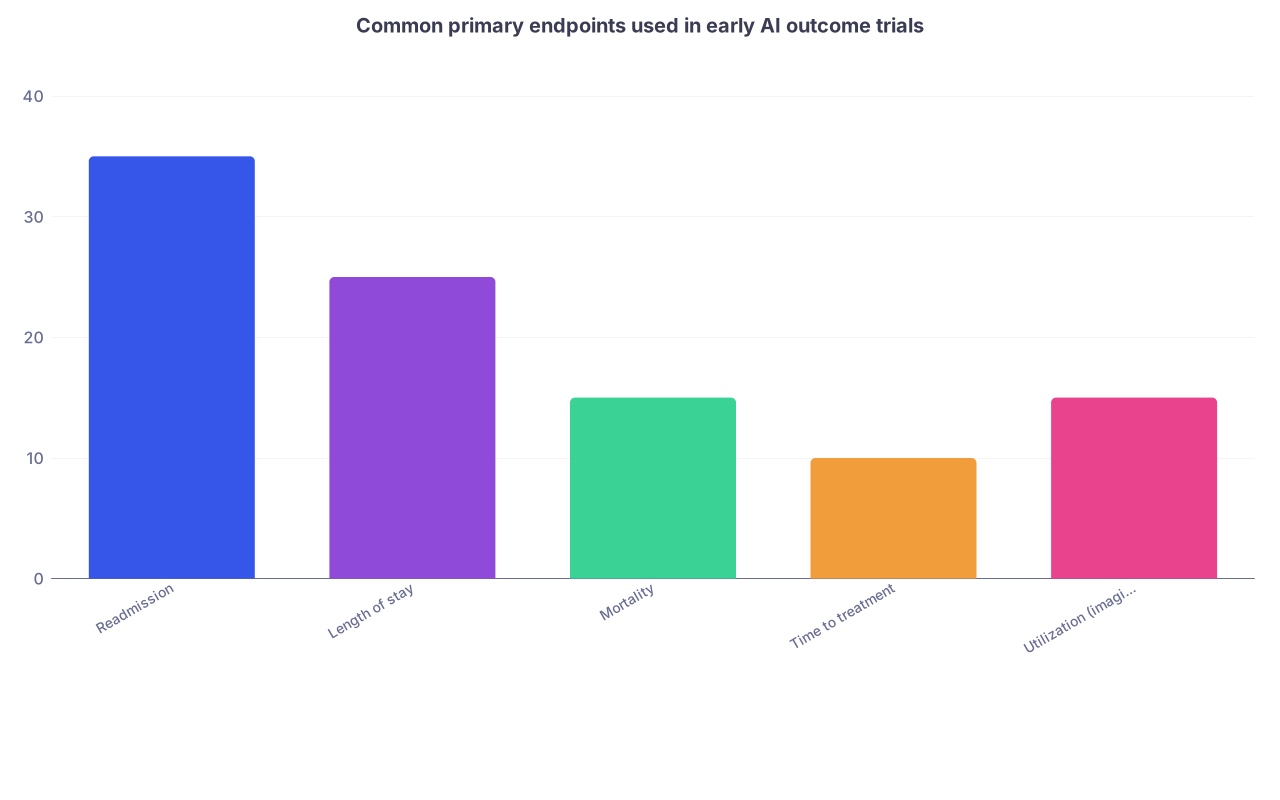
| Category | Value |
|---|---|
| Readmission | 35 |
| Length of stay | 25 |
| Mortality | 15 |
| Time to treatment | 10 |
| Utilization (imaging/labs) | 15 |
Those percentages roughly match what I see in early AI trials that actually get published and cited.
Step 4: Build a realistic sample size and duration plan
This is where a lot of physician-founders fake it and hope nobody asks. Bad idea. Any semi-serious partner or investor will ask, “How many patients and how long?”
You cannot wing this. You also do not need a biostatistics PhD. You need:
- Baseline data from your site (or a very similar site)
- A clinically and financially meaningful effect size
- A statistician for 2–3 hours
Here is the workflow I have seen work:
- Pull 12–24 months of historical data for your target population from your hospital’s data warehouse.
- Compute:
- Baseline rate of your primary endpoint (e.g., 30-day CHF readmission rate = 22%).
- Volume per month (e.g., about 90 CHF discharges per month across hospitalist service).
- Decide on the minimum effect size that would make your product commercially compelling (e.g., 20% relative reduction, from 22% down to ~17.6%).
- Sit with a biostatistician. Get a sample size estimate for:
- Two-group comparison (AI vs usual care).
- With clustering if relevant.
- Target power of 80–90% and alpha 0.05.
They will likely tell you something unromantic like:
- “You need roughly 800–1,000 patients per arm for sufficient power, given your baseline rate and desired effect size.”
Then you translate that into time:
- 90 discharges per month → 180 per month across both arms (if evenly split).
- To get 1,000 per arm, you need about 11–12 months of enrollment.
This is the part founders hate. You were hoping for a cute 3‑month trial with 200 patients. That is rarely enough for real outcomes like mortality or readmission.
I will be blunt: underpowered trials hurt you more than no trial. They produce ambiguous results that sink investor confidence and make future partners wary.
Step 5: Wire the AI into the workflow before you hit “start trial”
This is where most non-clinician-founded startups have no idea what they are stepping into. You, as a clinician, have an advantage—but you still need to be systematic.
You must have:
- Stable integration into the EHR (or a defined workflow outside of it).
- Clear, predictable alerting or display logic.
- Clinicians who understand what they will see and how they are supposed to respond.
- Logging of every AI recommendation and how (or if) it was used.
Do not start the outcome clock while you are still debugging interfaces. That converts your trial into an expensive beta test.
Practical integration checklist
- Is the model running on approved infrastructure (on-prem or cloud compliant with hospital policy)?
- Is there a visible UI element where clinicians can see model output without extra clicks?
- Are AI outputs time-stamped and stored in a structured log table?
- Is there a linkage between AI output and subsequent action (e.g., order placed, consult requested)?
- Has IT signed off that the system is stable (no frequent downtime, no random delays)?
You want at least 4–8 weeks of “stability period” where the system runs in the background, with or without being visible to clinicians, before you formally start measuring outcomes.
Step 6: Decide what level of blinding is feasible
Here is the ugly truth: most AI workflow trials are not truly blinded. You cannot realistically blind clinicians to whether they see an AI alert on their screen.
But you can structure things sensibly:
- Outcome assessors can be blinded if any manual adjudication is involved (e.g., classification of ambiguous readmissions).
- Data analysts can be partially blinded to group assignments while writing analysis code.
- You avoid “peeking” at interim results every two weeks and then quietly changing endpoints.
What you should absolutely not do:
- Run the AI in “silent mode” (no clinician exposure) and then claim outcome improvements. That just gives you validation, not intervention data.
- Change the primary outcome mid-trial because the first three months look flat.
If you want early safety monitoring (e.g., ensuring the AI is not causing obvious harm), define simple guardrails and a DSMB (even a lightweight one with 2–3 impartial clinicians + 1 statistician).
Step 7: Pre-register and pre-specify. Yes, even as a startup.
No, you are not Big Pharma. Yes, you still need to behave like a serious clinical research actor.
Do this:
- Register the trial on ClinicalTrials.gov or a similar registry.
- Publish or internally lock a protocol with:
- Trial design
- Inclusion/exclusion criteria
- Primary and key secondary endpoints
- Analysis plan (high level)
- Duration and planned sample size
Why this matters for your startup:
- It signals maturity to investors: you treat your product like a therapeutic, not a pet script.
- It heads off accusations of p-hacking or “AI hype.”
- It makes journal editors and regulators more comfortable with your data.
This is one of those moves that costs you very little but pays out every time you talk to a serious health system or payer.
Step 8: Define your minimal viable evidence package
Do not delude yourself: this first outcome trial will not be definitive. You are not going to prove, beyond all doubt, that your AI saves lives across every demographic and hospital type.
The goal is more modest and more tactical:
- Show a plausible, statistically supported improvement in 1–2 high-value outcomes in a real-world setting.
- Document safety and absence of obvious harm.
- Generate a playbook for future implementations.
Your “minimal viable evidence” (MVE) for investors and health systems usually looks like:
- One well-structured outcome trial at a credible site, with at least 6–12 months of data.
- A primary endpoint that moves in the right direction with statistical support or, at worst, a strong effect size with borderline significance but a clean design.
- Subgroup analysis that shows no obvious harm to vulnerable groups (age, sex, race).
- Operational metrics: alert volume, clinician adherence/override rates, and usability feedback.
If you try to solve every question in Trial 1, you will design yourself into paralysis. Get a strong first result. Then design the multi-center refinement.
Step 9: Build your “trial ops” on a shoestring that does not snap
You are post-residency, starting full-time clinical work. You do not have bandwidth to personally manage every patient record. You also do not have a 10-person CRO team.
The realistic structure looks something like:
- Principal Investigator: you, or a senior ally at the partner hospital.
- Clinical Champion: a respected attending or unit director who will help with clinician buy-in.
- Research Coordinator (part-time): funded by a small grant, department funds, or your startup’s seed money.
- Data Analyst / Biostatistician: fractional effort; maybe 5–10% FTE.
- Startup Tech Lead: someone on your team responsible for system reliability and logging.
Do not underestimate the importance of the coordinator. They keep:
- Enrollment and eligibility lists
- IRB documents and amendments
- Training logs for clinicians
- Issue tracking (e.g., “alerts not firing during night shift on 6E”)
Without that person, outcome trials die a slow death of unlogged deviations and half-baked data.
Step 10: Plan your analysis and story before seeing the data
This part is more political than statistical.
You want your analysis plan to produce a narrative that maps cleanly to your startup’s business story.
Example:
- Primary outcome: 30-day readmission rate for CHF
- Secondary:
- Index length of stay
- ED revisits without admission
- Number of follow-up appointments scheduled before discharge
- Safety:
- 7-day mortality
- ICU transfers within 48 hours of discharge order cancellation
Your analysis story could be:
- “We reduced readmissions by X%, without increasing mortality or ICU transfers, and we saw modest reductions in LOS.”
- Or: “We did not hit statistical significance on readmissions overall, but in high-risk patients (top quintile risk), we saw a 30% relative reduction, suggesting where our AI is most valuable.”
The point: pre-plan how you will interpret not only a clear win, but also a mixed result. You will likely not get a slam dunk. You need to know how a “promising but incomplete” outcome can still support your next fundraise or pilot.
A concrete model: one practical design for a first AI outcome trial
Let me give you a specific pattern I have seen work for early-stage medical AI startups deploying in hospitals.
Assume: You built a model to predict 30-day readmission risk for CHF discharges, with a planned workflow that escalates high-risk patients to targeted discharge planning and post-discharge outreach.
Trial structure (stepped-wedge cluster)
- Population: Adult CHF inpatients discharged from general medicine services at a single academic hospital.
- Clusters: Hospitalist teams (e.g., 4–6 teams).
- Phases:
- 3 months baseline, no AI (data collection only).
- 9 months stepped-wedge rollout: every 3 months, 2 teams are turned on to AI-assisted discharge planning.
- Intervention:
- AI risk score surfaced to the team care coordinator and discharging physician.
- Risk ≥ threshold triggers standardized discharge bundle: early cardiology follow-up, phone outreach, med reconciliation reinforcement, etc.
- Control:
- Usual discharge practices with no AI risk score shown.
Endpoints
Primary:
- 30-day all-cause readmission for index CHF hospitalization.
Secondary:
- 7-day ED revisit rate
- Index length of stay
- 30-day mortality
- Cost per episode (if finance will work with you)
Sample size and duration
- Historical baseline: 22% 30-day readmission rate, ~90 CHF discharges/month.
- Target: 20% relative reduction (22% → ~17.6%).
- Total needed: ~2,000–2,500 discharges across all periods and teams to have adequate power after clustering.
- Timeline: ~12–18 months total (including baseline).
Analysis
- Mixed-effects regression with:
- Fixed effects for intervention vs control, calendar time.
- Random effects for clusters (teams).
- Primary analysis: intention-to-treat at team level (if a patient is admitted to AI team during their active phase, they are “AI arm,” regardless of whether clinician obeyed the alert perfectly).
- Pre-specified subgroup: top 20% risk patients, where AI is most likely to drive behavior change.
This design:
- Respects clinical workflows.
- Gives you a publishable methodology.
- Produces a result that hospital administrators understand: “We turned this on in this order, and here is what happened to readmissions and costs.”
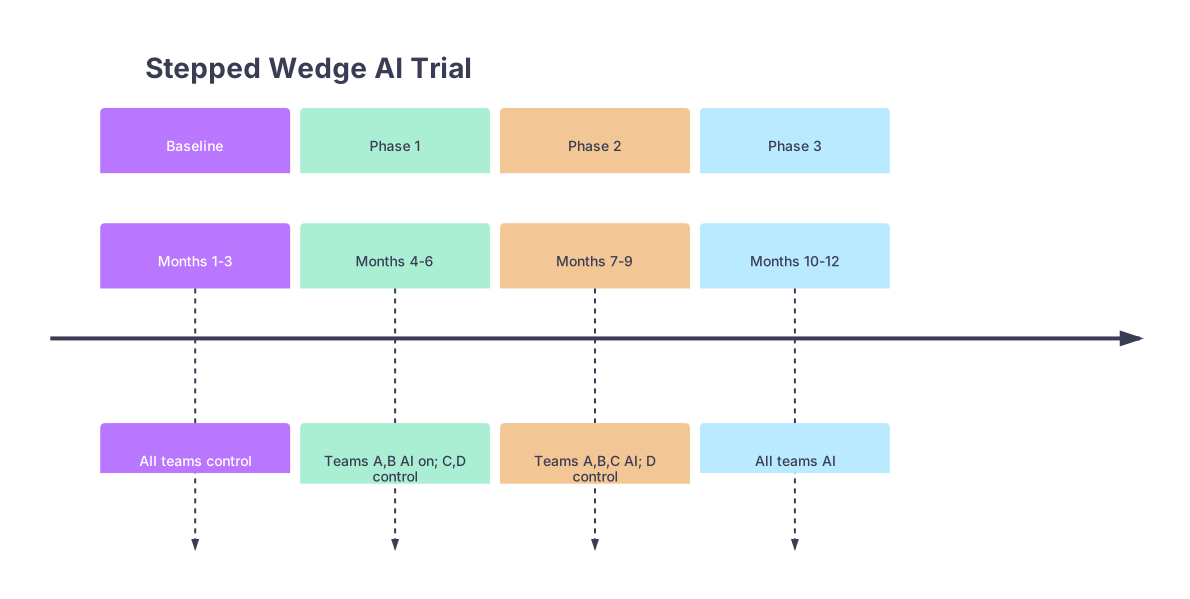
| Period | Event |
|---|---|
| Baseline - Months 1-3 | All teams control |
| Phase 1 - Months 4-6 | Teams A,B AI on; C,D control |
| Phase 2 - Months 7-9 | Teams A,B,C AI; D control |
| Phase 3 - Months 10-12 | All teams AI |
Common traps that kill outcome trials for AI startups
I have watched good ideas die from predictable mistakes. Here are the worst offenders:
Underpowering the trial
Running a 3‑month trial with 200 patients and declaring “no effect.” All you did was confirm that you lacked enough data to see anything.Changing the endpoint midstream
Starting with “30-day readmission” and quietly pivoting to “ED revisits” after seeing preliminary numbers. People notice. Reviewers shred this.No real integration
AI runs in a shadow system, clinicians barely see or trust it, and adoption is 10%. Then you blame the AI for not changing outcomes. That is not an AI trial; that is an implementation failure.Ignoring human factors
Alert overload, poorly timed notifications, or outputs with no clear action steps. If the AI is annoying, clinicians will bypass it, and your “trial” becomes a test of their patience, not your model.No serious safety monitoring
Launching an AI that influences care without any stopping rules or basic oversight. This is how you get crushed by ethics committees and malpractice carriers.
How this plays with regulators and payers
You are probably not doing a full FDA pivotal trial on Day 1, but you should design your first serious outcome trial as if someone at FDA, CMS, or a national payer will eventually read it.
A few specific implications:
- For tools that influence diagnosis/treatment directly (e.g., triage for stroke, treatment recommendation systems), your outcome trial is a rehearsal for submission-level evidence.
- For operational tools (length of stay, discharge planning, scheduling optimization), payers and hospital CFOs care primarily about cost and quality metrics. They want clean, understandable designs and endpoints.
If your outcome trial:
- Has a clear population and comparator
- Uses pragmatic, operationally relevant endpoints
- Shows a plausible benefit without obvious safety issues
…it becomes a foundational piece of your “coverage and adoption” story later.
FAQ (exactly 4 questions)
1. Do I really need randomization, or can I just do a before–after study and call it a day?
If you want internal discussions and a slide for seed investors, a pre–post study might be enough. For any serious hospital partnership, payer conversation, or future regulatory dialogue, randomized or at least stepped-wedge designs carry far more weight. Before–after studies are fragile: seasonal effects, staffing changes, and policy shifts can all masquerade as “AI effects.” Use them only as an initial signal, not as your flagship evidence.
2. How do I convince my hospital to support a randomized trial when they just want to “turn it on for everyone”?
Frame the trial as a safer, smarter rollout, not as an academic indulgence. Tell leadership: “If we randomize units or use a stepped-wedge rollout, we will know if this actually improves outcomes and where it works best. That protects you from wasting money or harming patients with an unproven tool.” Emphasize that high-quality evidence will help them justify scaling and external recognition. Hospital executives understand risk management and reputation; speak that language.
3. What if the outcomes do not improve, but my AI is clearly ‘accurate’ in validation?
Then your product as implemented does not improve care. Harsh but true. That does not mean the idea is dead. It usually means one of three things: (1) clinicians did not change behavior in response to the AI, (2) the workflow is wrong—alerts at the wrong time, wrong person, or without clear actions, or (3) the chosen outcome is too distal or insensitive to your intervention. In that case, you iterate: refine workflow, pick a more proximal outcome, target a narrower high-risk group, and design a follow-up trial. Do not hide the negative result; use it to sharpen your product.
4. Should I wait until I have multi-center data before talking to investors or payers?
No. Multi-center outcome trials are expensive and slow. Your first serious, well-run trial at a single credible institution is enough to start substantive conversations. What you must show is methodological seriousness, clean execution, and a signal that your intervention can move a meaningful outcome in a real setting. Then your story to investors and payers becomes: “Here is what we achieved at Site A; here is our plan and budget to replicate and scale this across Sites B, C, and D.” That shows ambition anchored in real evidence, not hand-waving.
With this model in your head, you are no longer just the attending with a cool model and a dream. You are the founder who can walk into a CMO’s office and lay out a concrete, credible outcome trial plan on a single whiteboard.
Your next step is not more AUROC tuning. It is picking one clinical area, one partner site, and locking down that first trial design with real dates and real numbers. Once that is in motion, then we can talk about how to turn a single-site outcome win into a multi-center implementation playbook and, eventually, into a product that systems do not just pilot—they budget for. But that is the next chapter in your journey.


