
The worst mistake future clinician-educators make is waiting until fellowship to “get serious” about teaching. By then, you are late.
If you want a real educator career—clerkship director, program leadership, major teaching role—you start building that identity years before anyone gives you an official title. The good news: there is a predictable arc. At each stage of training, there are specific, time-bound moves that set you up or shut you out.
Here is your residency roadmap—month by month, year by year—for when to start serious preparation for educator roles and what to do at each point.
Big-Picture Timeline: When Serious Prep Actually Starts
At this point, zoom out. You need to see the whole training arc first.
| Stage | Primary Focus | Educator Actions Start Serious |
|---|---|---|
| Pre-clinical med school | Self-learning & peer teaching | Light |
| Clinical med school (M3–M4) | Role modeling & informal teaching | Moderate |
| Early residency (PGY1) | Survive & observe | Foundation |
| Core residency years (PGY2–3+) | Deliberate teaching & projects | Serious |
| Fellowship / early faculty | Formal roles & scholarship | Full commitment |
Here is my blunt opinion: “serious” preparation for educator roles begins in late M3 / early M4 and should be fully intentional by mid-PGY2. If you start after this, you are playing catch-up.
Late Medical School: The Quiet Launch (M3–M4)
M3: Start Acting Like a Junior Educator
At this point, nobody calls you a teacher, but you are already being evaluated on “team contribution,” “initiative,” and “professionalism.” Teaching feeds all three.
M3 (by rotation, not calendar):
First 4-month block of core clerkships
- Goal: Learn how good residents teach.
- Week-by-week:
- Week 1–2 of each new rotation:
- Identify the best bedside teacher on your team (often a senior resident).
- Watch their micro-skills: how they give a 2-minute explanation, how they question without humiliating, how they summarize a topic at the end of rounds.
- Start a “teaching notebook” in your phone: phrases that worked, structures they used (“one-liner → differential → next best step,” etc.).
- Week 3–4:
- Offer peer help to classmates: “Want to review heart murmurs before tomorrow’s shelf?”
- After each session, note what confused them. That is your first feedback.
- Week 1–2 of each new rotation:
Mid-year M3 (around month 6–8 of clerkships)
- At this point you should:
- Volunteer to orient new M3s starting a rotation you already finished.
- Run short, structured topics for peers:
- 10 minutes on ABG interpretation.
- 15 minutes on reading a basic ECG.
- Start noticing what you like explaining. That often predicts your future educator niche (procedures, physiology, communication skills, etc.).
- At this point you should:
End of M3 (spring / early summer)
- Now you formalize the intention.
- Concrete actions:
- Meet with a faculty member known for teaching (clerkship director, academy of educators member).
- Say explicitly: “I am interested in an educator career. What should I be doing in M4 and residency to be competitive for teaching-heavy jobs?”
- Ask about:
- Your school’s distinction in education track.
- Medical education electives or scholarly projects.
- Opportunities to be a peer tutor, anatomy TA, OSCE standardized patient educator, etc.
- Meet with a faculty member known for teaching (clerkship director, academy of educators member).
- Output by end of M3:
- 1–2 mentors identified.
- At least 1 concrete teaching role lined up for M4.
M4: From “Interested” to “Developing Educator”
M4 is where you can experiment with identity. Less service, more choice.
Early M4 (first 3–4 months)
At this point you should:
Schedule at least one dedicated education-related elective:
- Examples: “Clinical Teaching Elective,” “Medical Education Practicum,” “Curriculum Design in Medicine.”
- During this elective, aim to:
- Prepare and deliver 2–3 formal sessions to junior students (small group, skills lab, sim).
- Receive structured feedback on your teaching (written forms, direct observation).
- Reflect and document: keep copies of evaluations for your future teaching portfolio.
Apply for formal roles:
- Peer tutor (Step prep, OSCE, anatomy, etc.).
- Pre-matriculation summer program teacher.
- Interview day student faculty (not really teaching but signals engagement).
Mid–Late M4 (after your first few away / sub-I rotations)
- While doing sub-Is:
- Tell residents and attendings you are interested in medical education. Not in a braggy way. Just: “I am exploring clinician-educator careers, so I would love feedback on my teaching with students.”
- Actively:
- Offer to run quick chalk talks for M3s on the team.
- Help students with presentations, SOAP notes, and oral case presentations. That is teaching.
By the time you submit your ERAS application for residency, you want:
- At least 2–3 documented teaching activities.
- One brief “education” paragraph in your personal statement or CV.
- A faculty member who can truthfully write: “This student has clear potential as a future educator.”
Residency Year by Year: When Serious Preparation Must Kick In
Now to the real core of this roadmap.
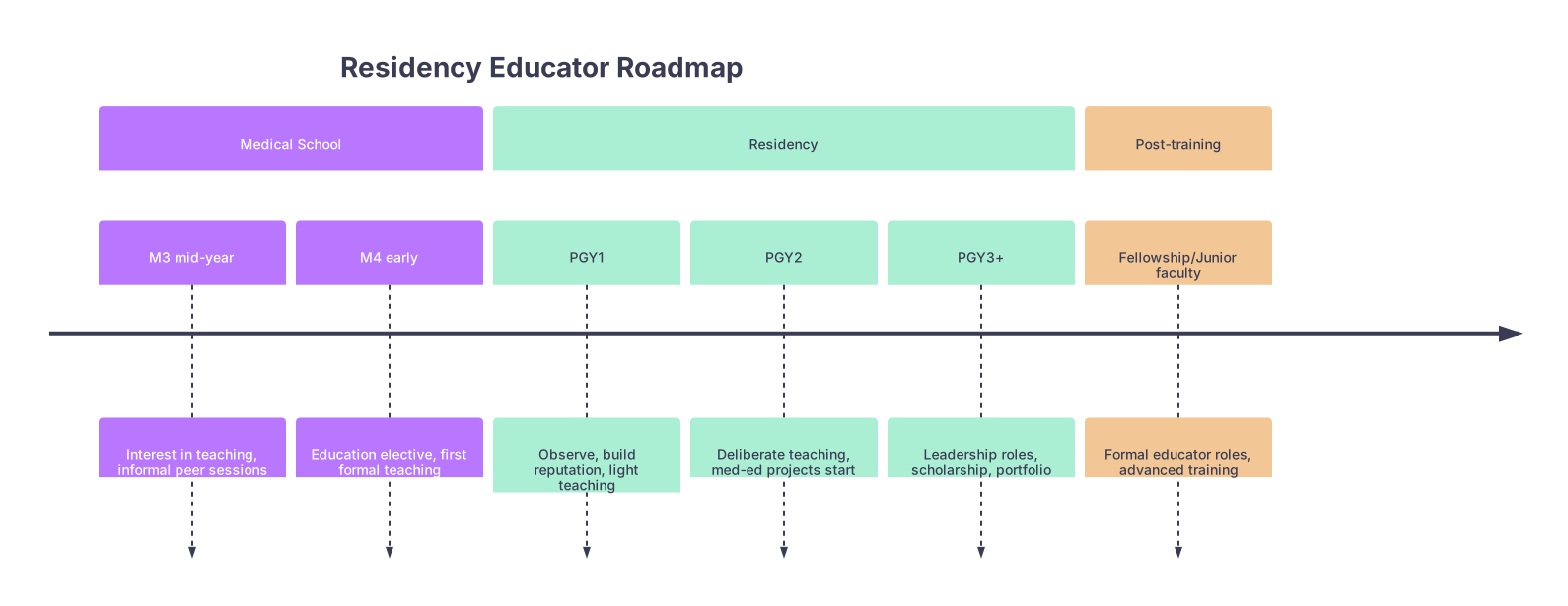
| Period | Event |
|---|---|
| Medical School - M3 mid-year | Interest in teaching, informal peer sessions |
| Medical School - M4 early | Education elective, first formal teaching |
| Residency - PGY1 | Observe, build reputation, light teaching |
| Residency - PGY2 | Deliberate teaching, med-ed projects start |
| Residency - PGY3+ | Leadership roles, scholarship, portfolio |
| Post-training - Fellowship/Junior faculty | Formal educator roles, advanced training |
PGY1: Foundation Year – Build Credibility First
Reality check: your primary job as an intern is not to be an amazing teacher. It is to not kill anyone and to become clinically competent.
But you can quietly lay the groundwork.
First 3 months of PGY1
At this point you should:
- Focus 90% of energy on:
- Efficient notes.
- Safe orders.
- Calling consults without sounding lost.
- Teaching behaviors here are micro:
- Always explain your reasoning out loud when working with students: “I am choosing ceftriaxone instead of piperacillin-tazobactam because…”
- When you do a procedure with a student (ABG, Foley), narrate the steps even if you are doing it yourself.
Months 4–6 of PGY1
Now you are less terrified. You can add explicit teaching.
Weekly actions:
- Pick one topic per week you know cold (DKA fluids, COPD exacerbation, chest pain workup).
- Offer a 5–10 minute “hallway huddle” teaching on that topic once during the week. No slides. Just whiteboard / paper.
- Ask students afterwards: “Was that useful? Anything I could do differently?” That is feedback collection 101.
Meet with your program’s APD for education or residency education director:
- Say: “I am interested in being a teaching-focused resident. How do residents here get involved with formal teaching?”
- Get clarity on:
- Resident-as-teacher curriculum.
- Opportunities to teach:
- Intern bootcamps.
- Clinical skills sessions.
- Sim labs for med students.
Months 7–12 of PGY1
- At this point you should be:
- Routinely offering brief structured teaching for students and juniors.
- Keeping a simple log:
- Date, audience, topic, approximate duration.
- Any written evals or emails praising your teaching.
- Identifying a core med-ed mentor at your institution (often someone on education leadership).
The output by end of PGY1:
- A clear mentor.
- A log of at least 10–15 informal teaching episodes.
- 1–2 invitations (or at least interest) to participate in formal teaching sessions in PGY2.
PGY2: This Is Where “Serious” Officially Starts
If you want to be taken seriously as a future educator, PGY2 is not just “more responsibility.” It is the year you deliberately start building an educator profile.
Early PGY2 (first 3–4 months)
At this point you should:
Secure at least one recurring formal teaching role
- Examples:
- Small-group leader for M2 physical exam course.
- Preceptor in a student clinic half-day per month.
- Case discussion leader in morning report once per block.
- Commit: same group or same role over time. Consistency matters more than flash.
- Examples:
Enroll in a formal “resident-as-teacher” or educator development program if your institution has one:
- Multi-session workshop series (feedback, bedside teaching, case-based learning).
- If there is a certificate, plan to complete it by end of PGY3.
Start your first small education project
- Not a 3-year randomized trial. A small QI-education hybrid is fine.
- Examples:
- Revamp the orientation handout for new M3s on your ward. Measure if evaluations improve.
- Create a short, structured checklist for interns teaching handoffs. Survey confidence before/after.
- Timeline:
- Month 1–2: Identify problem and mentor.
- Month 3–4: Implement small intervention.
Mid PGY2 (months 5–8)
Now is the time to think scholarship.
Actions:
- Turn that small project into an abstract:
- Submit to local GME/education day.
- Aim for a regional or national meeting: APDIM, SGIM, Clerkship Directors networks, etc.
- Request formal teaching evaluations:
- If you teach in a course, ask the course director for compiled feedback.
- Save everything. This becomes your future teaching portfolio.
- Turn that small project into an abstract:
Teaching cadence target:
- 1–2 short teaching sessions per week on the wards.
- 1 formal session per month (small group, sim, skills lab).
Late PGY2 (months 9–12)
This is decision time.
At this point you should:
- Decide how central education will be to your long-term career:
- “I like teaching but it will be 10–20% of what I do.”
- “I want a clinician-educator track faculty job.”
- “I am aiming for program/clerkship director levels eventually.”
- Based on that, scale your involvement:
If you want moderate teaching:
- Continue current roles.
- Maybe one simple project, local poster.
If you want serious educator career:
- Start planning:
- Fellowship with strong education track (if applicable to your specialty).
- Or: Chief resident year with explicit focus on education.
- Meet with:
- Program director.
- A faculty with the job you want in 5–10 years (hospitalist educator, clerkship director).
Output by end of PGY2:
- At least one substantial, repeated teaching role.
- One education project ready for abstract/poster.
- Clear plan for PGY3: leadership, scholarship, or advanced training.
PGY3+ (Senior Resident Years): Build a Real Educator Portfolio
Now you are no longer just “interested in teaching.” People watch you as a model for juniors. Use that.
PGY3 – First Half (months 1–6)
At this point you should:
Hold a named leadership or formal teaching position
- Examples:
- Chief resident (especially “Education Chief”).
- M3 clerkship resident liaison.
- Curriculum committee resident representative.
- Simulation lab teaching resident.
- If your program has a resident teaching award, aim to at least be nominated.
- Examples:
Run structured teaching for groups regularly
- Set a clear cadence:
- 1 recurring series: “Resident noon case series,” “Morning chalk talks,” “ECG bootcamps.”
- Use simple but intentional structure:
- Set objectives in 1–2 sentences.
- Use cases, not lectures.
- Ask for 1-minute written feedback afterward.
- Set a clear cadence:
Finish and present at least one education scholarly product
- Abstract at a conference (local, regional, or national).
- If possible, a brief write-up:
- MedEdPORTAL submission.
- Short education article or innovation piece.
PGY3 – Second Half (months 7–12)
This is transition time. You shift from “resident who teaches” to “future faculty educator.”
Build your teaching portfolio, with:
- CV section “Teaching Experience” listing:
- Roles, dates, learners, approximate hours.
- Summary of teaching evaluations.
- 1–2 paragraphs describing your teaching philosophy—grounded in what you have actually done, not abstract theory.
- CV section “Teaching Experience” listing:
Apply strategically:
- If going to fellowship:
- Target programs with:
- Education tracks.
- Medical education fellowships-in-fellowship.
- Use your educator work in:
- Personal statements.
- Interview conversations. Be concrete: “I led X small group for 2 years and redesigned Y orientation.”
- Target programs with:
- If going directly to faculty:
- Look for clinician-educator positions explicitly.
- Ask in interviews:
- “What proportion of my FTE could be protected for teaching or education projects?”
- “Are there internal educator development programs (e.g., Teaching Academy)?”
- If going to fellowship:
Fellowship / Early Faculty: Formalize and Scale Up
By this stage, “serious preparation” becomes “ongoing career development,” but the timeline logic still holds.
Fellowship: 2–3 Year Intensification Window
Year 1 of Fellowship
At this point you should:
Immediately find:
- A med-ed focused mentor in your new institution.
- The local educator development structure: academy of medical educators, faculty development series.
Within first 6 months:
- Secure a formal recurring teaching slot:
- Didactics for residents.
- Procedural workshops.
- Case conferences.
- Identify a larger education project:
- New curriculum module.
- Simulation case series.
- Assessment tool development.
- Secure a formal recurring teaching slot:
Year 2+ of Fellowship
- Translate your work into:
- Publications (even small MedEdPORTAL pieces).
- National conference presentations.
- Consider:
- A certificate or master’s in health professions education if you are committed to a long-term educator track and can realistically complete the work.
Early Faculty (Years 1–3): Protect Time, Avoid the Trap
The trap is this: you become the “teaching workhorse” who does tons of sessions with no time, no advancement, and no recognition.
At this point you should:
- Negotiate from the start:
- Defined percentage of your job as teaching or education work.
- Specific roles: clerkship co-director, site director, simulation lead, etc.
- Continue the timeline rhythm:
- Year 1:
- Solidify 1–2 formal education roles.
- Join an academy of educators or similar.
- Year 2:
- Take on moderate leadership (course segment lead, small program).
- Produce 1–2 pieces of scholarship from your educator work.
- Year 3:
- Position yourself for official leadership roles: assistant program director, co-clerkship director, etc.
- Year 1:
One-Year Micro-Timeline: When You Decide to “Get Serious” Now
If you are mid-residency and thinking, “I am late,” here is a compressed 12-month plan.
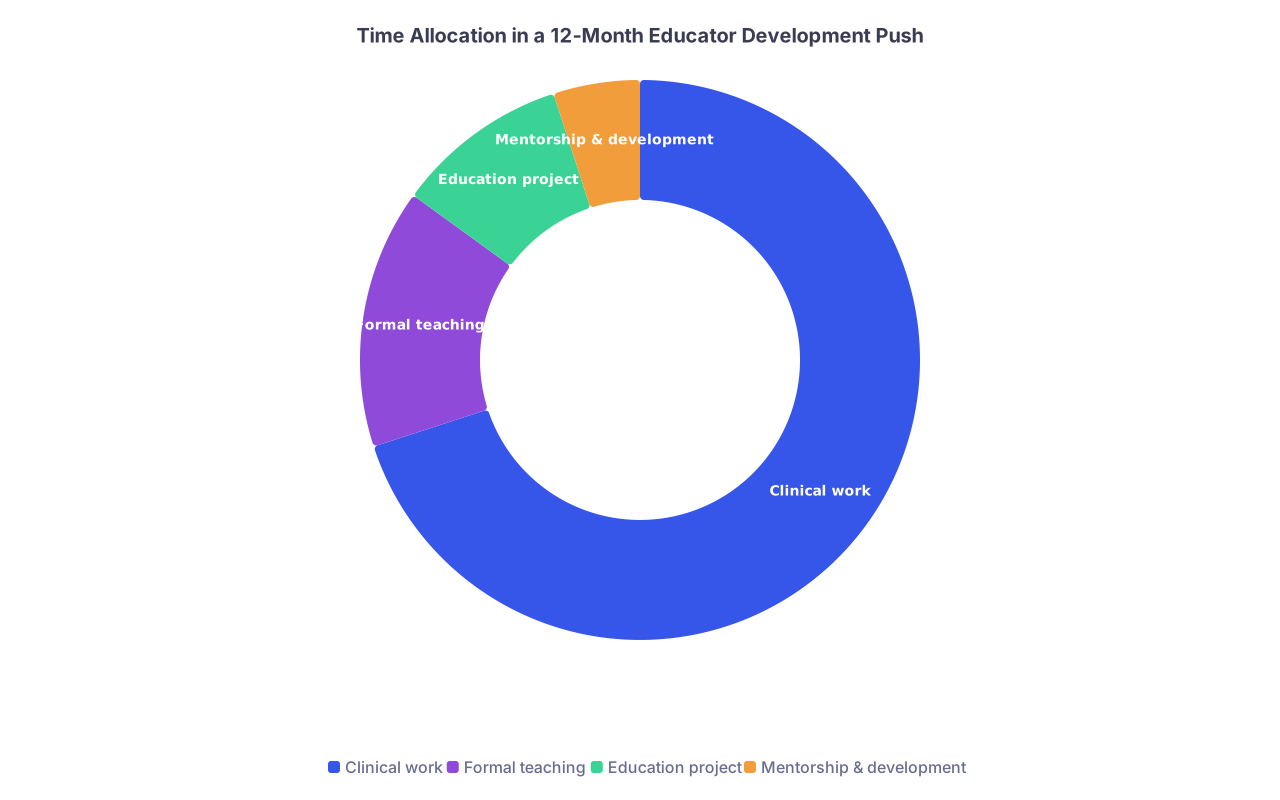
| Category | Value |
|---|---|
| Clinical work | 70 |
| Formal teaching | 15 |
| Education project | 10 |
| Mentorship & development | 5 |
Month 1–2
- Identify mentor.
- Log existing teaching.
- Join any existing resident-as-teacher program.
Month 3–4
- Start one recurring teaching role.
- Define one small education project with clear outcome measure.
Month 5–6
- Collect systematic feedback on your teaching.
- Submit project abstract locally.
Month 7–9
- Expand teaching slightly (but not beyond your capacity).
- Present your project.
- Draft teaching philosophy paragraph.
Month 10–12
- Compile mini teaching portfolio.
- Use it in fellowship/faculty applications or internal roles.
Visual Snapshot: Roles and Focus by Stage
| Stage | Typical Teaching Roles | Primary Educator Focus |
|---|---|---|
| M3–M4 | Peer tutor, small group helper | Explore interest, basic skills |
| PGY1 | Bedside micro-teaching | Build credibility, observe models |
| PGY2 | Small groups, sim, clinic precept | Deliberate practice, first projects |
| PGY3+ | Course leader, chief, liaison | Leadership, scholarship, portfolio |
| Fellowship/Faculty | Course director, APD, clerkship roles | Advanced skills, program building |
Two Key Visuals for Planning

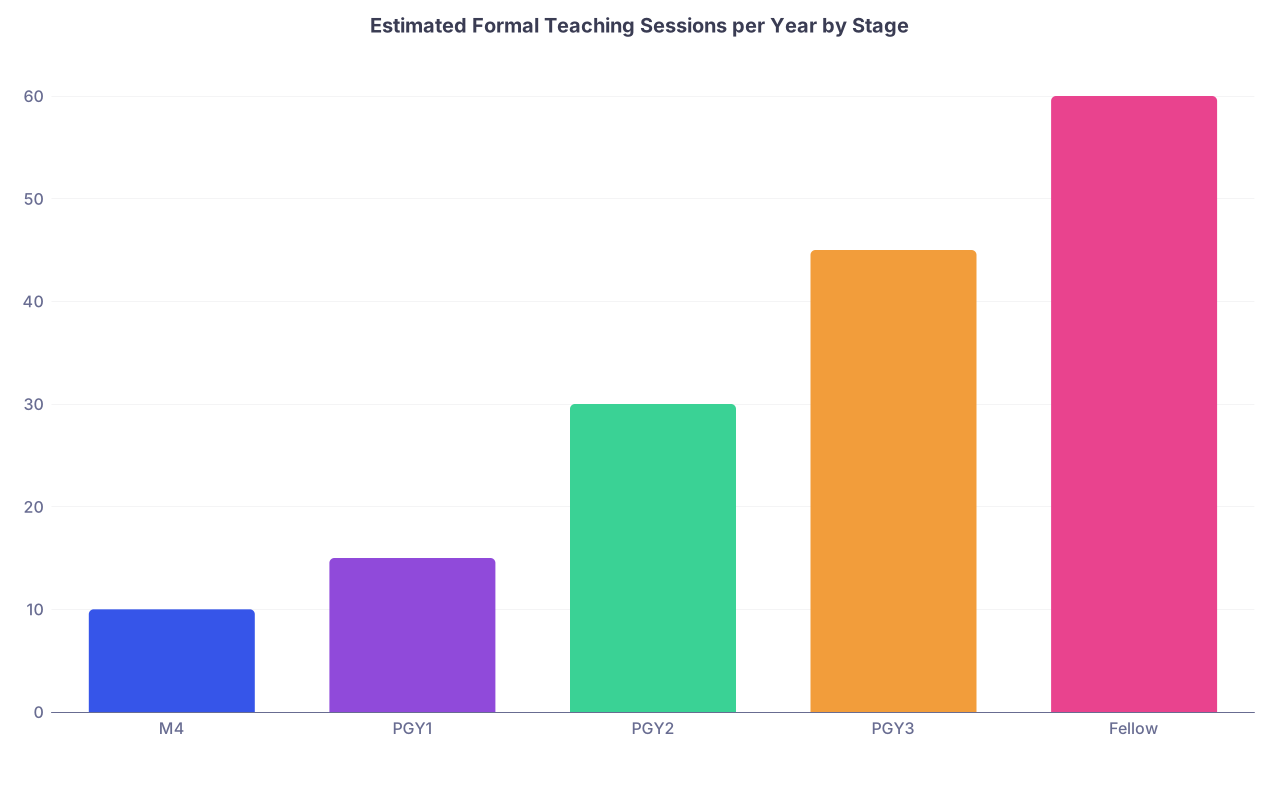
| Category | Value |
|---|---|
| M4 | 10 |
| PGY1 | 15 |
| PGY2 | 30 |
| PGY3 | 45 |
| Fellow | 60 |
Final Thoughts: What Actually Matters
Condensing the whole roadmap into a few sharp points:
- Start earlier than feels necessary. Late M3 / early M4 is not “too soon.” PGY2 is not optional if you want a real educator career.
- Think in roles and projects, not vague “interest.” Each year, you should be able to name: one recurring teaching role and one education project.
- Document everything. Logs, evaluations, abstracts, leadership titles—this is your currency when you want a clinician-educator job, not the number of times you said you “love teaching.”
Follow the timeline, adjust for your specialty, and stop waiting for someone to anoint you as an educator. You become one by acting like it, on schedule, long before the title shows up on your badge.