
Introduction: AI at the Center of Healthcare Innovation
Artificial Intelligence (AI) is no longer a distant concept in medicine; it is now embedded in the daily reality of healthcare systems worldwide. As healthcare innovation accelerates, AI and related medical technologies are transforming how clinicians diagnose disease, plan treatments, conduct research, and deliver patient care—both in person and through telemedicine.
For residents, fellows, and early-career physicians preparing for the post-residency job market, understanding AI is quickly becoming a professional necessity. Employers increasingly expect clinicians to be comfortable working with decision-support tools, data-driven care pathways, and AI-enabled platforms.
This expanded overview explores:
- What Artificial Intelligence in healthcare actually means
- Core technologies underpinning AI-driven medical innovation
- Real-world clinical applications across specialties
- Practical benefits and limitations for patient care and workflow
- Ethical, regulatory, and workforce considerations
- How AI will shape your practice in the coming decade
By the end, you should have a clearer, more nuanced view of AI’s role in modern medicine and how to position yourself to work effectively with these tools after residency.
Understanding Artificial Intelligence in Healthcare
AI in healthcare broadly refers to computational systems that perform tasks requiring human-like intelligence—such as pattern recognition, prediction, reasoning, and language understanding—applied to clinical and operational problems.
Core Technologies Behind AI-Driven Medical Technology
Several overlapping domains of AI power current healthcare innovation:
Machine Learning (ML)
- Systems learn patterns from data and use them to make predictions or classifications.
- Used for risk stratification, outcome prediction, and image interpretation.
- Includes traditional ML (e.g., random forests, gradient boosting) and deep learning (neural networks with many layers).
Deep Learning and Neural Networks
- A powerful subset of ML particularly suited to complex data such as imaging, signals, and free text.
- Convolutional neural networks (CNNs) excel at image analysis.
- Recurrent and transformer architectures handle time-series data (e.g., EHR trends) and language.
Natural Language Processing (NLP)
- Enables computers to read, interpret, and generate human language.
- Applied to clinical notes, pathology reports, radiology reports, and patient messages.
- Powers chart summarization, coding support, and clinical documentation improvement.
Computer Vision
- Specialized AI focused on understanding visual data.
- Crucial in radiology, pathology, dermatology, ophthalmology, and surgery.
- Can detect features at or beyond human perceptual limits.
Robotics and Automation
- AI-augmented surgical robots enhancing precision and ergonomics.
- Autonomous systems in logistics (medication delivery, supply chain).
- Robotic process automation (RPA) for repetitive administrative tasks.
Understanding these components helps clinicians critically evaluate claims about “AI-powered” tools and recognize where such technologies can realistically add value to patient care.
Real-World Clinical Applications of AI in Medicine
AI’s impact is most visible where large volumes of structured or semi-structured data exist—imaging, EHR data, genomics, and claims. Below are key areas where AI is already reshaping practice.
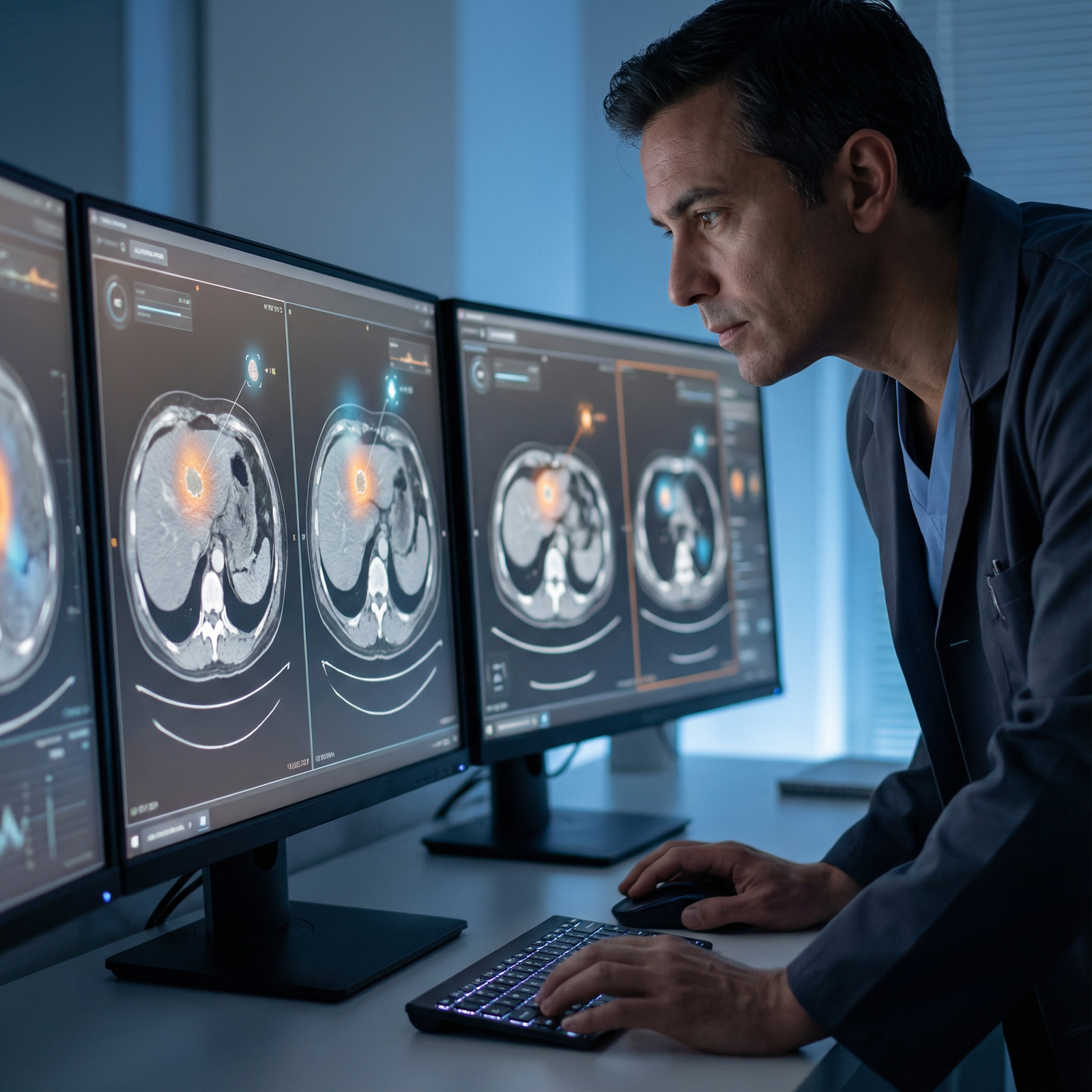
1. AI in Diagnosis and Risk Prediction
AI-based diagnostic support is rapidly maturing across multiple domains.
Imaging-Based Diagnosis
- Deep learning models now match or exceed human expert performance in certain narrow tasks:
- Detection of breast cancer on mammography
- Identification of pulmonary nodules on CT
- Classification of diabetic retinopathy from retinal photographs
- AI can pre-triage studies (e.g., flag suspected intracranial hemorrhage or large vessel occlusion) to prioritize urgent reads, reducing time-to-intervention.
Example: Breast Cancer Screening
Studies published in Nature and The Lancet Digital Health show AI models achieving radiologist-comparable performance in mammogram interpretation, and in some workflows, assisting radiologists to reduce false positives and recall rates.
EHR-Based Risk Prediction
- Predictive models integrate lab trends, vital signs, comorbidities, and medications to:
- Predict deterioration (e.g., sepsis risk, ICU transfer)
- Forecast readmission risk
- Estimate risk of complications or mortality after procedures
- Such tools can power early warning systems, ensuring earlier escalation or targeted follow-up.
Example: IBM Watson Health (Conceptual Legacy)
While IBM Watson Health in its original form has undergone strategic changes, the broader paradigm it introduced persists: mining large clinical and research datasets to support diagnosis and treatment recommendations, especially in oncology. Modern successors continue to use AI to suggest personalized regimens based on tumor genomics, comorbidities, and real-world outcomes.
Actionable Takeaways for Clinicians
- Learn how your institution’s risk scores are derived and validated.
- Use AI outputs as adjuncts, not replacements, for clinical judgment.
- Document clearly when AI contributed to a decision, especially for high-stakes care.
2. Treatment Personalization and Precision Medicine
AI is a powerful engine behind the vision of precision medicine—matching the right intervention to the right patient at the right time.
Genomics and Molecular Profiling
- AI can rapidly analyze high-dimensional genomic, transcriptomic, and proteomic data, identifying:
- Actionable mutations
- Biomarker signatures predicting drug response or toxicity
- Novel disease subtypes that correlate with prognosis
Case Study: Tempus and Similar Platforms
Companies like Tempus combine genomic sequencing with AI-driven analytics to:
- Interpret complex mutation patterns
- Suggest targeted therapies or clinical trials empirically linked to similar profiles
- Provide oncologists with ranked treatment options grounded in both molecular data and outcomes evidence
Clinical Decision Support for Treatment Selection
- Predictive models estimate:
- Likely response to specific chemotherapeutic regimens
- Risk of adverse events from particular medications
- Optimal anticoagulation or antihypertensive strategies for defined phenotypes
- Some platforms integrate cost and formulary data, supporting value-based care decisions.
Dynamic and Adaptive Treatment Pathways
- AI can monitor real-time patient data (labs, symptoms, wearable data) to dynamically adjust treatment plans:
- Adjust insulin dosing suggestions in diabetes management
- Recommend titration of heart failure medications
- Flag patients who deviate from expected recovery trajectories after surgery
For residents transitioning to practice, familiarity with these tools allows for more nuanced, data-informed conversations with patients about risks, benefits, and alternatives.
3. AI in Medical Imaging and Digital Pathology
Imaging is one of the most advanced and heavily validated domains for AI in healthcare.
Radiology
- AI applications include:
- Automated detection and segmentation of lesions, nodules, and fractures
- Quantification of disease burden (e.g., emphysema extent, coronary calcium scoring)
- Automated comparison with prior studies
- These tools improve efficiency by pre-populating measurements and highlighting suspicious areas, supporting radiologists under increasing workload.
Example: Google DeepMind and Eye Disease
DeepMind’s work in ophthalmology demonstrated that AI can:
- Interpret retinal OCT scans
- Detect conditions such as diabetic retinopathy and age-related macular degeneration
- Triage cases by urgency with high accuracy, supporting prioritization in busy clinics
Digital Pathology
- Whole-slide imaging plus AI enables:
- Detection of micrometastases
- Grading of tumors (e.g., prostate cancer Gleason scoring)
- Quantification of tumor-infiltrating lymphocytes and other microenvironment features
- Pathologists remain central but are increasingly supported by algorithms that handle repetitive tasks and highlight atypical regions.
4. AI-Powered Virtual Health Assistants and Telemedicine
The COVID-19 pandemic accelerated the integration of AI into telemedicine and virtual care workflows.
Intelligent Triage and Symptom Checkers
AI chatbots and virtual assistants:
- Collect structured symptom histories before visits
- Provide preliminary triage recommendations (e.g., urgent care vs. self-care vs. primary care visit)
- Integrate with scheduling systems to direct patients to appropriate services
Example: Babylon Health and Similar Systems
Babylon Health’s chatbot and others like it use symptom-checking algorithms to:
- Suggest possible conditions
- Guide patients to appropriate next steps
- Extend access to health information beyond clinic hours
Virtual Care and Remote Consultations
- AI can summarize telemedicine encounters in real time, auto-generating visit notes.
- NLP can extract diagnoses, plans, and orders from the clinician-patient dialogue, reducing documentation burden.
- Video-based AI tools are under development to assess movement disorders, respiratory effort, and facial expressions suggestive of pain or mood changes—though these remain in early validation stages.
Post-Residency Relevance
As telemedicine becomes standard rather than exceptional, clinicians who understand how to leverage AI-enhanced virtual care tools will be more efficient and better able to manage larger panels without sacrificing quality.
5. AI in Drug Discovery, Clinical Trials, and Population Health
AI is reshaping not just bedside care, but the entire pipeline from discovery to delivery.
Accelerating Drug Discovery and Repurposing
The traditional drug development cycle is lengthy and expensive. AI offers:
- Virtual screening of millions of compounds against molecular targets
- Prediction of off-target effects and toxicity
- Identification of promising drug repurposing candidates from existing molecules
Example: Atomwise and Related Platforms
Atomwise uses AI to perform structure-based virtual screening:
- Predicts how small molecules bind to target proteins
- Rapidly narrows the field of candidate compounds
- Has been applied in areas including infectious diseases, oncology, and neurology
Optimizing Clinical Trials
AI can:
- Identify eligible patients from EHRs and registries more efficiently
- Simulate trial outcomes and optimize protocol design
- Monitor safety signals in near-real time using adaptive algorithms
Population Health and Public Health Surveillance
AI-enabled analytics can:
- Forecast disease outbreaks (e.g., influenza, dengue, COVID-19) based on mixed data sources
- Identify high-risk patient subpopulations for targeted interventions (e.g., vaccination campaigns, chronic disease management)
- Support health systems in value-based care contracts by predicting utilization, admissions, and gaps in care
Benefits of AI in Healthcare for Patients and Clinicians
While the promise of AI is sometimes overstated, several concrete benefits are already evident when systems are designed and implemented well.
Clinical and Operational Advantages
Improved Diagnostic Accuracy and Consistency
- Reduced variability between clinicians and across sites
- Detection of subtle or rare patterns that might be missed under time pressure
Enhanced Efficiency and Reduced Burnout
- Automation of repetitive tasks—documentation, order entry prompts, coding assistance
- Shorter time-to-diagnosis and streamlined workflows improve throughput
Better Patient Outcomes and Safety
- Earlier detection of deterioration and adverse events
- More precise risk stratification and tailored therapy
- Enhanced monitoring between visits through remote sensors and telemedicine
Cost Reduction and Resource Optimization
- Avoidance of unnecessary tests and admissions via improved risk prediction
- Optimized use of imaging, ICU beds, and specialized services
- Support for value-based care models and quality-based reimbursement
Career and Workforce Implications
For residents and early-career physicians:
- Skills in interpreting and contextualizing AI outputs will be valued in hiring.
- Clinicians who understand data quality, bias, and evaluation of AI tools can help shape institutional adoption.
- Far from replacing clinicians, AI is more likely to reallocate time away from clerical work toward high-value patient interaction and complex decision-making.
Challenges, Risks, and Ethical Considerations
Despite impressive potential, AI deployment in healthcare carries serious challenges that clinicians must understand and help address.
1. Data Privacy, Security, and Governance
- AI systems require large volumes of sensitive health data.
- Robust de-identification, access controls, and cybersecurity are essential.
- Cross-border data sharing raises regulatory and ethical questions, especially under HIPAA, GDPR, and other frameworks.
2. Algorithmic Bias and Health Equity
- Models trained on non-representative datasets can:
- Underperform in underrepresented demographic groups
- Reinforce or widen existing disparities in access and outcomes
- Examples include mis-calibration by race, ethnicity, or socioeconomic status.
Clinicians should:
- Ask about the datasets and validation cohorts behind AI tools.
- Be alert to unexpected patterns of false positives/negatives in vulnerable populations.
- Advocate for inclusive, representative data in model development.
3. Integration into Clinical Workflow
- Poorly integrated tools add “click burden” and cognitive load.
- Alerts that are too frequent or non-specific lead to alert fatigue.
- Successful implementations:
- Embed AI into existing workflows and EHRs
- Present outputs in intuitive, actionable formats
- Provide training and iterative feedback loops with clinicians
4. Regulatory, Legal, and Professional Accountability
- Regulatory agencies (e.g., FDA, EMA) are evolving frameworks for “Software as a Medical Device” (SaMD) and adaptive algorithms.
- Key questions remain:
- Who is liable when AI-supported decisions cause harm?
- How should clinicians document AI involvement?
- What level of explainability is required?
Physicians will likely retain ultimate accountability for decisions. This means:
- Maintaining independent clinical reasoning
- Understanding when to override AI recommendations
- Being prepared to justify decisions to patients, colleagues, and regulators
5. Trust, Transparency, and Explainability
- Many deep learning models operate as “black boxes,” which can challenge clinician trust and patient acceptance.
- Emerging techniques (e.g., saliency maps, feature attribution) offer partial transparency but require careful interpretation.
- Building trust requires:
- Clear communication about AI’s role and limitations
- Shared decision-making with patients when AI influences care
- Ongoing post-deployment monitoring of performance and harms
The Future of AI in Modern Medicine and Your Career
As you move into independent practice and the post-residency job market, AI will increasingly influence how and where you work.

AI-Enhanced Telemedicine and Remote Patient Monitoring
Telemedicine 2.0:
- Integrated AI triage before visits
- Real-time decision support during video encounters
- Automated documentation after visits
Continuous Monitoring:
- Wearables and home devices streaming vitals, sleep, activity, and symptoms
- AI algorithms flagging concerning trends (e.g., heart failure decompensation, COPD exacerbations, arrhythmias)
- Virtual care teams intervening early to prevent ED visits and admissions
Clinicians comfortable with these tools can manage larger, more complex patient panels while maintaining quality.
Multidisciplinary Collaboration and New Roles
AI will spur new career paths for clinicians, including:
- Clinical informatics leadership roles
- Physician champions for AI adoption and evaluation
- Hybrid careers in healthcare technology, startups, and academic innovation centers
- Participation in algorithm development, validation, and post-market surveillance
Public Health, Policy, and Systems-Level Impact
- AI-enhanced surveillance and modeling will shape responses to pandemics and chronic disease burdens.
- Policymakers will rely on predictive analytics for resource allocation and prevention strategies.
- Clinicians with systems thinking and data literacy will be well positioned to influence policy and leadership decisions.
Preparing Yourself for an AI-Enabled Job Market
Practical steps you can take:
- Develop data literacy: Basic understanding of sensitivity, specificity, AUC, calibration, and bias.
- Engage with your institution’s AI tools: Participate in pilots, give feedback, ask about validation.
- Pursue focused training:
- Clinical informatics electives
- Short courses in AI, digital health, or data science for clinicians
- Participation in quality improvement projects using predictive analytics
- Stay current: Follow journals and conferences in medical technology, AI in healthcare, and digital medicine.
Employers will increasingly value clinicians who can safely and effectively partner with AI to improve patient care.
Frequently Asked Questions (FAQ)
Q1: Will AI replace physicians and other clinicians?
AI is far more likely to augment rather than replace clinicians. Current systems excel at narrow, well-defined tasks—such as image classification or risk prediction—but they lack the holistic reasoning, empathy, contextual judgment, and ethical responsibility that clinicians provide. In most realistic scenarios, AI will handle repetitive or data-heavy tasks, allowing physicians to focus on complex decision-making and direct patient interaction.
Q2: How can I critically evaluate an AI tool being introduced at my hospital?
Ask a few key questions:
- What specific clinical question does the tool address, and how will it change workflow?
- On what population and dataset was it trained and validated? Are these similar to your patients?
- What are its sensitivity, specificity, and calibration, and how do these compare to current practice?
- How are false positives and false negatives handled, and who bears responsibility?
- How will performance be monitored after deployment, and how can clinicians provide feedback?
If these questions can’t be answered clearly, caution is warranted.
Q3: What are the main risks of using AI in clinical decision-making?
Key risks include:
- Over-reliance on algorithm recommendations without sufficient clinical judgment
- Hidden bias leading to poorer performance in specific demographic groups
- Alert fatigue from poorly calibrated systems
- Data breaches or misuse of sensitive patient information
- Erosion of patient trust if AI’s role is not transparently communicated
Mitigating these risks requires thoughtful implementation, clinician oversight, and regular performance review.
Q4: How does AI intersect with telemedicine and remote care?
AI and telemedicine are synergistic:
- AI-powered symptom checkers and triage tools direct patients to appropriate telehealth or in-person care.
- During virtual visits, AI can summarize conversations, suggest diagnoses, and support guideline-based care.
- Between visits, AI analyzes data from wearables and home monitoring devices, flagging issues that require clinician review.
This combination enables more proactive, continuous care, particularly for chronic disease management and rural or underserved populations.
Q5: What should I learn now to be prepared for an AI-driven future in medicine?
Focus on:
- Core concepts in statistics, evidence appraisal, and predictive modeling
- Basics of how ML and NLP are applied in healthcare (at a conceptual level)
- Practical skills in EHR use, clinical documentation, and quality improvement
- Ethical, legal, and equity considerations of digital health tools
You do not need to become a programmer to work effectively with AI, but you do need to understand its capabilities, limitations, and how to use it safely in patient care.
By engaging thoughtfully with Artificial Intelligence and related medical technology, clinicians can help steer healthcare innovation toward safer, more equitable, and more effective patient care. AI is not a replacement for clinical expertise—it is a powerful ally that, when used wisely, can transform both your practice and your patients’ outcomes in the era of modern medicine and advanced telemedicine.