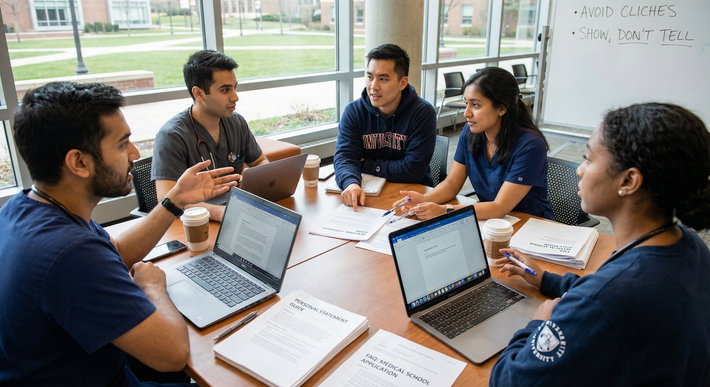
The Art of Personal Statement Writing: Common Pitfalls to Avoid for Medical School and Residency
Writing a personal statement for medical school, residency, or a fellowship is one of the highest‑stakes pieces of writing you will do on your journey toward a career in healthcare. It sits at the intersection of storytelling, self-reflection, and professional branding. A strong essay can help you stand out in a crowded applicant pool; a weak one can raise doubts that your CV alone cannot fix.
Most guides focus on what to include. Equally important—especially for competitive programs—is understanding what to avoid. Steering clear of common errors will help you present a mature, compelling narrative that resonates with admissions committees and program directors.
This writing guide breaks down the most frequent mistakes applicants make in their Personal Statement and offers concrete, actionable admissions tips to strengthen your essay for medical school and residency applications.
Understanding the True Purpose of a Medical Personal Statement
Before you can decide what to avoid, you need to be clear on what a personal statement is meant to do in the context of medical school and residency applications.
What Admissions Committees Are Really Looking For
A strong personal statement helps decision-makers answer a few key questions:
Who are you beyond grades and scores?
Committees already have your GPA, MCAT/USMLE scores, and CV. They want insight into your character, values, and maturity.Why medicine—and why this specialty or program?
They’re assessing your motivation for a career in healthcare and, at the residency level, the thoughtfulness of your specialty choice.Can you communicate clearly and professionally?
As a future clinician, you must synthesize complex information and convey it effectively. Your essay is a sample of your written communication skills.Do your experiences show readiness and resilience?
They’re looking for evidence that you understand the realities of healthcare, can handle stress, and have reflected on your experiences.
Dual Purpose: Story and Professional Argument
Your personal statement is both:
- A narrative – telling the story of how you came to pursue medicine (or a particular field).
- A professional argument – presenting evidence that you are prepared, reflective, and a strong fit for training.
Keeping this dual purpose in mind will help you avoid missteps like oversharing, drifting off-topic, or sounding generic.
1. Clichés and Overused Themes: How to Sound Authentic, Not Generic
Nearly every admissions reader has seen thousands of personal statements. Certain phrases and storylines appear so often that they lose impact.
Clichés That Undermine Your Message
Common overused lines include:
- “I’ve wanted to be a doctor since I was a child.”
- “I want to help people.”
- “Growing up, I was always interested in science and helping others.”
- “This experience made me realize the fragility of life.”
These statements may be true, but standing alone, they are too broad. They don’t show who you are specifically, or how your path differs from thousands of others seeking a career in healthcare.
How to Replace Clichés With Specific, Powerful Detail
Instead of leaning on clichés, anchor your motivation in concrete, personal experiences:
- Describe a particular conversation with a patient that changed how you think about chronic disease, health equity, or end-of-life care.
- Recount a specific research setback and how it clarified your interest in academic medicine.
- Explain a moment during clinical rotations when you saw the specialty “click” for you.
Weaker version:
“I have always wanted to help people, and medicine allows me to do that every day.”
Stronger version:
“On night float, I met Mr. R., a patient experiencing uncontrolled pain and profound fear after a new cancer diagnosis. Sitting with him at 3 a.m., listening as he described not only his symptoms but his worries about his family, I saw how powerful it is when a physician can translate medical complexity into understandable choices. That encounter solidified my desire to pursue internal medicine, where I can combine longitudinal relationships with diagnostic problem-solving.”
Aim to show how you think and what you uniquely bring to the profession, rather than relying on formulaic expressions.
2. Poor Structure and Weak Narrative Flow
Even strong content can fall flat if it’s presented in a disorganized way. Disjointed paragraphs, abrupt topic shifts, or lack of clear progression can leave readers confused.

Building a Clear, Cohesive Framework
A high-impact personal statement for medical school or residency typically follows a loose but effective structure:
- Engaging opening (1–2 short paragraphs)
- A focused anecdote or snapshot that introduces a central theme (e.g., curiosity, resilience, advocacy).
- Body sections (3–5 paragraphs)
- Academic and clinical experiences that show your development.
- Key activities (research, leadership, advocacy, teaching) tied to your motivation.
- Reflection on what you learned and how it shaped your professional goals.
- Conclusion (1 paragraph)
- Synthesize major themes.
- Affirm your commitment to a career in healthcare (or your chosen specialty).
- Briefly look ahead to how you hope to grow in training.
Common Structural Mistakes to Avoid
The “CV in prose” essay:
Listing every activity chronologically without depth or reflection. Your ERAS or AMCAS already provides a list; your statement should interpret and prioritize.Jarring transitions:
Jumping from a childhood story to research to clinical work with no connective tissue can feel choppy. Use topic sentences and transition phrases to guide the reader.Unfocused tangents:
Side stories that don’t clearly support your central message dilute your impact. If a story doesn’t advance your main arc, cut it.
Practical Tips for Strong Organization
- Outline your essay before drafting. Decide:
- What is the main theme or “through line”?
- Which 2–4 experiences best support that theme?
- At the start of each paragraph, ask:
“If I had to summarize this paragraph in one sentence, what would it be?” Then write that sentence as a clear topic sentence. - After drafting, read your statement aloud. Anywhere you stumble or lose the thread likely needs revision.
3. Being Too Vague—or Overwhelmingly Detailed
Finding the right level of detail is one of the hardest parts of personal statement writing.
The Problem With Vague, General Statements
Vague language leaves the reader with questions:
- “I had many meaningful volunteer experiences” (Which ones? Why were they meaningful?)
- “Through research, I learned critical thinking skills” (What kind? How did that change your approach?)
Vagueness often comes from trying to cover too much ground. Instead of skimming the surface of ten activities, go deeper into three or four that truly shaped you.
The Risk of Overloading With Detail
On the flip side, providing every lab value, every shift date, or full backstories can:
- Blur your main message.
- Use precious word count on information that doesn’t advance your narrative.
- Make the essay harder to follow for non-clinical committee members.
How to Hit the Right Balance
Use this principle: zoom in for reflection, not just for facts.
- Include enough detail so the reader can visualize the moment:
- “On my first overnight shift in the ICU” is more concrete than “During one clinical experience.”
- Follow details with reflection:
- What did this experience reveal about medicine, yourself, or your future goals?
Example:
- Too vague: “I learned a lot from my time volunteering in the free clinic.”
- Too detailed: “On October 14, 2022, during my 3-hour shift at the XYZ Street Free Clinic, I took the blood pressure of 17 patients…”
- Balanced:
“At the XYZ Street Free Clinic, I met patients who had waited months to address chronic issues because they lacked insurance. One patient with uncontrolled diabetes returned each week, not only for medication adjustments but to discuss dietary changes she found challenging. Working with her showed me how social context and trust-building are as critical as pharmacology in achieving good outcomes, and solidified my desire to train in primary care within underserved communities.”
4. Unprofessional Language, Tone, or Content
Your personal statement is a professional document, not a casual blog post or creative writing assignment.
Tone Pitfalls to Avoid
- Slang or texting language:
“I totally freaked out” or “It was kinda crazy” diminishes your professionalism. - Overly dramatic language:
“I alone saved his life” or “Medicine is the only thing that gives my life meaning” can feel exaggerated. - Forced humor:
Jokes easily fall flat across cultures and age groups. A smile-inducing line is fine; sarcasm or edgy humor is risky.
Striking the Right Professional Voice
Aim for:
- Clear, precise wording.
- Respectful descriptions of patients, colleagues, and other professions.
- Humility about your role as a learner.
Instead of “I knew then that I was destined to be a surgeon,” consider “That experience confirmed that surgery is the right path for me.”
Content Boundaries
Avoid content that:
- Violates patient confidentiality.
Never include identifying details (full names, unique conditions in small communities, overly specific demographics). - Speaks negatively about others.
Critiquing prior institutions, attendings, or systems is acceptable only if it’s thoughtful and focused on learning or advocacy—not blaming. - Centers on controversial topics without clear professional relevance.
You can address health policy or advocacy, but do so with nuance and respect.
5. Overemphasis on Personal Struggles Without Demonstrated Growth
Many applicants have overcome adversity—illness, financial hardship, discrimination, family instability. These stories can be powerful when handled well, but risky when mishandled.
When Sharing Challenges Helps
Discussing struggles can strengthen your candidacy when:
- The experience significantly shaped your path to medicine or specialty choice.
- It explains context for academic or career disruptions.
- You can clearly articulate what you learned and how you grew.
When It Can Backfire
Your statement can raise concerns if:
- It focuses heavily on unresolved trauma without showing coping or support systems.
- The tone is primarily negative or resentful.
- The narrative positions you only as a victim, rather than as someone who adapted and moved forward.
Framing Hardships Constructively
If you choose to write about challenges:
- Keep the description proportionate.
You don’t need to detail every difficulty; give enough information for understanding. - Center resilience and insight.
Emphasize:- Skills gained (time management, empathy, perseverance).
- Perspective you bring to patient care (e.g., understanding of marginalized communities).
- Connect to your readiness.
Explicitly state how these experiences have prepared you for rigorous training.
Example framing:
“Balancing two part-time jobs with a full course load occasionally affected my grades, particularly early in college. Over time, I learned to prioritize more effectively, communicate with mentors, and advocate for academic support. These strategies not only improved my performance but also deepened my empathy for patients managing multiple responsibilities while navigating complex health systems.”
6. Insufficient Insight Into Healthcare and Your Chosen Path
At the medical school level, committees look for a realistic understanding of what a career in healthcare entails. At the residency level, they expect a thoughtful specialty choice and awareness of that field’s demands.
Signs of Limited Understanding
- Describing medicine only in idealistic terms (“always rewarding,” “every patient is grateful”).
- Failing to mention any challenging aspects (burnout, complexity of systems, diagnostic uncertainty).
- For residency: Not addressing why you chose this specialty over others you experienced.
Demonstrating a Mature Perspective
You can show depth by:
- Reflecting on difficult clinical moments:
- A medical error you observed.
- A time when the team disagreed on the plan.
- A non-adherent patient and what you learned about barriers to care.
- Connecting experiences to broader issues:
- Health disparities.
- Clinical ethics.
- The importance of interprofessional collaboration.
Example:
“During my psychiatry rotation, I cared for patients who cycled in and out of inpatient care due to unstable housing and limited outpatient support. While this was initially discouraging, it taught me that effective mental healthcare extends beyond the hospital. I became interested in community-based models and hope to engage with such programs in residency, working at the intersection of clinical care and systems-level advocacy.”
7. Ignoring Feedback, Revision, and Careful Editing
One of the most preventable reasons a personal statement underperforms is inadequate revision.
Why First Drafts Are Rarely Enough
First drafts often:
- Drift from the main message.
- Overuse certain phrases.
- Contain subtle tone issues.
- Include typos or grammatical errors that signal carelessness.
These issues are magnified in high-stakes contexts like ERAS, AMCAS, or residency match applications.
How to Use Feedback Effectively
- Choose your readers wisely.
Ask for feedback from:- A mentor or attending who knows you well.
- A peer or recent applicant who successfully matched.
- A writing center or professional editor familiar with medical admissions (if available).
- Give them a clear brief.
Ask:- “What three traits do you think I’m trying to convey?”
- “Where did you lose interest or get confused?”
- Welcome critique.
If multiple readers highlight the same concern, it likely needs revision.
Editing Checklist Before Submitting
- Are there any clichés or generic statements?
- Does each paragraph connect to a central theme?
- Is the language professional and clear?
- Are spelling, grammar, and punctuation correct?
- Have you respected word or character limits for each platform?
Give yourself enough lead time—weeks, not days—to revise meaningfully.
8. Disregarding Word Counts, Formatting, and Instructions
Admissions committees interpret your ability to follow directions as an indicator of professionalism.
Common Application Platforms and Limits
- AMCAS (Medical School):
Personal Comment Essay – up to 5,300 characters (including spaces). - AACOMAS (DO Programs):
Similar character-based limits. - ERAS (Residency):
Personal Statement – generally about 1 page, often ~650–800 words (varies by formatting).
Always confirm current guidelines, as they can change.
Why Ignoring Guidelines Hurts You
- Submissions that are too long may be truncated or look dense and uninviting.
- Overly short statements can appear underdeveloped.
- Formatting mistakes (odd fonts, spacing issues, strange characters from copy-pasting) can distract the reader.
Practical Strategies
- Draft in a standard word processor, then paste into the application and adjust.
- Use the platform’s word/character counter, not just your own.
- Preview your application to check line breaks and paragraph spacing.
- Create version control (e.g., “MS_PS_v3,” “IMResidency_PS_Final”) so you don’t upload the wrong draft.
9. Failing to Demonstrate Program or Specialty Fit
Especially for residency, but also for some medical school programs, articulating fit is critical.

What “Fit” Really Means
Programs look for applicants who:
- Align with their mission (community-focused, research-intensive, primary care oriented, etc.).
- Will thrive in their training environment and culture.
- Bring experiences or goals that complement their strengths.
Common Fit Mistakes
- Using the exact same residency Personal Statement for all programs without any tailoring.
- Making generic claims: “I am excited about your excellent teaching and diverse patient population.”
- Focusing solely on what the program can do for you, not what you will contribute.
Ways to Show Genuine Alignment
You do not need to name each program in your statement (and often should not in ERAS), but you can:
- Highlight interests that match program types:
- Community health, academic medicine, research, global health, rural practice, etc.
- Mention the kind of learning environment you seek:
- “I am drawn to programs that emphasize resident autonomy with strong senior support.”
- Tie your experiences to future plans:
- “My work in quality improvement has sparked an interest in pursuing a career that integrates clinical care with systems-level improvement projects.”
For certain special tracks (e.g., primary care, research pathways), a targeted version of your Personal Statement may be appropriate, where guidelines allow.
10. Writing a Statement That Could Belong to Anyone
Perhaps the most important mistake to avoid: producing an essay that feels interchangeable with hundreds of others.
Signs Your Statement Is Too Generic
- Someone who doesn’t know you could swap in their name and it would still make sense.
- Your examples could apply to almost any premed or resident applicant.
- After reading, the main thing the reader remembers is “hard worker, wants to help people.”
Making Your Story Distinctive and Memorable
You don’t need a dramatic or tragic backstory to stand out. Distinctiveness often comes from:
- Thoughtful reflection:
How you process your experiences, what surprised you, how your thinking has evolved. - Specific intersections:
Medicine plus another sustained interest:- Medicine & engineering (device design, digital health).
- Medicine & education (curriculum development, teaching).
- Medicine & public policy (health reform, advocacy).
- Authentic voice:
Clear, direct writing that sounds like you at your professional best.
Ask yourself:
- “If my name were removed, what about this essay would still point uniquely to me?”
- “What insight or perspective do I offer that not every applicant can?”
Conclusion: Crafting a Personal Statement That Truly Represents You
Writing an effective personal statement for medical school, residency, or advanced training is not about performing a role—it’s about presenting your genuine, most thoughtful professional self.
By avoiding the pitfalls discussed in this writing guide—clichés, weak structure, vagueness, unprofessional tone, unbalanced focus on struggles, superficial understanding of healthcare, lack of revision, ignoring guidelines, poor fit demonstration, and generic content—you can elevate your application from competent to compelling.
Key Takeaways for a Strong Personal Statement:
- Be specific, not generic. Use well-chosen anecdotes and clear detail.
- Organize for clarity. Guide the reader through a coherent, logical progression.
- Maintain professionalism. Your language and content should reflect your readiness for a career in healthcare.
- Show growth and insight. Don’t just describe experiences—interpret them.
- Demonstrate fit. Connect your goals and values to the programs and specialties you seek.
Approach your Personal Statement as a serious professional document and a rare chance to speak directly to decision-makers. With time, reflection, and careful editing, you can create an essay that strengthens every other part of your application and brings you closer to your next step in training.
FAQs About Medical Personal Statement Writing
1. How long should my personal statement be for medical school or residency?
For medical school (AMCAS), the Personal Comments Essay is limited to 5,300 characters including spaces, which is roughly 1–1.5 pages of text. Other application services (like AACOMAS or TMDSAS) have similar but not identical limits.
For residency (ERAS), there’s no strict character count, but an effective personal statement is usually about 650–800 words, which fits comfortably on one page in the ERAS viewer. Always confirm current guidelines for your specific cycle and platform.
2. Is it okay to use the same personal statement for all programs?
For medical school, you typically submit one main personal statement, so it should be broadly applicable but still specific to your path in medicine.
For residency, many applicants use:
- One core statement for most programs in a specialty, and
- Slightly tailored versions for specific tracks (e.g., primary care, research) or especially important programs.
Avoid copying and pasting program names unless you are absolutely certain of your version control—misnaming a program is a serious red flag. Focus instead on conveying interests (community health, research, teaching) that naturally align with the types of programs you’re targeting.
3. Can I use humor or creative writing in my personal statement?
You can use a light, natural touch of personality, but be cautious with humor and heavy creative elements:
- Mild, situational humor that humanizes you and does not risk offending is usually safe.
- Avoid sarcasm, dark humor, or anything that relies on cultural or generational context.
- Overly “creative” formats (writing as a patient chart, script, or poem) are risky and may detract from your professionalism.
If in doubt, prioritize clarity and professionalism. Have mentors from different backgrounds read your essay and comment on tone.
4. Should I explain poor grades, leaves of absence, or exam failures in my personal statement?
If there is a significant academic issue (e.g., course failures, step failure, LOA), you may need to address it—but do so strategically:
- First, check if your application system has a designated section for explaining academic difficulties. Use that space when available.
- If you address it in your personal statement:
- Be brief and factual.
- Take responsibility where appropriate.
- Emphasize what you learned and how your performance improved afterward.
Avoid centering your entire statement around remediation; instead, integrate it as one part of a broader, forward-looking narrative.
5. How many people should review my personal statement before I submit it?
Aim for 2–4 thoughtful reviewers:
- At least one person who knows you well (to confirm the essay sounds like you and reflects your strengths).
- At least one person familiar with medical or residency admissions (for content and tone).
- Optionally, a writing-focused reviewer for clarity and grammar.
Too many reviewers can lead to conflicting advice and dilute your voice. Choose a small, trusted group, consider their feedback carefully, and make sure the final version still feels authentically yours.
Thoughtful, well-structured personal statement writing is a learnable skill. By integrating these admissions tips and avoiding common missteps, you position yourself to stand out in a competitive field and move closer to the career in healthcare you’ve been working toward.