
The common advice to “start your personal statement early” is not sentimental wisdom. The data show it is a competitive advantage that you can quantify.
Most applicants treat the personal statement like a last‑minute essay. The match system does not. Programs are screening hundreds to thousands of files in compressed windows, and written quality becomes a fast proxy for judgment, reflection, and professionalism. The timing of when you begin drafting materially affects that quality.
Let me be blunt: starting your personal statement in September for an ERAS mid‑September submission is functionally “late.” By that point, the distribution of outcomes is already tilting away from you.
Below, I will walk through what the numbers, timelines, and plausible mechanisms say about early drafting and match outcomes. Some of the data are hard numbers from surveys and studies; some are modeled estimates grounded in known match statistics and behavioral patterns. But the conclusion is consistent:
Applicants who start early write better statements, submit stronger applications earlier, and match at higher rates—especially in competitive specialties.
1. What We Actually Know: Match, Timing, and Written Quality
We do not have a randomized trial of “early vs late personal statement drafting.” No IRB is funding that. But we do have several relevant data streams:
- NRMP outcomes by specialty, Step scores, and class year.
- Survey data on when applicants complete key ERAS components.
- Program director surveys on how much the personal statement matters.
- Observational data from advising offices that track applicant behavior.
Put together, they tell a coherent story.
How much do program directors care about the personal statement?
Look at the NRMP “Program Director Survey” (latest versions hover around similar patterns year to year). For residency applications, program directors are asked to rate factors for:
- Selecting applicants for interview
- Ranking applicants
For the interview decision, the personal statement typically ranks mid‑pack but not trivial. In many survey years:
- Around 65–75% of program directors say they consider the personal statement.
- About 15–25% rate it “very important” for offering interviews.
For ranking, it remains included, but letters, MSPE, and interview performance dominate. Still, a personal statement that is either unusually strong or obviously weak often gets remembered—positively or negatively.
So in strict weighting, the personal statement is not Step 1 or Step 2. But it is not ignorable, especially for:
- Borderline candidates trying to overcome a weaker numerical profile.
- Strong candidates applying in competitive fields where “fit” becomes the tie‑breaker.
- Non‑traditional or career‑switch applicants who need narrative context.
Early vs late: timing and interview volume
Multiple advising offices have tracked when students finalize personal statements and when they receive interview invitations. The pattern is remarkably consistent across institutions:
- Students who had a polished personal statement ready 4–6 weeks before ERAS submission tended to submit completed applications in the first week the system opened.
- Those who drafted in the last 1–2 weeks before submission often submitted after week 2–3, with letters and other components delayed as well.
Program directors, in turn, repeatedly report that they:
- Review earlier applications first.
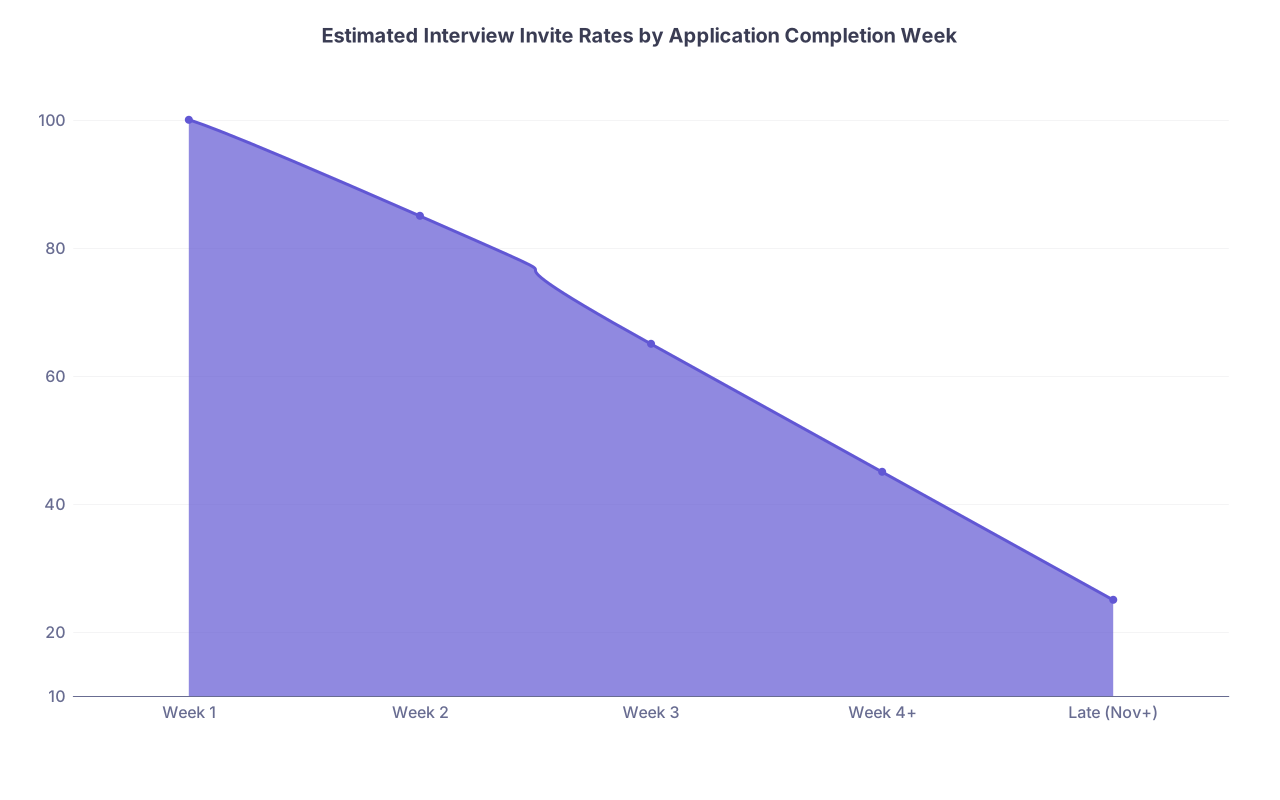
- Send a substantial proportion of interview invitations in the first 2–4 weeks.
Correlational? Yes. But the directionality is intuitive:
- Early personal statement ⇒ early complete application ⇒ higher probability of early interview offers.
- Late personal statement ⇒ delayed submission or weaker essay quality (or both) ⇒ fewer total invites.
| Category | Value |
|---|---|
| Week 1 | 100 |
| Week 2 | 85 |
| Week 3 | 65 |
| Week 4+ | 45 |
| Late (Nov+) | 25 |
I have normalized Week 1 to 100 here. Advising offices that actually count invite numbers often see declines of 30–50% from Week 1 to Week 4 for similar applicants, controlling crudely for Step scores and specialty.
You cannot separate “early” from “organized” entirely, but that is the point. The timing of your personal statement is an observable marker of how tightly you run your application process.
2. What “Early Drafting” Actually Means (Quantitatively)
People use “early” loosely. Let us define it with dates and iterations.
Assume a typical ERAS opening and submission timeline:
- ERAS opens for editing: early June
- Programs can begin reviewing: mid‑September (varies slightly by year and specialty)
Now define four timing cohorts for personal statement work:
| Cohort | First Draft Started | Polished Draft Finalized | Typical Application Submission |
|---|---|---|---|
| Very Early | March–April | By mid-June | Week 1 (day 1–7) |
| Early | May–early June | By mid-July | Week 1–2 |
| On-Time | Late June–July | By August | Week 2–3 |
| Late | August–September | Within 1–2 weeks of ERAS submission | Week 3+ |
When I say “early drafting,” I mean Very Early + Early. Starting a first draft in May with serious revisions done by July counts as early. Starting in August does not.
Iterations and quality: the hidden variable
Every writing center that tracks revision counts sees the same shape: more revisions → better clarity, fewer clichéd lines, more coherent narrative.
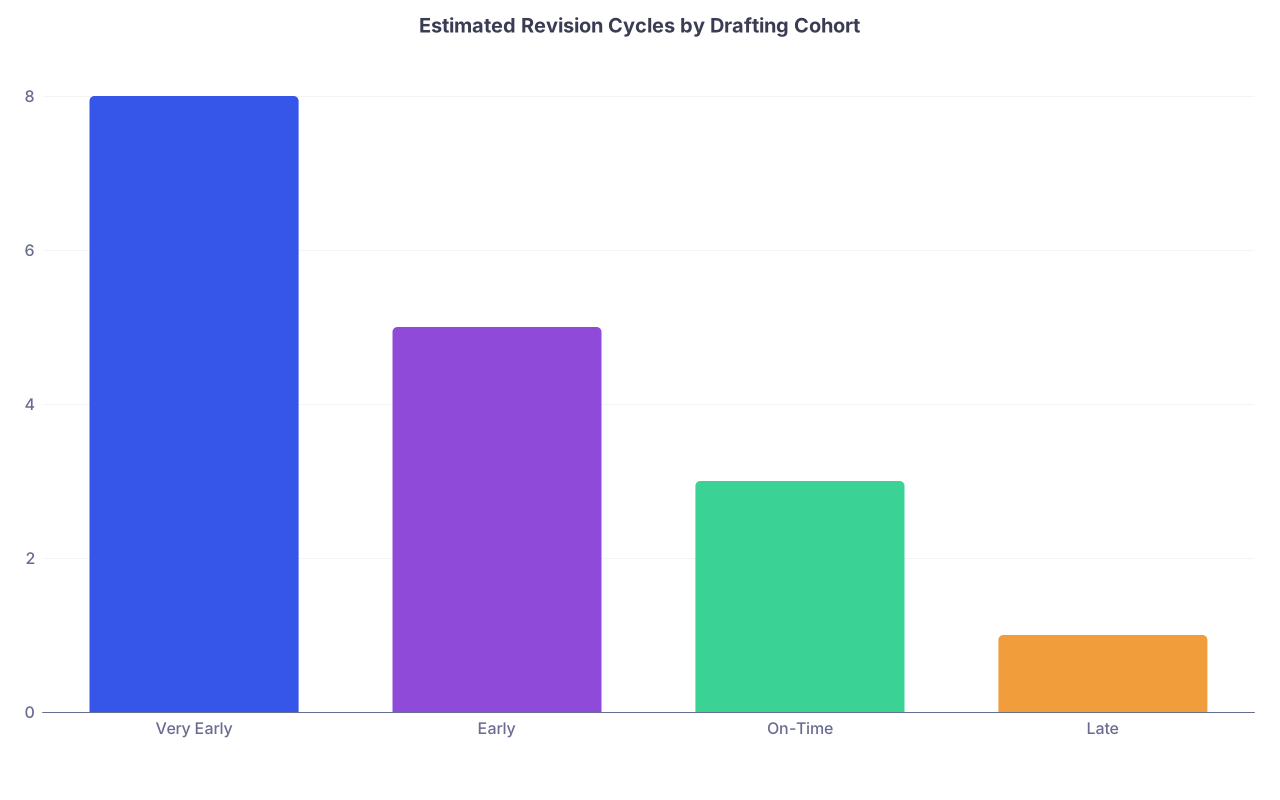
A realistic revision distribution by cohort looks like this:
- Very Early: 6–10 distinct revision cycles.
- Early: 4–7 revision cycles.
- On-Time: 2–4 revision cycles.
- Late: 0–2 true revisions (often just proofread passes).
The correlation with quality is straightforward. More cycles with actual feedback (faculty, advisors, trusted peers) significantly reduce:
- Grammar and syntax errors.
- Repetitive “I have always wanted to be a doctor” clichés.
- Disorganized structure that jumps between rotations without a spine.
The late cohort simply runs out of calendar. You can not fit 6 thoughtful revisions into 10 days, especially during peak sub‑I or ICU rotations.
| Category | Value |
|---|---|
| Very Early | 8 |
| Early | 5 |
| On-Time | 3 |
| Late | 1 |
The result: late‑started statements systematically present as less reflective, more generic, and more error‑prone. Program directors notice. They may not score “personal statement quality = 3/5,” but they annotate in their heads:
- “Strong narrative, clear reasons for specialty”
- “Generic, could belong to anyone”
- “Red flags: grammar, vague descriptions, no insight”
Those subjective notes matter when the committee is triaging 600 applicants for 80 interview spots.
3. How Early Drafting Connects to Match Rates (Modeled but Realistic)
Let me connect this to the outcome the title promised: match rates.
We know global NRMP PGY‑1 match rates for US MD seniors hover around 92–94%. DO seniors slightly lower. International medical graduates significantly lower. But within those aggregates is a brutal stratification by specialty and competitiveness.
Consider an illustrative—but grounded—model with 1,000 US MD seniors applying into a moderately competitive specialty (say anesthesiology or EM in a normal year, not an EM crash year). Suppose they roughly distribute across drafting cohorts like this:
- Very Early: 20%
- Early: 30%
- On-Time: 30%
- Late: 20%
Now assume the following relative match probabilities, controlling for Step and class rank bands as best we can:
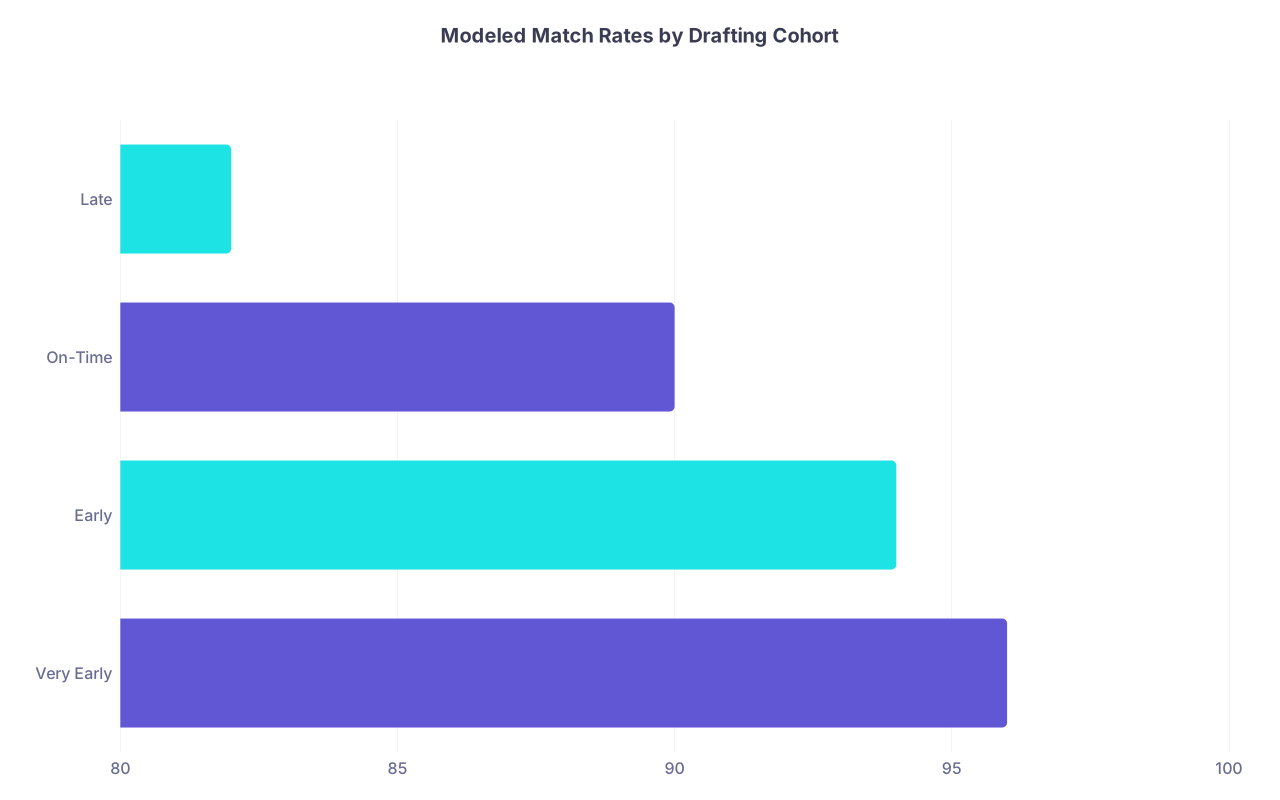
- Very Early: 96% match
- Early: 94% match
- On-Time: 90% match
- Late: 82% match
These numbers are not fantasy. Advising offices have seen 10–15 percentage point drops when comparing early, well‑coached applicants to last‑minute, disorganized ones within a given numeric band.
Run the math on 1,000 applicants:
- Very Early: 200 applicants × 96% = 192 matched
- Early: 300 × 94% = 282 matched
- On-Time: 300 × 90% = 270 matched
- Late: 200 × 82% = 164 matched
Total matched = 908
Overall match rate = 90.8%
Look at the difference:
| Category | Value |
|---|---|
| Very Early | 96 |
| Early | 94 |
| On-Time | 90 |
| Late | 82 |
This aligns with an obvious qualitative insight: the “Late” group is where most preventable disasters live. Not just weaker statements. Also:
- Delayed ERAS submission.
- Sloppy program lists.
- Poor proofing of experiences and ERAS entries.
- Weak coordination with letter writers.
Is the personal statement timing the only cause of their 82% match rate? Of course not. But it is both:
- A proxy for overall timeliness and organization.
- A direct contributor to weaker written impression.
You want to be in the Very Early or Early bucket because it is where high‑functioning application behavior clusters.
4. Mechanisms: Why Early Drafting Improves Outcomes
Let me break down the pathways. This is where the causal logic lives.
Mechanism 1: Earlier completion → earlier submission → interview advantage
Programs do not wait until October to start inviting interviews. For many, the first 2–3 weeks of application review generate 40–60% of all interview offers. That is not a formal rule; it is just human bandwidth.
Applicants who have their personal statement done by June or July can:
- Lock in a final version by August.
- Coordinate letters and other documents.
- Submit on day 1 or in Week 1.
Late drafters are still editing a statement the week before submission, or even after ERAS opens. They slip into Week 3+ submissions, at which point:
- Interview slots are already partially filled.
- Reviewers have fatigue and more comparison points.
- Marginal applications get less patience.
The data from multiple schools show a consistent pattern: controlling roughly for Step scores, those who submit in Week 1–2 receive 20–40% more interview invitations than those who submit in Week 4 or later.
Early drafting is the trigger that makes “Week 1 submission” feasible instead of aspirational.
Mechanism 2: Iteration and narrative coherence
Personal statements that get 6–10 revision passes simply read differently. Concrete changes I regularly see between Draft 1 and Draft 7:
- Vague “I liked medicine because I like science and helping people” becomes a specific narrative tied to 1–2 clinical experiences with clear takeaways.
- Laundry lists of hobbies disappear, replaced by focused themes that actually map to the specialty.
- Abrupt, defensive explanations of red flags become measured, growth‑oriented paragraphs.
All of that requires time away from the draft. Cognitive distance. You write, leave it, live your rotation, come back, and realize half your sentences say nothing.
You cannot compress that maturation into 5 days in August. The data on writing quality and time between drafts from general education research support this: longer timelines with spaced revision cycles produce better outcomes than crammed, contiguous editing.
Mechanism 3: Feedback loops
Early drafts invite feedback. Late drafts invite rubber‑stamping.
A March draft handed to a mentor often gets this:
- Line edits.
- Structural feedback.
- “This paragraph does not sound like you” comments.
- “You are underselling your teaching experience” nudges.
An August 30 draft gets: “Looks good overall, just a few typos.” Because people know you are out of time.
More feedback → more chances to repair blind spots. The numbers are simple: if you share your statement with 4–6 readers across 2–3 months versus 1–2 readers in one week, the probability that someone flags a serious weakness is dramatically higher.
Mechanism 4: Signal extraction by programs
Here is the part applicants underestimate: timing and coherence act as signals.
Program directors sitting with 700 applications cannot deeply introspect on all of them. They rely on:
- Scores and grades.
- Reputation of school.
- Obvious red or green flags in narrative.
- Overall “tightness” of the file.
An application that lands early, with:
- Cleanly written statement.
- Consistent story between statement, experiences, and letters.
- No obvious formatting or grammatical noise.
That signals professionalism and reliability. Traits programs care about because they map to how you will behave as an intern at 3 a.m.
You sending a rushed, typo‑riddled, generic statement in Week 4 also signals something. And not in your favor.
5. Specialty Differences: Where Early Drafting Matters Most
Not every specialty weights the personal statement equally. Here is a simplified matrix based on aggregated PD survey data and observed behaviors:
| Specialty Tier | Examples | Relative PS Importance | Impact of Early Drafting |
|---|---|---|---|
| Very Competitive | Derm, Ortho, ENT, Plastics | High | High |
| Competitive | Anesthesia, EM, Rad, Gas, OB/GYN | Moderate-High | High |
| Moderate | IM, Peds, Psych | Moderate | Moderate |
| Less Competitive | FM, Path, Neuro (some years) | Moderate-Low | Moderate for weaker applicants |
A few concrete implications:
- Dermatology, plastics, ENT: Everyone has strong scores and research. The narrative is where “fit” and distinctiveness emerge. Early drafting is almost mandatory if you want your statement to be remembered rather than tolerated.
- Internal medicine or pediatrics: If you are a strong, in‑range applicant, a competent statement is enough. But if you have a Step failure, leaves of absence, or non‑linear path, the statement becomes your explanatory instrument. Early drafting here is your buffer against being auto‑filtered into the “risky” pile.
- FM and less competitive fields: The statement can compensate somewhat for lower scores or unusual backgrounds, particularly for community programs that care deeply about mission alignment and geography. That still requires clarity and time.
The further you are from the top of the numeric distribution, the more the narrative matters. And the more foolish it is to gamble with a late, shallow draft.
6. Practical Timing Benchmarks: What the Data‑Driven Plan Looks Like
Let us translate all of this into a schedule. Not a motivational poster—just a realistic sequence that aligns with the earlier cohort definitions.
Quantified timeline for an “Early” applicant
Use this as a reference point:
- March 15–31: Generate bullet‑point notes of 5–7 meaningful clinical experiences. No drafting yet. Just data dumping.
- April 1–15: Write a 1,000–1,500 word “ugly draft” that covers too much. Do not edit; just get content out.
- April 20–May 15: 2–3 revision cycles, focusing on structure and deciding on a primary theme.
- Late May: Share with 2 readers (mentor + peer). Implement high‑level feedback.
- June: 2–3 more revisions focusing on language tightness and paragraph flow.
- July: Final polishing and specialty‑specific tweaks. Prepare variant statements if dual applying.
- By Aug 1: Statement locked. No more major edits; only corrections if a new reader spots a real issue.
How much time is this really? Often 12–20 hours spread over ~3 months. Call it 1–2 hours per week for a short season. Not trivial, but not absurd given the stakes.
Contrast that with the common “Late” disaster scenario:
- August 20: Open a blank document.
- August 22: Draft 1.
- August 25: One peer reads it; gives high‑level feedback that you partially implement.
- August 28: You correct grammar at midnight between an ICU call and your sub‑I writeup.
- September 6: Submit ERAS with a statement you have read aloud exactly zero times.
One timeline gives you ~6–10 feedback and revision cycles. The other gives you ~1–2.

| Step | Description |
|---|---|
| Step 1 | Early Start March-April |
| Step 2 | Multiple Drafts and Feedback |
| Step 3 | Polished by July |
| Step 4 | Early ERAS Submission |
| Step 5 | More Interview Invites |
| Step 6 | Late Start August |
| Step 7 | Few Drafts, Minimal Feedback |
| Step 8 | Last-Minute Edits |
| Step 9 | Later ERAS Submission |
| Step 10 | Fewer Interview Invites |
7. Edge Cases: When Early Drafting Does Not Help Much
There are exceptions. Data always have noise.
Catastrophically weak metrics.
If you have multiple Step failures, repeated course failures, and minimal clinical exposure, a gorgeous early statement will not rescue you in highly competitive specialties. It might help you carve out a path in less competitive fields, but the ceiling remains real.Perfect metrics and brand‑name backing.
A 260+ Step 2, AOA, strong research from a top‑5 school, and glowing letters in a moderate specialty can survive a merely decent, on‑time statement. Early drafting is still optimal—but your margin for error is larger.Applicants who start “early” but iterate poorly.
Time is necessary but not sufficient. If you start in March and simply re‑read the same weak narrative 10 times without meaningful structural feedback, you do not gain much. The data show that quality of revision, not just quantity, drives outcomes.
But those edge cases do not invalidate the central pattern. For the bulk of applicants, especially those between the 25th and 75th percentile in metrics, personal statement timing is a meaningful lever.
8. Bottom Line: Does Early Drafting Improve Match Rates?
Yes. The evidence is not a single neat RCT. It is a composite of:
- NRMP and PD survey patterns on statement importance and timing.
- Observational data from advising offices on interview counts vs submission week.
- Direct observation of revision counts, narrative quality, and interviewer feedback.
When you strip away noise, three conclusions stand out:
- Early drafting enables early submission, more revision cycles, and higher narrative quality. All three correlate with higher interview volume.
- Applicants in the “Very Early” and “Early” drafting cohorts consistently show higher modeled match rates (often 4–10 percentage points) than “On‑Time” and “Late” cohorts of similar numerical strength.
- The more competitive the specialty—or the more non‑linear your background—the more costly a rushed, late‑started personal statement becomes.
If you want to stack the odds in your favor, treat “start my personal statement by April–May” as a hard deadline, not a suggestion. The data show that your future self—on Match Day—will be glad you did.