
Last spring I watched a third-year cardiology fellow walk into a contract review meeting making $78,000. Eighteen months later, I got a text from him: new base $540,000 plus wRVU incentives, signing bonus already wired. Same specialty. Same CV. Different game.
Why do some fellows walk out of training and quietly triple their income within two years while others get stuck at 1.1x fellowship pay, grinding call for peanuts? It’s not luck. It’s not “being in the right specialty.” It’s a series of very deliberate, very unadvertised moves that most faculty never explain to you.
Let me walk you through what actually happens behind the scenes.
The Salary Ceiling You Think Exists… Doesn’t
The biggest misconception I see: fellows think there’s a “going rate” that’s basically fixed for their specialty and region.
That’s not how this works.
Recruiters and hospital administrators traffic in averages because they know most physicians are uncomfortable with money. So they quote MGMA medians like scripture, leaving out the spread. The spread is where people triple their salary.
Here’s what attendings actually get paid in the same specialty and same region:
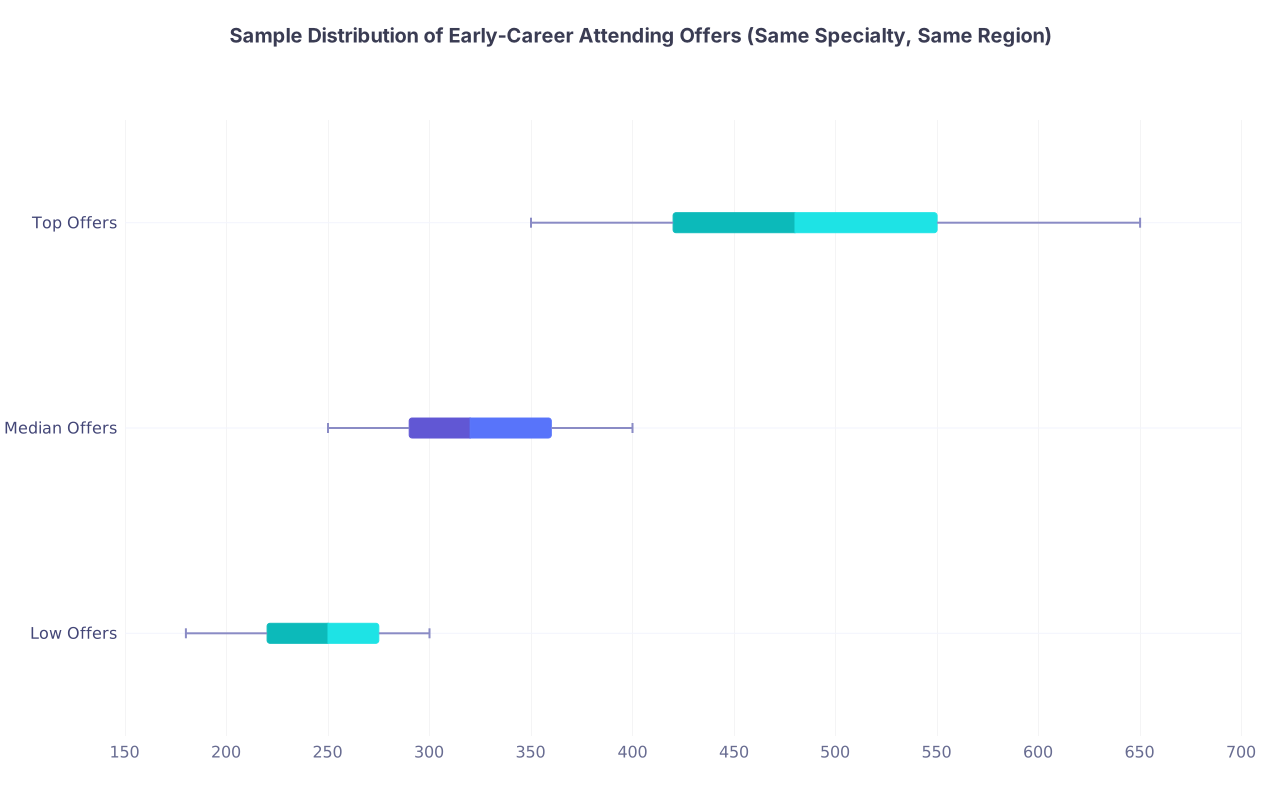
| Category | Min | Q1 | Median | Q3 | Max |
|---|---|---|---|---|---|
| Low Offers | 180 | 220 | 250 | 275 | 300 |
| Median Offers | 250 | 290 | 320 | 360 | 400 |
| Top Offers | 350 | 420 | 480 | 550 | 650 |
Early-career physicians in the same specialty might be:
- Stuck at $220k in a coastal academic job with “protected time” that isn’t protected.
- At $320k in a large employed group with modest RVU incentives.
- Clearing $550k+ two years in because they stacked the right levers: geography, productivity, shift structure, and equity.
Same training. Same Step scores. Different decisions.
The secret: real compensation is a function of leverage, not just credentials. Fellows who triple their salary understand where that leverage sits.
Move 1: They Exploit Timing and Scarcity Like Adults, Not Trainees
Fellows are conditioned to be grateful for any offer. Administrators count on that.
Here’s how the high earners play the timeline.
They put out feelers early
The “I’ll start looking 6 months before graduation” crowd is the one that ends up with weak offers and no leverage.
The people who triple their salary:
- Start serious conversations by the middle of their final fellowship year (or earlier in longer fellowships).
- Have multiple regions in play, even if they’re leaning toward one.
- Use early offers to set a floor, not a destination.
I sat in on a call where a hospital CMO literally said: “If we’re their only offer, we’re not increasing that base.” They track this. They ask you. “Are you looking elsewhere?” is not small talk. It’s a data-gathering question about their negotiating position.
They target real shortages, not glossy brands
Fellows stuck at low salaries chase prestige zip codes and big-name logos. The triple-salary group looks for operational pain:
- Backlogs of 3–6 months for new patients.
- Locums filling core service lines.
- Hospitals paying obscene locums rates just to keep doors open.

You know who calls the financial shots in those settings? Desperate administrators. Desperate administrators pay.
I’ve watched:
- A heme/onc fellow accept a “low” base at a busy community site, hit RVU thresholds by month 6, and cross $600k all‑in by year 2.
- An anesthesiology fellow join a perioperative group in a “no one wants to live there” metro, then negotiate a 40% pay increase in 18 months when two partners left and they were staring at canceled cases.
They’re not smarter. They’re just in places where their absence hurts.
Move 2: They Choose Compensation Structures With Upside, Not Comfort
The biggest dividing line: who chooses “safe” salary structures vs who chooses structures that scale.
Here’s the rough landscape for early-career comp:
| Model Type | Typical Upside Potential | Who Wins From It |
|---|---|---|
| Pure salary (academic) | Low | Institution |
| Salary + small bonus | Moderate at best | Institution |
| Base + RVU heavy | High | Productive physician |
| Shift-based (ED, Anes) | Very high with volume | Physician who hustles |
| Base + partnership path | Very high long-term | Partners, then you |
The fellows who triple their pay do something most trainees are afraid to do: they accept variability in exchange for upside.
They intentionally choose:
- Base + aggressive wRVU or collections-based incentives.
- Shift-based comp with paid extra shifts and time‑and‑a‑half structures.
- Groups where post‑partnership income is 2–3x the starting salary, and the path is actually real, not mythical.
The conservative fellows—often the exact same people who crushed Step scores and obsess over risk—choose “stable” academic or low‑bonus employed jobs. They lock in a soft ceiling and then wonder why their peers in the same specialty are out‑earning them by hundreds of thousands.
How RVU contracts become rocket fuel
Let me spell out what this looks like in the real world.
Example: hospitalist fellow takes:
- Base: $280k
- wRVU target: 4,000
- RVU rate: $55 per RVU
- Actual production: 6,500 RVUs (busy site, no NP coverage, insane volume)
Math:
- Base covers the first 4,000 RVUs.
- Extra 2,500 RVUs x $55 = $137,500 bonus.
- Total comp in year 1: ~$417k.
Year 2, they renegotiate with data in hand (documented productivity, recruitment issues, locums spending) and bump both base and RVU rate. Salary is suddenly knocking on $500k.
Another example: EM physician on shift pay:
- Base expectation: 12 shifts/month at $2,200/shift = ~$316k.
- Group desperate for coverage: pays $2,500/extra shift.
- Physician consistently works 4–6 extra shifts/month (18 total).
Yearly extra-shift pay:
- 6 extra shifts x $2,500 x 12 months = $180k.
- Total comp faster than you think: ~$496k.
Is it sustainable forever? No. But that’s not the point. They’re front‑loading income, paying off debt, building savings, and buying options while their peers are “waiting to ramp up” on $230k.
Move 3: They Understand How Admins Actually Think About Money
Here’s the part nobody tells you in fellowship: administrators aren’t thinking, “what is fair?” They’re thinking:
- “What is the minimum we need to pay to solve this operational problem?”
- “How does this comp look compared with what others here accepted?”
- “What’s our risk if they walk and we have to use locums?”
You triple your salary when you stop acting like a trainee begging for approval and start acting like someone who understands their value to the system.
They speak the hospital’s language: margin and risk
The high earners walk into negotiations with:
- Clear data: “Your locums spend on this service line last year was $1.4M. I can cover that volume at a lower annual cost and with better continuity.”
- Specifics: “Your wait time for new rheum patients is 5 months. That’s leakage to outside systems and a direct hit to downstream imaging and infusion revenue.”
- Solutions: “If we structure my comp with a lower guaranteed base but higher RVU rate, your fixed cost drops and my upside aligns with volume.”
That’s how you get admins to approve numbers that sound impossible to your co‑fellows.
I’ve been in rooms where the CFO balked at an extra $50k of base, then quietly approved a $150k higher total potential payout because it was structured as variable incentive tied to volume. “Fixed vs variable” is everything to them.
Move 4: They Use the First Job as a Leverage Platform, Not a Life Sentence
The fellows who triple comp don’t treat their first job as “the dream job.” They treat it as a springboard.
They go in with a 2–3 year mindset, not 10.
What this looks like:
- Year 0–1: Take a high‑need, high‑volume job with real upside, even if the city is not ideal or the call is heavy.
- Year 1–2: Build disgusting productivity. Become locally indispensable. Document everything.
- Year 2: Either renegotiate hard or leave with a track record that commands top‑tier offers elsewhere.
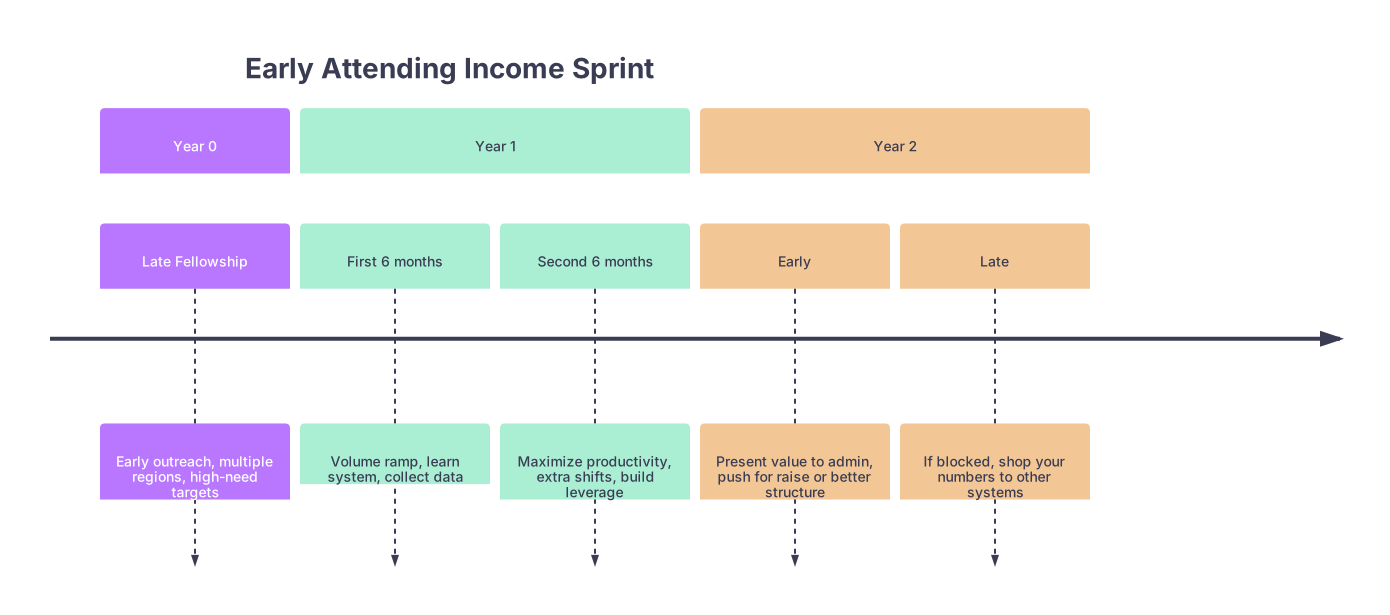
| Period | Event |
|---|---|
| Year 0 - Late Fellowship | Early outreach, multiple regions, high-need targets |
| Year 1 - First 6 months | Volume ramp, learn system, collect data |
| Year 1 - Second 6 months | Maximize productivity, extra shifts, build leverage |
| Year 2 - Early | Present value to admin, push for raise or better structure |
| Year 2 - Late | If blocked, shop your numbers to other systems |
The key is this: they never confuse loyalty with self‑sacrifice. Hospitals love to sell “family” and “we’re a team.” Until budget season. Then you’re a line item.
High earners accept that awkward truth early. They act accordingly.
Move 5: They Stack Non‑Clinical Leverage Quietly
Tripling salary is not always just about clinical shifts and RVUs. Some of the smartest fellows add layers of income that admins barely track.
I’ve seen fellows move their total comp by six figures using:
- Medical directorships with real stipends ($30–$80k/year) that many physicians don’t even ask about.
- Administrative roles tied to quality metrics or service line development.
- Equity in private practices, ASC ownership, and ancillary services (imaging, lab).
](https://cdn.residencyadvisor.com/images/articles_svg/chart-sample-income-stack-for-a-high-earning-early-caree-8756.svg "Sample Income Stack for a High-Earning Early-Career Physician")
| Category | Value |
|---|---|
| Clinical Base | 350 |
| Productivity Bonus | 120 |
| Admin/Director Stipends | 60 |
| [ASC/Equity Distributions](https://residencyadvisor.com/resources/physician-salaries-guide/equity-side-deals-and-medical-directorships-hidden-physician-income) | 70 |
That kind of stack turns a “$350k” job into a $600k job within a couple years.
The quiet truth: admin roles and directorships are often given to whoever raises their hand and can halfway function in meetings. They’re not always going to “the most senior” or “most qualified” person. They go to the person who shows up and says, “I can take that on, here’s my vision, and what’s the stipend?”
Most young attendings never ask that last question.
Move 6: They Negotiate Like Someone Who Can Walk Away
This is the single behavioral difference that correlates most with huge salary jumps.
The fellows who end up with massive comp changes:
- Never say, “This is my dream job” in front of administrators. Ever.
- Never show their hand on other offers until they need to.
- Always keep at least one credible alternative in play.

Behind closed doors, I’ve heard practice managers say: “We don’t budge for people who seem desperate.” They smell it. The fellow who’s “always wanted to be here” gets the standard offer. The one who calmly mentions:
- “I have a competing offer at $480k total comp. I’d like to be here, but I need you to be in the same ballpark.”
…magically discovers there was “a little more room” in the budget.
A few specifics these high‑earning fellows do:
- They get every element on paper: base, RVU rate, thresholds, call pay, directorship stipends, partnership timelines.
- They push on leverage points that matter long term: RVU rate, post‑ramp percentage of collections, defined buy‑in formula for partnership.
- They keep emotion out of it. “I’d feel more valued if…” does nothing. “Your competitor down the road is at $x RVU rate, and I produce y RVUs” gets attention.
They’re not rude. They’re not demanding. They’re just willing to say “no” in a calm, professional voice.
Move 7: They Use the Ugly Years to Buy Freedom, Not Lifestyle
The last differentiator is psychological.
The fellows who truly triple their salary and stay ahead do one thing consistently:
They don’t inflate their lifestyle the second the money hits.
The pattern among the ones who get stuck:
- First job: $260k → Nice. Upgrade apartment, new BMW, private school for kids, expensive vacations.
- Second job (2 years later): $310k → After taxes and lifestyle creep, they feel just as broke.
The high earners:
- Go from $70–80k fellowship to $350–500k but live like they’re on $150–200k for the first 2–3 years.
- Use the income jump to obliterate student loans, build a real emergency fund, and start serious investing.
- Then, with options in hand and savings behind them, they negotiate harder or walk away to even better positions.
That’s how you combine a 2–3x income jump with actual freedom. Not golden handcuffs.
What Triple-Salary Fellows Don’t Do
Quick contrast, because it matters. The people who do not see big gains in the first 2–3 years usually:
- Restrict to one narrow geographic area “because family,” with no flexibility.
- Accept the first offer from the first place that showed interest.
- Never ask what others in the group are making.
- Downplay or ignore RVU/shift structures because “I just want stability.”
- Avoid any conversation that feels like “conflict” with administrators.
They behave exactly like residents and fellows are trained to behave: deferential, grateful, averse to advocating for themselves. That conditioning is great for getting through training. It’s terrible for maximizing your compensation.
A Concrete 2-Year Triple-Salary Scenario
Let me spell out one path I’ve personally watched, because you probably know someone who quietly did something similar.
Subspecialist fellow (non‑surgical):
- Fellowship income: ~$72k.
- Year 0 (late fellowship): Starts looking in multiple states, including one “undesirable” mid‑size city with massive need.
- First job signed: Base $320k + RVU incentive, modest signing bonus, underserved community hospital. Co‑fellows roll their eyes at the city.
Year 1:
- Volume is insane. RVUs blow past 150% of target by month 9.
- Admin is happy because wait times drop, downstream imaging and infusion revenue surges.
- Total comp year 1: ~$450k.
Year 2:
- Fellow tracks everything. Shows admin: RVUs, downstream dollars, locums they no longer need.
- Negotiates: Higher RVU rate, small bump in base, picks up a medical directorship for the service line at $40k/year.
- Total comp year 2: ~$575k.
From $72k to $575k in about two years. Same doctor who almost signed a “dream academic job” for $210k with a vague promotion track and no real bonus structure.
That’s the difference in mindset and moves.
FAQs
1. Do I have to work in a rural area or “undesirable” location to triple my salary?
No, but it’s easier. True rural and second‑tier markets pay more because they’re hurting. You can still do very well in suburbs or smaller metros, but if you insist on top‑tier coastal cities and prestigious academic centers, you’re trading money for location and brand. You cannot usually have all three: elite city, elite institution, and elite pay, at least not early.
2. How early in fellowship should I start planning for this?
For a 3‑year fellowship, start serious thought and research in PGY‑5, with outreach by early PGY‑6. For shorter fellowships, start 12–18 months before you finish. The earlier you create options, the more leverage you have. Waiting until 4–6 months before graduation is how you end up taking whatever is left on the shelf.
3. What if I genuinely love academic medicine—am I doomed to low pay?
No, but you need to be strategic. Look for hybrid roles with protected time actually written into the contract, clear promotion criteria, and defined bonus structures for clinical productivity or admin work. Also, be honest with yourself: if 80–90% of your time is clinical but the pay is way below community jobs, you’re subsidizing the institution. Some people are fine with that; most are not once real life costs hit.
4. How do I find out what others in a group or hospital are really making?
You ask. Quietly and respectfully. Senior partners and recently hired attendings are usually more transparent than you expect if you frame it as, “I want to make sure my offer is in line with what others at my level receive.” You can also cross‑check with MGMA data, state salary databases (for public institutions), and recruiters who see multiple offers in the same region. If a group is evasive about internal comp, that’s a red flag.
5. Do I need a lawyer to review my first contract?
Yes. A real physician contract attorney, not your cousin who does real estate closings. Not to “fight” with the hospital, but to identify traps: non‑competes that box you into a tiny radius, vague partnership promises, abusive call expectations, or “discretionary” bonuses that never materialize. The fellows who triple their salary treat that $800–$2,000 legal fee as the cheapest ROI they’ll ever get.
The fellows who triple their income in two years are not inherently more talented. They just stop thinking like trainees faster. They go where they’re needed, choose structures with upside, and are willing to walk if the numbers do not reflect their value. Do those three things, and the salary “ceilings” you’ve been shown evaporate very quickly.