
You’re sitting at your kitchen table with two offers in front of you.
Offer A: Community hospital job, $240k starting, $20k sign-on, plus $20k/year in guaranteed loan repayment for 5 years.
Offer B: Private group across town, $310k starting, production upside, no loan repayment help.
You’ve got $280k in federal loans at 6.3%. You’re exhausted from residency and just want to “do the right thing” financially. Every recruiter says their deal is better. Everyone on Reddit says something different.
Here’s the answer you’re looking for: you almost never make this decision correctly by “vibes” or by focusing on a single number. You have to run the math and factor in control, risk, and happiness.
Let’s walk through how to actually decide when to prioritize loan repayment programs over higher salary offers.
Step 1: Understand what “loan repayment” actually means
Programs advertise loan help in ways that sound great but are very different in real dollars.
Most common structures:
Fixed employer repayment
Example: “$25,000 per year in loan repayment for 3 years.”
Usually paid directly to your servicer or as a taxable bonus you’re required to apply to loans.Lump-sum forgiveness / retention bonus
Example: “$100,000 loan forgiveness after 5 years of service.”
Translation: Golden handcuffs. You leave at 4 years, 11 months? You probably get zero.State or federal programs (NHSC, PSLF, state LRPs)
These may require:- Specific practice settings (FQHC, VA, rural, tribal)
- Full-time work, specific FTE thresholds
- Documentation and recertification every year
Sign-on “for loan repayment” that’s just a bonus
I’ve seen this: “$50k loan repayment bonus” but it’s just taxable cash. No requirement to use it on loans.
Key point: The label doesn’t matter. The cash does. And the strings do.
Step 2: Compare what actually goes in your pocket
You need to compare apples to apples: after-tax money you end up controlling.
Basic reality: most employer loan repayment is taxable unless it’s through specific Section 127 plans (which are still capped and not universal). Many programs don’t structure it that way. So assume it’s taxed unless contract and HR confirm otherwise.
Let’s build a simple framework.
Example scenario
- Your marginal tax rate: ~35% (federal plus state; adjust for your situation)
- Offer A:
- Salary: $240k
- Loan repayment: $25k/year (taxable)
- Offer B:
- Salary: $300k
- No loan repayment
On paper, Offer B pays $60k more in salary, but Offer A gives $25k in loan help.
After approximate taxes:
Offer A:
- Salary after tax: $240k × 0.65 = $156k
- Loan repayment after tax (if paid to you as income): $25k × 0.65 = $16.25k
- Total after-tax cash/benefit: ~$172.25k
Offer B:
- Salary after tax: $300k × 0.65 = $195k
So purely as “money you could use or save”:
- Offer A: ~$172k
- Offer B: ~$195k
That means: if the loan repayment is just taxable income, Offer B is actually richer by ~$23k/year, even though Offer A markets itself as “we help with your loans.”
There are exceptions:
- If the employer uses a qualified educational assistance program under Section 127 (up to $5,250/year tax-free)
- If the loan repayment dollars give you psychological benefit (more on this in a second)
But financially? Most of the time, higher salary will beat a standard taxable repayment program if you have the discipline to attack your loans yourself.
Step 3: When loan repayment is worth prioritizing
You should seriously prioritize a loan repayment program over a higher salary when one or more of these is true:
The repayment is effectively tax-free and guaranteed
Examples:- Certain VA/DoD programs
- Some state programs that pay servicer directly and have specific tax treatment
- PSLF path (public or nonprofit employer, 10 years of qualifying payments, remaining balance forgiven tax-free)
If you’re on a real PSLF track in a 501(c)(3) hospital or FQHC and committed to 10 years, those “lower salary but PSLF-eligible” jobs can absolutely beat higher-paying private ones over a decade.
The repayment is large and front-loaded
Example: $100k over 3 years, paid early and annually, not all backloaded at the end.If you can realistically stay at least through the payout period, that’s meaningful. Just recognize it as a retention tool.
The program meaningfully changes your time-to-debt-free
Say:- You owe $250k @ 6.5%
- You’d pay $50k/year on loans if left alone
- Employer offers $40k/year for 3 years, on top of your own $50k/year
Now you’re paying $90k/year instead of $50k/year. You might be debt-free in 3 years instead of 6. That time compression matters. Being debt-free 3 years earlier changes compounding, your ability to invest, and your stress level.
You know yourself: you won’t aggressively pay loans without forced structure
Some people say they’ll “pay extra on loans” with the higher salary, then life happens. Kids, house, vacations, the “I deserve this” phase.If a loan repayment program is the only way you’ll truly get aggressive, that’s worth something psychologically, even if the raw math suggests taking the higher salary and self-paying.
Step 4: When the higher salary is clearly better
Here’s where I stop sugarcoating.
If both of these are true:
- The loan repayment is taxable and not massive
- The salary difference is substantial (think $40k+)
Then in most cases, you’re better off taking the higher salary and doing your own loan strategy.
Why?
Because with higher salary you get:
Control
You decide:- How fast to pay your loans
- How much to save for retirement
- Whether to rent, buy, move, switch jobs, go part-time later
Flexibility if things turn bad
Loan repayment is almost always contingent: maintain employment, full-time status, maybe certain call coverage, sometimes production numbers. If the job becomes toxic, you’ll hesitate to leave because of the strings. That’s how they want it.Better long-term compounding
Extra $40–60k/year that you can direct partly to loans and partly to retirement accounts generally beats a smaller locked loan repayment.
Let’s make it concrete:
- Offer A: $250k + $25k/year repayment (taxable)
- Offer B: $320k, no repayment
After tax at 35%:
- Offer A total (salary + repayment): $275k × 0.65 ≈ $178.75k
- Offer B total: $320k × 0.65 ≈ $208k
Difference: ~$29k/year in your favor with Offer B.
If you commit to:
- Putting $29k extra each year toward your loans (on top of what you’d do with Offer A), you’ve effectively replicated the loan help yourself and still keep job flexibility.
Step 5: Factor in non-cash realities (this is where people screw up)
Physicians obsess over salary and loans, then ignore the stuff that actually determines whether they stay:
- Call schedule
- RVU pressure
- Clinic support and staffing
- Autonomy over schedule and practice style
- Commute and where your partner can work
- Culture: are the attendings burned out or content?
A “loan repayment” job that feels like a grindhouse is expensive in a way spreadsheets don’t show.
So ask:
- What’s the realistic all-in comp in year 3–5, not just year 1?
- How many hours are you actually working to earn that salary?
- Would you willingly stay here for 5+ years even if there were no loan perks?
If the honest answer to #3 is “probably not,” be very cautious signing up for long, backloaded loan repayment terms.
Step 6: Use a simple comparison model
Here’s the quick and dirty way I walk people through this.
Write down:
- Loan balance
- Interest rate
- Personal target: “I want loans gone in X years”
For each offer, calculate:
- After-tax salary (roughly)
- After-tax value of any loan repayment
- Whether that repayment is:
- Guaranteed annually
- Backloaded / cliff-based
- Contingent on RVUs or “meeting expectations”
Decide how much you would direct to loans under each scenario.
Ask:
- Under Offer A, how many years until I’m debt-free with their help + my extra payments?
- Under Offer B, if I self-pay aggressively, how many years until I’m debt-free?
If the “debt-free” date is basically the same, prioritize:
- Better job fit
- Higher long-term earning potential
- Fewer strings attached
If the loan repayment gets you debt-free several years faster without brutal job conditions, then it is worth prioritizing—even over a higher salary.
Quick comparison example
You owe: $300k @ 6.5%
You’re willing to put $50k/year toward loans from your own income.
Offer A:
- Salary: $250k
- Loan repayment: $40k/year × 5 years (taxable)
- Your loan payments: $50k/year
Offer B:
- Salary: $320k
- No loan repayment
- Your loan payments: $70k/year (you force yourself to use $20k of the extra salary for loans)
Very rough math:
- Offer A: $90k/year toward loans
- Offer B: $70k/year toward loans
Offer A likely gets you debt-free 1–2 years earlier. But Offer B probably leaves you with higher take-home along the way and more control.
Which to choose? Comes down to:
- Do you value getting debt-free faster more than flexibility and slightly higher lifestyle now?
- Does Offer A come with location/call/culture you actually like?
There’s no universal right answer, but “they help with loans” by itself is not enough to override a much higher salary if job quality is better too.
| Situation | Better Choice |
|---|---|
| PSLF-eligible nonprofit vs higher-paid private, you’re committed to 10 years | Loan repayment / PSLF path |
| Small taxable repayment ($10–20k/yr) vs +$40k+ salary difference | Higher salary |
| Large front-loaded repayment ($40k+/yr) and you like the job | Loan repayment |
| Backloaded lump sum after 5–7 years, job seems iffy | Higher salary / more flexible offer |
| You’re undisciplined with debt payoff and need structure | Lean toward loan repayment |
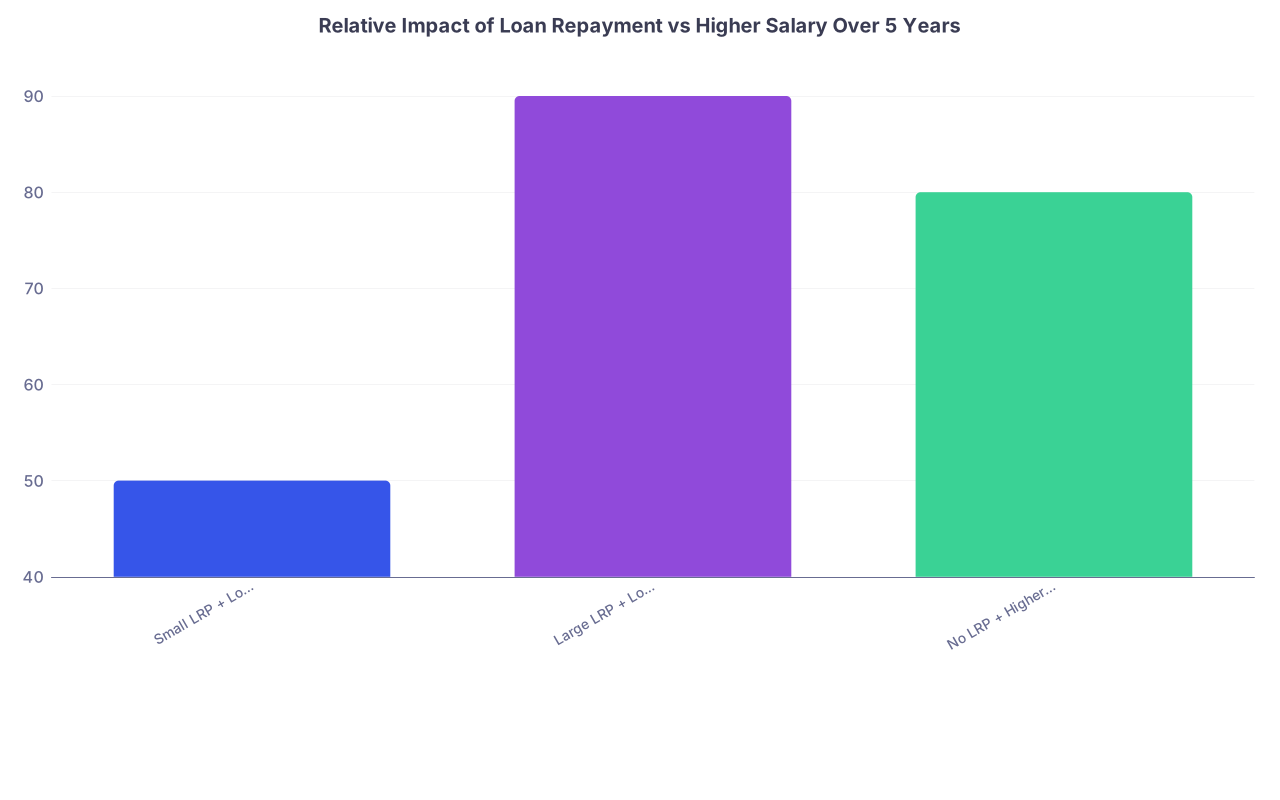
| Category | Value |
|---|---|
| Small LRP + Lower Salary | 50 |
| Large LRP + Lower Salary | 90 |
| No LRP + Higher Salary | 80 |
The bottom line answer
If you want a rule of thumb, here it is:
- If the “loan repayment” is just small, taxable money attached to a lower salary, do not prioritize it. Take the higher salary and pay your loans yourself.
- If the loan repayment is:
- Large,
- Relatively secure,
- PSLF-eligible, or
- Shortens your debt-free timeline by several years
and the job isn’t a nightmare—then it can absolutely be worth prioritizing over raw salary.
But you always:
- Run after-tax numbers
- Compare time-to-debt-free
- Pressure-test how realistic it is that you’ll stay long enough to earn the full benefit
And you never:
- Choose a toxic job solely because “they help with loans”

| Step | Description |
|---|---|
| Step 1 | Compare Offers |
| Step 2 | Prioritize higher salary |
| Step 3 | Consider prioritizing loan repayment job |
| Step 4 | Is loan repayment large or PSLF path? |
| Step 5 | Does it shorten debt payoff by years? |
| Step 6 | Would you stay 5 plus years anyway? |

FAQ (6 questions)
1. Is Public Service Loan Forgiveness usually better than a higher private salary?
If you can honestly commit to 10 years in qualifying employment, PSLF is usually extremely powerful, especially with high loan balances ($300k+). A $220k nonprofit hospital job with PSLF potential can easily beat a $300k private job over 10 years if you end up with six figures forgiven tax-free. The problem is people who think they “might” do PSLF, then switch to private after 4–6 years. In that case, they’ve taken the lower salary and never captured the real benefit. So PSLF is great if you’re all-in; mediocre if you’re half-committed.
2. Are employer loan repayment benefits always taxable?
Often yes, but not always. Many employers simply structure it as additional income or bonus that’s taxed. Some use a Section 127 educational assistance program that allows up to $5,250/year tax-free. Certain federal or state programs may also have special tax treatment. You need to ask HR and, ideally, a tax professional for the exact structure. Do not assume it’s tax-free because the recruiter casually says “loan forgiveness.”
3. Should I ever choose a lower-paying job with no loan repayment?
Yes, if the job is clearly better for your long-term career and life. Examples:
- Academic job with strong mentorship and research you care about
- Lower-paid but dramatically better lifestyle (4-day weeks, light call, great support)
- Location that works for your partner and family long term
You can absolutely make more money over a 20–30 year career by being in a field, group, or setting you can sustain, even if the first job pays a bit less and has no formal loan perks. Miserable but slightly better-paying jobs burn people out. Burnout is expensive.
4. How big does a loan repayment program need to be to really matter?
If it’s taxable, I start paying attention when it’s at least $30–40k/year for several years or a well-structured $100k+ package that isn’t entirely backloaded. Anything like $5–15k/year looks nice on a flyer but usually vanishes when you compare against a $30–60k salary difference. Exceptions exist if you’re in a very low-paying specialty or you know you’ll psychologically only attack loans if someone “forces” you with a program.
5. What if the higher-paying job has a much worse call schedule?
Then that “higher salary” isn’t free. If you’re working 20–30% more hours, under more stress, for that extra pay, you’re trading time and sanity for dollars. Sometimes that’s worth it for a few years to crush debt. Sometimes it’s stupid. My view: It’s reasonable to choose a slightly lower-paying but saner job, even if it slows your loan payoff by a year or two. You just have to be honest with yourself and run the numbers—do not give up $70k/year for a marginally better schedule without thinking hard.
6. What’s one simple rule I can use when I’m overwhelmed by details?
Use this: “Would I still want this job if there were no loan repayment perk?” If the answer is no, and the only thing making you consider it is the marketing about loans, be very cautious. Then ask: “If I took the higher salary job and earmarked the entire difference for loans, how fast could I be debt-free?” Put those two timelines side by side. If the “loan repayment” option does not significantly beat what you can do yourself with a higher salary, it probably doesn’t deserve to drive the decision.

Today’s next step: open a loan calculator, plug in your actual balance and interest rate, and model two scenarios—one where you take a hypothetical “loan repayment” job, and one where you take a higher salary and self-pay aggressively. Look at the year you’d be debt-free in each scenario and how much cash you control each year. That 20-minute exercise will make at least half of your current confusion disappear.