
It’s 11:47 p.m. You’ve got a half-finished consult note open, three tabs of salary data, two loan calculators, and a Zillow page with houses you absolutely cannot afford. You’re doing mental math you’re not qualified for and the question underneath all of it is ugly and simple:
If I actually become a doctor, can I have a real life? A family. Kids. Time to see them. And also… not be broke and drowning in debt?
You’ve seen the Instagram attendings with their Teslas and beach vacations. You’ve also seen the residents venting about $300k in loans, $2k daycare bills, and 60–80 hour weeks. And you’re stuck in the middle, thinking: what if being a physician is just an insanely expensive trap where I never get to breathe?
Let’s be blunt: this is the part everyone hand-waves away with “do what you love” and “it all works out.” I’m not going to do that. I’m going to tell you what actually happens with physician salaries, families, and “balance” — especially the stuff that keeps you up at night.
First, the scary math you’re already doing in your head
You probably already know rough numbers, but seeing them stacked is what makes your stomach drop.
| Stage | Approx Years | Typical Pay Range | What’s Happening Financially |
|---|---|---|---|
| Med school | 4 | $0 (negative) | Tuition, living costs, loans |
| Residency | 3–7 | $60k–$80k | Low pay, interest growing |
| Fellowship | 1–3 | $70k–$90k | Slight bump, still tight |
| Early attending | 3–5 | $200k–$450k+ | Big jump, lifestyle pressure |
| Mid-career attending | 5+ | $250k–$600k+ | Peak earning, more control |
You’re thinking:
- “Med school: negative income, big loans.”
- “Residency: not enough to actually live where programs are.”
- “Attending: big numbers, but after loans, daycare, mortgage, taxes… is it actually enough to have a life?”
Here’s the part people don’t like to say out loud: you can absolutely make physician money and still feel broke and trapped, especially if you try to “live like a doctor” the second you finish residency. I’ve watched brand-new attendings sign for a $1.2M house and two luxury cars before they even got their first full paycheck. They are not free. They are handcuffed.
So the real question isn’t “Are physician salaries high enough?” It’s: “Can physician salaries support a sane, family-centered life if you’re deliberate and not reckless?”
Yes. But it’s not automatic. And it’s not what the loudest flexing people on social media are doing.
What balance actually costs in real numbers
Let’s talk about what you’re really asking:
“I want a family and a life” =
- I want kids and to be present for them.
- I don’t want my marriage or relationships to implode.
- I want to not feel constant money panic.
- I want some time that’s mine.
That all has a price tag. Here’s a rough sense of where physician money actually goes if you try to have a “normal” life in a medium-to-high COL city (think Boston, Seattle, Chicago suburbs) on, say, $300k as a generalist/some IM subspecialties early attending:
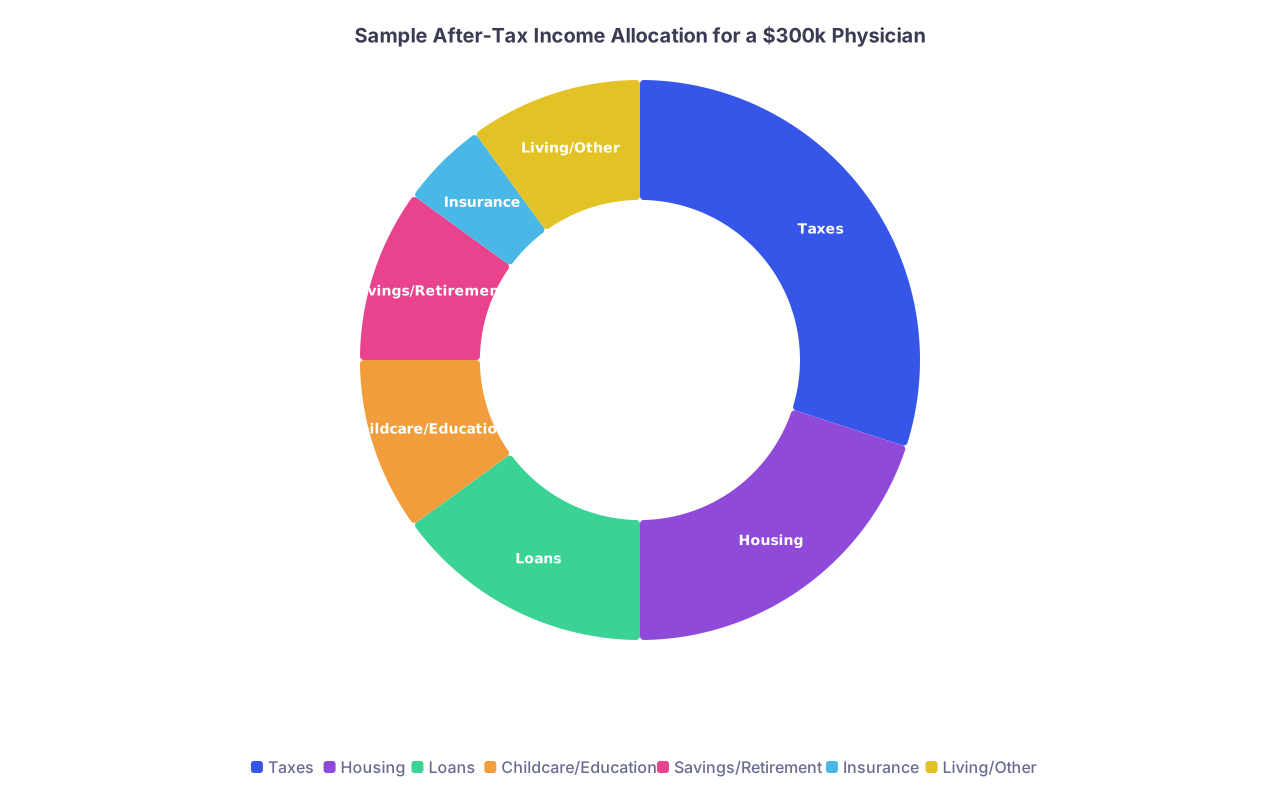
| Category | Value |
|---|---|
| Taxes | 30 |
| Housing | 20 |
| Loans | 15 |
| Childcare/Education | 10 |
| Savings/Retirement | 10 |
| Insurance | 5 |
| Living/Other | 10 |
That’s the reality behind “high income”:
- Taxes swallow a huge chunk.
- Housing is brutal in academic/urban centers.
- Loans can easily be a second mortgage.
- Childcare is absurd — $1.5–3k per kid per month in many cities.
- Insurance (malpractice, disability, life, health gaps) is non-negotiable.
If you go into this pretending your $300k is “$300k to spend,” you will be miserable. If you treat it like “$300k is a tool to buy back my time and mental peace,” you actually stand a chance.
So can that salary support balance? Yes — if “balance” means:
- Modest house, not dream house (at least at first).
- Reasonable cars, not status symbols.
- Conscious decisions about daycare, extra help, maybe living near family.
- Aggressive but sane loan strategy for 5–10 years.
If “balance” to you means a huge house, private school, luxury everything, AND cutting back to 0.6 FTE… that’s where the math breaks.
Specialty choice: you can’t ignore this if you care about life outside work
Everyone tells you “don’t pick a specialty for money.” Fine. But ignoring lifestyle and money is just as stupid if you’re someone who knows you want three kids and soccer games and actual weekends.
Different specialties don’t just vary in pay — they vary in predictability and the ability to say “no.” That matters way more than the top-line salary.
| Specialty Type | Typical Full-Time Pay Range | Lifestyle Reality Snapshot |
|---|---|---|
| Road specialties (Derm, Optho, Rad, Anes, Path) | $350k–$700k+ | Higher pay, more schedule control in many jobs |
| Outpatient IM/FM/Peds | $200k–$320k+ | Lower pay, but potential for no call, more stable hours |
| Surgical (Gen surg, Ortho, ENT, OB) | $350k–$800k+ | High pay, but nights/weekends, harder to cut back early |
| Hospitalist | $250k–$350k+ | Blocks of time off, but intense shifts and nights |
I’m not saying “don’t do OB if you want kids.” People do it. But be honest with yourself:
- Will you be okay missing some bedtimes and holidays?
- Will your partner be okay being default parent more often?
- Are you planning to be sole breadwinner?
Because if your dream is: “I want three kids, to see them most nights, and to go 0.7 FTE by mid-30s,” then outpatient specialties or hospitalist roles (with blocks) plus thoughtful financial planning are going to line up with that dream a lot better than heavy-call surgical subspecialties.
You can have a family as a surgeon or OB. Plenty do. But they usually buy balance with either:
- A partner with a very flexible or stay-at-home situation, or
- Very expensive help (nannies, housekeeping, etc.), or
- A conscious choice to earn a lot more but live under their means for years so they can later cut back.
The money can support balance — but it has to be used to support balance, not lifestyle optics.
The loan + kids overlap: the part nobody wants to think about
Here’s the worst-case scenario you’re probably running at 1 a.m.:
You finish residency/fellowship:
- Age: 31–35
- Loans: $200k–$400k+
- Want kids: like, now, before fertility becomes its own nightmare
- Just started your first real job, still figuring everything out
- Daycare: $2–3k/month per kid
- Loan payment: $2–4k/month if you’re trying to be aggressive
- You also would like… I don’t know, furniture? Maybe a vacation every few years?
This is the window where people feel the most squeezed. And this is when you’ll really ask: “Is this worth it?”
Here’s the honest answer: those first 3–7 attending years can feel tight if you stack every expensive life decision at once at full price in a high COL area.
But physician salaries are still ridiculously powerful compared to most jobs if you resist two traps:
Inflating lifestyle too fast.
New car, big house, private school, luxury daycare, fancy vacations — all at once. This is how a $400k salary can feel like $80k.Ignoring structure and contracts.
Working for a place that owns your time, underpays relative to market, and buries you in RVU pressure with no cap — that’s how you turn high income into golden handcuffs.
If you want kids and sanity, accept that your first few attending years might need to look a little boring on paper: normal house, reasonable cars, not saying yes to everything that costs money. Use the salary to crush the two things that steal your freedom: debt and inflexible jobs.
The contract and hours side: salary isn’t the only number that matters
You know what ruins “balance” more than anything? A contract where:
- Your “1.0 FTE” is secretly 60–70 hours/week.
- Call is vaguely defined and ends up swallowing your life.
- “Productivity expectations” are code for double-booked clinics and 25+ patients a day.
A $350k job where you consistently work 60+ hours and chart at home is not better than a $260k job where you’re out at 5 most days and have no call. Not if you care about being present for your family.
You have to start thinking in terms of effective hourly rate + control:
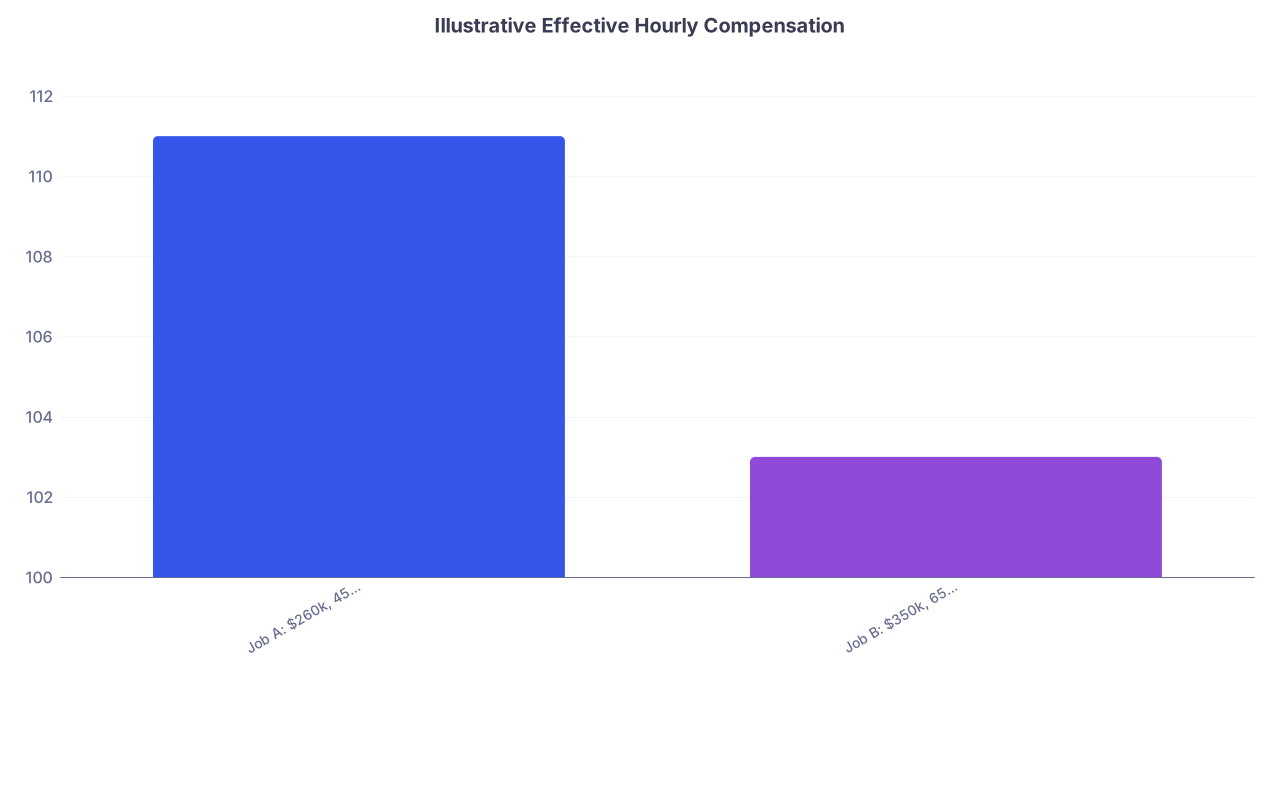
| Category | Value |
|---|---|
| Job A: $260k, 45 hrs/wk | 111 |
| Job B: $350k, 65 hrs/wk | 103 |
So yeah, Job B “pays more.” But your actual pay per hour of your life? Lower. And your remaining energy for your spouse, kids, friends? Also lower.
When you look at physician salaries and ask “can they support balance?” don’t just look at the number on the offer letter. Look at:
- Hours actually worked (ask current docs off the record).
- Call — how often, how bad, how unpredictable.
- NP/PA support, scribes, realistic RVU targets.
- How easy it is to go 0.8 or 0.6 FTE without getting punished.
You want a job that doesn’t just pay well — it gives you the option to dial back once you’ve stabilized your finances.
Okay but will I ever be able to go part-time or actually see my kids?
This is likely the core fear: “What if I trap myself in a salary cage where the only way we survive is if I work myself into the ground forever?”
The answer depends on three things you can somewhat control:
How aggressively you attack debt early.
The less you owe, the easier it is to reduce hours. If you drag loans out for 20–25 years while inflating lifestyle, you basically guarantee you need full-time income forever.Where you choose to live.
A $300k salary in rural/small city with a $350k house and $1k daycare is a wildly different life than $300k in San Francisco with a $1.3M townhome and $3k daycare. Same salary. Completely different stress level.Your definition of “enough.”
If you’re okay with “nice but not flashy,” physician salaries absolutely can buy down your hours over time. If you need private school + luxury everything + constant upgrades, you’re going to be stuck.
I’ve watched actual timelines like this work:
- Years 1–3 attending: Full-time, moderate lifestyle, slam loans, build 6-month emergency fund.
- Years 4–7: Refinance or finish loans, bulk up retirement, maybe drop to 0.8 FTE when second kid arrives.
- Years 7+: Kids in school, debt minimal or gone, plenty of options: stay 0.8, go 0.6 and add some telemed, switch to a slower outpatient role, or keep full-time but with a big safety cushion.
The salary is not the enemy. It’s the decisions around it in those first 5–10 years that either free you or trap you.
The mental piece: what balance actually feels like for physicians with families
Here’s the thing nobody says: even if the money works, the guilt might not go away.
- Guilt when you miss bedtime because of a late case.
- Guilt when you skip a kid’s event for an extra shift because loans are due.
- Guilt when you don’t volunteer for extra shifts because you’re exhausted, and good colleagues pick it up.
Having a family and a life as a physician is emotionally messy. But money gives you options:
- Option to hire help so your limited off-time isn’t all chores.
- Option to live closer to work so commute doesn’t steal an hour each way.
- Option to say no to extra shifts because you’re not desperate for the cash.
- Option to take a “worse-paying” but saner job.
So yes, physician salaries can support balance. But they don’t automatically give you peace. You still have to decide what you’re willing to trade and what you’re not.
If you’re someone who’s already anxious about this, that’s actually a good sign. The people who scare me most are the ones who never even ask these questions and then wake up at 38 locked into a life they hate.
You’re asking early. That’s how you avoid the worst-case version.
What you can actually do now, before you even have an attending paycheck
You’re probably not in a position to change your salary right now. But you can do a few things that radically increase the odds that your future income actually supports a life you want, not just a LinkedIn-flex life.
- Start paying attention to cost of living, not just salaries, when you think about future jobs.
- Watch the attendings and residents ahead of you: who seems miserable, who seems sane? Ask them what choices they made around money, location, specialty, hours.
- Be very skeptical of lifestyle creep fueled by “I deserve this, I’ve sacrificed so much.” That’s how people wreck the power of physician income.
- Learn basic personal finance — not crypto nonsense, just: debt, interest, taxes, retirement accounts, insurance. It’s incredibly boring and incredibly freeing.
You don’t have to have a 30-year plan. But you do need a rough sense of: “I care about having kids and not resenting my job; therefore, I will not chain myself to $10k/month fixed expenses the second I finish residency.”
FAQ (Exactly 5 Questions)
1. If I want kids in training, is that financially impossible on resident salary?
Hard, not impossible. Residents have kids every year. The main pain points are childcare and unpaid leave. You survive by stacking support: partner income if possible, family help, cheaper locations, hospital daycare discounts, government benefits (like dependent care FSAs if offered). You will not be “saving aggressively” during this time, and that’s okay. The key is not to layer big, optional fixed expenses (luxury car leases, expensive apartments) on top of that.
2. Should I pick a super high-paying specialty just so I can work part-time later?
If you hate the specialty, it’s a terrible trade. You’ll burn out before you get to the “part-time later” part. But if you like two things equally and one has higher income and more part-time options (say, derm vs heme/onc, or anesthesia vs a brutal surgical subspecialty), it’s rational to factor in future flexibility. Don’t pretend money doesn’t matter. Just don’t let it be the only thing that matters.
3. Is it realistic to pay off $300k+ in loans and still have a life?
Yes, but not if you try to do it in three years and spend like crazy. What I’ve seen work: 5–10 year horizon, living like a well-paid normal person instead of like a TV doctor. You can still travel modestly, have kids, and buy a reasonable house. If you’re PSLF-bound with academic jobs, your path looks different, but the same rule applies: don’t inflate lifestyle just because the payments feel lower.
4. Can I actually go 0.8 or 0.6 FTE without wrecking my career?
In a lot of outpatient and hospitalist roles, yes. In some surgical and call-heavy fields, it’s harder but not impossible. The trick is to choose jobs and groups that don’t treat part-time as “not committed.” Large systems, academic centers, and some multispecialty groups often have formal part-time tracks. This is a question you should explicitly ask when job-hunting: “Do you have attendings working 0.6–0.8 FTE long-term? How does that affect promotion/partnership?”
5. Am I crazy for even worrying about this before I’m an attending?
No. The people who think you’re “overthinking” are often the ones who never ran the numbers and now feel stuck. You don’t need a perfect forecast, but asking, “Will this career let me be the kind of parent/partner I want to be?” is not neurotic — it’s responsible. Use the anxiety to get curious and intentional, not to paralyze yourself.
Open a new note on your phone or laptop right now and write down two things: (1) what “having a life” actually means for you in concrete terms (how many kids, what kind of time at home, what you will not sacrifice), and (2) one financial boundary you’re willing to set in your first 5 attending years to protect that life (house size, car spending, loan plan, location). That’s your starting line.