
The mythology around physician side gigs is wrong. The data shows most doctors are not secretly doubling their income on the weekends—and the ones who do it right treat it like a business, not a hobby.
What the Surveys Actually Say About Physician Side Income
Let me start with the top-line numbers, because fantasy dies quickly when you put it next to a bar chart.
Across recent surveys from Medscape, Doximity, Physician on FIRE’s audience data, and smaller specialty-specific polls, the pattern is consistent:
- Roughly 35–45% of physicians report some non‑W2 clinical or nonclinical income.
- Only about 15–20% earn “meaningful” side income (≥$25,000/year).
- A much smaller subset—under 10%—clear $100,000/year or more outside their primary job.
Here is a reasonable composite, distilled from overlapping survey results:
| Side Income Status | Approx. % of Physicians |
|---|---|
| No side income | 55–60% |
| Small side gigs (< $10k/year) | 15–20% |
| Moderate ($10k–$50k/year) | 15–18% |
| High ($50k–$100k/year) | 5–7% |
| Very high (> $100k/year) | 3–5% |
If you are imagining a world where “everyone has a six‑figure side hustle,” that picture is unsupported by the data. The median side-gig doc is making in the low five figures, often for a meaningful time trade.
Now, look at who is doing side work. Self‑reported rates are higher in:
- Emergency medicine, anesthesia, hospitalist medicine
- Younger physicians (30–44), especially those with higher student debt
- Male physicians slightly more than female physicians, largely explained by hours and family constraints, not capability
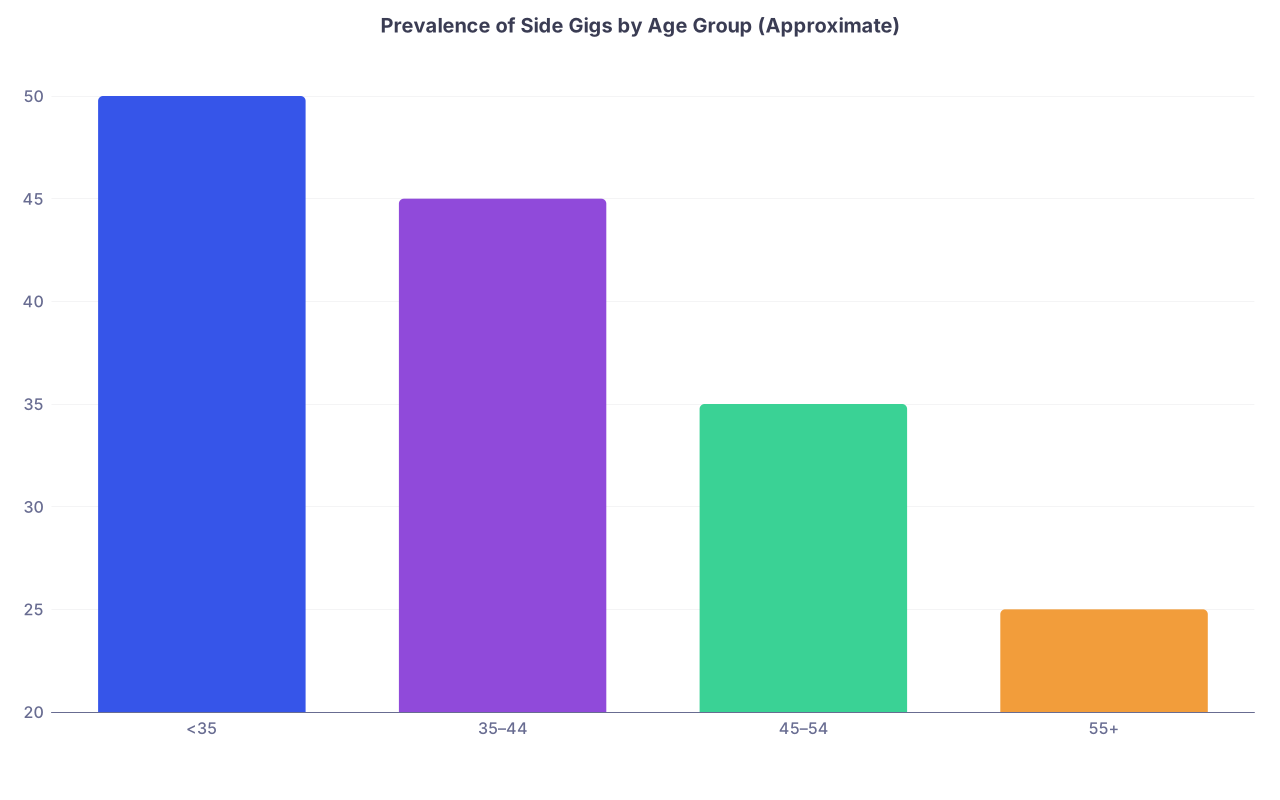
| Category | Value |
|---|---|
| <35 | 50 |
| 35–44 | 45 |
| 45–54 | 35 |
| 55+ | 25 |
That is the basic prevalence picture. Side gigs are common but not universal, and extremely lucrative side gigs are rare outliers.
Where Side Gig Money Actually Comes From
Most conversations about “side gig medicine” mix fantasy (start a SaaS company, cash out) with reality (extra call, moonlighting, chart review). The surveys cut through that noise.
If you strip the data down, physician supplemental income clusters into four broad buckets:
- Extra clinical work (still medicine, just packaged differently)
- Consulting / advisory and expert work
- Content, education, and “influence”
- Investing and ownership income
1. Extra Clinical Work: Still the 800‑Pound Gorilla
The data shows: the single largest source of supplemental income for physicians is still more clinical work. Moonlighting, per‑diem shifts, locums, telemedicine, urgent care.
In multiple surveys, 50–70% of physicians with side income cite “extra clinical shifts” as at least one component of that income stream.
Typical income ranges reported:
- Hospitalist / EM moonlighting: $150–300/hour
- Urgent care: $100–180/hour
- Telemedicine: $60–150/hour (huge spread based on platform and specialty)
- Locums in high-demand areas: effective rates of $250–400/hour when back-calculated
But the more important number is net income after opportunity cost. If you already worked 50–60 hours this week, the next 10 hours may not be your highest-value move when you factor in fatigue, risk, and burnout.
2. Consulting, Advisory, and Expert Witness Work
This is where the compensation per hour starts to spike—if you can get in.
The surveys and self-reported numbers typically show:
- Expert witness: $300–$800/hour, sometimes higher for seasoned subspecialists
- Industry advisory boards: $250–$500/hour or flat per‑meeting fees
- Chart review / utilization management: $100–$200/hour
- Pharma / device speaking (compliant programs): wide range, $1,000+ per talk is not unusual
But you also see a serious participation drop-off here. Only around 10–15% of physicians report any consulting income, and an even smaller subset (>5%) rely on it as a major side income source.
Why? Gatekeeping and network effects. A lot of these opportunities flow through reputation, referral, and prior relationships—less through “apply online here.”
3. Content, Courses, and the Education Economy
Let’s be blunt: the data shows almost everyone overestimates the income from this category.
Physicians blog. They start YouTube channels. They launch online courses. A tiny fraction make substantial money.
Surveys and anecdotal income reports reveal something like this shape:
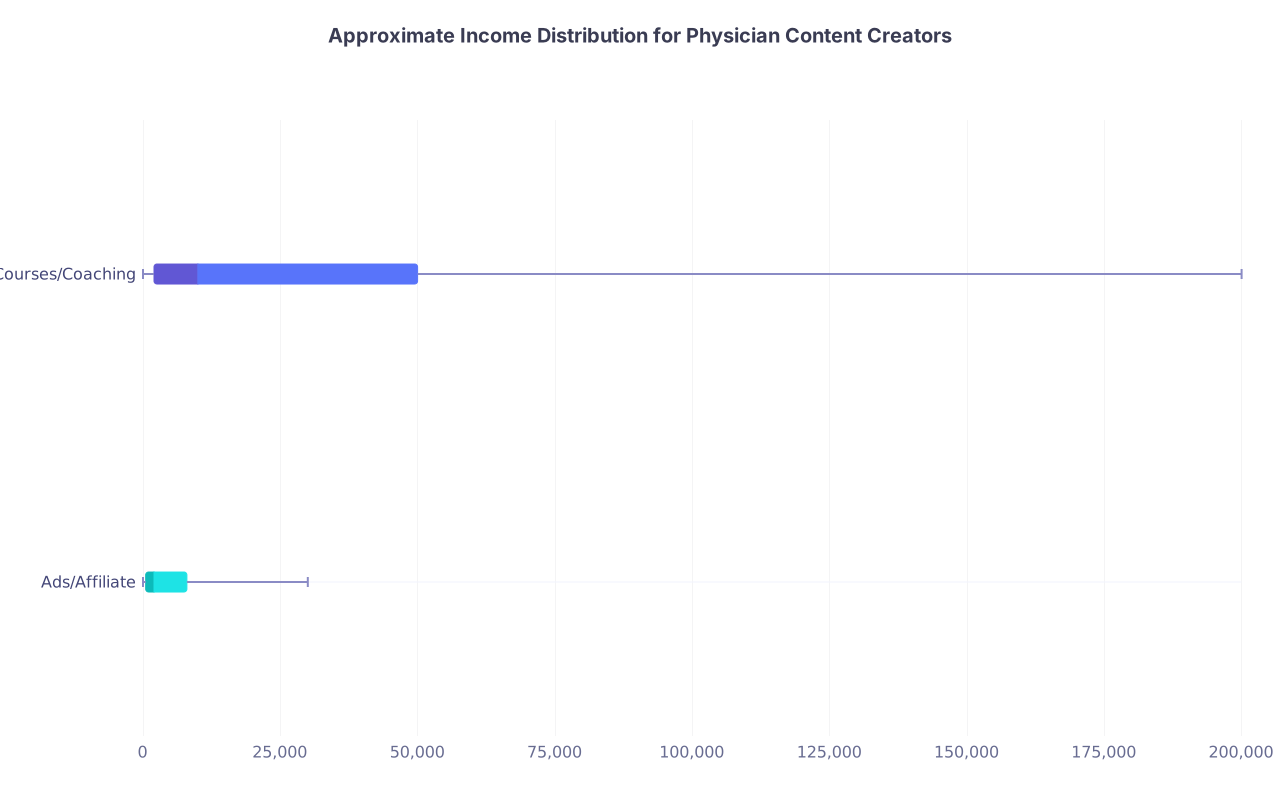
| Category | Min | Q1 | Median | Q3 | Max |
|---|---|---|---|---|---|
| Ads/Affiliate | 0 | 500 | 2000 | 8000 | 30000 |
| Courses/Coaching | 0 | 2000 | 10000 | 50000 | 200000 |
Interpretation:
- A majority of physicians who try “content” earn under $5,000/year from ads and affiliate deals.
- Courses and coaching have a much fatter upper tail. A minority hit $50k+ or even low six figures, but they are outliers with strong niches, large lists, or aggressive marketing.
The reason is obvious once you think like an analyst: physicians are not competing only with other physicians here. You are competing with professional creators who live and breathe marketing funnels.
4. Investing and Ownership Income
Some surveys lump this under “side gigs,” others treat it as separate, but from a cash flow and tax perspective, it matters. Especially for “financial and legal” planning.
Common streams:
- Real estate (rentals, syndications, funds): widely reported, often $10k–$50k/year for those active in the space
- ASCs, imaging centers, group practice ownership distributions
- Angel investing and startups (high variance, often zero for years, then rare large outcomes)
The key distinction: most of this is capital income, not self‑employment income. That matters for tax treatment, retirement account strategy, and asset protection.
Time vs Money: What Side Gigs Really Pay Per Hour
You would be shocked how few physicians actually compute an effective hourly rate across their different income streams. The ones who do often shift their behavior quickly.
Let us compare typical effective hourly rates, based on survey data, self-reports, and reasonable assumptions.
| Side Gig Type | Typical Effective $/hr (Range) |
|---|---|
| Extra clinical shifts | $120–$300 |
| Telemedicine | $60–$150 |
| Chart review / UM | $100–$200 |
| Expert witness | $300–$800+ |
| Industry consulting | $250–$500 |
| Content (blog/YouTube) | $0–$50 initial, scale later |
| Online courses/coaching | $50–$300 (once mature) |
| Real estate active mgmt | Highly variable, $50–$200 |
Yes, there are physicians making $500+ effective hourly rates on refined course businesses or niche consulting. They are not the average case. They are the right-tail of the distribution.
You want the brutal, data-aligned truth? For most physicians, the short-term highest cash-per-hour is:
- Extra clinical work
- Specialized consulting / expert witness
- Everything else, if and when it scales
Which leads to the next, less glamorous point: risk and durability.
Risk, Burnout, and Why “More Shifts” Is Not a Long-Term Strategy
The surveys are loud on this point. You can almost hear the fatigue through the Likert scales.
When physicians are asked why they pursue side gigs, the top answers are:
- Pay off student loans faster
- Increase savings / reach financial independence
- Offset stagnant or falling reimbursements
- Reduce dependence on a single employer
But when you cross-tab those respondents against burnout measures, a pattern emerges:
- Physicians working >60 hours/week total (primary + side gig) have significantly higher reported burnout scores.
- Those with nonclinical side income are more likely to report “feeling able to cut back clinically” within 5 years.
- Physicians doing only extra clinical shifts as side income report the least improvement in autonomy and satisfaction.
So more hours at the same kind of work buys money, but rarely freedom.
Here is the rough structure I see repeatedly in survey comments and in conversations:
- Year 1–2: “I picked up extra shifts to crush my loans.”
- Year 3–4: “The money is good, but I am tired. Looking at other side options.”
- Year 5+: Split. Some burned out and cut back. Others built a nonclinical lever and pulled it hard.
The data does not tell you which path to pick, but it tells you what happens if you only pick “more clinical hours” indefinitely. You trade years of energy for money, then often have to backtrack.
Financial and Legal Realities Most Doctors Underestimate
Side income is not just “extra money.” It is a tax profile change, a legal exposure change, and an administrative overhead problem. The surveys are weaker here, but the anecdotal evidence is awful: a stunning number of physicians running five-figure “businesses” like teenagers mowing lawns for cash.
Let’s talk about the three biggest blind spots.
1. Tax Structure: W‑2 vs 1099 vs Entity
Most side gig income for physicians is 1099. That means:
- You owe both income tax and self-employment tax, unless offset by S‑corp structuring or specific planning.
- You can, however, deduct legitimate business expenses and potentially open solo retirement plans (SEP IRA, Solo 401(k)).
What actually happens, based on CPA reports and survey‑adjacent observation:
- Many physicians earning $10k–50k in side income do not create an entity at all. They file as sole proprietors.
- A subset in the $75k+ range still operate without S‑corp or PLLC structures, leaving money on the table in self‑employment tax and exposing assets.
There is no magic threshold, but the data from tax pros converges: once you cross roughly $40–60k/year in predictable 1099 income, entity planning usually starts to pay for itself.
2. Contracts, IP, and Noncompetes
Another underappreciated legal risk: stacking obligations.
I have seen this too many times:
- Physician signs an employment contract with a broad noncompete or “no outside clinical practice” clause.
- Starts telemedicine or moonlighting without formal approval.
- Employer discovers and asserts breach; at best this becomes ugly negotiation, at worst legal action.
Surveys of employed physicians suggest:
- Around 40–50% have noncompete clauses.
- Many of those clauses have vague language around “other professional activities” or “outside practice.”
If you earn side money from anything even adjacent to your clinical expertise, you need to know exactly what you already agreed to. Same for IP: content, courses, software, protocols—your employer might claim some or all rights if created “in the scope of employment” or using employer resources.
3. Malpractice and Liability
For clinical side gigs, the malpractice question is straightforward but often ignored: are you covered, or not?
- Moonlighting at a hospital: often separate coverage is provided, but not always.
- Telemedicine: usually covered by the platform, but the policy limits and jurisdictions matter.
- Expert witness: some add coverage via rider policies; some rely on corporate structures and contracts.
Nonclinical consulting is lower risk, but the stakes rise as your influence rises. If your advice shapes product design, protocols, or policies, you want contracts that are very clear on scope, indemnification, and liability.
How Side Income Changes Physician Wealth Trajectories
Let us move from qualitative to quantitative. The real power of side income is not “I made an extra $20k this year.” It is in compounding over time if you do not let lifestyle creep swallow it.
Consider a physician earning $300,000/year W‑2, saving 20% ($60k) annually, investing at a 5% real return over 20 years.
Now compare three scenarios:
- No side gig
- Side gig netting $25k/year, all invested
- Side gig netting $75k/year, all invested
I will keep the math simple and directional.
Baseline: No Side Gig
Annual investment: $60,000
Real return: 5%
Horizon: 20 years
Future value ≈ $60,000 × ((1.05^20 − 1) / 0.05) ≈ $60,000 × 33.07 ≈ $1,984,200
Scenario 2: +$25k/year Side Income, Invested
Annual investment: $85,000
Same time horizon and return.
Future value ≈ $85,000 × 33.07 ≈ $2,810,950
Difference vs baseline: ≈ $826,750
Scenario 3: +$75k/year Side Income, Invested
Annual investment: $135,000
Future value ≈ $135,000 × 33.07 ≈ $4,464,450
Difference vs baseline: ≈ $2,480,250
That is what side income really buys when handled like a business: time. Faster FI. The ability to say “no” years earlier.
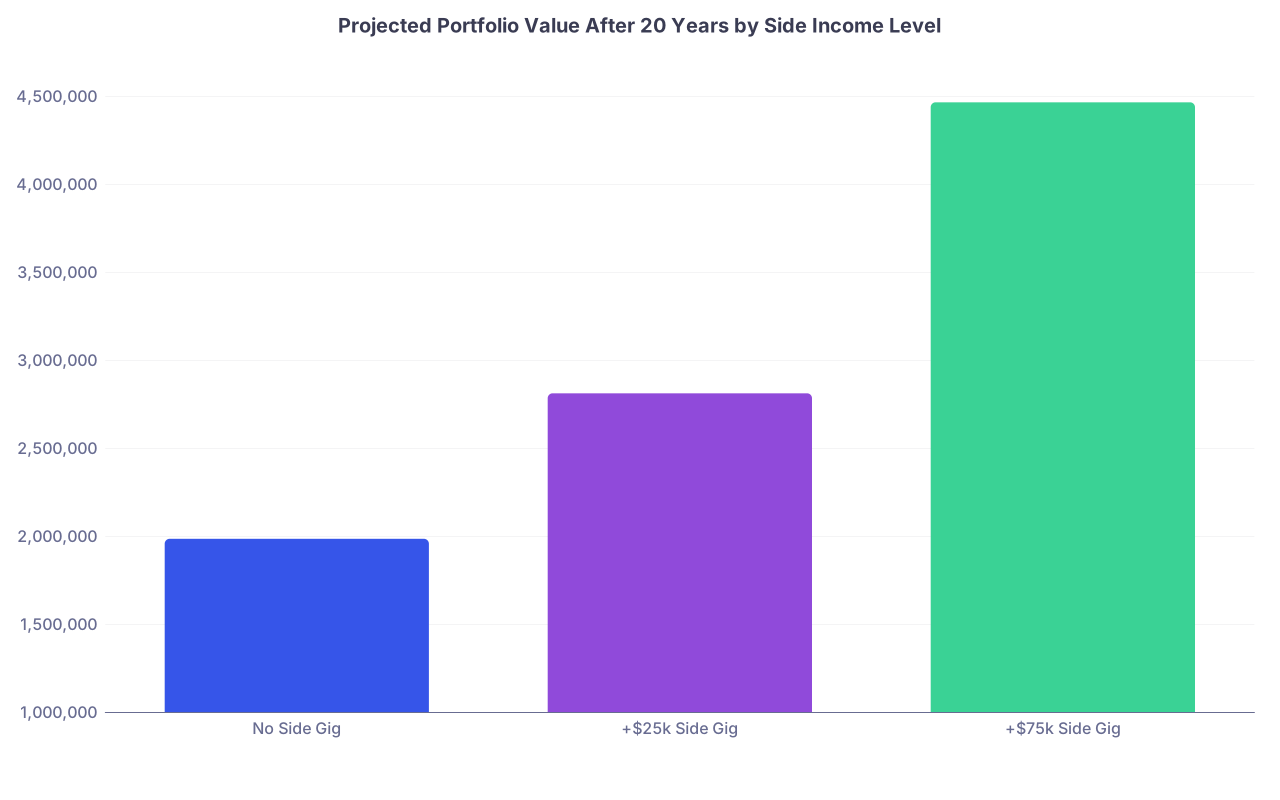
| Category | Value |
|---|---|
| No Side Gig | 1984200 |
| +$25k Side Gig | 2810950 |
| +$75k Side Gig | 4464450 |
Of course, almost no one invests 100% of their side income. Lifestyle creep is real. But even if you invest half, the trajectory change is still massive.
Strategic Patterns That Work (And Those That Don’t)
I have seen enough survey data and longitudinal stories to say this bluntly: doctors who win at “side gig medicine” tend to follow a similar pattern. Those who spin their wheels also follow a pattern.
Winning pattern, data-backed:
Clean up the foundation first
- Consumer debt gone or aggressively attacked
- Reasonable lifestyle relative to primary income
- Basic protections in place: disability, term life, umbrella policy
Start with simple, high-yield side income
- Extra clinical shifts or straightforward consulting to rapidly hit short-term financial goals (loan payoff, seed capital)
- Document everything, track effective hourly rate, monitor burnout
Gradually shift toward scalable or less time-dependent streams
- Equity, ownership, or intellectual property
- Real estate or equity stakes in practice / ASC / related ventures
- Courses, products, or systems that can partially decouple time from income
Use legal and tax structure early once income is predictable
- Entity setup when 1099 income justifies it
- Separate accounts, clear books, professional tax help
Losing pattern, also common:
- Underpaid extra clinical work accepted out of desperation, with no clear end point.
- Side ventures launched with no demand validation (“I built a course; no one bought it”).
- No separation between personal and business finances.
- No attention to contractual or noncompete risk.
- Burnout hits; side gig abandoned, with little to show for the effort.
That is the difference between “I dabbled in a side gig once” and “I built a second economic engine.”
Practical Filters Before You Say Yes to a Side Gig
You do not need another “50 side hustles for doctors” list. You need a decision filter.
Here is the one I use when physicians ask for a second opinion on an opportunity:
- Does this clearly beat my main job on a dollars-per-hour basis, or create a scalable asset?
- Can I see a direct path from this work to either autonomy, equity, or exit options?
- Does this violate any existing contracts, noncompetes, or IP assignments?
- Is there a credible plan for taxes, bookkeeping, and legal structure if it works?
- Will this push my total working hours into a burnout zone for more than 1–2 years?
If you cannot answer those cleanly, you are not starting a side business. You are just selling more of your time, probably at a discount, under higher stress.
Side gig medicine is not magic. The surveys show a noisy, uneven landscape: a lot of small wins, a few spectacular successes, and quite a few physicians who tried something, got tired, and walked away.
The good news: the data also shows that even modest, sustained side income—handled with discipline and legal/financial structure—can move your financial timeline forward by years. You do not have to become a physician influencer or a serial entrepreneur. You just have to treat your supplemental income like a business decision, not a hobby.
Once you have that second income stream running and aligned with your long‑term goals, the next conversation is not “What side gig should I try?” It becomes “How and when do I buy back my time?” That is where the real leverage is. But that is a topic for another day.