
Most physicians have this exactly backward: your salary is not primarily about how “valuable” you are. It’s about how strategically replaceable you are and what your hospital’s spreadsheets say about you.
Let me walk you into the room where those decisions actually get made.
The Room Where Your Salary Really Gets Decided
Compensation is not “the CEO deciding what feels fair.” In medium and large systems, it runs through a pretty standard, quiet machine:
There’s usually a Physician Compensation Committee. It’s not glamorous. Conference room, bad coffee, a couple of physicians, a finance VP, HR comp person, maybe legal, and someone from service line leadership. Once a quarter, sometimes monthly, they look at:
- Market survey data (MGMA, SullivanCotter, AMGA, Gallagher, etc.)
- System financials and margins
- Service line profitability
- Recruitment/retention problems in specific specialties
- Compliance and Stark law guardrails
What you never see: the spreadsheets sorted by RVUs, tiered by percentile, with color-coding for “over benchmark,” “under benchmark,” “pay compression risk,” and “risk of leaving.”
They’re not starting with “What does Dr. Patel deserve?”
They’re starting with: “We need a compensation grid for hospitalists that is Stark-compliant, competitive enough that they don’t leave, but not so generous that we blow the service line margin.”
If you do not understand that sentence, you’re negotiating with the wrong playbook.
The Myth of Pure “Market Rate”
Every administrator will tell you, “We pay at fair market value based on MGMA (or similar) benchmarks.”
That’s not entirely false. It’s just incomplete bordering on misleading.
Here’s what really happens.
The comp analyst pulls survey data from multiple sources. Something like:
- Total compensation by specialty
- wRVUs by specialty
- Percentiles (10th, 25th, 50th, 75th, 90th+)
- Compensation per wRVU
Then someone in finance marries that to your system’s data:
- What your docs in that specialty are currently producing (wRVUs)
- What you’re currently paying them
- The gap between current effective $/RVU and survey benchmarks
- The net contribution margin per physician (how much profit/loss after expenses)
They set a “target percentile” for pay and often a slightly higher percentile target for productivity. Example: “Let’s set base salary for cardiology at 50th percentile, but the wRVU threshold for bonuses at 60–65th percentile productivity.”
So right away, the game is rigged toward you working harder to hit the same money peers get for less work.
Now look at a simplified version of what they’re staring at:
| Percentile | Total Comp ($) | wRVUs | Comp per wRVU ($) |
|---|---|---|---|
| 25th | 475,000 | 9,000 | 52.8 |
| 50th | 575,000 | 10,500 | 54.8 |
| 75th | 700,000 | 12,500 | 56.0 |
| 90th | 825,000 | 14,500 | 56.9 |
Then they pick something like: “We’ll pay $55 per wRVU, guarantee 9,000 RVUs year one, and set tiers at 10,500 and 12,000.”
Is it “market-based”? Technically yes. Is it tilted to protect the hospital? Absolutely.
The Real Inputs That Drive Your Pay Tier
Let’s get more blunt. The actual drivers of your pay tier inside a hospital system:
How hard you are to replace in that ZIP code
Not in the world. In that town. A rural hospital with one GI doc will pay differently than a major metro with six practices competing to sign you.Your specialty’s contribution margin
Some services print money (ortho, GI, cardio). Others lose money on paper but are strategic (peds, psych, geriatrics). Admins won’t say this out loud during recruitment, but I’ve heard the off-mic versions:
“We can’t afford to pay family med at 75th when the clinic is barely breaking even.”
“We can stretch for interventional cardiology; they’re driving downstream revenue.”System financial posture this year
Margin up? Committees become generous. Margin down? Suddenly “we have to realign to market” and “remove outliers.” That’s code for: cut comp and slow raises.Regulatory fear—Stark and Anti-Kickback
Legal sits in the back of the room and periodically says, “We can’t pay that; it’s above the 75th percentile for comp with 50th percentile productivity, that’s a problem.”
So they slide numbers down. This is why they cling to survey data—it’s their legal shield.Internal equity politics
The one thing they hate more than losing a doc is triggering a revolt. If they bump you dramatically, five others in your specialty will find out (they always do) and demand more. So they build tier ladders and narrow ranges to keep everyone “within band.”Recruitment/retention crisis level
When a department is on the verge of collapse, “market rates” suddenly become flexible. I’ve watched a hospital go from “we only pay at 50th percentile” to “we’ll do 75th + sign-on + retention bonus” in three months once three hospitalists resigned.
Your personal virtue, bedside manner, being “a team player”? Nice, but not primary levers. They show up in the gray zones—whether they bend rules for you, find a novel title, or bump your tier faster.
How Tiers Are Actually Structured
You’ve probably seen the end product: a clean PDF making it look intentional and fair. It is structured; it’s just not structured the way they explain at orientation.
Most large systems use some version of: base + wRVU + tiers + “other.”
Base Salary
For employed docs (non-partnership), base is often pegged near a percentile of MGMA total comp assuming a certain volume.
Two common plays:
Pure wRVU model with a draw
You get a “base” that’s actually a guaranteed advance against expected RVUs. End of year, they reconcile—overperform and get bonus; underperform and maybe you owe or your base gets reset.True base with separate productivity bonus
Base is fixed, often 50th percentile for 3-year rolling surveys. Bonus kicks in after a wRVU threshold.
The internal tables will look something like this—even if they don’t show you:
| Tier | Annual Base ($) | wRVU Threshold | $ per RVU above Threshold |
|---|---|---|---|
| 1 | 250,000 | 4,000 | 45 |
| 2 | 275,000 | 4,500 | 47 |
| 3 | 300,000 | 5,000 | 50 |
If you’re wondering why your colleague with the same job description makes 25–50k more: they’re at Tier 2 or 3 on a grid just like this.
wRVU Rate and Thresholds
The number that quietly defines your life: $ per wRVU.
The games:
- Set a respectable-looking rate (e.g., $50/RVU)
- Pair it with a quietly inflated threshold (e.g., no bonus until 5,500 RVUs when survey median is 4,500)
- Or pay “market” $/RVU but lowball the base so you’re forced to chase volume
I’ve sat in meetings where someone said, “If we bump their wRVU rate, lower the guarantee. Net effect: same cost to us, looks like a win to them.”
That’s your raise, repackaged.
Non-Productivity Pay: The Hidden Lever
This is where the insiders get made whole—and the naïve get underpaid for years.
Hospitals carve out “non-clinical” buckets:
- Medical directorships
- Committee chairs
- Quality/administrative roles
- Call stipends
- Teaching stipends
Official story: “We value leadership and quality.”
True story: these are the pressure valves for inequity and retention.
Someone they can’t afford to lose but “can’t justify” bumping in the main grid? They give them 0.1–0.2 FTE as “quality director,” pay another 30–80k that doesn’t show up as pure clinical comp. On the spreadsheet, the main RVU grid still looks compliant and modest.
If you’re doing any of that work for free or for a token stipend, understand: someone else at your hospital is getting six figures for the same category of work.
Call Pay and the Tier You Never See
Call is its own side market.
The more miserable the call, the more negotiating room. I’ve heard lines like:
“We’re not touching base pay. If they want more money, we can raise call stipends; that’s easier to justify.”
So you’ll see ugly call schedules with “compensation” that looks like:
- $400–$1,500 per 24-hour call (wild variation by specialty/market)
- Extra pay for post-call clinics? Usually not. You eat it.
For some subspecialties, call pay is the only way they get above “market” without blowing up the formal tiers.
The Data They Use to Justify Keeping You Flat
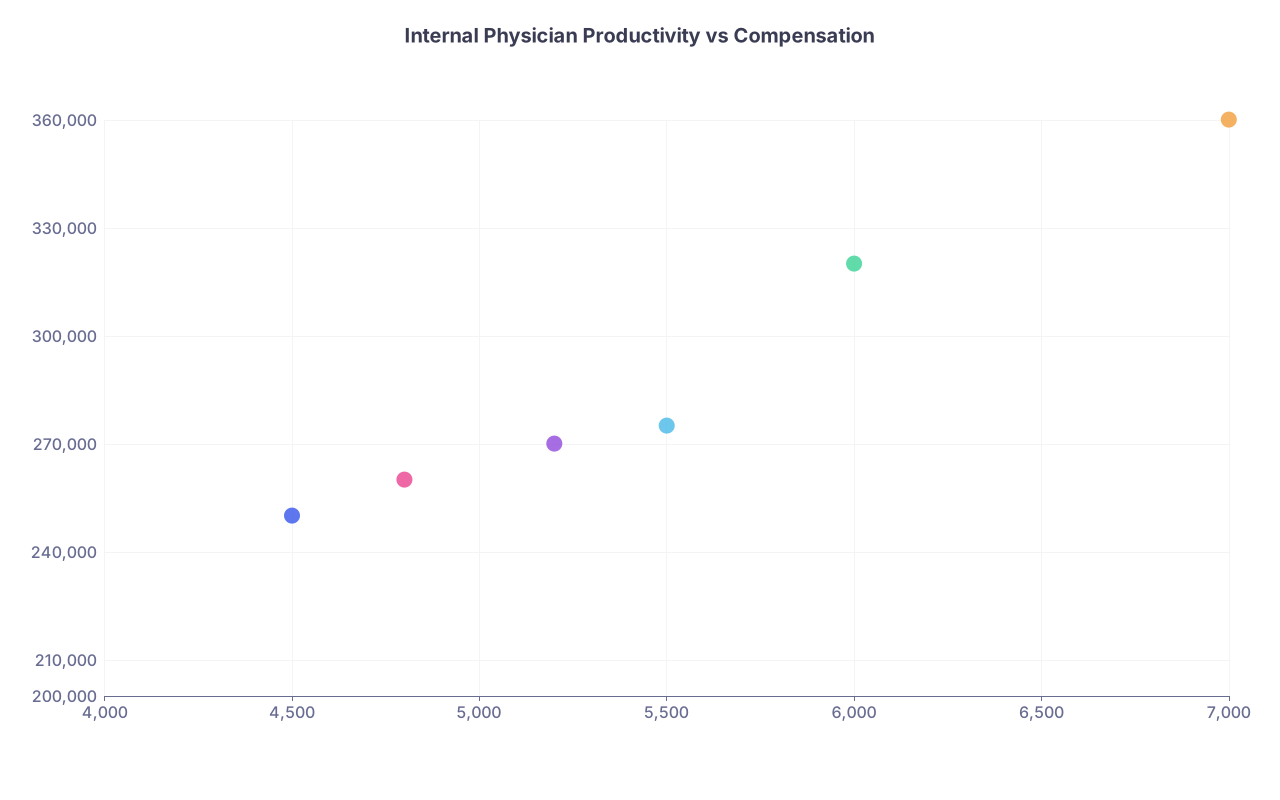
Let me show you the kind of chart that quietly kills raises:
| Category | Value |
|---|---|
| Doc 1 | 4500,250000 |
| Doc 2 | 5200,270000 |
| Doc 3 | 6000,320000 |
| Doc 4 | 7000,360000 |
| Doc 5 | 4800,260000 |
| You | 5500,275000 |
This is the slide. X-axis: RVUs. Y-axis: total comp. A regression line through the points.
You go in asking for a 50k raise. They pull this out internally:
“Look, she’s right on the compensation line for her productivity. If we bump her, she becomes an outlier above the curve. That’s hard to defend.”
Do they mention:
- She takes more call?
- She covers more nights?
- She leads a committee informally?
Often no, because those are not coded in a way that shows up cleanly in their model. If it is not in the structured data fields, it basically does not exist at comp meeting time.
So they say, “We’re aligned with market and internally equitable.” Meeting adjourned.
That’s how your raise dies without anyone actually saying “no” in your face.
How Promotions and Tier Bumps Are Really Granted
Officially, there are policies. Years of service, leadership roles, board certification, academic rank, blah blah.
Unofficially, there are three doors through which people actually move tiers:
Squeaky wheel with leverage
The doc who says, “I have an offer in writing from X group for 60k more.”
Not vague. Written. Specific. Hospital admin understands they’re about to lose RVUs and call coverage. Suddenly there’s an “equity review.”“Key person” quietly protected
The one surgeon or proceduralist the hospital simply cannot afford to lose. Finance already knows their downstream revenue. Service line leader fights during comp meetings:
“If we don’t bump him, we lose two OR days per week. That’s insane.”
They find a way. Extra role, special stipend, stealth tier.Political capital and visibility
The doc who chairs three committees, talks regularly with the CMO, and plays the game. They get the heads-up before reforms happen, have input on the next comp plan, and magically land favorably when the dust settles.
If you’re in a large system and you think “years of service” alone will raise your tier, you’re going to be sitting at the same number while others slide past you.
The Legal Fence Around All This
The part they’re not over-explaining to you is how much Stark and Anti-Kickback fear drives standardization.
Basic idea: hospitals cannot just throw crazy money at high-referring docs or wildly overpay compared to work performed. That looks like disguised kickbacks.
So they armor themselves with:
- Written compensation plans
- Documented use of reputable benchmark surveys
- Tiers that apply to “all similarly situated physicians”
- Compensation committees with minutes documenting rationale
You’re feeling underpaid? Legal loves that. Under is safer than over.
This is also why trying to negotiate a truly off-the-grid deal inside a big system is hard. If they create a “special” comp model just for you, they have to defend it later to auditors and regulators. Most just do not want that headache.
So instead they:
- Create formal “exceptions” categories (recruitment, retention, leadership roles)
- Cap percentages: “No one above 75th percentile comp unless approved by CMO + legal with justification”
You may think it’s “unfair bureaucracy.” They think it’s survival. But it absolutely caps your upside.
Academic vs Private vs System: Different Shells, Same Pea
Let’s clear up a common misconception: different settings, but the core levers are the same.
| Setting | Who Sets Tiers | Main Pay Driver | Real Upside Lever |
|---|---|---|---|
| Academic | Dean + Chairs + HR | Rank + FTE | Outside income / rank |
| Employed system | Comp committee + finance | RVUs + service margin | Non-clinical roles |
| Private group | Partners | Collections | Ownership / ancillaries |
Academic places pretend it’s about scholarship. They absolutely care, but when departments renegotiate? They still drag out MGMA, still talk about RVUs and clinical FTE, still ask “what is the hospital subsidy per faculty FTE?”
Private groups pretend they’re immune to this. They’re not. They just replace MGMA spreadsheets with payer mix and collections spreadsheets. Your tier is based on ownership stake, buy-in, and how much you bring in above overhead.
Big integrated systems are just the most formal and opaque version of the same game.
How to Read Your Contract Like an Insider
When you get a contract or a “revised comp plan,” here’s what people on the inside look for first:
What percentile are they really pegging you at?
Ask bluntly: “Is this near 50th percentile MGMA total comp for my specialty? Based on which year’s data?” If they dodge, that’s data.Where is the wRVU threshold relative to median productivity?
If survey median for your specialty is 4,800 RVUs and they set bonus threshold at 5,500, you’ve just been quietly moved above median productivity to get median-ish pay.What is the all-in $/RVU, not just the published rate?
Take your total projected comp (base + expected bonus) divided by expected RVUs. Compare to MGMA comp-per-RVU data. That’s the real story.What non-clinical pay buckets exist?
Instead of arguing over $2/RVU, sometimes the smarter play is:
“Given I’m already doing X and Y, can we formalize that as 0.1 FTE admin at $Z?”
They can often move on that faster than changing the grid.
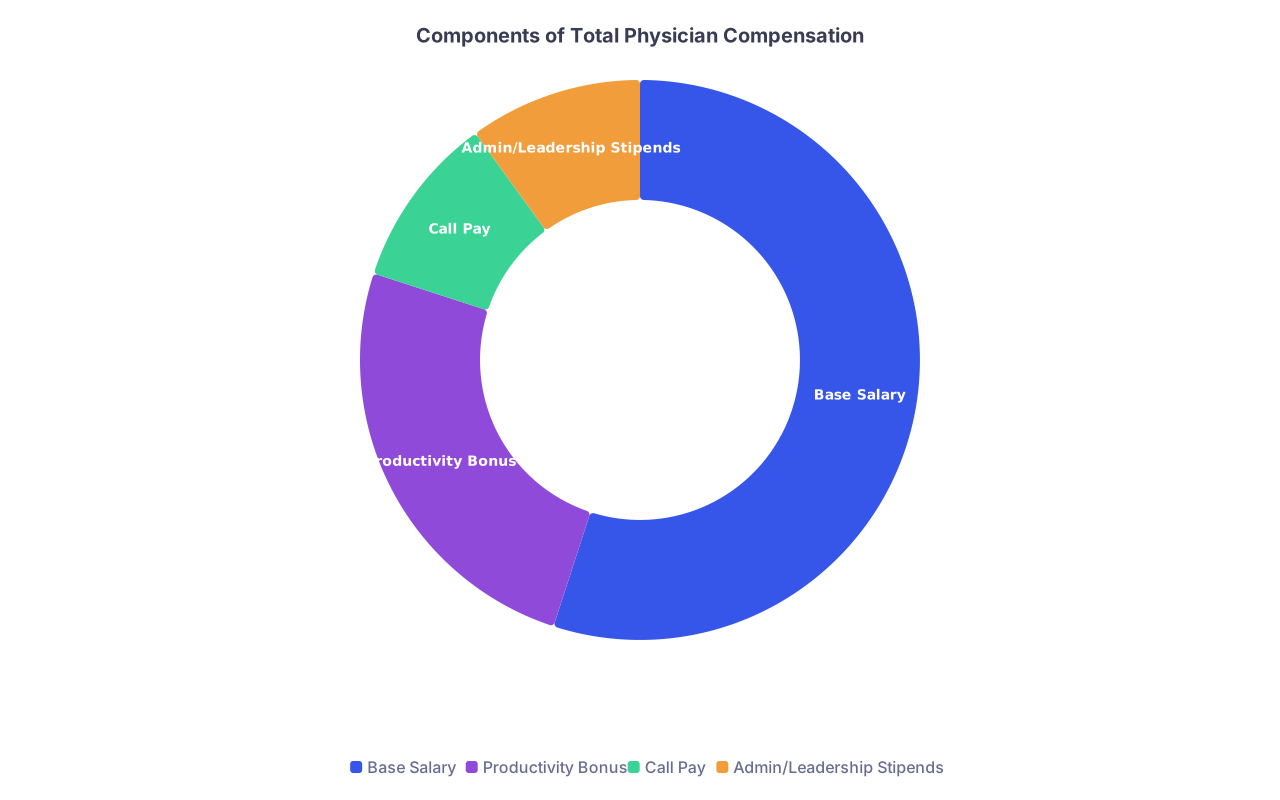
Here’s a crude but useful mental chart for you:
| Category | Value |
|---|---|
| Base Salary | 55 |
| Productivity Bonus | 25 |
| Call Pay | 10 |
| Admin/Leadership Stipends | 10 |
Most physicians obsess over the base slice and maybe the bonus slice. Insiders work all four.
Why New Grads Get Screwed (and How Some Don’t)
Residents and fellows walk into this mess with zero context and usually one question: “Is this number good?”
Behind the scenes, your new grad tier is normally:
- Lower base than established peers
- Lower wRVU expectation in year one (ramp up)
- But lower bonus opportunities
- And virtually no non-clinical or leadership pay
The hospital calls it a “protected ramp-up.” Finance calls it “lower risk while we see how they perform.”
But some grads jump tiers faster. Why?
- They come with competing offers they can prove
- They’ve done local rotations and the department is already invested in them
- They’re walking into a crisis slot (vacancy that’s killing coverage)
I’ve literally heard:
“We’re not going to lose her over 20k. Give her Tier 2 on start; we’ll say it’s a recruitment exception.”
So yes, the starting point is negotiable. Not infinite, but not fixed.
The Quiet Reset: System-Wide Comp “Reforms”
Every few years, systems do a “compensation redesign.” The talking points are always the same: “align with quality,” “align with market,” “ensure fairness.”
What’s really happening:
- Finance realized too many docs drifted above target bands
- Or margins have compressed and they need to pull back costs
- Or they merged with another system and need uniform tiers
I’ve watched this script from inside:
- Consultants are hired. They run surveys, present pretty decks.
- They recommend narrower bands, more RVU alignment, and less guaranteed money.
- Legacy outliers (high earners) get “grandfathered” or eased down over 2–3 years.
- Everyone else is told, “Don’t worry, this will create upside for high performers.”
Translation: if you’re already underpaid, you’re the easiest group to squeeze further. You have no legal claim to your colleague’s prior, richer deal.
When this comes, your move is not to whine about “fairness.” Your move is to quantify your value, know your true benchmark, and either secure special carve-outs or line up your exit options.
Because once a new grid is in, it can be locked for a decade.

Bottom Line: What Actually Moves Your Pay Tier
You’re not going to charm your way into a different grid inside a big system. But you can absolutely stop playing blind.
Here’s what actually shifts your tier over a 3–5 year horizon:
- Credible outside offers or clear replaceability advantage
- Documented productivity and scope that outstrips your peers
- Visible organizational roles that they’d struggle to refill
- Understanding the internal rules well enough to ask for the right type of money
And yes, sometimes you need to leave. Or at least be ready to. Hospital systems will not typically re-tier you out of sheer appreciation. They re-tier you to reduce risk—to their coverage, to their service line, to their strategic plans.
Know that, and your conversations change.

| Step | Description |
|---|---|
| Step 1 | Survey Data MGMA etc |
| Step 2 | Comp Committee |
| Step 3 | Hospital Financial Margin |
| Step 4 | Service Line Profitability |
| Step 5 | Recruitment Retention Risk |
| Step 6 | Legal Stark Guardrails |
| Step 7 | Set Base Salary Bands |
| Step 8 | Define RVU Thresholds |
| Step 9 | Create Nonclinical Stipends |
| Step 10 | Individual Offers |