
Does Moonlighting in Residency Meaningfully Change Your Financial Trajectory?
It’s 10:45 p.m. You just signed out from your primary service, grabbed a bad cup of coffee, and you’re logging into a telemedicine platform or heading to a small community ED to start a moonlighting shift. You’re doing it for the extra $120–$200 an hour. But in the back of your mind is the real question:
“Is this actually moving the needle on my long-term finances, or am I just trading sleep for a slightly nicer checking account right now?”
Let me answer that directly:
If done strategically, moonlighting can absolutely and meaningfully change your financial trajectory.
If done poorly, it just makes you tired and slightly less broke.
The difference is in how you use it, when you start, and whether you understand the tax and risk side.
The Core Question: How Much Can Moonlighting Really Add?
Forget the vague “it helps.” Let’s talk numbers.
Realistic ranges for residents who moonlight (US, 2024 ballpark):
| Scenario | Approx Annual Extra Income |
|---|---|
| 1 shift/month, $120/hr, 8 hr | $11,520 |
| 2 shifts/month, $150/hr, 8 hr | $28,800 |
| 4 shifts/month, $175/hr, 8 hr | $67,200 |
| Aggressive (6–8 shifts/month) | $100,000+ |
Most people fall into the 1–4 shifts/month zone. Very few can safely sustain 6–8 without burning out or running into duty hour issues.
Now layer this with taxes and compounding.
After-tax reality
Moonlighting income is usually 1099 (independent contractor), not W-2. That means:
- No taxes withheld
- You pay both sides of Social Security/Medicare (self-employment tax)
- Effective tax rate can easily hit 30–40% depending on your total income and state
So your $50,000 gross might be closer to $30,000–$35,000 after taxes if you do nothing smart.
But you’re not going to do nothing smart.
The compounding angle
Say PGY-3 and PGY-4 you average $30,000/year after tax from moonlighting and invest it instead of inflating your lifestyle. Assume 7% real return (stock market long-term after inflation).
Rough math:
- $30k/year for 2 years → $60k total invested
- In 20 years at 7% → roughly $232k
- In 30 years at 7% → roughly $457k
That’s from moonlighting for two years.
Does that “meaningfully” change your financial trajectory? Yes. That’s the difference between “comfortable” and “I can cut back a few years early without worrying.”
The 3 Main Ways Moonlighting Shifts Your Financial Trajectory
Here’s where moonlighting actually moves the needle:
- Killing high-interest debt early
- Jump-starting investing 5–10 years earlier than your peers
- Reducing how aggressively you need to work or save as an attending
1. Crushing debt – especially the toxic kind
If you’re sitting on:
- Credit cards at 18–25%
- Personal loans at 8–12%
- Private student loans at 7–10%
…moonlighting is a financial sledgehammer.
Take a resident with:
- $15k on credit cards at 20%
- $40k private loans at 9%
Even one moderate moonlighting setup:
- 2 shifts/month
- $150/hr, 8 hours
- ~$28,800/year gross
- Let’s say $19k after tax
You can wipe the cards in year 1 and put a serious dent in the private loans. That’s thousands of dollars in avoided interest over the next 5–10 years.
If you’re in PSLF or a favorable federal repayment plan, different story. In that case, the “pay off debt as fast as possible” instinct might actually be wrong. Extra moonlighting money might be better going into:
- Roth IRA
- Traditional IRA/solo 401(k) (if you want to cut taxes)
- Taxable brokerage
But the point stands: aligning moonlighting money with your highest return use (often debt early on) moves your long-term trajectory substantially.
2. Getting 5–10 years of investing head start
You know the cliché: time in market > timing the market. Annoying, but true.
Most residents tell themselves they’ll “start investing as an attending.” Translation: They’ll start late.
If you can force in:
- $500/month into a Roth IRA from moonlighting, or
- $1,000–$1,500/month into a taxable account or solo 401(k)
That 3–4 year head start is massive.
Let’s compare two versions of you:
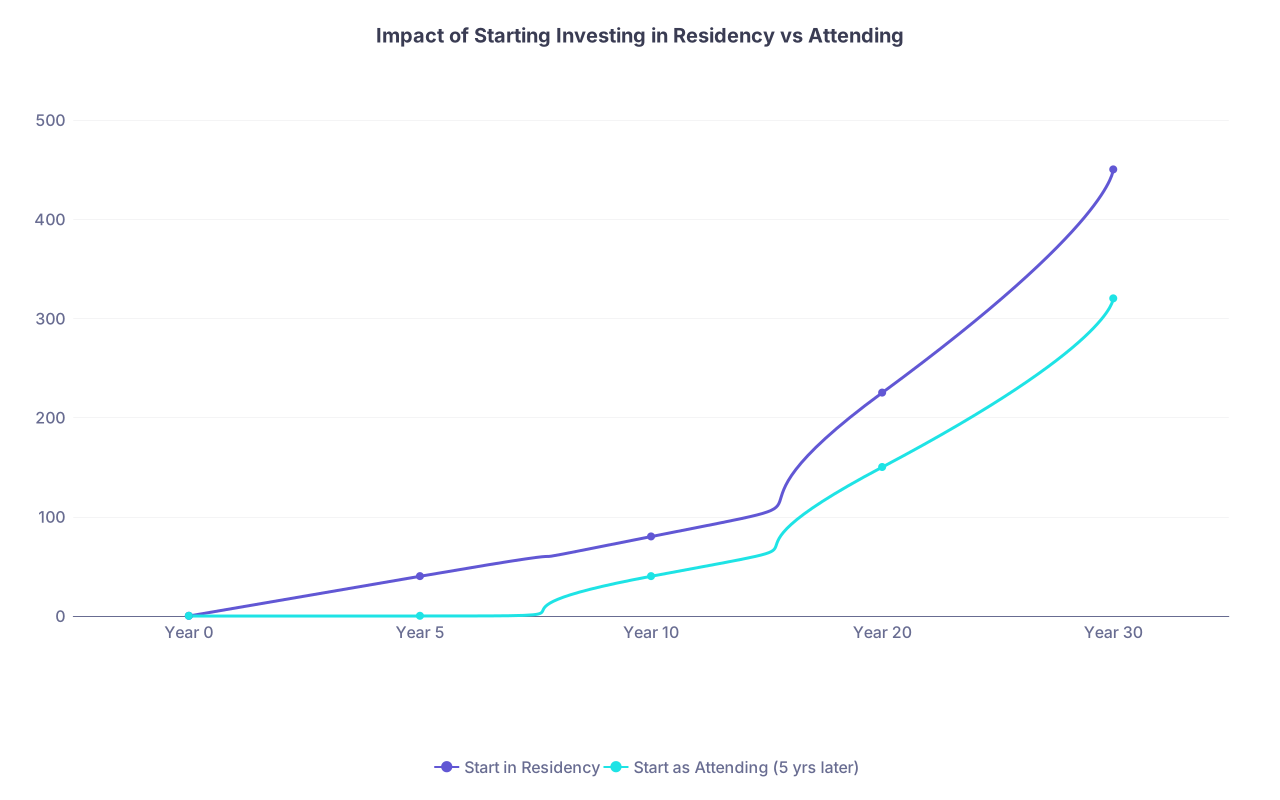
| Category | Start in Residency | Start as Attending (5 yrs later) |
|---|---|---|
| Year 0 | 0 | 0 |
| Year 5 | 40 | 0 |
| Year 10 | 80 | 40 |
| Year 20 | 225 | 150 |
| Year 30 | 450 | 320 |
Assume:
- Residency version: invest $10k/year for 3 years, then stop
- Attending version: invest $10k/year but starts 5 years later
By year 30, early starter ends up with roughly ~40–50% more despite contributing the same or even less. That’s what moonlighting really buys you: time leverage.
3. Changing your attending life
This is the part residents underestimate.
Strategic moonlighting can:
- Let you finish residency with minimal or zero consumer debt
- Give you a 5–6 figure taxable or retirement portfolio already working for you
- Make it possible to:
- Take a lower-paying but better-lifestyle job
- Work 0.8–0.9 FTE instead of killing yourself at 1.2 FTE
- Say “no” to garbage RVU contracts or toxic groups because you have a cushion
I’ve watched people who aggressively moonlighted:
- Pay off most of their high-rate loans before finishing training
- Walk into attending life with $50–100k in investments
- Feel way less trapped by the first job offer that came along
That’s an actual trajectory change, not a slightly nicer car in residency.
The Downsides: Where Moonlighting Backfires
Moonlighting isn’t a free lunch. There are three things that wreck residents financially and professionally:
- Fatigue and performance issues
- Legal/contractual landmines
- Wasting the money instead of leveraging it
1. Fatigue: The hidden cost
Most programs allow moonlighting “as long as it doesn’t interfere with your primary responsibilities” and within duty hours. Reality: a lot of residents quietly crush themselves.
Signs it’s gone too far:
- You’re dragging through your actual residency rotations
- You’re snapping at patients/nurses because you’re cooked
- Your learning suffers; you’re just surviving
If moonlighting starts threatening board pass rates, evaluations, or patient safety, you’re lighting your future income on fire to make extra now. That’s dumb.
Set hard rules:
- Max number of shifts/month
- No moonlighting after brutal stretches (e.g., ICU, 28-hour calls)
- 10–12 hours between end of moonlighting and next residency duty when possible
If your base performance starts slipping, you’re overdoing it. Full stop.
2. Legal and contractual risk (this part gets people blindsided)
Residents routinely screw this up because no one spells it out, and they’re tired and just sign whatever.
Red flags you must handle before moonlighting:
- Your residency contract:
- Does it explicitly allow moonlighting?
- Does it require program director approval?
- Are there limitations on settings (in-house vs external)?
- Malpractice coverage:
- Are you covered by the moonlighting site?
- Are you covered for all types of work you’re doing?
- Is it claims-made or occurrence? Tail coverage issues?
- Duty hours:
- Moonlighting hours absolutely count toward ACGME duty hours. Playing games here is a good way to get you and your PD in hot water.
If you’re signing a separate contract with a group/hospital/telemed platform, expect:
- Non-compete language (yes, even as a resident)
- Indemnification clauses (them pushing liability risk onto you)
- Obligations around minimum shifts / short-notice cancellation penalties
You should not be casually signing this without understanding:
- “If I leave residency or move, does this thing follow me or restrict my job options?”
- “If something goes really wrong clinically, am I personally on the hook beyond what malpractice covers?”
If you’re not sure, pay an actual attorney to review one contract. It’s not overkill. It’s cheap compared to a career-long mess.
3. The biggest waste: lifestyle creep
Here’s where residents blow it.
They moonlight, then:
- Upgrade the car
- Order UberEats five nights a week
- “Deserve” three big vacations
- Move to a nicer apartment they barely spend time in
Suddenly that extra $30–40k/year is gone and they’ve changed exactly nothing long term.
The whole point of moonlighting is to convert extra work into:
- Less debt
- More assets
- More options later
If you’re using it just to live like a poorly-paid attending, you’re doing extra work for almost no long-term benefit.
How to Decide: Should You Moonlight, and How Much?
Use this simple decision grid.
| Question | If YES | If NO |
|---|---|---|
| Do you have high-interest debt (>7–8%)? | Moonlighting strongly favored | Less pressure; investing may dominate |
| Are you consistently exhausted? | Reduce or skip moonlighting | You might tolerate some shifts |
| Does your contract clearly allow it? | Proceed with structured plan | Clarify or avoid |
| Do you have a clear use for the money? | Green light | You risk wasting it |
| Are exams/boards coming up? | Limit or pause until after | Can consider more |
And zooming out: what actually changes your financial trajectory is not doing moonlighting. It’s pairing moonlighting with a defined plan:
- “Every moonlighting dollar in 2025 goes to paying off X loan.”
- “First $20k builds my emergency fund. Next $20k goes to Roth IRA.”
- “I’ll do 2 shifts/month maximum; more only during lighter rotations.”
Practical Game Plan: Making Moonlighting Actually Work for You
Here’s a simple, repeatable framework.
Step 1: Get PD and contract clarity
- Explicit written approval from your program (email or form)
- Confirm duty hour accounting expectations
- Make sure the moonlighting location has malpractice coverage in writing
Do not “I’m pretty sure it’s fine” your way through this.
Step 2: Decide your why in one sentence
If you can’t write your reason in one line, you’re going to drift.
Examples:
- “I’m moonlighting to wipe out my 9% private loans before graduation.”
- “I’m moonlighting to fund a $50k down payment by end of PGY-4.”
- “I’m moonlighting to fully max Roth IRA + taxable investing during residency.”
Anything that isn’t that goal? You fund it from your base resident salary.
Step 3: Pre-allocate every moonlighting dollar
Before you do your first shift, decide percentages:
Example:
- 50% → extra debt payments
- 30% → Roth IRA / solo 401(k)
- 10% → taxable investing
- 10% → guilt-free fun (yes, leave some room to breathe)
You can tweak the numbers, but the main idea is this: decisions get made upfront, not at 1 a.m. while you’re browsing flights on your phone.
Step 4: Automate and protect yourself from yourself
- Separate checking account for moonlighting income
- Automatic transfers set up:
- Once/month to loan servicer
- Once/month to IRA / brokerage
- Quarterly estimated taxes if you’re 1099 (talk to an accountant at least once)
Moonlighting without planning for taxes is how residents get slapped with a $8–15k bill the next April and panic.
Step 5: Reassess every 6 months
Quick check-in:
- Are you more burned out?
- Are you slipping academically or clinically?
- Have your goals changed (e.g., matched to a fellowship, decided on PSLF, partner’s job shifted)?
You’re allowed to dial back or stop entirely. “I said I’d do this all residency” is not a binding blood oath.

Where Moonlighting Matters Most by Specialty and Setting
One more nuance: moonlighting impact varies by specialty.
Rough pattern:
- Primary care, hospitalist-track IM, EM: lots of moonlighting-friendly gigs (telemed, urgent care, cross-coverage, small EDs)
- Surgical fields: often less external moonlighting during residency due to case requirements and fatigue; more in senior years or as chief
- Psych: telepsych and inpatient weekend coverage can be lucrative and relatively flexible
- Anesthesia: OR coverage, endoscopy centers, smaller facilities – high hourly rates when allowed
But here’s the thing: the math doesn’t care about your specialty. An extra $30–50k/year used intelligently has the same long-term effect whether you’re psych, EM, or ortho. The constraint is really time, duty hours, and fatigue.
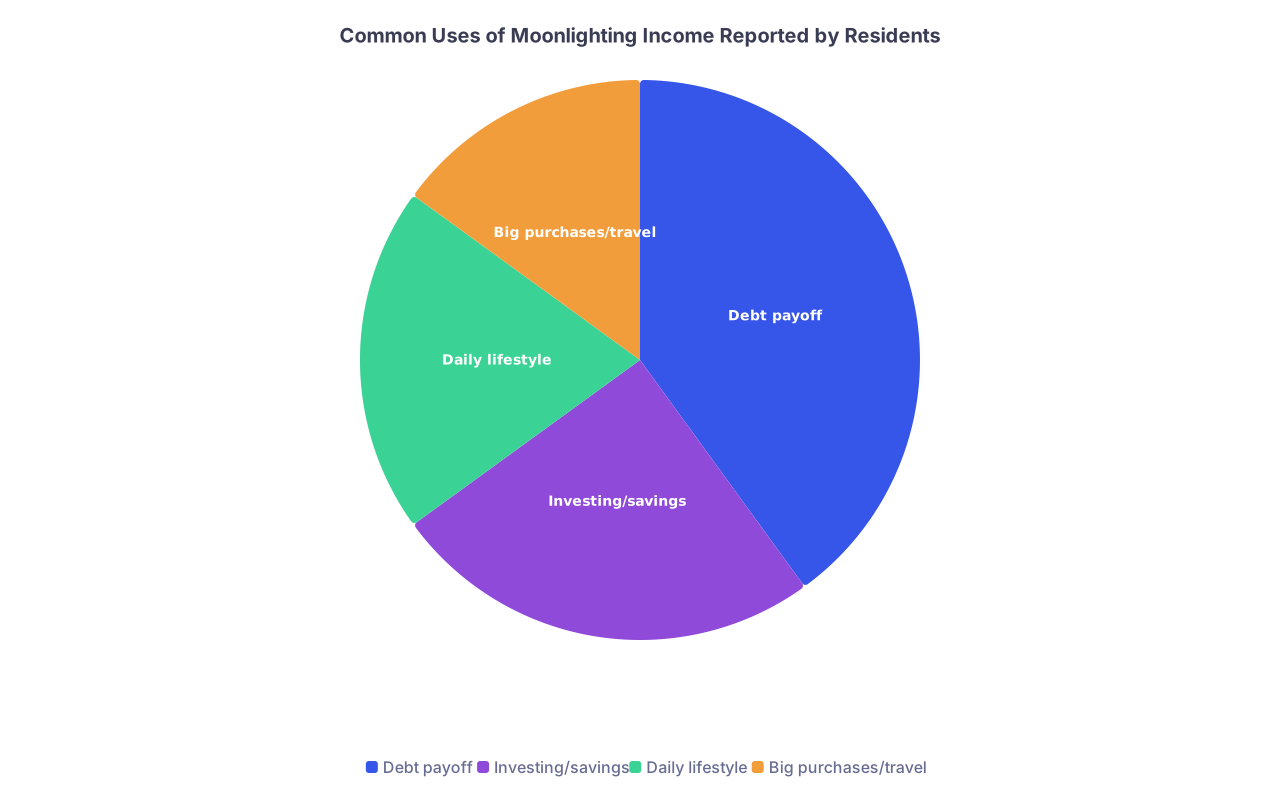
| Category | Value |
|---|---|
| Debt payoff | 40 |
| Investing/savings | 25 |
| Daily lifestyle | 20 |
| Big purchases/travel | 15 |
Most residents say they’re using moonlighting for debt and savings. In practice, lifestyle eats a much bigger slice than they admit. You can be the exception.
Bottom Line: Does It Meaningfully Change Your Financial Trajectory?
Yes—if:
- You aren’t trading away your core training and health.
- You handle the legal/malpractice/tax side with your eyes open.
- You treat moonlighting dollars as capital to build future freedom, not just nicer stuff right now.
Think of it this way:
Moonlighting is a lever. If you pull it while standing on solid ground—with a plan—and point it at debt and assets, it can accelerate you by years.
If you pull it while half-asleep, with no plan, pointing at lifestyle inflation, it just makes you more tired and slightly less stressed about your credit card bill. That’s not a trajectory change. That’s noise.
Do this today
Open a note on your phone and write a one-sentence purpose:
“I’m considering moonlighting in residency to _____________ by _____________.”
If you can fill in both blanks with something clear and measurable, then it’s worth building a structured plan around it. If you can’t, fix the sentence before you sign up for a single extra shift.