
The belief that locum tenens is “only a short-term stopgap” is wrong—and it can cost you hundreds of thousands of dollars.
Locums can be a brutally effective long-term salary strategy for some physicians and a terrible idea for others. The trick is knowing which camp you’re in and how to run the math like a business owner, not like a tired employee daydreaming on call.
Let’s walk through it like that.
The one-sentence answer
Locum tenens is a great short-term income accelerator and a reasonable long-term strategy only if:
- You’re in a higher-paying or in-demand specialty
- You’re willing to travel or accept less-desirable locations/schedules
- You treat it like a business (tax, benefits, downtime, and risk priced in)
If you want stability, local control, predictable benefits, and a clear partnership or leadership track? Long-term full-time employment will almost always beat long-term locums on total life return, even when raw hourly pay is lower.
Step 1: Understand what you’re really comparing
Most people compare “$250/hr locums” to “$300K salary.” That’s sloppy. You need to compare total economic packages.
Here’s the cleaner way to think about it:
- What’s your true hourly rate as an employed doc?
- What’s your true net hourly rate as a locums doc after:
- Unpaid days
- Taxes
- Benefits you now buy yourself
- Travel/housing gaps
- What risks are being shifted onto you?
If you don’t do this, any conclusion you reach is basically a guess.
| Category | Employed Physician | Locum Tenens Physician |
|---|---|---|
| Base pay | Salary / wRVU comp | Hourly or daily rate |
| Benefits | Included by employer | You pay (health, disability, etc.) |
| Retirement | Match or pension | Solo 401(k)/SEP IRA (your dollars) |
| Malpractice | Employer covers | Often covered, but verify tail |
| Time off pay | PTO usually paid | Unpaid; downtime = $0 |
| Admin/busy work | Often high, unpaid | Usually less, but unpaid |
| Stability | High | Variable, contract-to-contract |
If you can’t roughly estimate each box for your situation, you’re not ready to make a long-term decision.
Step 2: Run the numbers like a business owner
Let’s do a simple, real-world style comparison.
Scenario A: Employed internal medicine hospitalist
- Salary: $320,000
- Schedule: 7-on/7-off, 15 shifts/month average
- Average work hours: 14 hrs/shift (includes charting, calls, admin)
- Benefits value: roughly $50,000 (health, disability, retirement match, CME, etc.)
Rough math:
- Annual hours: 15 shifts × 14 hrs × 12 months ≈ 2,520 hrs
- Total comp: $320,000 + $50,000 = $370,000
- Effective hourly rate: $370,000 / 2,520 ≈ $147/hr
Not as sexy as “$320K” sounds, right?
Scenario B: Locums hospitalist
- Rate: $230/hr
- Actual booked clinical time: 12 shifts/month average (travel, gaps, cancellations happen)
- Hours/shift: 12 hrs
- Employer covers malpractice but not tail; you buy:
- Health insurance: $8,000/yr
- Disability + life: $5,000/yr
- Retirement: you fund $30,000/yr from your own income
- Unpaid CME, licensing, accounting, etc.: ~$7,000/yr
- Assume 6 weeks/year without work (contracts in flux / chosen breaks)
Rough math:
- Work months: 10.5 effective months
- Annual hours: 12 shifts × 12 hrs × 10.5 ≈ 1,512 hrs
- Gross income: 1,512 × $230 = $347,760
- Subtract self-paid benefits/overhead: ≈ $50,000
- Net before tax: ≈ $298,000
Effective hourly rate net of benefits cost:
$298,000 / 1,512 ≈ $197/hr
So here, long-term locums beats employed by about $50/hr. That’s real money.
But here’s the catch: if your locums schedule is less full, your rate lower, or your overhead higher, that advantage shrinks or disappears completely.
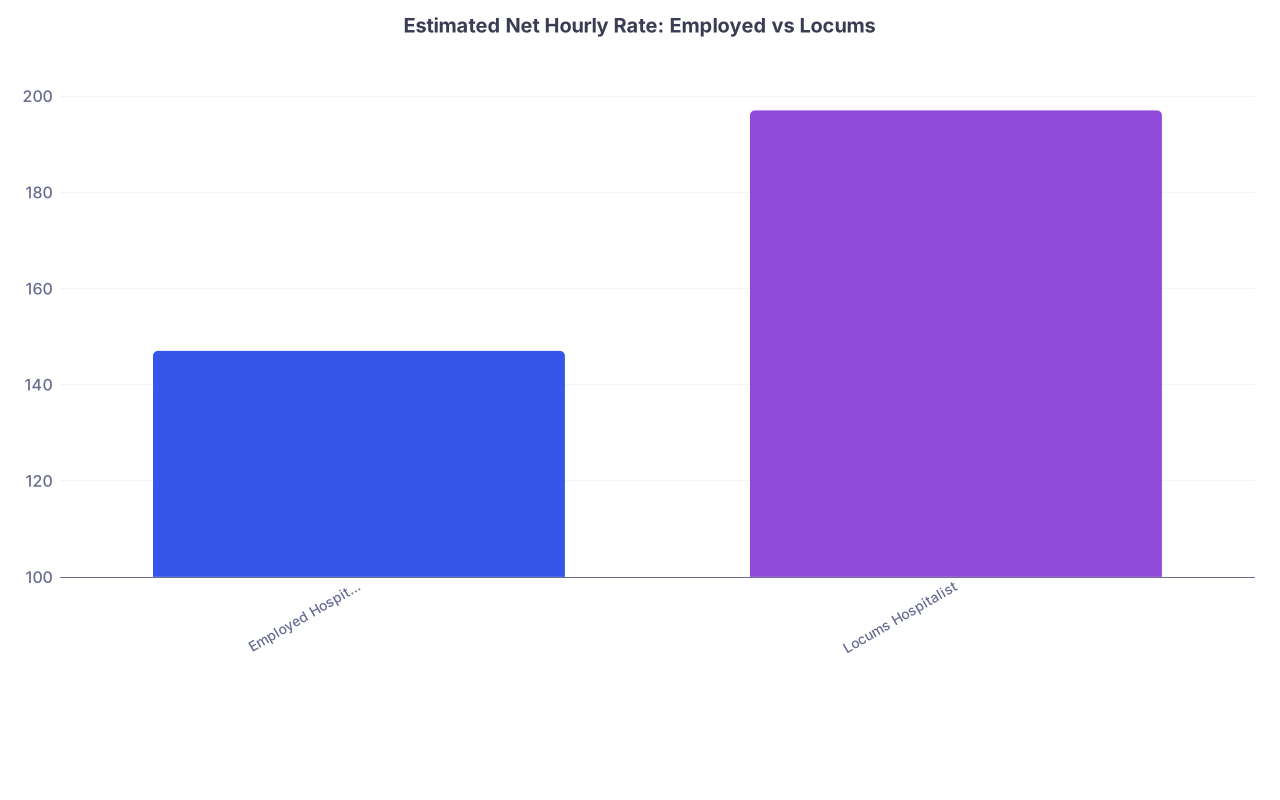
| Category | Value |
|---|---|
| Employed Hospitalist | 147 |
| Locums Hospitalist | 197 |
The point isn’t the exact number. It’s the framework:
- Don’t compare “salary vs hourly rate”
- Compare “effective net hourly rates over a full realistic year”
When locums is smart as a short-term tool
Using locums as a short, focused play is often a very smart move. I’d almost call it underused.
Here are situations where locums shines:
Aggressive debt payoff (2–4 years)
- New attending with $300–500K loans
- You do 0.8–1.2 FTE of locums, stack high-paid shifts, live relatively lean
- Knock out a huge chunk of principal early, then pivot to a more stable role
Bridge years
- Between fellowship and permanent role
- Between jobs if your group implodes or gets bought
- While relocating for a spouse/partner’s career
Testing markets and practice styles
- Try community vs academic
- Try rural vs suburban vs urban
- See how different EMR/culture/admin structures feel before signing a big contract
Capital-building for a specific goal
- Want $300K down payment in 2 years?
- Want to fund a business, surgery center buy-in, or rental portfolio?
Locums is a sledgehammer tool for “I need a lot of cash, relatively fast.”
Short-term, you can tolerate:
- Less stability
- More travel
- Higher uncertainty
Because you have a clear finish line and a specific dollar target.
If you don’t define that finish line, short-term locums easily drifts into “I’ve been doing this 7 years and I’m tired” territory.
When locums can work as a long-term strategy
Spoiler: it’s not for most people. But there are very real exceptions.
Locums can be a solid long-term play if:
You’re in a high-demand, high-rate specialty
- EM, anesthesia, radiology, some surgical subspecialties, hospitalist, critical care, some psych gigs
- Your locums rates are meaningfully higher than realistic employed comp in your region
You value autonomy and flexibility more than stability
You like:- Saying no to bad contracts
- Walking when administration changes
- Taking 2–3 months off yearly without negotiating PTO
You’re willing to build a pseudo-“panel” of sites
The best long-term locums physicians I’ve seen:- Rotate among 2–4 familiar hospitals/clinics
- Negotiate repeat contracts
- Become “their” go-to fill-in
That solves some of the “I’m always the outsider” feeling.
You treat it like a business, not extra shifts
You:- Hire a competent CPA
- Set up an S-corp or LLC if appropriate
- Max out solo 401(k) or SEP
- Keep 3–6 months of cash for dry spells
- Track metrics: booked hours, collections, tax rate
If that sounds exhausting, you probably want a long-term employed job and maybe dabble in locums on the side.
When long-term locums is usually a bad financial move
Some people romanticize it. Then reality hits.
Locums is usually a bad long-term salary strategy if:
Your specialty doesn’t command high locums rates
- Some outpatient-heavy fields (e.g., allergy, derm unless cosmetic, outpatient neuro) just don’t get great locums rates
- You may earn less than a well-structured employed job with productivity or partnership potential
You want roots: kids, schools, community, leadership roles
Locums can absolutely be local and stable in a few markets, but it’s atypical.
If your life goals require:- Being present at home consistently
- Climbing leadership ladders
- Building a reputation in a single institution
Long-term locums usually fights those goals.
You need stable, predictable income for mental health or obligations
Divorce, alimony, complex caregiving, heavy financial responsibilities—these don’t play well with income volatility.You’re not disciplined about money
The locums trap I see often:- Big checks
- No automatic savings
- No deliberate retirement funding
- No tax planning
- A decade later: high lifestyle, low net worth
If you won’t treat the extra pay as a tool (and not just lifestyle fuel), long-term locums loses much of its advantage.
Non-financial factors that quietly matter a lot
Money isn’t the only variable here, but it often blinds people to these:
1. Call, shifts, and schedule control
Locums can sometimes offer:
- Better shift mixes (e.g., mostly days)
- Freedom to avoid bad call setups or specific holidays
But it can also be: - “You’re here to plug our worst holes” land
This varies wildly by site and specialty. Ask blunt questions up front. Don’t assume.
2. Workload and documentation
Locums gigs can be:
- “We just need warm bodies” with heavy censuses and poor staffing
- Or surprisingly light workloads with strong support
Permanent employed jobs can be:
- Soul-crushing productivity mills
- Or well-run systems where you trade slightly lower pay for sustainability
On paper, two $250/hr gigs look the same. On the ground, one might burn you out in a year.
3. Career trajectory
If you want:
- Chief roles
- Medical director positions
- Ownership/equity in group or practice
- Academic promotion
Long-term exclusive locums will make that harder. Not impossible—but harder.
You’re trading career capital and institutional influence for flexibility and short-term cash.
Long-term strategies that actually work
Here are a few real-world patterns I’ve seen work well:
Strategy 1: “Sprint then settle”
- 2–4 years heavy locums right after training
- Pay down debt aggressively, build cash cushion, maybe invest in a house or business
- Then transition to a carefully chosen employed/partnership track job with less financial pressure
Why it works: you front-load the grind when you’re young and flexible, then settle into a sustainable path.
Strategy 2: “Employed + selective locums”
You:
- Hold a stable 0.8–1.0 FTE employed role
- Do 1–2 weekends or weeks a month of high-yield locums (taxed as 1099, with business deductions)
Benefits:
- Keep benefits and stability
- Get serious extra cash for specific goals
- Hedge against local job risk
This is arguably the sweet spot for a lot of physicians who can tolerate some extra work in the short to medium term.
Strategy 3: “Long-term locums with intentional life design”
You:
- Live in a low cost-of-living area
- Maintain relationships with 2–3 reliable locums sites
- Work 0.7–0.9 FTE equivalent at high billable rates
- Keep expenses modest, invest heavily, and accept some uncertainty as the price of autonomy
This is niche but can work brilliantly for people who genuinely want flexibility and are good with money.

| Category | Value |
|---|---|
| Employed only | 3 |
| Employed + some locums | 4 |
| Short-term heavy locums | 5 |
| Long-term focused locums | 4 |
(Think of this as a 1–5 income potential scale, not exact dollars.)
How to decide what’s smart for you
Forget generic advice. Ask and answer these, in writing:
What’s my top priority for the next 3–5 years?
- Max money
- Max stability
- Max flexibility
Pick one. Seriously.
What’s my realistic locums hourly rate and fill rate in my specialty and region?
- Ask recruiters
- Ask colleagues actually doing it
- Look at multiple offers, not just one shiny posting
What’s my all-in annual cost for benefits and professional overhead as a 1099?
- Health, disability, life
- Retirement contributions
- CME/licensing
- Tax prep and legal
What does my effective net hourly rate look like for:
- Full-time employed
- Full-time locums
- Hybrid (employed + some locums)
What am I willing to trade?
Because you’re trading something—stability, control, income, time, or future options—in every direction.
Once you’ve done that, the “smart” choice usually becomes pretty obvious.
Bottom line
Locum tenens is:
Excellent as a short-term tool:
- Debt payoff
- Bridge years
- Testing practice environments
- Cash for specific goals
Viable but specialized as a long-term salary strategy:
- For high-demand specialists
- For people who actually want autonomy more than security
- For physicians willing to run their careers like a small business
If you’re chasing locums because you hate your current job, fix the analysis first. You might need a better employed position, not a lifetime of contract work.
Open a spreadsheet today and list three columns: “Employed,” “Full Locums,” and “Hybrid.” Fill in real numbers for pay, hours, benefits cost, and time off. Don’t stop until you can clearly see which column you’d bet the next 5 years of your life on.