
The biggest lie physicians tell themselves about compensation is that “call evens out in the long run.” The data say otherwise.
If you do not explicitly quantify how call frequency interacts with base pay, bonuses, and RVU production, you are almost certainly being underpaid for it. Sometimes by six figures per year.
Let us walk through this the way an analyst would: define variables, compare across specialties, quantify marginal effects, then stress‑test the assumptions with real‑world scenarios.
1. Defining the variables: what “call” and “compensation” actually mean
Most compensation conversations fall apart because people compare different things. You cannot correlate what you have not defined.
Call frequency: three dimensions that actually matter
“1 in 4 call” is useless as a standalone phrase. For financial analysis you need:
Frequency
How often you are on call:- In‑house vs home call
- Weeknight vs weekend
- Primary vs backup call
Intensity
What typically happens when you are on:- Pages per night
- Admissions/consults per call shift
- OR cases (for surgical fields)
- Expected sleep interruption hours
Compensation structure for call
How the time is monetized:- Included in base salary (no explicit call pay)
- Stipend per weekday / weekend
- Hourly rate for in‑house nights
- Per‑case or per‑consult bonus
- “Free” RVUs from hospital‑employed work (e.g., ED consults)
For analysis, I usually compress this to:
- Call nights per month (or 24‑hr call days per month)
- Proportion of those nights that are “busy” (defined as sleep <4 hours or >X tasks)
- Dollar per call equivalent (what you actually receive per additional call shift)
Total compensation: what you must include
Talking just about “salary” hides a lot of the effect. Properly, total compensation =
- Base salary (guaranteed)
- Production‑based pay (RVU, collections, profit share)
- Call stipends and differentials
- Quality / performance bonuses
- Employer retirement contributions
- Sign‑on and retention bonuses amortized over term
- Extra‑contractual moonlighting (if it is a direct result of call structure)
For this article, I am going to focus on cash compensation + call stipends + production related to call. Retirement match and benefits usually scale somewhat with base pay; they do not change much per incremental call.
2. The broad pattern: more call, more money… but not linearly
At the 30,000‑foot level, there is an obvious pattern: high‑call specialties tend to have higher total compensation. But once you quantify call frequency, the relationship is not a straight line.
Think of it as:
- Cross‑specialty effect: Specialties with structurally heavier call generally pay more.
- Within‑specialty effect: Additional call for a given specialty often pays poorly on a per‑hour basis.
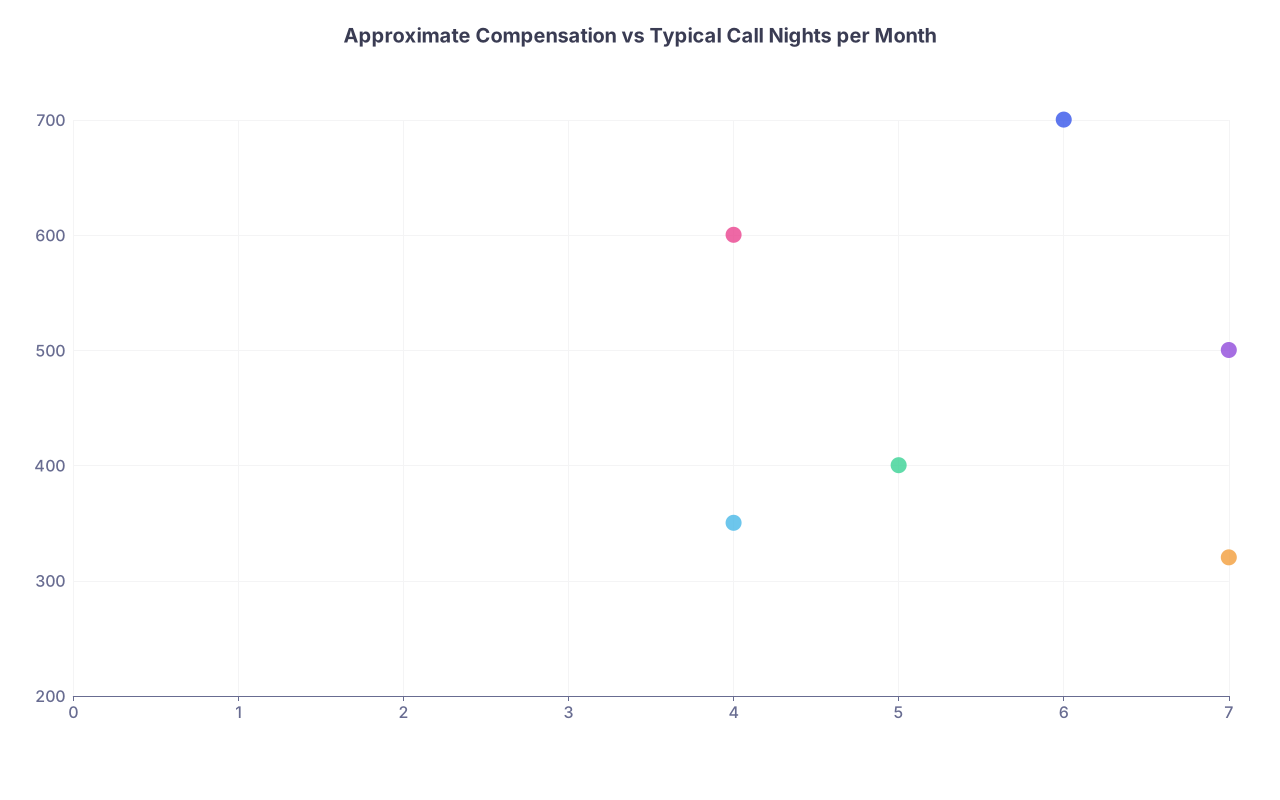
Here is a simplified snapshot using approximate mid‑career national averages from major surveys (Medscape, MGMA‑type data, blended and rounded for anonymity) and typical call patterns.
| Specialty | Call Nights/Month | Typical Call Type | Approx Total Comp ($k) |
|---|---|---|---|
| Orthopedic Surgery | 5–7 | In-house/Home mix | 650–750 |
| General Surgery | 6–8 | In-house/Home mix | 450–550 |
| OB/GYN (general) | 4–6 | In-house | 350–450 |
| Internal Med Hospitalist | 7 (blocks) | In-house | 280–350 |
| Cardiology (non‑invasive) | 3–5 | Home w/ callbacks | 550–650 |
| Neurology | 3–5 | Home w/ telestroke | 320–380 |
The high‑call procedural fields (ortho, general surgery, OB) sit at the top. Hospitalists, who are physically present and work night blocks, sit lower but still above many low‑call outpatient fields like dermatology or ophtho on a per‑hour basis.
Now, let me show that pattern visually.
| Category | Value |
|---|---|
| Ortho | 6,700 |
| Gen Surg | 7,500 |
| OB/GYN | 5,400 |
| Hospitalist | 7,320 |
| Cardiology | 4,600 |
| Neurology | 4,350 |
The relationship is positive but noisy. More call nights tend to correlate with higher total compensation, but there is a lot of scatter, especially where in‑house shift work blurs into “call.”
More interesting is within‑specialty variance. Two general surgeons in the same region:
- Surgeon A: 1 in 4 call (7–8 nights/month), no stipend, base $450k
- Surgeon B: 1 in 6 call (5 nights/month), $300 weekday / $800 weekend call stipend, base $475k
On paper, Surgeon A looks reasonably paid. Once you normalize for call, Surgeon B often comes out 15–25% ahead on a per‑work‑hour basis.
3. Quantifying the marginal value of each extra call shift
Stop thinking in “per year” terms and start in per additional call block.
Let us build a simple model.
Assume:
- Base salary: $400,000
- Standard expectation: 4 call nights/month
- Extra call coverage available: up to 4 more nights/month
- Call stipend: $500 per weekday, $1,000 per weekend day (blend average: say $650 per call)
- A call night consumes, on average, 8 “usable” hours (sleep disrupted, clinic next day shortened, etc.)
Step 1: Direct call pay
If you take 4 extra call nights/month at $650 per call:
- Extra direct call pay = 4 × $650 × 12 = $31,200/year
Step 2: Indirect production from call
If your call work is billable and you actually get credited:
Assume each busy call generates:
- 2 consults @ 3 RVUs each
- 1 procedure @ 5 RVUs
Total = 11 RVUs per call night.
If your conversion is $50/RVU and 75% of that work is credited to you:
- Credited RVUs per call night = 8.25
- Dollar value per call = 8.25 × $50 ≈ $412
Add that to the stipend and your total per call night = $650 + $412 ≈ $1,062.
At 4 extra calls/month:
- 4 × $1,062 × 12 ≈ $51,000/year incremental.
Now, look at the time cost. If each call “costs” you 8 hours of usable life/energy (between the night and the post‑call day drag), that is:
- 4 calls × 8 hours × 12 = 384 hours/year.
$51,000 / 384 ≈ $133/hour.
That is actually reasonable for many hospital‑employed physicians. Now compare that to the next scenario: same extra call, but no RVU credit.
Then:
- Per call = stipend only = $650
- 4 extra per month ⇒ 4 × $650 × 12 = $31,200/year
- $31,200 / 384 ≈ $81/hour
This is where I start to see many physicians effectively doing call at nurse practitioner rates, once you net out the fatigue cost.
And unfortunately, in a lot of real contracts, call is even worse: no stipend, no explicit production credit. It is “part of being a team player.”
4. How the call–compensation correlation changes by specialty type
The correlation is not uniform. The slope—how much more you get paid as call increases—depends heavily on specialty economics.
I usually break specialties into four buckets.
A. High‑call, high‑pay procedural (ortho, neurosurgery, trauma surgery)
These fields:
- Have heavy call
- Have expensive emergencies
- Are often the linchpin for hospital facility revenue
That means hospitals and groups will pay to ensure coverage. For orthopedic trauma, it is common to see:
- Monthly trauma call stipends: $5,000–$15,000
- Per‑day trauma call pay: $1,000–$2,500
- Plus RVUs on top
So the marginal value of each trauma call day can easily exceed $2,000–$3,000, when you factor in OR cases that bleed into the next day.
The result: strong positive correlation between call burden and total compensation.
But even there, the per‑hour rate may drop as call frequency climbs; your effective hourly rate is often best when you are not oversaturated with call.
B. High‑call, medium‑pay procedural (general surgery, OB/GYN, ENT, anesthesiology)
Here, the economics are more subtle. General surgery call at a small community hospital might pay:
- $0–$500 per weeknight
- $1,000–$2,000 per weekend day
But some private groups simply divide work without explicit call pay and just split collections. In those practices, the relation between call frequency and compensation is indirect: more call ⇒ more cases ⇒ more collections… unless the payer mix is terrible.
For OB/GYN, I have seen the following absurd pattern multiple times:
- Group A: 1 in 4 call, base $300k, deliveries RVU‑based, no call stipend
- Group B: 1 in 6 call, base $320k, $300/night call stipend, better CNM coverage
Group A partners are often working 1.5x more nights for less per‑hour take‑home once you adjust for call.
C. Cognitive specialties with night emergencies (neurology, cardiology, GI)
These fields have call that is stressful but not always well monetized.
The telestroke neurologist taking 1 in 3 nights often receives:
- Minimal or no nightly stipend (e.g., $200/night)
- RVUs for consults that may not reflect actual complexity
- Burnout risk that is far out of proportion to the marginal pay
Cardiology is more nuanced. Interventional call is better paid (and more clearly tied to cath lab revenue). Non‑invasive and EP call is often pooled or less explicit.
But the main pattern: compensation does not rise in a straight line with call frequency. Saturation hits quickly.
D. Hospitalists and shift‑based models
Hospitalists are the edge case because “call” is embedded in the shift. Nights are often:
- Paid at a differential (e.g., $2,000/night vs $1,600/day), or
- Structured via nocturnist tracks with a higher salary
The data are relatively consistent:
- Nocturnists typically earn 15–25% more than day hospitalists
- They work similar or slightly fewer shifts/year
- Their nights/weekend burden is much higher
So the marginal value of “call‑like” work (night shifts) is concretely priced. When you run hourly calculations, nocturnists often land around $10–$20/hr more than day‑only hospitalists.
5. A structured view: specialties where call is and is not paid proportionally
Let me crystallize the disparity.
| Category | Call Burden | Comp Level | Call Pay Transparency | Effective $/Call (Typical) |
|---|---|---|---|---|
| Ortho/Neuro Trauma | Very High | Very High | High | $2,000–$4,000 |
| General Surgery / OB | High | High | Variable | $500–$1,500 |
| Cardiology / GI (mixed) | Medium–High | High | Medium | $400–$1,200 |
| Neurology / Pulm / ICU | Medium–High | Medium | Often Low | $200–$800 |
| Hospitalist (nights) | Medium | Medium | High (shift pay) | $1,000–$2,000 per shift |
These are broad ranges, but the pattern holds: there is substantial underpricing of call in several cognitive and mid‑pay procedural specialties.
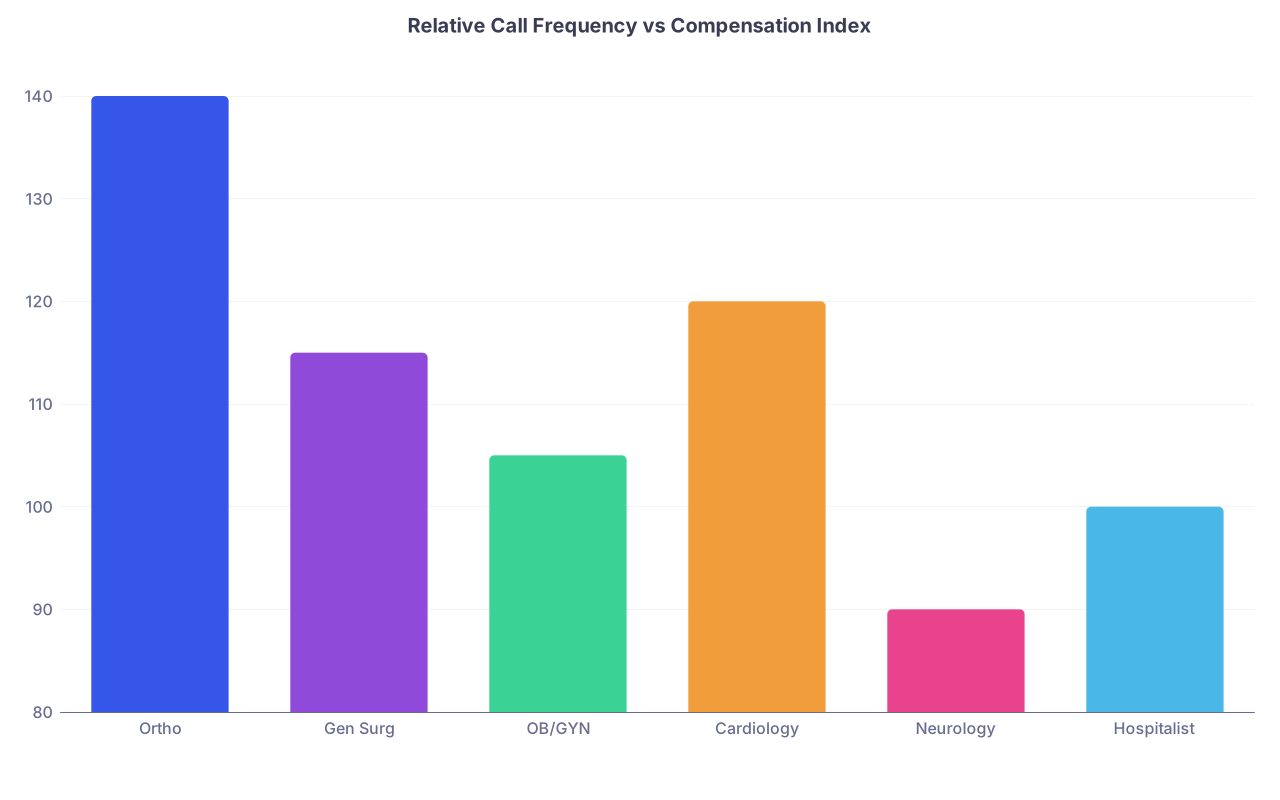
To visualize the mismatch between call frequency and relative pay bump, look at a simple index.
| Category | Value |
|---|---|
| Ortho | 140 |
| Gen Surg | 115 |
| OB/GYN | 105 |
| Cardiology | 120 |
| Neurology | 90 |
| Hospitalist | 100 |
Here I normalized 100 = “balanced” relationship between compensation and call. Values >100 suggest you are relatively well‑paid for the call burden; <100 suggests underpaid.
Neurology routinely comes out under 100 in these analyses. OB/GYN often hovers near 100 or slightly above if there is good call structure, but slides below in many community practices where call is bundled for free.
6. How contracts distort the correlation: buy‑downs, stipends, and “equal shares”
The underlying economics are one thing. The contract you sign is another layer that can completely change the call–compensation correlation.
I frequently see four contract structures:
1. “Equal call, equal pay” partnership models
Everyone takes roughly the same call. Everyone earns roughly the same income share. This works… until someone wants to reduce call.
Then you quickly see the true price of call when partners negotiate buy‑downs, such as:
- “If you drop to half call, your draw falls by $100,000.”
- “Retiring partner gets 1 in 8 call but takes 30% lower profit share.”
Those implicit prices usually work out to $1,000–$2,000 per call night in surgical groups. That is the revealed value of call, regardless of what the stipend line item says.
2. Hospital‑employed with token call stipends
This is the most common and the most economically irrational for the physician.
Example pattern:
- Base: $350,000
- RVU bonus structure
- Call expectation: 1 in 4, “reasonable” weekend coverage
- Call stipend: $150 per weekday, $250 per weekend day
When I run the math on these, the incremental compensation per extra call night often lands below $50/hour of effective time cost, once you factor in second‑day fatigue and clinic disruption.
The correlation between call and total compensation within that group is essentially flat. More call, same pay.
3. Explicit tiered call buy‑downs
Better groups do this:
- Base pay: $X for full call (e.g., 1 in 4)
- If you go to half call, base pay falls by $Y
- If you take extra call, you get $Z per call night
You can then compute:
- Marginal pay per extra call = Z
- Implied hourly rate = Z / (estimated hours consumed)
I have seen reasonable structures where Z = $1,500 for busy surgical call and $800 for moderate internal medicine call. When Z drops under $500 for heavy night call, the economics are ugly.
4. Shift‑based with clear differentials
As with hospitalists, ED, some ICU, and anesthesia groups. Here the correlation is cleaner:
- More nights/weekends ⇒ more pay
- Night differential explicit (e.g., 20–30% more)
This is the one environment where call frequency and compensation often map cleanly. You work more undesirable hours; you get clearly more money.
7. Practical benchmark: are you underpaid for your call?
Here is a simple quantitative sanity check I walk residents and attendings through. It is crude, but better than shrugging.
Estimate your call hours/year.
Call nights per month × 12 × 8 “usable” hours per call as a proxy.Compute your total effective hourly rate.
Assume 48 work weeks/year. Rough numbers:- Clinic/OR/rounding hours: 45–55/week
- Plus your call hours from step 1
- Total work hours/year = (50 × 48) + call hours (approx)
Then: total comp / total hours = effective $/hour.
Recalculate assuming you dropped half your call, with a hypothetical fair price.
Suppose a fair call rate for your specialty is:- $1,500 per call for high‑acuity surgical
- $800 per call for moderate intensity (cards, GI, neuro)
- $500 per call for lower intensity home call
If your current contract pays dramatically less per call than these benchmarks, you can confidently say: you are subsidizing the hospital or group.
| Category | Value |
|---|---|
| No Call | 140 |
| Moderate Call | 120 |
| Heavy Call | 100 |
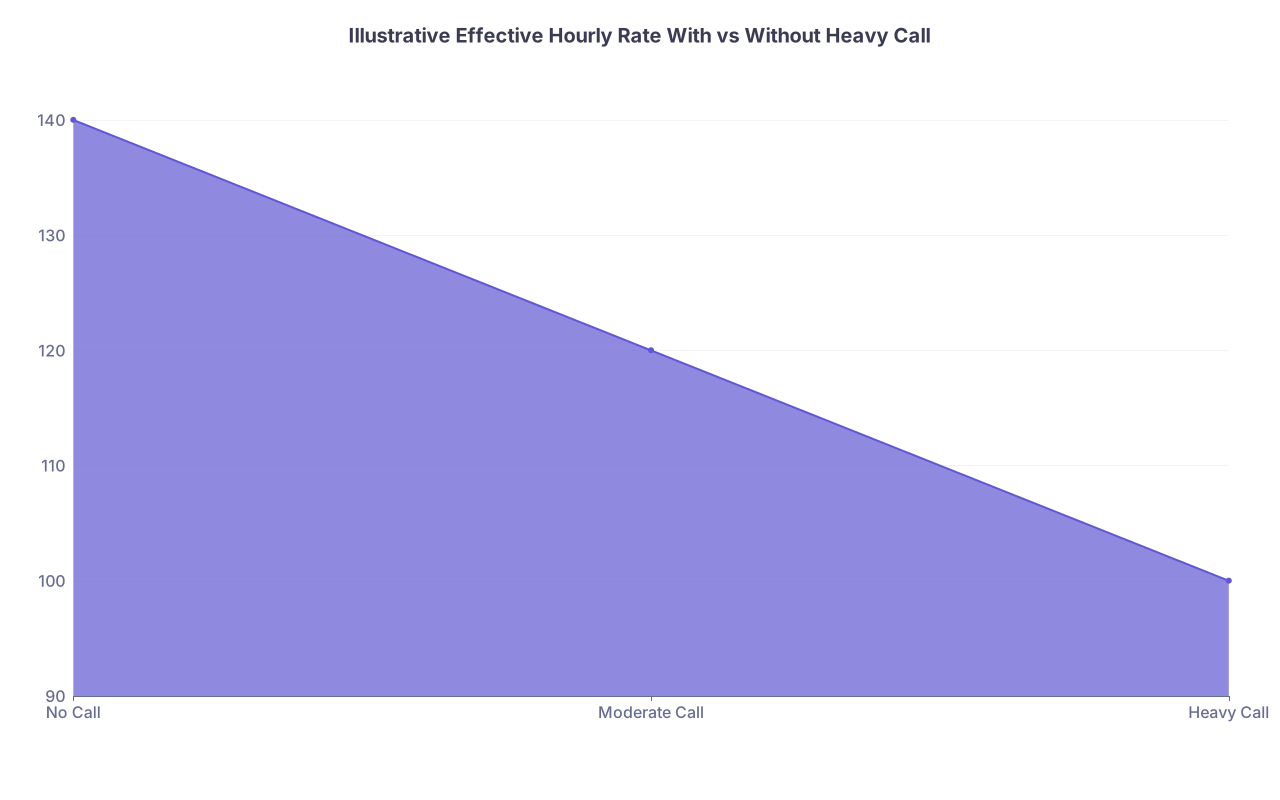
This area chart conceptually shows what happens in many practices: as call ramps up, effective hourly rate trends down because the marginal compensation per call is too low.
8. Two real‑world style scenarios
Let me ground this with compact but realistic examples.
Scenario 1: General surgeon comparing offers
Offer A (rural hospital):
- Base: $475,000
- Call: 1 in 2 (average 15 call nights/month)
- Call stipend: $0 (bundled)
- OR block time generous, RVU bonus after 7,000 RVUs
Offer B (suburban hospital‑employed):
- Base: $425,000
- Call: 1 in 5 (6 call nights/month)
- Call stipend: $300/night weekday, $800/weekend (blended ~$450)
- Similar RVU bonus structure
Calculate incremental value of call in A vs B:
- Extra call nights in A: roughly 9 more per month
- That is 108 more call nights/year
Assume busy general surgery call “consumes” 10 hours/night effectively (night plus OR/clinic impact).
Extra hours/year ≈ 1,080.
Extra pay in A vs B:
- Base: +$50,000 (475 vs 425)
- Stipend difference: 0 vs ~($450 × 6 × 12) = -$32,400
Net advantage of A = roughly +$17,600.
Hourly premium for ~1,080 extra hours of call work = $17,600 / 1,080 ≈ $16/hour.
This is what “better paid” rural jobs often look like when you normalize for call. That extra $50k headline salary is quietly paying you less than a medical assistant rate for your added call nights.
Scenario 2: Neurologist with telestroke call
Current contract:
- Base: $320,000
- Call: 1 in 3 (10 nights/month)
- Stipend: $200/night
- Telestroke consults generate RVUs but are diluted across group
- Sleep disruption: 3–4 pages/night on average
Neutral benchmark for moderate intensity home call might be ~$600–$800 per night. They are being paid $200, roughly 25–33% of a fair market value estimate.
Annual shortfall:
- Fair value target ≈ $700/night
- Current stipend = $200/night
- Gap = $500/night
- Nights/year ≈ 120
- Undercompensated by ≈ 120 × $500 = $60,000/year
That is not a rounding error. That is a full year of med school tuition, every year, indefinitely, coming out of their sleep.
9. What the data say you should actually do with this information
If you are serious about aligning your compensation with your call burden, you have to approach it as a quantified negotiation, not a vague complaint.
The data‑driven steps:
Track your call for 3–6 months.
Log:- Nights on call
- Time paged / awake
- Number of consults/procedures
- Next‑day clinic cancellations or shortened blocks
Estimate your real hourly cost of call.
Use your log to refine:- Effective hours consumed per call
- Combined stipend + incremental RVU pay per call
Benchmark against peers and external data.
Use compensation reports, specialty society surveys, and trusted colleagues to triangulate reasonable call rates in your region.Quantify the ask.
Do not say, “I want more for call.” Say:- “Our current structure pays about $250 per call night. Given the intensity, comparable groups in this market are in the $700–$900 range. At a minimum, adjusting to $600/night would add ~$X/year in cost but bring us closer to fair market value.”
Be willing to trade call for compensation or vice versa.
Some groups will not increase pay but will let you buy down call at the cost of lower salary. That is still data‑driven progress. You can explicitly value your sleep.
Key takeaways
Across specialties, heavier call generally correlates with higher total compensation, but within any given specialty, the marginal pay for additional call is often poor once you quantify it per hour.
Many physicians—especially in mid‑pay procedural and cognitive specialties—are undercompensated for call by tens of thousands of dollars per year, because stipends are low and RVU credit is incomplete or opaque.
The only way to fix the mismatch is to treat call like any other billable asset: measure it, benchmark it, and insist on explicit pricing in your contract instead of letting “being a team player” subsidize everyone else’s balance sheet.