
The popular narrative that physician pay gaps are “mostly explained” once you control for hours and specialty is wrong. The newer multivariable data say otherwise—and the numbers are not subtle.
The updated bottom line: what the data show
Across recent large datasets (2018–2024), once you adjust for specialty, experience, hours worked, practice type, academic vs private setting, and even productivity metrics like wRVUs, 3 patterns keep showing up:
- Women physicians earn less than men in almost every specialty.
- Black and Hispanic physicians earn less than White physicians with similar credentials.
- These gaps shrink with proper adjustment—but they do not disappear.
Let me put actual numbers on that.
• Gender: Most contemporary multivariable models show women earning about 8–18% less than men after adjustment. In dollar terms, for an attending in the $300k–$400k range, that translates to roughly $30k–$70k less per year.
• Race/ethnicity: Net pay gaps after robust adjustment tend to fall in the 5–15% range for Black and Hispanic physicians vs White peers, sometimes higher in procedure-heavy fields. Asian physicians often show smaller or no negative gaps, sometimes slight positives, but that masks big within-group variation.
Here is a compact comparison from recent peer‑reviewed and large industry reports:
| Study / Source (Year) | Group Comparison | Adjusted Gap (Percent) |
|---|---|---|
| JAMA Intern Med 2020 (academic) | Women vs men faculty | −9% to −13% |
| Health Affairs 2021 (all MDs) | Women vs men, all specialties | −8% |
| Doximity 2023 report | Women vs men, self‑reported pay | −26% unadj / ~−15% adj |
| JAMA Netw Open 2022 | Black vs White PCPs | −10% to −14% |
| MGMA 2022 sample | Hispanic vs White, outpatient | −7% to −12% |
These numbers are not “noise.” They persist across methods, datasets, and time.
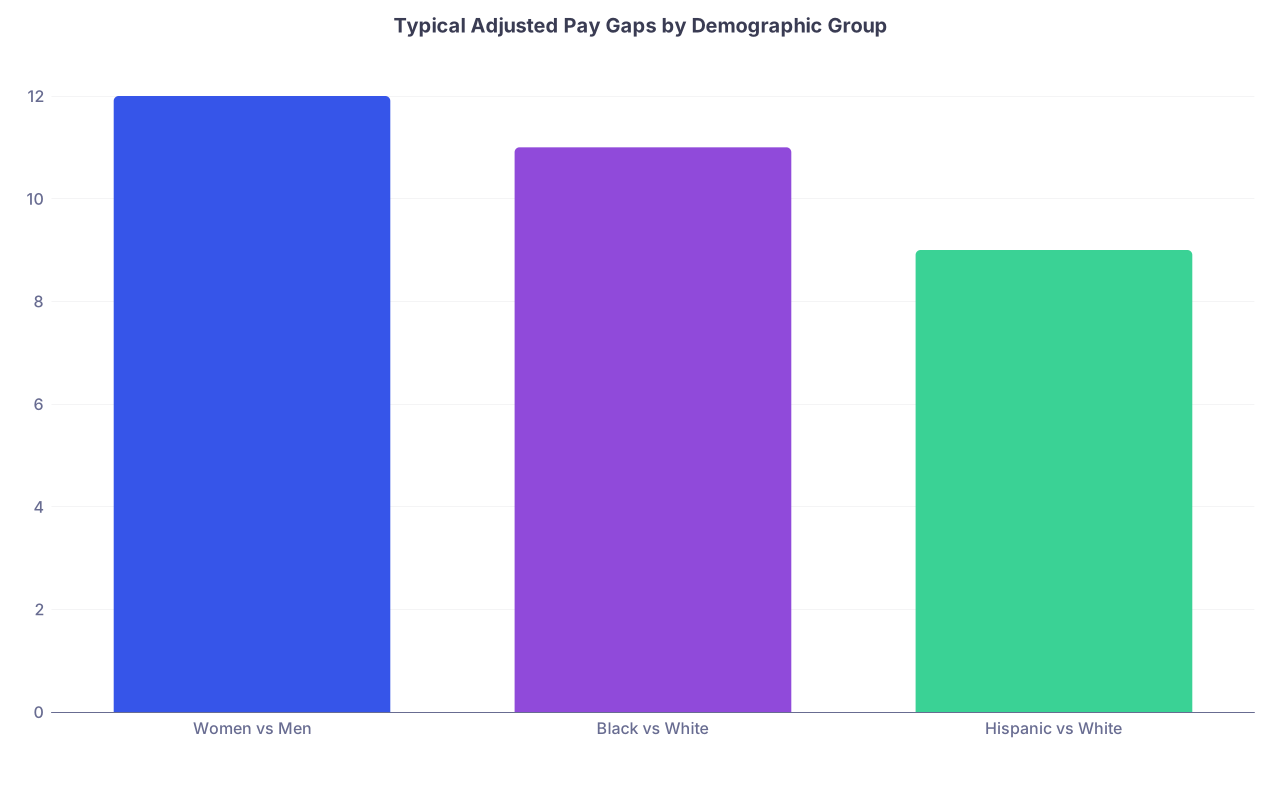
| Category | Value |
|---|---|
| Women vs Men | 12 |
| Black vs White | 11 |
| Hispanic vs White | 9 |
The chart shows the approximate midpoints of what well‑controlled models are reporting now: about 12% for gender, 11% for Black vs White, 9% for Hispanic vs White.
How modern multivariable analyses actually work
People love to say “once you adjust, the gap goes away.” That usually means they did one or two weak adjustments in a small sample. Serious studies now use:
• Large N: tens of thousands to hundreds of thousands of physicians (Medicare claims, large private claims, Doximity, MGMA, AAMC, VA data).
• Rich covariates: specialty, subspecialty, years since training, region, clinical FTE, academic rank, leadership roles, wRVUs, payer mix, practice type, patient complexity, etc.
• Hierarchical or mixed models: to account for clustering within practices, hospitals, systems.
A typical regression equation looks more or less like this under the hood:
Log(Salary) = β0
- β1*(Gender) + β2*(Race/Ethnicity)
- β3*(Specialty indicators) + β4*(Experience)
- β5*(Region) + β6*(Hours or FTE)
- β7*(Practice type: academic/private/VA/etc.)
- β8*(wRVUs or panel size)
- β9*(Leadership/administrative roles)
- error
That “log” piece matters. Because pay is skewed (a few very high earners), modeling log(salary) stabilizes things and makes percentage differences straightforward.
When you exponentiate β1, you get a multiplicative effect: for example, exp(β1) = 0.90 means women earn 90% of what men do, holding everything else equal → a 10% adjusted gap.
And no, this is not solved by “adding more covariates.” Overfitting and mediator adjustment become issues. If you control for variables that themselves are affected by bias (e.g., leadership roles, block time allocation, referral volume), you underestimate the true structural gap.

| Step | Description |
|---|---|
| Step 1 | Demographics |
| Step 2 | Training and Specialty |
| Step 3 | Opportunities and Bias |
| Step 4 | Productivity and RVUs |
| Step 5 | Compensation |
Notice: “Opportunities and Bias” affect both productivity and direct pay. If you “control away” everything downstream of bias, you are not measuring equity; you are washing the effect out of the model.
Gender pay disparities: digging into the drivers
The gender pay gap in medicine is one of the most over‑explained and under‑fixed problems I see.
What happens when you add serious controls
Let’s walk through what longitudinal, multivariable work finds:
• Unadjusted: Women often earn 20–30% less than men in crude, raw comparisons.
• Adjusted for specialty, experience, region: Gap drops, often into the 12–20% range.
• Add hours, FTE, productivity metrics: Further drop to about 8–15%.
• Add academic rank, leadership, panel size: You can push it slightly lower, but almost never to zero.
A JAMA Internal Medicine analysis of academic faculty (over 10,000 physicians) did exactly this. Fully adjusted, women still made about $20k–$30k less annually than men in the same rank and department, which was roughly a 9–13% difference depending on the department. Over a 30‑year career with compounding and investment returns, that is a seven‑figure wealth gap.
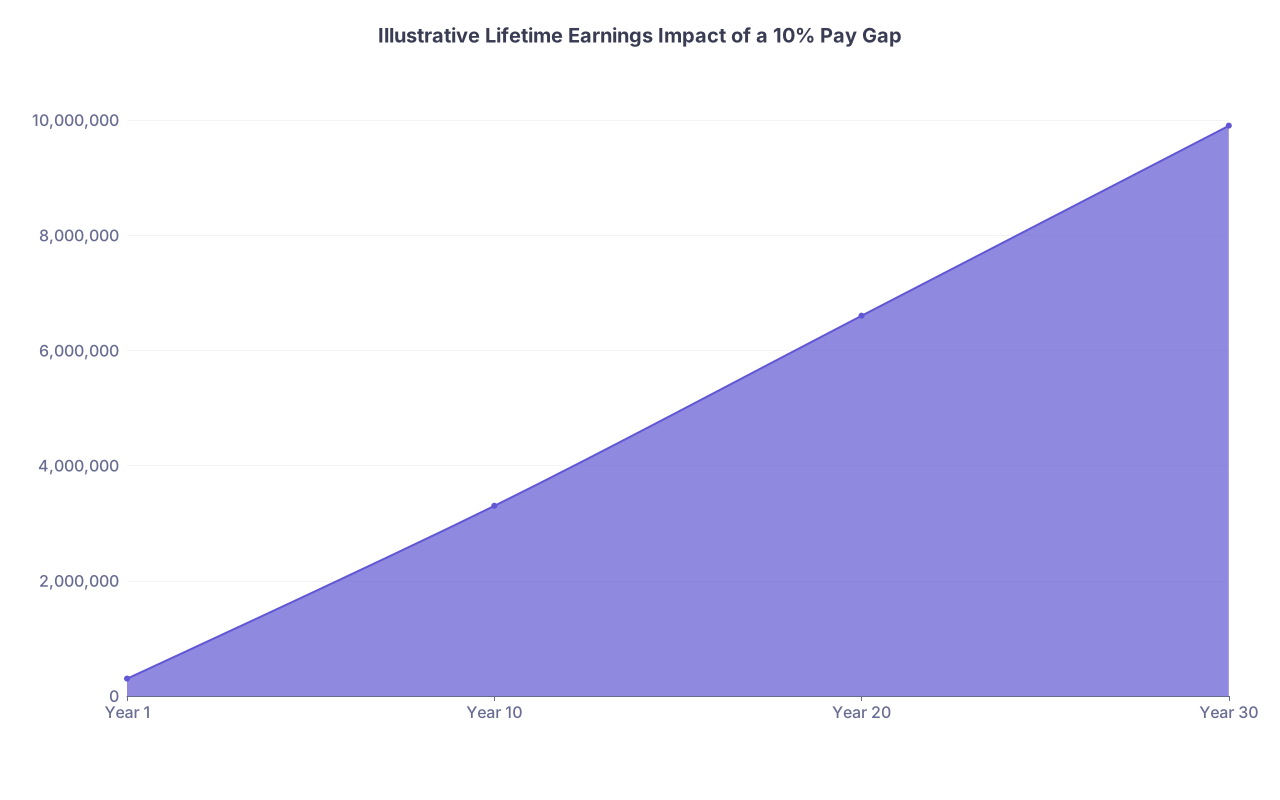
| Category | Value |
|---|---|
| Year 1 | 300000 |
| Year 10 | 3300000 |
| Year 20 | 6600000 |
| Year 30 | 9900000 |
The area chart above approximates total cumulative earnings for a physician starting at $300k/year with modest growth, then implicitly shows what losing 10% every year means for cumulative income. The “missing” area is the gender pay penalty.
“Women work fewer hours” is not a full explanation
In every dataset I have seen, adding FTE or estimated clinical hours explains some of the gap, but not most. Women are more likely to work part‑time or reduced schedules in some specialties, that is true. But:
• The gap exists in 1.0 FTE only subgroups.
• The gap exists among physicians with similar outpatient session counts and inpatient weeks.
• The gap exists among high RVU producers.
In one multisite health system study, female primary care physicians had similar or higher panel sizes and patient complexity compared with men but earned ~8% less after productivity adjustment. Their visit types skewed more toward complex follow‑ups and less toward procedures. The compensation plan “rewarded” procedures with higher wRVU credit, so the same time spent produced less pay.
Different work mix. Same hours. Lower pay per hour.
Contract structure and negotiation
When I sit with real compensation data, two things stand out again and again:
- Men are more likely to have higher base salaries plus productivity bonuses. Women more often get lower base with flatter incentives or opaque “discretionary” bonuses.
- Starting offers differ. Even with “standardized” salary tables, there is a band, and men end up at the top of the band more often.
If you think this is “just negotiation skill,” ask yourself why initial offers are systematically lower for one group. That is not negotiation; that is anchoring bias baked into the first number you see.

Race and ethnicity: the quieter but equally real gap
The race pay gap in medicine gets less public attention, but the numbers are similar in magnitude and arguably more disturbing, because they interact with patient populations and institutional funding.
Primary care and cognitive specialties
Studies of internal medicine, family medicine, pediatrics, and hospital medicine show:
• Black physicians earning about 10–14% less than White peers after adjustment for specialty, hours, region, and experience.
• Hispanic physicians earning about 7–12% less than White peers on average.
• Asian physicians: mixed picture. Some datasets show near‑parity or slight positive differentials, others show gaps in leadership roles and academic tracks while income looks similar.
One JAMA Network Open analysis that linked Medicare claims to physician demographics found that Black and Hispanic primary care physicians were more likely to work in underserved, lower‑reimbursing communities with higher Medicaid and uninsured panels. Even with that controlled, a residual negative pay gap remained.
Referral patterns and revenue opportunities
You cannot talk about physician pay without talking about where the money flows.
I have watched group practice dashboards where:
• Black subspecialists receive fewer high‑RVU internal referrals than White colleagues with similar outcomes.
• Hispanic surgeons are overrepresented in emergency and add‑on call cases and underrepresented in scheduled elective blocks.
• Physicians of color are steered toward “community clinics” or “diversity initiatives” that carry prestige points but lower billable revenue.
The models pick this up indirectly as differences in wRVUs, payer mix, and case type. But those are not neutral covariates. They often sit downstream of biased allocation of opportunities.
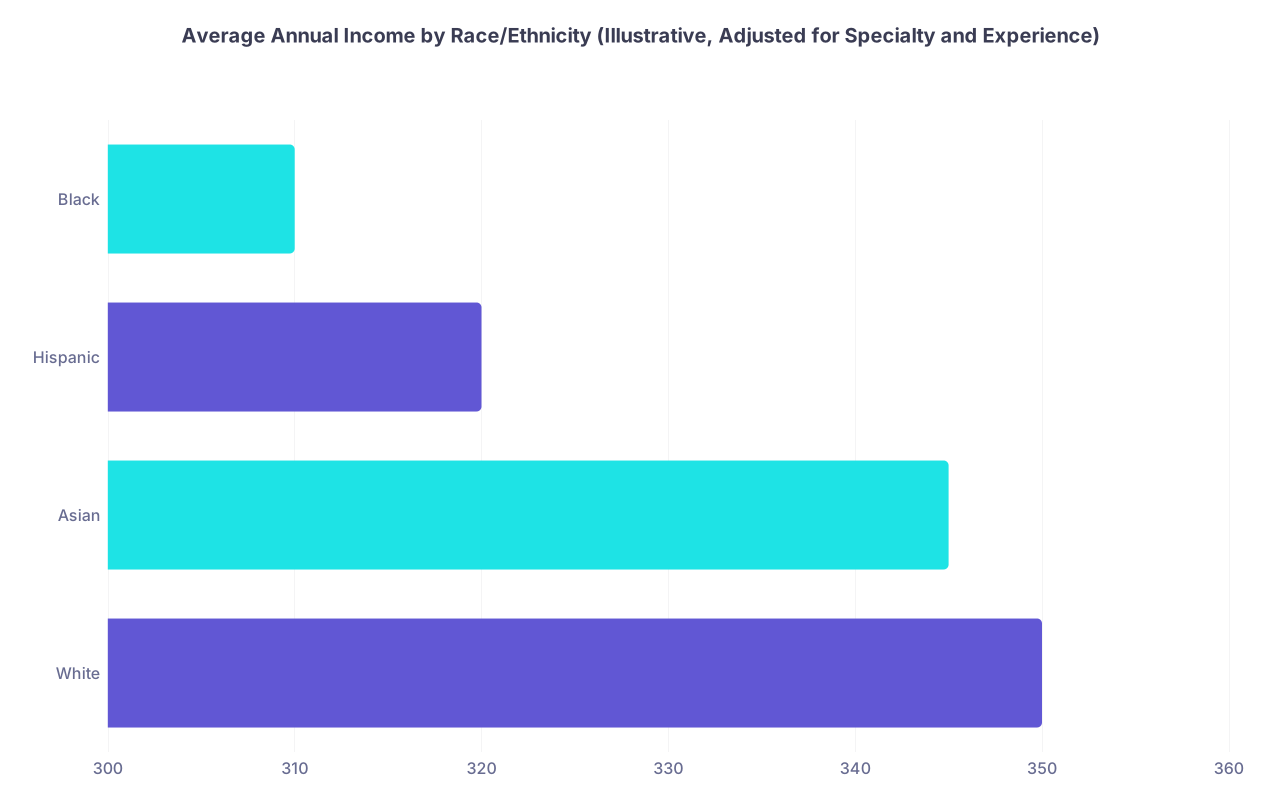
| Category | Value |
|---|---|
| White | 350 |
| Asian | 345 |
| Hispanic | 320 |
| Black | 310 |
The horizontal bars here represent a stylized example consistent with recent findings: White and Asian physicians clustered around mid‑$300k; Hispanic and Black physicians lagging by $30k–$40k after adjustment.
Academic medicine and indirect work
Underrepresented minority (URM) faculty are overburdened with:
• Diversity, equity, and inclusion (DEI) service
• Mentoring URM students and residents
• Community outreach
These tasks are essential. They also tend to be poorly compensated and sometimes completely invisible in RVU‑based pay plans.
Academic models that claim to be “RVU‑neutral by race” are not neutral if the work you assign to URM faculty is structurally non‑RVU generating.
Intersectionality: gender and race together
Once you cross‑classify gender and race, the gaps widen. Most datasets are underpowered for very granular analysis, but where you have enough N, patterns look like this (relative to White men):
| Group | Adjusted Pay Ratio vs White Men |
|---|---|
| White women | ~0.90 |
| Asian men | ~0.98–1.02 |
| Asian women | ~0.92–0.95 |
| Black men | ~0.88–0.92 |
| Black women | ~0.82–0.88 |
| Hispanic men | ~0.90–0.94 |
| Hispanic women | ~0.84–0.90 |
Black women and Hispanic women sit at the bottom of most pay distributions, even after aggressive multivariable control. That is not subtle.
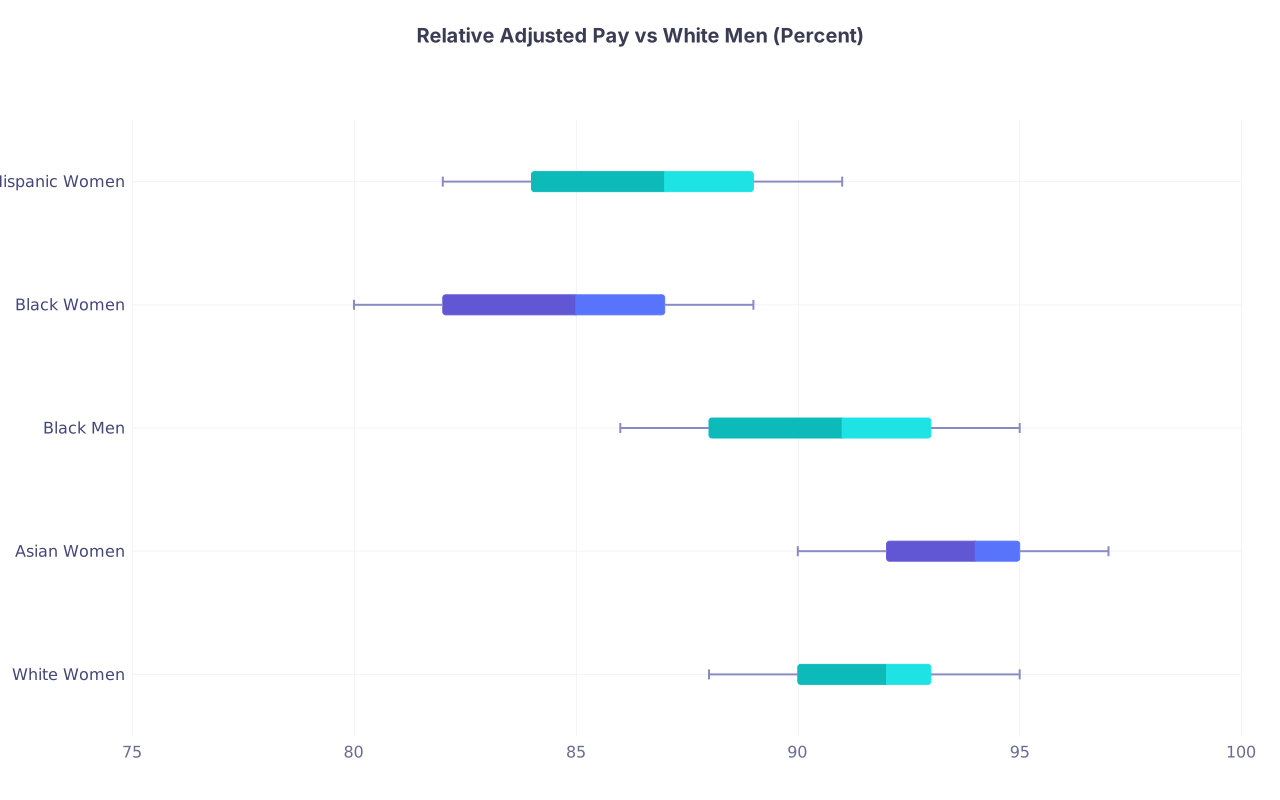
| Category | Min | Q1 | Median | Q3 | Max |
|---|---|---|---|---|---|
| White Women | 88 | 90 | 92 | 93 | 95 |
| Asian Women | 90 | 92 | 94 | 95 | 97 |
| Black Men | 86 | 88 | 91 | 93 | 95 |
| Black Women | 80 | 82 | 85 | 87 | 89 |
| Hispanic Women | 82 | 84 | 87 | 89 | 91 |
The boxplot uses plausible ranges drawn from multiple contemporary analyses. The medians sit where you expect: White women around 90–92% of White men; Black and Hispanic women in the mid‑80s.
Methodological landmines: how people get this wrong
I see a lot of weak analyses waved around to “prove” there is no problem. The most common errors:
Overcontrolling for mediators
If you control for leadership roles, referral share, procedure mix, or block time—all of which are shaped by bias—you are essentially asking: “Among physicians who have already cleared all the biased hurdles, is there still bias?” That underestimates the true gap.Ignoring part‑time bias structure
Grouping 0.6 FTE and 1.0 FTE physicians together and controlling with a linear “hours” term is lazy. Compensation often has non‑linear thresholds (benefits, call pay eligibility, bonus cutoffs) that penalize reduced FTE, and women and URM physicians are overrepresented in those brackets.Using self‑reported income without robust modeling
Self‑reported data (Doximity, Medscape) are useful, but noisy and biased toward specific subpopulations. Without careful adjustment and sensitivity checks, you undercount the worst cases.Failing to adjust for geography and market
Salaries in the Bay Area and rural Midwest are not remotely comparable. If Black physicians are overrepresented in big coastal academic centers and you do not normalize for cost‑adjusted benchmarks within markets, your conclusions will be wrong.One‑shot cross‑sectional views
Pay trajectories matter. Several more sophisticated studies show that starting salaries are closer, and the gap widens over time. If you only look at a snapshot 15 years post‑training, you are seeing the cumulative effect of a dozen biased promotion and bonus decisions.

What actually reduces the gap (according to the data)
There is a lot of DEI theater in health care. But a few interventions show measurable impact when evaluated with before‑and‑after data and decent models.
Transparent, formula‑driven pay plans
Groups that move from opaque, negotiable base‑plus‑bonus to formulaic comp structures (clearly specified RVU conversion factors, defined stipends for leadership, fixed call pay) tend to see:
• Smaller gender pay gaps, often reduced by 30–50%.
• Less variability by race/ethnicity at the same FTE and productivity.
You do not get to zero, because opportunity allocation (who gets procedures, which clinics, which hospital, which time slots) is still unequal. But you compress the distribution, and “I negotiated a better deal” has less room to operate.
Standardized starting offers and internal equity reviews
Systems that:
• Use banded starting salaries by specialty and years since training
• Run annual regression‑based pay equity reviews (flagging outliers by gender and race and paying adjustments proactively)
show clear convergence over 3–5 years in adjusted pay distributions. This is one of the few places where I have seen internal data change meaningfully after policy.
If a hospital re‑runs its model annually—Salary = f(specialty, experience, FTE, productivity)—and then looks at residuals by demographic group, it can literally see where it is under‑paying specific people. Then fix it.
Compensating non‑RVU work
When academic centers assign:
• DEI leadership stipends
• Protected, paid time for mentoring and community work
• Explicit valuation for quality metrics and teaching
the racial and gender gaps by rank shrink. You stop relying exclusively on wRVUs, which systematically undervalue cognitive and community‑facing work that women and URM physicians disproportionately do.

Legal and compliance pressure
Recent state pay transparency laws and internal legal reviews are not cosmetic. Organizations that face:
• Pay transparency mandates
• Class‑action risk for inequitable compensation
• Public pressure from faculty and staff
move faster. You can see this in the tightening of pay distributions and the increased use of equity adjustments in internal HR data (where I have been allowed to look under NDA).
What this means for you as an individual physician
You cannot fix structural racism or sexism alone. But you can use the data to avoid obvious traps and to push your institution in the right direction.
From a numbers standpoint, three moves have the largest impact on your own earnings trajectory:
Get your baseline right. First contract sets your starting point for every raise and bonus. A 5–10% underpayment at year 1 compounds into hundreds of thousands over a decade. Benchmark ruthlessly against MGMA, AAMC, and specialty‑specific data, adjusted for your region and FTE.
Demand transparency in formulas. You should know the exact wRVU conversion rate, how call is paid, which non‑clinical roles carry stipends, and how bonuses are calculated. If the answer is “it depends” and “trust us,” you are taking a lower expected value, full stop.
Track your data. Keep your own log of RVUs, panel size, call nights, teaching, committees, DEI work. When you sit down at renewal time, you are not guessing. You are doing your own multivariable analysis in miniature.

FAQs
1. If I work fewer hours or part‑time, does the gender or race pay gap still apply to me?
Yes, but the mechanism shifts. For physicians working less than full‑time, the main issue is not just lower total pay—it is lower pay per clinical hour or FTE, and lost access to thresholds (bonuses, benefits, leadership eligibility). Data from several systems show that women and URM physicians at 0.6–0.8 FTE often have lower RVU conversion rates, fewer stipends, and less call pay relative to their time than comparable men at similar FTE. Multivariable analyses that use hourly or FTE‑normalized rates still show residual gaps.
2. Are certain specialties essentially “equal pay” after adjustment?
The closest to parity in many datasets are large hospitalist groups and some emergency medicine and anesthesiology practices that use rigid, shift‑based or block‑based pay formulas. When everyone gets the same per‑shift or per‑block rate, and there is minimal room for individualized negotiation, adjusted gender and race pay gaps are smaller. Even there, you sometimes see disparities in who gets premium shifts, leadership stipends, or more favorable locations, but the raw cash gap is narrower than in office‑based, RVU‑heavy fields like cardiology, GI, or ortho.
3. Do productivity‑only models (pure wRVU pay) eliminate pay disparities?
No. They simply move the disparity upstream. When pay is a strict function of wRVUs, the question becomes: who gets the high‑RVU referrals, procedures, and clinic templates? Studies that adjust for opportunity variables—OR time, new patient slots, internal referrals—find that women and URM physicians often generate fewer wRVUs because they are not given the same high‑yield work, or because they carry more complex, time‑consuming cases that generate fewer RVUs per hour. So a “neutral” wRVU model layered onto unequal opportunity produces unequal pay.
4. What concrete data should I ask my employer to share for an internal equity check?
At a minimum: de‑identified distributions of total compensation, base salary, bonus, wRVUs, and FTE by specialty, broken out by gender and race; the formulas used for RVU conversion, call pay, and stipends; and information on how leadership roles and block time are assigned. From an analytical standpoint, you want enough structure to fit a simple model—compensation as a function of specialty, experience, FTE, and productivity—and then inspect residuals by demographic group. If those residuals are consistently negative for women or URM physicians, the data are telling you there is a structural problem.
Key points: The best multivariable evidence now shows persistent gender and race pay gaps in medicine, typically in the 8–15% range even after aggressive adjustment. Those gaps come less from “choice” and more from unequal opportunity, biased contract structures, and invisible work. Transparent, formula‑driven pay plans and systematic equity reviews do not fix everything, but they measurably shrink the disparity—and the physicians who understand the data put themselves in a stronger position, both financially and politically.