

34% of employed physicians report that their RVU targets are “unreachable” or “only reachable by cutting corners.”
That is not a soft complaint. That is a systems problem. And the data around RVU targets by specialty backs it up: in many contracts, the math simply does not work.
Let me walk through what the numbers actually say about realistic productivity, specialty by specialty, and how to tell if your own RVU target is grounded in reality or fantasy.
RVUs 101: The Productivity Currency You Get Paid In
Relative Value Units (RVUs) are not magic. They are a weighted scoring system.
Each CPT code has three RVU components:
- Work RVU (wRVU): your effort, skill, and time.
- Practice expense RVU: overhead.
- Malpractice RVU: liability cost.
Most physician compensation models tie your bonus—and often your entire salary—to work RVUs. So that is what matters for “targets.”
Typical structures:
- Base salary + wRVU bonus over a threshold
- Pure production: $/wRVU with a draw (guarantee) against future production
- Hybrid: panel-based or quality incentives layered on top of RVUs
For our purposes, assume the key metric is:
Annual work RVUs (wRVUs) per full-time physician
And the central risk is here: employers set wRVU targets based on “top quartile” data, then pretend it is median.
What Benchmarks Actually Say (MGMA, AAMC, AMGA)
Most large systems pull from MGMA (and sometimes AMGA or AAMC Faculty data). You usually do not see the raw tables, but I will translate them into practical ranges.
These are approximate contemporary ranges for annual wRVUs by specialty for full-time, non–academic physicians, based on common benchmark compilations and large-group employer norms:
| Specialty | Low (25th %) | Median (50th %) | High (75th %) |
|---|---|---|---|
| Family Med (no OB) | 4,000 | 5,000 | 6,000 |
| Internal Med (outpt) | 4,500 | 5,500 | 6,500 |
| Hospitalist (7 on/7 off) | 4,000 | 4,800 | 5,600 |
| General Surgery | 6,000 | 7,500 | 9,000 |
| Orthopedics | 7,000 | 9,000 | 11,000 |
| Cardiology (non-intv) | 7,000 | 8,500 | 10,000 |
Those are not “targets.” Those are distributions of actual production. But many contracts quietly anchor targets at or above the 75th percentile.
So if your offer letter says:
- “Target: 7,000 wRVUs” for outpatient internal medicine
- “Bonus only after 9,000 wRVUs” for general surgery
you are being benchmarked against high performers, not average peers.
Visit-Level Math: How RVU Targets Translate To Your Day
The fastest sanity check for any RVU target is simple:
Target wRVUs ÷ wRVUs per visit ÷ clinic days per year = visits per day
Plug in numbers and see if the schedule is human.
Most bread-and-butter E/M coding yields roughly:
- Level 3 established: ~0.97 wRVU
- Level 4 established: ~1.50 wRVU
- Level 3 new: ~1.60 wRVU
- Level 4 new: ~2.60 wRVU
Real primary care mixes average about 1.3–1.6 wRVU per visit when you blend new/established and sprinkle in procedures.
Let’s run an example.
Outpatient Internal Medicine
- Contract target: 5,500 wRVUs
- Assume: 1.5 wRVUs per visit
- Assume: 46 work weeks per year
- 4 clinic days/week = 184 clinic days
Math:
- 5,500 ÷ 1.5 = 3,667 visits / year
- 3,667 ÷ 184 ≈ 19.9 visits per day
Twenty visits per day. That is busy but realistic if you are not drowning in non-RVU work.
Now bump the target to 7,000 wRVUs with the same assumptions:
- 7,000 ÷ 1.5 = 4,667 visits
- 4,667 ÷ 184 ≈ 25.4 visits per day
25+ visits per day plus inbox messages, refills, prior-auths, notes, portal communications. That starts to cross into fantasy unless you have:
- 1:1 MA or better
- Scribes or full documentation support
- Protected admin time (that actually exists, not just on paper)
The data shows that when targets hit that 25–30 visit/day equivalent, error rates, burnout scores, and turnover spike.
Specialty-by-Specialty: What Realistic Looks Like
Let’s break down a few common specialties. Numbers are approximations built from current benchmark data and real-world schedules from large groups.
Family Medicine / General Internal Medicine (Outpatient)
Most full-time primary care jobs land in the 4,000–6,000 wRVU range.
- 4,000: often associated with part-time, heavy non-RVU tasks, or poorly supported practices.
- 5,000–5,500: solid full-time with manageable throughput.
- 6,000+: typically high-volume practices or those with significant procedures / chronic care management / advanced coding.
If your contract target is >6,000 wRVUs, and you are not doing procedures (colpos, skin, joint injections, etc.), check the daily volume math aggressively.
Quick reference checks for PCPs
Assume 1.5 wRVU/visit, 4 days clinic/week, 46 weeks/year:
| Annual Target | Visits/Year | Visits/Day |
|---|---|---|
| 4,500 | 3,000 | 16.3 |
| 5,500 | 3,667 | 19.9 |
| 6,500 | 4,333 | 23.5 |
| 7,500 | 5,000 | 27.2 |
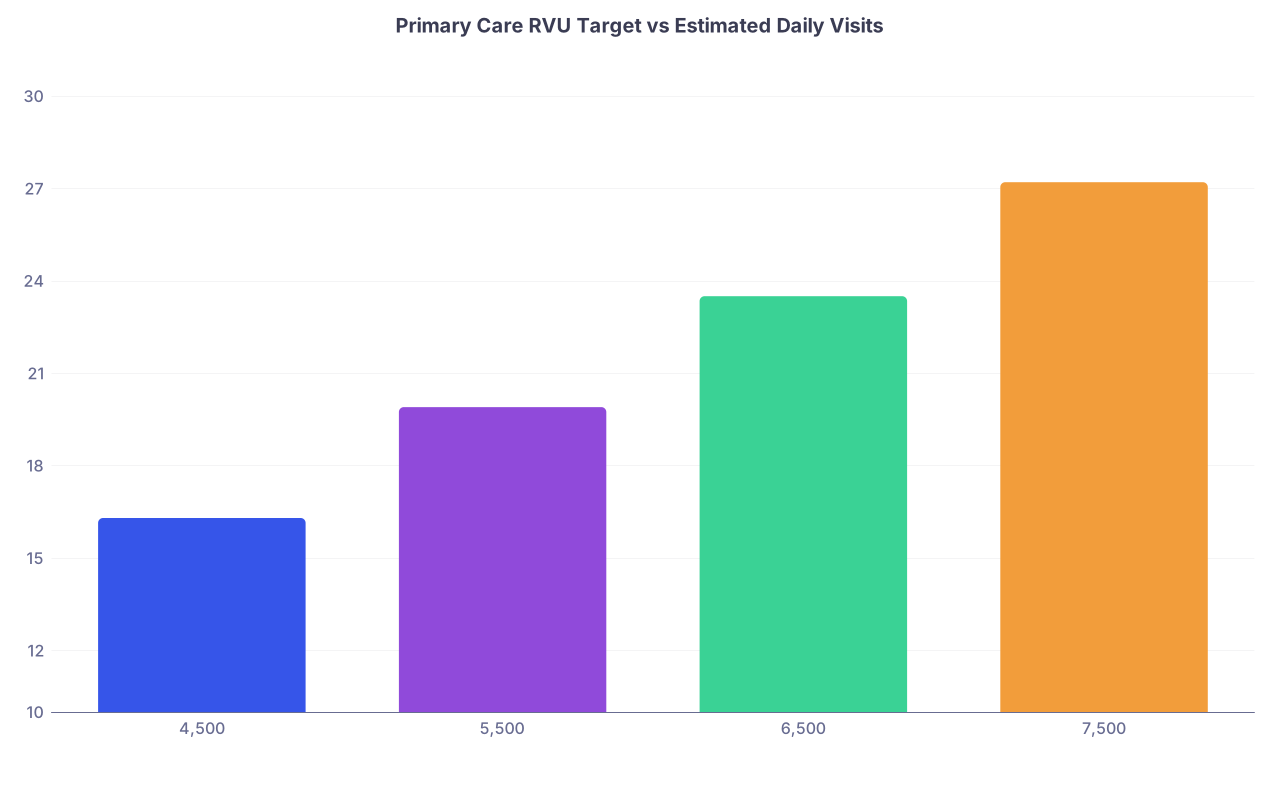
Once you cross ~22–24 visits/day consistently, you are in the zone where most physicians report “unsustainable” workloads unless support is robust.
| Category | Value |
|---|---|
| 4,500 | 16.3 |
| 5,500 | 19.9 |
| 6,500 | 23.5 |
| 7,500 | 27.2 |
If your daily reality already looks like the right side of that bar chart, and your target is at or above those levels, the contract is not built for long-term retention.
Hospitalists
Hospitalist productivity is a bit different. RVUs per encounter vary more with acuity, procedures, and nocturnist vs day shifts.
Typical full-time 7-on/7-off daytime hospitalists:
- 18–20 encounters/day
- Average 2.5–3.5 wRVUs per encounter
- Rough annual range: 4,000–5,500 wRVUs
For a 7-on/7-off (182 shifts/year):
Suppose:
- 18 encounters/day
- 3.0 wRVUs/encounter
- 18 × 3 = 54 wRVUs/shift
- 54 × 182 ≈ 9,828 wRVUs
That looks stunningly high. Two caveats:
- Many groups count “encounters” differently than RVU-generating visits.
- Shift-based comp often decouples from pure RVUs; the RVU math gets used for internal benchmarking, not directly for your paycheck.
Still, if your employer is pushing targets like 7,000–8,000 wRVUs for a 7-on/7-off gig with no signouts, heavy admits, and lots of cross-cover, they are likely applying outpatient-like expectations to inpatient work. That rarely matches real throughput.
A more realistic target for a balanced 7-on/7-off postist role is closer to 4,500–5,500 wRVUs if used as a bonus threshold. Anything significantly above that warrants detailed scrutiny of census, shift intensity, and PA/NP support.
General Surgery
Here the RVU distribution is skewed upward. A small number of very productive surgeons generate big numbers.
Typical band:
- Reasonable full-time: 6,000–8,000 wRVUs
- “Heavy” surgical practice: 9,000–10,000+ wRVUs
Surgeons can rack up RVUs fast with the right case mix. A few examples:
- Laparoscopic cholecystectomy: roughly 10–15 wRVUs
- Open colectomy: 18–25+ wRVUs
- Major hernia repairs: 10–20+ wRVUs
If you are doing 2–3 decent OR cases per day plus clinic, you can reach 7,000–9,000 wRVUs relatively quickly.
The trap: some systems quietly set 9,000 wRVUs as the baseline expectation for new general surgeons in communities with limited OR access, limited block time, and weak referral networks. The RVUs themselves are plausible—if volume exists. Without guaranteed OR time and marketing support, they are fantasy.
You want answers to three data questions:
- How many OR block hours per week are you guaranteed?
- What is the current average wRVU production of surgeons in that group (by anonymized numbers, not verbal assurances)?
- Are you inheriting an established practice or starting cold?
If they will not show you group-level production data, assume the target is aspirational.
Orthopedic Surgery
Orthopedics regularly posts some of the highest wRVU counts in medicine.
Common ranges:
- “Standard” ortho: 8,000–10,000 wRVUs
- High-volume joint/spine: 10,000–14,000+ wRVUs
Knee replacements can be in the 20–25+ wRVU range per case. Add clinic injections, fracture care, and follow-ups, and numbers climb quickly.
Again, the constraint is not your willingness to work. It is:
- OR block time
- Implant availability and support
- Referral patterns
- Call pay / trauma volume
I have seen rural ortho contracts with:
- Guarantee year 1: $600,000
- Then pure production: $65/wRVU
- Target to “maintain income”: 9,500 wRVUs
Math:
- 9,500 × $65 = $617,500
Look feasible on paper. But when you ask about established partners, they are each around 7,500–8,000. That means the new target assumes a 25–30% productivity jump with no new OR time, no second PA, and the same call schedule.
The data says: not going to happen.
Cardiology (Non-Interventional)
Non-interventional cardiology sits somewhere between high-intensity primary care and procedural specialties.
Typical bands:
- 6,500–8,000 wRVUs for balanced clinic + imaging oversight
- 8,000–10,000+ wRVUs if reading lots of echoes, stress tests, nuclear, etc.
Cardiology is heavy on imaging. Echo reads, stress tests, nuclear imaging, TEE, etc., all carry RVUs:
- TTE complete: 1.3–1.5 wRVUs
- TEE: 3–4 wRVUs
- Nuclear stress test: 3–4+ wRVUs
If your job is strongly weighted toward imaging supervision, you can hit high wRVU numbers without 30 office visits per day.
The realistic test here is alignment: are the wRVU targets matched to the mix of clinic visits vs imaging? If the employer sets a target based on a partner who does massive imaging plus clinic, but your role is mainly clinic and consults, your “benchmark” is not your job.
Where RVU Targets Go Off the Rails
Patterns I see in contracts and employer presentations:
Conflating percentiles:
Presenting 75th percentile production as “median” in conversation, or using a “blended” benchmark that mysteriously leans toward upper quartiles.Ignoring ramp-up:
Year 1: guaranteed base.
Year 2: full target (often at or above median).
But actual ramp-up curves typically show 60–80% of full productivity in year 2 for new grads or those building from scratch.Counting only billable time:
RVU targets only see billable encounters and procedures. They ignore teaching, meetings, QI, committees, call without associated billables, and bureaucratic tasks.Not adjusting for payor mix and denial rates:
RVUs are assigned to CPT codes, not collections. But if documentation is poor, denials high, or coding under-optimized, your “realized” RVUs can lag your work.
Your leverage comes from translating every rosy promise into:
“Show me last year’s anonymized wRVU production data for physicians in roles similar to mine.”
If their targets are above what current physicians are hitting, that is not a target. That is wishful thinking.
Converting RVUs To Dollars (and Back Again)
You do not get paid in RVUs. You get paid in dollars per RVU.
Contemporary $/wRVU rates:
- Primary care: often $40–$60/wRVU
- Hospitalists: $40–$70/wRVU (varies with shift pay structure)
- General surgery: $60–$80+/wRVU
- Orthopedics, cardiology, other procedurals: $70–$100+/wRVU
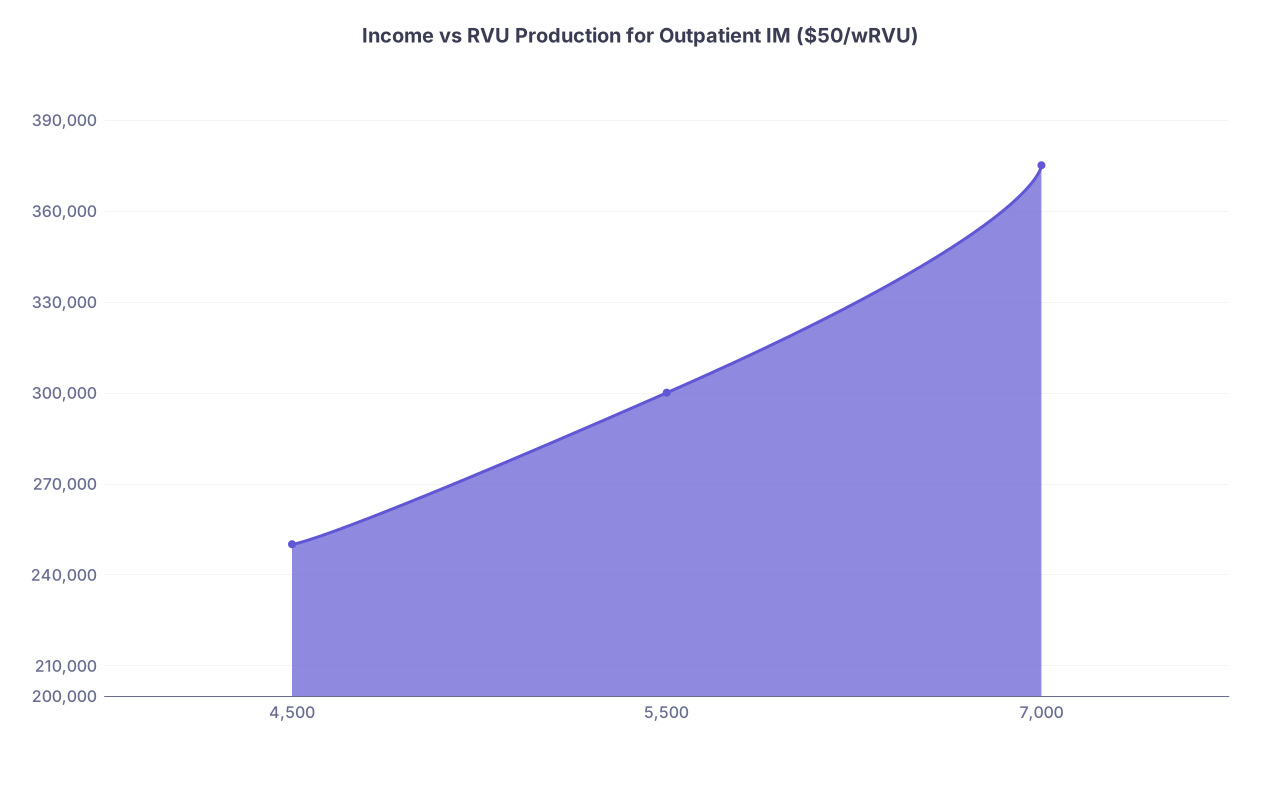
Quick example: Outpatient IM, $50/wRVU.
- Base: $250,000
- Threshold: 4,500 wRVUs
- Bonus: $50 per wRVU above 4,500
If you produce:
- 5,500 wRVUs → 1,000 over threshold → $50,000 bonus → effective pay: $300,000
- 7,000 wRVUs → 2,500 over threshold → $125,000 bonus → effective pay: $375,000
But now look at the visit volume we computed earlier. To hit 7,000 wRVUs, you are living at 25+ visits/day. You are earning that $375,000 the hard way.
| Category | Value |
|---|---|
| 4,500 | 250000 |
| 5,500 | 300000 |
| 7,000 | 375000 |
The line climbs. Your time and cognitive bandwidth do not.
The data suggests that while high RVU productivity can generate strong income, burnout, error rates, and turnover follow similar curves once productivity pushes past realistic daily limits.
Spotting Unrealistic RVU Expectations Before You Sign
Do this before you ink anything.
1. Build a Simple RVU Model for the Job
You do not need an MBA. You just need a spreadsheet and some assumptions.
For outpatient:
- Estimated wRVU/visit (ask coding or a trusted colleague; 1.3–1.6 is common for PCPs)
- Estimated procedures/ancillary RVUs per week
- Clinic sessions/week
- Weeks/year (subtract vacation, CME, holidays)
Then solve for visits/day required to hit the quoted target. If the number starts with a “2” and your job is primary care with average support, be skeptical. If it starts with a “3”, you are being sold a fantasy.
For inpatient/surgical:
- Expected cases/day
- Typical RVUs/case
- OR days/month
- Clinic days/month
Run the same math.
2. Demand Group-Level Productivity Data
You want, in writing, anonymized data for physicians in a similar role:
- Distribution of annual wRVUs (min, median, max)
- Average FTE status (are they really all 1.0 FTE, or is everyone quietly 0.8?)
- Turnover in the last 3–5 years
If the median production is below your target, you are being hired into an experiment.

3. Adjust for Non-Clinical Time and Role Creep
If the job includes:
- Committee work
- Medical directorship
- Teaching residents or students
- QI projects
find out whether:
- Those hours reduce your RVU expectations
- Or the RVU targets stand and the extra work is simply “part of being a team player”
The data in many organizations shows “0.9 clinical FTE + 0.1 admin FTE” on paper but RVU targets built for a full 1.0 clinical FTE. That 10% admin time comes out of your evenings.
4. Look at Support Ratios and Infrastructure
RVUs do not happen in a vacuum. They require:
- Schedulers who can fill your templates with appropriate patients
- MAs or nurses who handle pre-work
- Coders who optimize legitimate RVU capture
- IT that does not crash every third chart
High-performing physicians in MGMA’s upper quartiles typically do not do it with bare-minimum support. If your job environment is “we are still building the team,” but your target is already top-quartile, the numbers will not hold.
Realistic vs Unrealistic: A Quick Pattern Map
Let me summarize the pattern I see repeatedly in contracts:
| Scenario | Likely Realism |
|---|---|
| PCP 5,000–5,500 wRVUs, strong support | Realistic |
| PCP 7,000+ wRVUs, average support | Questionable |
| Hospitalist 4,500–5,000 wRVUs, 7-on/7-off | Realistic |
| Gen Surg 7,000–8,000 wRVUs, established group | Realistic |
| Gen Surg 9,000+ wRVUs, new practice build | Unrealistic |
| Ortho 10,000+ wRVUs, full block time | Realistic (hard) |
| Ortho 10,000+ wRVUs, limited OR access | Unrealistic |

| Step | Description |
|---|---|
| Step 1 | Get RVU Target |
| Step 2 | Convert to Daily Volume |
| Step 3 | Negotiate or Walk |
| Step 4 | Request Group RVU Data |
| Step 5 | Check Support and Nonclinical Time |
| Step 6 | Target Likely Realistic |
| Step 7 | Volume Reasonable? |
| Step 8 | Target <= Median? |
| Step 9 | Aligned? |
You Cannot Outwork Bad Math
Here is the bottom line from the data:
Most “stretch” RVU targets are not coaching tools. They are cost-control tools.
If a significant portion of your comp is only accessible at 75th percentile production, the system is banking on most physicians not reaching it.Realistic productivity sits in a relatively narrow band for each specialty.
Once you push beyond that—say 20–22 visits/day in primary care, or surgical schedules without adequate block time—error rates, burnout, and attrition go up. Consistently.RVU benchmarks without context are meaningless.
The only numbers that matter for you are: your specific job’s mix (clinic vs OR vs imaging vs admin), your support level, and what current peers are actually producing.
If you anchor your decisions in that data, you will avoid the worst RVU traps and find roles where your productivity—and your paycheck—are actually achievable.


