
The biggest lie in physician compensation is that “partners make $X.” They do not. They distribute $X. What they actually take home can be wildly different from what you think—and from what recruiters or older docs casually brag about.
Let me walk you through what really happens behind those closed-door partner meetings, the spreadsheets you never see as an associate, and why two “partners” in the same group can have incomes that differ by $300,000.
The Myth vs. Reality of “Partner Income”
Here’s the first thing you need to understand: most groups throw around numbers that are top-line partner distributions, not what partners personally net.
I have sat in a conference room where the managing partner said, “Our partners are at the 90th percentile—around $700k” right after we’d finished a meeting about capital calls, unfunded buyouts, and partners covering call gaps out of their own pockets. The junior associates in the next room heard “$700k.” The partners around the table were thinking, “More like $450–500k this year after everything.”
The gap comes from three layers most residents and early attendings never see:
- How collections turn into “profit”
- How profit gets split on paper
- What actually hits a partner’s personal account after obligations and reinvestment
So let’s strip it down.
How Money Actually Flows in a Private Group
Forget the brochure version. The real flow looks like this:
You (the doctor) generate charges → The practice collects money → The group pays overhead and obligations → What’s left is distributable profit → That profit is carved up based on a formula that almost no one outside the partner group fully understands.

| Step | Description |
|---|---|
| Step 1 | Physician Work RVUs and Procedures |
| Step 2 | Charges Submitted |
| Step 3 | Collections Received |
| Step 4 | Practice Overhead and Fixed Costs |
| Step 5 | Group Obligations and Buyouts |
| Step 6 | Distributable Profit Pool |
| Step 7 | Partner Split Formula |
| Step 8 | Partner Take Home Pay |
Now the ugly details.
Step 1: Collections are not your money
You generate RVUs, do procedures, see consults. The group bills. Collections come in—months later, partially denied, partially underpaid.
From that gross collections number, the group pulls out:
- Staff salaries and benefits
- Rent, equipment leases, malpractice, IT, EMR, billing, legal, accounting
- Hospital subsidies and stipends (yes, those matter a lot now)
- Bad debt, write-offs, failed payor contracts
The overhead percentage you hear is almost always understated to recruits. I’ve seen groups swear they run at “35–40% overhead” and then the real fully loaded number (including partner benefits, retirement, IT capital, locums, and unpaid call coverage) comes out to 50–60%.
So if you “produce” $1.5M in collections, and your real overhead is 55%, that’s $675k left before any group-level obligations and profit sharing.
That $675k is not all yours. That’s where the profit-split games begin.
Step 2: The three silent drains on partner money
Before you even get to your personal “partner income,” three things often come off the top of that remaining pool:
Buyouts of retiring partners
You don’t hear these numbers until you’re in the room. A common setup: the group owes a retiring partner 2–4 years of trailing income, or a multiple of average earnings, paid out by the remaining partners. That can be $100–300k per year per retiring doc for several years.
Translation: your “partner pay” silently subsidizes people who are already on the golf course.Capital reserves / building projects / new ventures
Partners often vote to “retain” a portion of profit for a surgery center, imaging center, EHR overhaul, or a building purchase. It sounds exciting and “entrepreneurial” until you realize it’s reducing current take-home from, say, $600k to $450k for several years, on the promise that maybe you’ll see more later, if you’re still there.Unequal burdens: call, admin, subsidizing low producers
Senior rainmakers seldom want to talk about this in front of associates. Some groups explicitly or quietly over-credit certain partners: the long-time chair, the one with the hospital relationship, the one with all the referrals. Others just allow deadweight to stay: older partners coasting at 60% of former productivity but still taking nearly full shares. You’re paying for that.
So by the time the “profit pool” is actually ready to be split, it’s smaller and more politicized than anyone tells you during recruitment.
The Five Main Ways Profit Actually Gets Split
Most private groups fall roughly into one of these models, or some hybrid version. How they structure it changes everything about what a partner truly takes home.
| Model Type | Main Basis | Typical Winner | Typical Loser |
|---|---|---|---|
| Equal Split | Seniority/Time | Older, coasting | Younger, high RVU |
| RVU-Based | Individual RVUs | High producers | Lower volume docs |
| Eat-What-You-Kill | Pure collections | Workaholics | Anyone with balance |
| Tiered Hybrid | Base + RVU bonus | Solid performers | Extreme outliers |
| Committee / Political | Subjective | Insiders | New partners |
1. Equal split (the “country club” model)
Every partner gets essentially the same pay, with minor adjustments for call or admin.
You’ll see this in long-established groups with older partners who have no interest in seeing their income drop just because they’ve slowed down. They sell it to new people as “collegial” and “shared culture.”
Translation: you, as the younger, hungrier partner, will subsidize the last 5–10 years of several older docs’ careers.
If you’re the new partner doing 20–30% more work than the gray-hairs, your real take-home per RVU is significantly lower. You’re donating your productivity to keep the peace.
This can still be a great deal if the pie is huge and stable (think high-demand procedural specialties in markets with limited competition). But make no mistake: your “partner income” is not purely a function of your own effort.
2. Pure RVU or production-based split
This looks fair on paper: each partner’s share of profit is proportional to their work RVUs or collections.
The catch? The denominator games:
- Whose RVUs count? Clinic only? Procedures? Hospital admin time?
- Who gets credit for shared patients?
- Do partners with heavy admin/leadership roles get protected income from a separate pool?
I’ve watched partners spend more time arguing about attribution of RVUs than actually seeing patients. And guess what: the partners with hospital titles and political clout usually carve out guaranteed stipends or “protected” shares.
In a relatively honest RVU model, your real take-home is more tightly linked to your effort, which is good. But your risk is higher: volume drops, you eat the loss. Partners usually get little “salary floor” protection.
3. Eat-what-you-kill (true production)
Money comes in tied to your billing ID → overhead is applied → you take the rest. Shared costs get apportioned by some formula, but there’s minimal cross-subsidy.
This is the model where you’ll hear insane top-line numbers: “We have guys taking home $1M+.”
That can be true. But those guys are running hot: long days, heavy procedure volume, stacked OR blocks, minimal admin. And when they slow down, they drop fast.
The hidden issue: risk. Collections tank? Contract lost? Hospital shifts strategy? There’s no partner safety net; there’s just a smaller check. You are half-employee, half-business owner, with all the downside and no HR department to cushion the fall.
4. “Hybrid” models (what most groups claim to be)
Most “partner comp” decks use hybrid language:
- Some base per partner (equal share of certain dollars)
- Some variable (RVU-based, bonus pools, call stipends, leadership stipends)
The problem: the exact weights keep drifting. And they usually drift in favor of whoever is already powerful in the group.
I watched one large subspecialty group change formulas three times in five years, each time after a couple of big-producer partners threatened to leave. Everyone else’s income became whatever was left after appeasing the top two or three.
When you hear “hybrid,” your homework is to ask, “Give me the exact percentages from last year: what portion was equal, what portion was pure production, what portion was stipends/other?” If they won’t show you real, anonymized partner-level numbers, that’s all you need to know.
5. Committee-controlled / opaque formulas
This is the most dangerous structure for you as a younger physician: a compensation committee or executive board that “reviews” and “adjusts” partner comp annually.
On paper, it sounds responsive and holistic. In practice, it lets insiders quietly redistribute money.
Here’s what happens behind the scenes:
- “Strategic partners” get bumped for relationship-building, politics, or future potential
- Underperformers with strong personalities get protected “transition” years that last a decade
- New partners get told to “trust the process” and “give it time”
You won’t see the real math. You’ll just see a yearly sheet with your number on it. Fight it and you’re “not a team player.” Accept it and you realize too late that you’ve spent your prime years boosting other people’s retirement packages.
What Partners Actually Take Home vs. What They Tell You
Let’s quantify this with something concrete. Here’s what I’ve seen repeatedly in multi-specialty and subspecialty groups when you peel back the layers.
| Scenario | Advertised "Partner Income" | Realistic Take-Home Range |
|---|---|---|
| Busy procedural specialty group | $800k–$900k | $500k–$700k |
| High-volume primary care group | $400k–$450k | $250k–$350k |
| Hospital-based anesthesia/rads | $600k–$700k | $400k–$550k |
| Academic-affiliated private group | $450k–$500k | $300k–$380k |
Where does the difference go?
Taxes – Partners are often LLC/partnership K-1 recipients. You’re paying both sides of certain payroll taxes plus estimated taxes. Nobody subtracts this in the “we make $700k here” pitch.
Mandatory capital contributions – Extra 5–15% of your share plowed back into the business annually: ASC investments, building shares, EMR, reserves. On the books, it’s “your money,” but you can’t spend it.
Unfunded obligations – Legacy buyouts, legal settlements, call coverage problems, recruitment costs when high producers leave.
Lifestyle drag – Paradoxical but real. Partners often assume future income and build expenses (big house, private school, second home) around the top advertised number. Their effective discretionary income feels much smaller.
So when a senior partner tells you, “You’ll clear around $650k here,” ask them a more honest question: “How much hits your personal checking account each month after everything—taxes, buy-ins, mandatory capital, and required savings for retirement?”
That monthly number is the only number you should anchor to.
How Non-Clinical Revenue Skews the Split
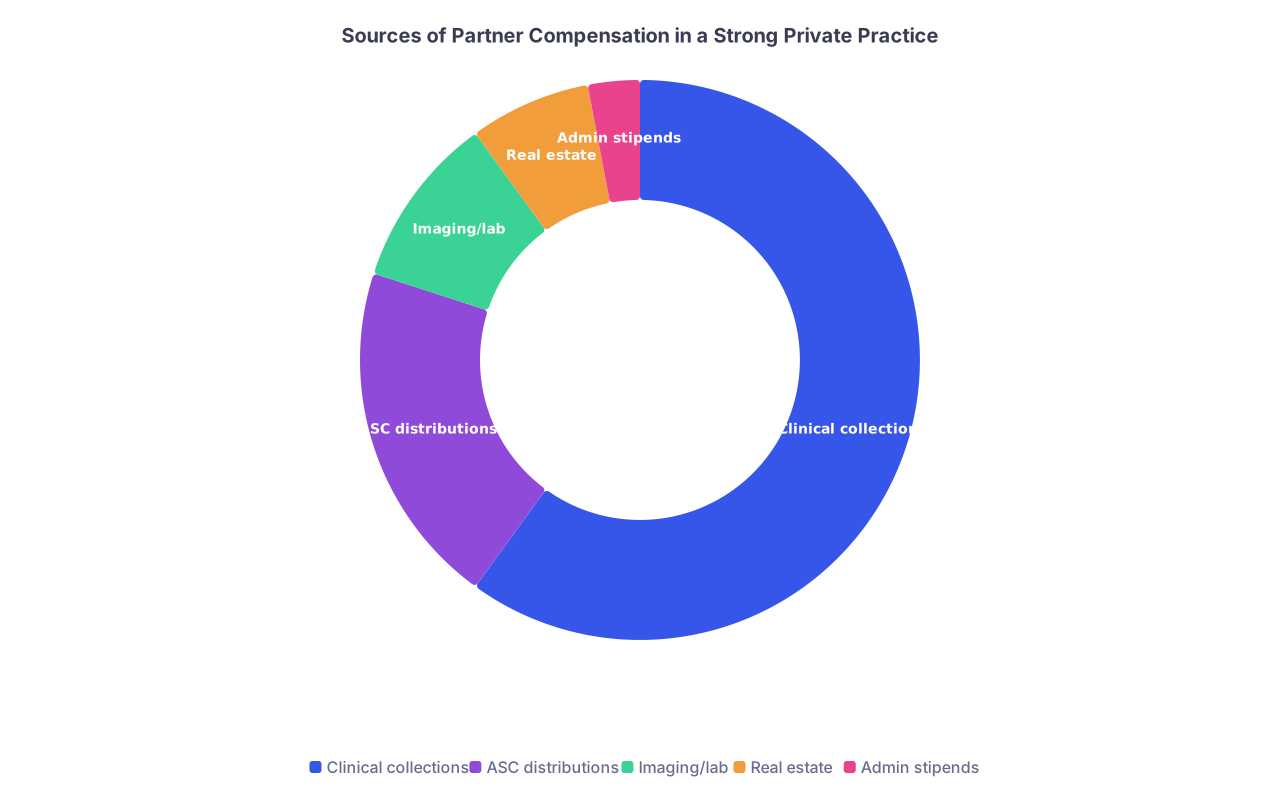
Non-clinical revenue streams—ASC, imaging center, lab, real estate—are the real leverage points. But they’re also where the most games get played.
| Category | Value |
|---|---|
| Clinical collections | 60 |
| ASC distributions | 20 |
| Imaging/lab | 10 |
| Real estate | 7 |
| Admin stipends | 3 |
What partners really take home often looks like that: only ~60% from straightforward clinical work, and 40% from things you don’t see on your pay stub as an associate.
Here’s the important part: access to those revenue streams is usually tiered.
- Early partners get small ASC shares at higher valuations
- Legacy partners got in early, cheap, and hold the bigger percentages
- New ventures are sometimes “pre-allocated” to existing inner circle before the rest of the group hears about them
So two partners who “both make $600k” on paper might be living very different lives:
- Partner A: $550k from clinical, $50k from ASC – working like a dog
- Partner B: $350k from clinical, $250k from ASC/real estate – golfing on Fridays, still making more
What matters to you is not just partner track, but equity track. Different question. Very different answer.
Red Flags in a Partner Track Offer
You’re smart enough to read your own contract. What you’re not being shown is the structural stuff. Let me give you the specific things I’d look for, because I’ve seen people burned on each of these.
No written, quantitative partner compensation policy
If it’s all “trust us, everyone does fine,” that means the numbers are either embarrassing, chaotic, or political.Vague buy-in language
“Buy-in to be determined based on future valuation.” Translation: we will decide later how much to charge you, and it will be whatever maximizes our ability to cash out.Multiple classes of partners
Voting vs non-voting partners. Equity vs “income” partners. Different call requirements. Ninety percent of the time, junior partners are stuck in the lesser class far longer than they expect.High senior partner attrition in the last 5–7 years
If several high earners have left recently, the story you’ll get is “they wanted a different lifestyle” or “they moved for family.” Often the real story is: the comp formula or power structure stopped being tolerable.Hospital contract concentration risk
One big hospital contract drives most of the revenue, controlled by one or two senior partners with titles. If that contract shifts or those people retire, you’re exposed. Massive downside.
If they won’t hand you at least anonymized partner P&L distributions from the last 2–3 years, you’re walking in blind.
How to Actually Evaluate a Partner Opportunity
You want to know: “What will I really take home as a partner here, and what will I have to trade to get it?”
Here’s a practical framework I’d use sitting across the table from any group:
Ask for last year’s range of partner take-home pay after overhead, before taxes. Not “average,” not “top,” but low–median–high.
Ask what proportion of that came from:
- Clinical work
- ASC/imaging/lab/real estate
- Admin or leadership stipends
Ask what the all-in buy-in has been for the last three partners: dollar amount, years to pay, and how much their real take-home dipped those years.
Ask to see the written partner compensation policy, including:
- How overhead is allocated
- How RVUs or collections are credited
- How call is valued (or not valued)
- How new revenue streams (like a new ASC) are distributed
Then translate it to this question: “If I perform at the 70th–80th percentile for this group, what was the actual take-home for a similar partner over the last 3 years, averaged, after buy-in?”
If they can’t or won’t give you that level of detail, assume the real answer is less flattering than the recruiting pitch.
FAQs
1. Is partnership in private practice still worth it financially?
In many procedural specialties and in markets where private groups still control high-margin services (ASC, imaging, etc.), yes—it can absolutely be worth it. But it’s not automatic. The days where “just become a partner and you’ll be rich” are gone. You need to see real numbers on non-clinical income, buy-ins, and how many years partners stay at peak before retiring or burning out. In some hospital-employed models with aggressive wRVU bonuses and minimal overhead, you may end up with comparable or even better take-home than a badly structured partnership.
2. How many years does it usually take for a new partner to “catch up” financially after buy-in?
From what I’ve seen directly, it’s typically 3–7 years after you become partner before you feel like you’ve fully recovered from the hit of buy-ins and reduced early distributions. The first 2–3 years of partnership, your headline number may look big, but a noticeable slice is often going to capital contributions, equity purchases, or legacy obligations. If you’re planning a big lifestyle jump the moment you make partner, you’re going to feel squeezed.
3. What’s the single most important question to ask a group about partner compensation?
Ask this, verbatim: “For a mid-career partner working at a solid but not insane pace, what was the average monthly amount that actually hit their personal bank account last year, after buy-ins and required capital contributions?” Then shut up and wait. If they dodge, minimize, or say “it varies too much,” you have your answer: the story they sell and the checks they cut do not match.
If you remember nothing else, remember these three truths:
- “Partner income” is almost always quoted before all the hidden drains and obligations.
- How profit is split matters more than how big the gross revenue looks.
- Equity access and non-clinical revenue streams quietly separate the comfortably wealthy partners from the ones just barely justifying all the extra risk.