
Last year I sat in a “special review” meeting where a hospitalist’s name was on the chopping block. On paper he was fine: solid RVUs, good patient satisfaction, no complaints. By the end of that hour, his raise disappeared, his bonus was cut in half, and he had no idea why. He never will.
Let me tell you how that actually happens. Because the way compensation committees judge you is not what shows up in your contract or the glossy recruitment slide deck.
The Myth vs. The Room You’re Not In
You’ve been sold the fairy tale: hit your work RVU target, get your bonus. Exceed it, get more. Clinical productivity is objective, measurable, fair.
That’s the brochure.
What really happens is a small group—usually 5–10 people—sitting around a table with coffee gone cold, flipping through PDFs with your name on them. The RVU number is the starting point, not the verdict. The conversation is where your money moves.
I’ve watched this play out in large academic systems, midsize community hospitals, and private equity–backed groups. Different logos, same script:
- They say it’s about “productivity.”
- It’s actually about “value to the organization” as interpreted by a handful of humans with their own pressures, politics, and blind spots.
Here’s the uncomfortable part: those humans are often using unofficial criteria that no one ever told you about, because no one wants that written down.
What Compensation Committees Actually Look At (That You’re Not Told)
Let’s start with the obvious, then pull back the curtain on the rest.
| Category | What You Think Matters Most | What Actually Drives Decisions |
|---|---|---|
| RVUs | 80% | 40–60% |
| Collections | 10% | 10–20% |
| Quality metrics | 10% | 10–20% |
| “Soft factors” | 0% | 20–40% |
RVUs: The Official Language, Not the Full Story
Yes, RVUs matter. A lot. But the key is which RVUs and how they’re framed.
You see your total wRVUs for the year. The committee sees:
- Your wRVUs compared to your peers in your department
- Your trend over 2–3 years
- Your wRVUs adjusted for FTE, clinic sessions, call burden
- Your RVUs per encounter and RVUs per hour
They’re asking: is this person efficient or just busy?
I’ve seen surgeons with 12,000 wRVUs who still got grilled because their RVUs per case were out of line with national benchmarks. Translation: “Is this person gaming the system or just coding better than everyone else?” They’ll never say that out loud in front of you. They sure as hell say it in the room.
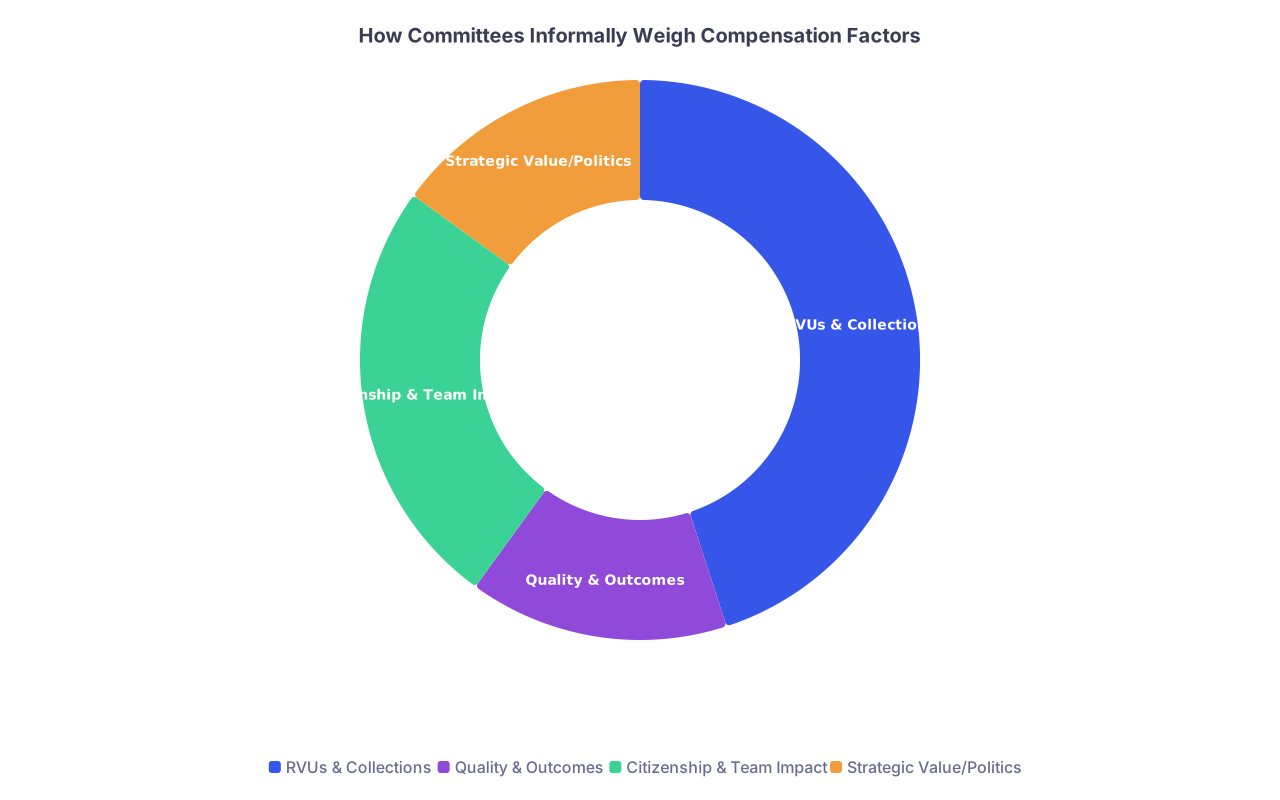
| Category | Value |
|---|---|
| RVUs & Collections | 45 |
| Quality & Outcomes | 15 |
| Citizenship & Team Impact | 25 |
| Strategic Value/Politics | 15 |
The real lever is not just “more RVUs.” It’s being in the right quartile for your specialty, in your market, and not setting off alarms.
Collections: The Quiet Second Column
If your contract is “RVU-based, not collections-based,” you think you’re insulated from payer mix and billing. You’re not.
Comp committees still see:
- Your total professional collections
- Your effective dollars per wRVU
- Payer mix trends if you’re an outlier (“Why is her Medicaid % so high?”)
- Denial rates and coding adjustment patterns
I’ve watched a high-RVU endocrinologist get their bonus quietly trimmed because:
“Her dollars per RVU are significantly below peers; we’re losing margin.” No one told her that to her face. They just “adjusted the bonus pool for sustainability.”
You had the RVUs. They didn’t like the financials behind the RVUs.
Quality Metrics: Only Matter When You’re at the Extremes
Quality gets weaponized at the edges.
If your metrics are normal, they barely move the needle. If you’re stellar or terrible, they absolutely do. Committees look at:
- Readmission rates, complication rates, LOS (for proceduralists and hospital-based)
- Panel size stability, preventive care metrics, access (for primary care)
- Complaint volume vs. peer median
A cardiologist I know consistently ran LOS one day shorter than peers with similar case mix. That fact got brought up every compensation cycle. Not because administration loves quality for its own sake. Because short LOS saved the system millions. She never had to fight for her bonus. That metric fought for her.
The Unwritten Scorecard: Politics, Risk, and “Citizenship”
Here’s the part nobody writes into policy docs, but every veteran knows is real.
1. Are You a Flight Risk?
Comp committees absolutely talk about this.
The script sounds like: “We need to stay competitive so we don’t lose her to the group across town.” That’s code for: this person has options and we know it.
Things that make you look like a flight risk—in a good way:
- You’re a high producer in a scarce specialty (GI, heme/onc, certain surgical subspecialties, nocturnists in some markets).
- You’ve had recruiters sniffing around and you didn’t hide it.
- You’ve asked intelligent questions about external benchmarks, not just “What’s my raise this year?”
Conversely, the “they’re not going anywhere” group? They get squeezed hardest. Elderly docs near retirement, people obviously tied down by family/school situations, niche subspecialists with no local competitors—those are the ones who get the “flat this year, thanks for your service” treatment.
I’ve watched an ortho group where two mid-career surgeons casually mentioned they’d been approached by another system. Next cycle, they got “market adjustments.” The senior guy who’d been “loyal” for 25 years? Same RVUs, no adjustment. The committee literally said: “He’s stable, we can’t afford to lose the other two.”
2. Are You Expensive or Profitable Beyond Your RVUs?
Hospital-based folks especially underestimate this.
Comp committees look at downstream revenue. They’ll never give you the full data, but they absolutely model it:
- Your admit patterns
- Your surgical volume feeding imaging, anesthesia, pathology
- Your referrals inside vs. outside the system
A pulmonologist who admits high-acuity patients that fill ICU beds is “worth” more than their professional billing statement. Same wRVUs, very different value to the C-suite.
One neurosurgeon I know was untouchable not because of his RVUs—others matched him—but because radiology, ICU, rehab, and OR volume tied to his cases were monster lines on the hospital P&L. His comp committee conversations: “We pay him above 75th percentile, but he generates 300th percentile contribution margin.” Done. Approved.
If you’re keeping care inside the system and feeding profitable service lines, you have leverage. If you’re sending patients out or your work doesn’t drive facility revenue (think telehealth-only, consult-only arrangements), you have less.
3. Are You a Problem or a Solver?
This is where “citizenship” comes in. The word is vague by design. It lets people move money around without a strict formula.
Here’s the reality:
- The doc who always says yes to last-minute call coverage.
- The one who took an extra clinic day during an access crisis.
- The one who didn’t blow up when the schedule changed for the fourth time.
Those people get subtle credit. When there’s a question—“Do we bump their comp target this year?”—the room remembers the extra effort.
On the flip side, constant complainers, email warriors, and meeting snipers? They get subtle penalties. No one writes “annoying at MEC meetings” in the minutes. They just say, “Maybe we hold their comp flat this year given everything else going on.”
I’ve literally heard: “He’s already at 60th percentile and honestly he’s been difficult this year. Let’s leave him there.” That’s tens of thousands of dollars decided on vibe.
The RVU Stories You Never Hear (But I’ve Seen)
Let me give you a few real-world composites. These are the conversations behind closed doors that determine how your RVUs convert to dollars.
The “Too Many RVUs” Problem
A hospitalist blowing past 7,000 wRVUs per year, in a group averaging 4,500. On paper, rockstar. Committee discussion:
- “Is this sustainable?”
- “Are they double-dipping shifts somewhere?”
- “Are they churning admissions or over-documenting?”
Outcome: They “cap” the bonus at a certain RVU level “for equity within the group.” Translation: You worked more. We’ll pay you… but only so much, because your success makes others uncomfortable.
Did anyone warn him ahead of time? Of course not.
The Part-Timer Who Got Full-Time Respect
An outpatient psychiatrist working 0.6 FTE but producing 0.9 FTE RVUs. Admin wanted to keep her badly—shortage specialty, long waitlist.
Committee talk:
- “She’s technically part-time, but she’s carrying almost full-time volume.”
- “We should adjust her FTE to reflect actual work or risk losing her.”
Outcome: She got a “market correction” bump and an FTE reclassification that raised her base. Same RVUs. Different story: rare specialty + overperformance per FTE + perceived risk of losing her.
She thought it was her “good attitude.” That didn’t hurt. But the math and scarcity did most of the heavy lifting.
The “Great Clinician, Bad Business” Scenario
Beloved PCP. Great Press Ganey scores. Right at RVU target. Collections per RVU significantly lower than peers due to documentation gaps and sloppy coding.
Committee talk:
- “We’re writing off a lot on his charts.”
- “Love him, but financially we’re taking a hit.”
- “Can we push him to do coding education?”
Outcome: Bonus stagnant for two years with vague feedback like “we’re looking at alignment with system priorities.” Only when he sat with coding and cleaned up his documentation did the financial story improve and the committee’s tone change.
He thought they “didn’t value primary care.” They valued it fine. They didn’t value leaving money on the table.
How to Tilt the Room in Your Favor (Without Being Sleazy)
You can’t control everything. But you’re not powerless. You just need to stop thinking of comp as a formula and start thinking of it as a negotiation framed by political and financial realities.
Know the Benchmark Game Better Than They Do
Do not walk into any comp conversation without knowing:
- Your specialty’s MGMA/AAMC percentiles for wRVUs and total comp in your region
- Where you roughly sit relative to those (even if the system won’t tell you, you can estimate)
- Your own wRVUs per FTE and per clinical day
You want to be able to say, calmly:
“I’m working at about 60th–70th percentile wRVUs for my specialty, but my compensation is closer to the 40th. Can we talk about a plan to align those over the next cycle?”
When you talk in their language—percentiles, alignment, sustainability—you shift from “complaining physician” to “data-literate professional who might walk if this stays unfair.”
Make Your Downstream Value Visible
You know you fill beds or generate imaging or drive surgeries. The committee might not have the full picture.
Without sounding like a CFO, you can frame it:
- “My OR days are consistently full, and the cases generate additional work for anesthesia, radiology, and pathology. I’d like my compensation plan to recognize that contribution.”
- “Our clinic’s referrals into the system have significantly increased; I’d be interested in how that factors into compensation decisions.”
You’re planting a seed: cutting my comp isn’t just cutting my RVU conversion, it’s threatening a revenue engine.
Manage Your “Citizenship” Reputation Strategically
You do not have to be a doormat. But you do need to understand which behaviors leave a trail that shows up in that room.
The things that mysteriously help during comp talks:
- Serving on one or two visible, high-yield committees (quality, access, operations). Not ten.
- Volunteering once or twice a year for painful but mission-critical tasks (ED coverage crisis, urgent clinic expansion).
- Being the person leadership can email when they need honest feedback—and you give it constructively, not as a rant.
The point is simple: when your name comes up, someone in that room should say, “They’ve been really helpful this year, we should take care of them.”
Signal, Deliberately, That You Have Options
This makes physicians nervous. You’ve been trained to be “grateful.” That mindset costs people six figures over a career.
You don’t have to threaten. You just have to stop pretending you’re stuck. Examples:
- “I’ve been contacted by a couple of recruiters offering higher RVU rates. I’d prefer to stay here, but I do want to make sure we’re staying reasonably aligned with market.”
- “Several colleagues in the region are at $X per wRVU with similar volumes. How do we see ourselves positioning relative to that?”
Now the committee conversation becomes: “If we don’t move, will they leave?” even if you have zero immediate intention of going anywhere. Leverage is perception.
How This Plays Out Over Your Career
You only see your own salary letters and bonus checks. I’ve seen the longitudinal patterns.
The physicians who quietly accept every lowball and “flat year” and never ask for data? Five or ten years in, they’re often sitting 15–25% under market with no easy way to catch up.
The ones who:
- Track their RVUs and volumes
- Understand their relative productivity and rarity
- Participate selectively in system life
- And ask very pointed, respectful questions in comp reviews
…tend to drift upward. Not overnight, but over cycles. Comp committees remember squeaky wheels that make sense, not just noise.
You don’t have to be the highest producer in the group. You just have to be the person they’re slightly afraid of losing and slightly guilty about shortchanging.
That’s who gets the market “adjustments.” That’s who gets exceptions approved. That’s whose RVUs magically convert at the high end of the range.

| Step | Description |
|---|---|
| Step 1 | Your Actual Work |
| Step 2 | RVU Report |
| Step 3 | Collections and Payer Mix |
| Step 4 | Quality and Complaints |
| Step 5 | Reputation and Citizenship |
| Step 6 | Comp Committee Meeting |
| Step 7 | Perceived Value and Risk |
| Step 8 | Final Compensation Decision |
FAQ (Read This Before Your Next Comp Review)
1. Can I ask to see exactly how my compensation is calculated?
Yes, and you should. Ask for: your total wRVUs, RVUs per FTE, your RVU conversion rate, and which quality or other metrics affect your bonus. They might stonewall on external benchmarks, but the internal math? You have every right to understand it. The physician who asks intelligent questions gets treated differently than the one who signs whatever is handed over.
2. Does being “nice” to administrators really affect my pay?
Not in a cartoonish way. No one says, “She brought cookies, give her 20k.” But your reputation—constructive, solutions-oriented vs. hostile and obstructive—absolutely colors how hard people will fight for you in that room. When marginal dollars are being allocated, people back the colleagues who make their lives easier, not harder.
3. I’m in a strictly RVU-based contract. Am I safe from this fuzziness?
No. Even in “pure” RVU models, committees can and do adjust: RVU targets, thresholds for bonuses, caps on payouts, and future base salaries. They can freeze your base, change your FTE designation, or “recalibrate” the conversion factor. The formula is only as rigid as the people controlling the inputs allow it to be.
4. What’s the single most important thing I should start doing now?
Track your own data and learn the benchmark language. Know your wRVUs, your FTE, and where you roughly sit compared to regional MGMA percentiles. Then, in every comp discussion, stop asking “Can I get a raise?” and start asking “How do we bring my compensation into alignment with my productivity and market benchmarks over the next year or two?” That framing changes everything.
Key points to walk away with:
- RVUs are only half the story; committees judge your risk, profitability, and “citizenship” just as much.
- Being data-literate and visibly valuable to the system gives you leverage those with the same RVUs simply do not have.
- If you are silent, you will be underpaid. The room you’re not in is making decisions anyway—so learn how to shape what they say when your name comes up.