
Most physicians who are underpaid did not get “lowballed.” They signed themselves into a bad deal and then stayed stuck. For years.
You are not underpaid because administrators are clever. You are underpaid because no one ever taught you how not to trap yourself.
Let me walk you through exactly how physicians accidentally lock in below‑market salaries, the landmines inside those “standard” contracts, and how to stop giving away tens to hundreds of thousands of dollars a year.
1. The First Job Trap: Anchoring Yourself Low… Forever
The most expensive mistake physicians make happens before they ever see a contract:
They pick a first job based on:
- Location
- “Good culture”
- “We take care of our people here”
- Free parking and a “signing bonus”
And they never ask the only question that matters:
“How does this compensation compare to the 50th, 75th, and 90th percentile for my specialty in this region?”
How this locks in low salaries
You anchor your market value too low.
If you think $230,000 for outpatient IM is “solid,” you will unconsciously benchmark every future offer against that number. Even when fair market in your region is $275,000–$300,000.Future employers use your current comp against you.
I have literally heard an administrator say on a comp committee call:
“She is currently at $210k. If we offer $245k, she will be thrilled.”
They never asked what the market was. They just used her existing underpayment as the ceiling.Your RVU productivity is built on a low base.
Many contracts will say: “Your initial base is set according to your current compensation plus an increase.”
Translation: if you started low, every “raise” is built on the wrong foundation.Your own confidence gets warped.
After a few years earning $220k while your peers are at $280k, you start thinking:
“Maybe I am just not as productive. Maybe this is what I am worth.”
That mindset alone will cost you six figures over time.
Red flags you are anchoring yourself low
- You chose your first job without ever seeing compensation benchmark data (MGMA, AMGA, SullivanCotter, Medscape as a rough start).
- You accepted the first offer without a counter.
- You said any of the following out loud:
- “It is more than residency, so I am happy.”
- “I do not want to rock the boat – I just want to start.”
- “This is what everyone else here makes” (based only on what admin told you).
How to avoid this
- Before you interview anywhere, know:
- 25th, 50th, 75th percentile total compensation for your specialty in your region.
- Typical RVU targets and $/RVU ranges.
- Decide your walk‑away number before you see a contract.
- Never accept the first written offer without a specific counter tied to data.
You do not fix underpayment by “proving your value first.” You fix it by refusing to start out 20–30% below market.
2. Poisoned Compensation Formulas: On‑Purpose Confusion
You know what keeps salaries low for years?
Comp plans that are complex enough you stop checking the math.
I see this constantly in:
- Hospital employed groups
- Large multispecialty groups
- Academic centers with “productivity plus incentives”
The comp plan is where most physicians accidentally agree to be underpaid indefinitely.
The classic traps inside comp formulas
RVU rates that never update to current market
Example:
- Year 1: $45/RVU (looks great)
- Year 2+: “Subject to review”
- Then, nothing. For 5–7 years.
Market RVU rates drift up. Yours does not. End result: You are effectively taking a pay cut every year as others’ rates rise around you.
“Blended” or tiered RVU rates that hide the real number
Looks like:
- 0–4,000 RVUs: $42/RVU
- 4,001–6,000 RVUs: $48/RVU
- 6,001+ RVUs: $55/RVU
Sounds great. But:
- You never hit the higher tiers because you are saddled with non‑billable admin work.
- The overall “blended” rate you actually earn is closer to $43–45, not $48–55.
Collections‑based comp with overhead games
“You get 35% of your collections.”
Then you discover:- Overhead is inflated.
- A chunk of your work is written off for “contractuals.”
- You pay for shared resources that you do not control.
And you cannot audit any of it because transparency is “not our policy.”
Quality or bonus metrics that never pay out
Common pattern:
- “Up to $40,000 in quality incentives”
- Definitions are vague, targets are unrealistic, or they keep “adjusting the blend.”
That “up to” number lives only in recruiting brochures. Over several years, you leave $100k+ of “illusory” compensation on the table.
Example misalignment (and how people miss it)
You are offered:
- Base: $260,000 for two years
- Then: pure productivity at $45/RVU
- RVU target quoted verbally: “Our docs usually do 6,000 RVUs a year.”
You calculate: 6,000 x $45 = $270,000. Not bad.
What you do not see:
- Your clinic schedule is 15 min slots with tons of non‑billable tasks.
- No scribes, mediocre support staff, EMR from 2008.
- Realistic sustainable RVUs: 4,200–4,500.
Now your “productivity” income is $189,000–$202,500. You will never hit what you thought you were agreeing to. But the contract is already signed.
How to avoid this comp‑formula trap
- Demand written examples in the offer:
- “At 4,000 / 5,000 / 6,000 RVUs, my total comp would be X / Y / Z.”
- Ask to see:
- Average and median RVUs for physicians in your department over the last two years.
- Actual distribution, not cherry‑picked top performers.
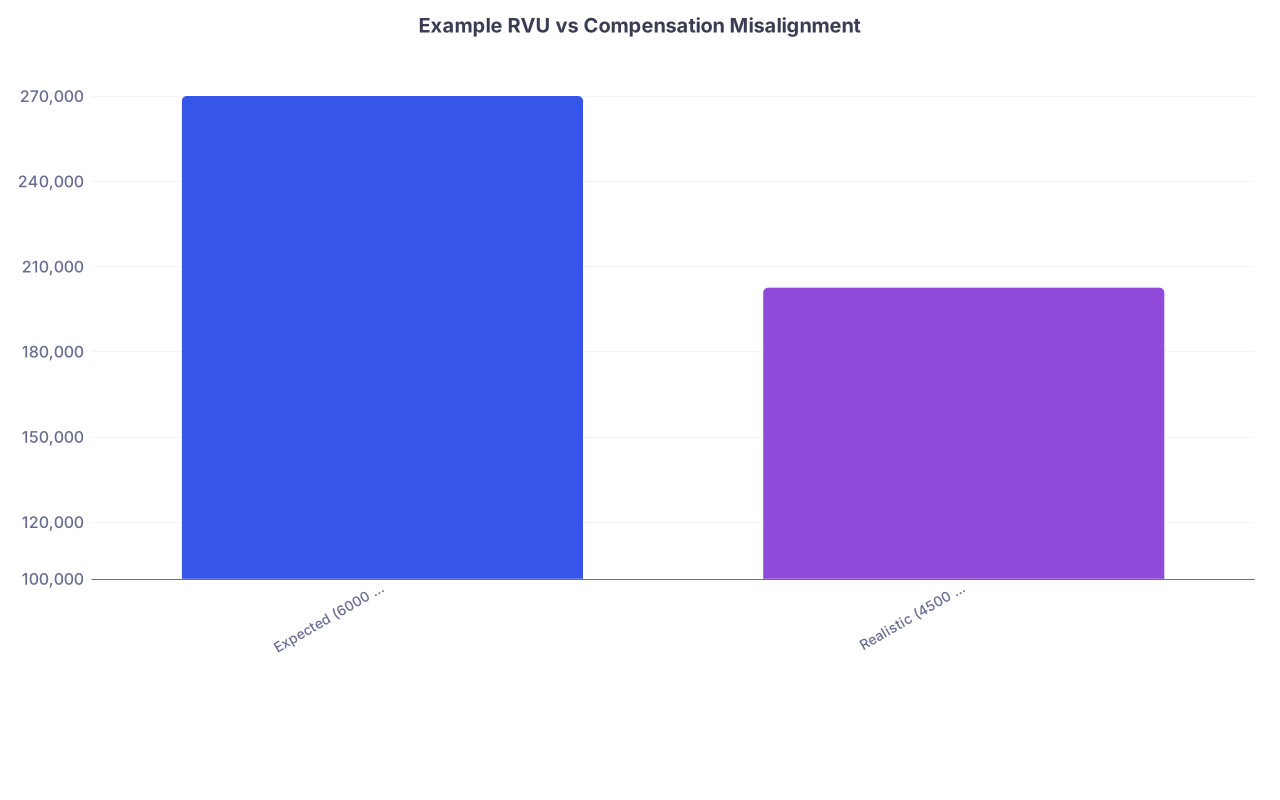
| Category | Value |
|---|---|
| Expected (6000 RVUs) | 270000 |
| Realistic (4500 RVUs) | 202500 |
- Push for automatic RVU rate review:
- “RVU rate will be reviewed at least every 2 years and benchmarked to current MGMA/AMGA median for specialty and region.”
If you do not understand the comp formula in 2–3 minutes with a pen and paper, do not sign it. Complexity is usually not for your benefit.
3. Contract Clauses That Freeze You in Place
The second way physicians lock in low salaries is by signing contracts that make it expensive—or impossible—to leave once they realize the pay is off.
You do not feel it at signing. You feel it later when you start thinking, “I need to get out of this,” and the contract quietly laughs at you.
The worst offenders
Long initial terms with auto‑renewals
Language like:
- “Initial term of 3 years, renewing automatically for successive 2‑year terms unless terminated in writing 180 days in advance.”
Consequences:
- If you miss the weird 180‑day window, you just renewed for 2 more years.
- Every negotiation turns into, “Well, your contract renews soon; we can look at this next term.”
Unreasonable notice periods
180–365 days is not “standard.” It is a retention strategy.
What this does:
- Makes it impossible to leave for attractive offers with shorter onboarding timelines.
- Forces you to stay in a bad situation another year because you did not start looking early enough.
Massive tail coverage obligations
Most dangerous when:
- You are in a malpractice‑hostile state.
- You are in a high‑risk specialty (OB, surgery, EM, anesthesia).
I have seen tail bills over $120,000 used to keep physicians from leaving. That is not an exaggeration.
Repayment of sign‑on, relocation, or retention bonuses
Typical structure:
- $30,000 sign‑on, forgiven over 3 years.
- If you leave early, you owe the remaining prorated amount immediately.
Combine that with tail coverage and you have a 6‑figure financial wall between you and the exit.
Non‑compete clauses that kill your local leverage
Classic pattern:
- You want to leave your low‑paying hospital for a better paying system across town.
- Your non‑compete says:
- 10–25 mile radius
- 1–2 years
- Applies to any hospital where your current system has contracts.
So your only options:
- Move.
- Take a huge pay cut in a non‑clinical role.
- Or accept yet another below‑market renewal.
| Clause Type | Reason It Keeps You Underpaid |
|---|---|
| 3+ year initial term | Delays your first real chance to renegotiate |
| 180–365 day notice | Prevents you from taking better offers quickly |
| Large tail obligation | Makes leaving financially painful |
| Bonus repayment | Creates artificial “handcuffs” |
| Broad non‑compete | Eliminates local bargaining power |
How to avoid getting trapped
Push for:
- 1–2 year initial terms.
- 60–90 day notice periods.
- Employer‑paid tail coverage if they terminate without cause.
- Narrow, time‑limited non‑competes (if you cannot eliminate them entirely).
Never, ever say:
“I am sure the non‑compete will not matter. I am never leaving.”
You are signing this for your future self, who absolutely might want to leave.
4. “I’ll Fix It Later” – The Negotiation You Never Actually Do
The quiet career‑destroyer is not the bad offer.
It is the good physician who thinks, “I will just prove my value and renegotiate later,” then never does.
Here is how that plays out:
- Year 1–2: You are new. You do not want to cause trouble. You accept under‑market comp to “get established.”
- Year 3: You are busier. You feel guilty about asking for more. You tell yourself, “Next year when my RVUs are higher.”
- Year 4–5: Now you have kids, a mortgage, a practice panel. Admin knows leaving is hard. They throw you a 3% raise. You accept.
- Year 6+: You are the “steady workhorse.” Leadership refers to you as “very loyal.” Translation: least likely to leave, easy to underpay.
I have watched this movie dozens of times. Same ending every time: a mid‑career physician finally realizes they are $80k–$150k under market, but changing jobs now is painfully disruptive.
Why physicians delay renegotiation
- Conflict avoidance. You are trained to be agreeable.
- Guilt. “They invested in me. They gave me a chance.”
- Fear. “What if they get angry? What if they say no? What if they replace me?”
- Busy‑ness. You tell yourself you do not have time to research benchmarks or talk to a lawyer.
So you do nothing. And nothing is very profitable—for your employer.

How to avoid staying locked in by your own inaction
- Put contract review dates on your calendar:
- 6–9 months before the end of your term or any auto‑renewal.
- Each year, do a quick check:
- Compare your comp to current MGMA/AMGA/other benchmarks.
- If you are more than ~10–15% below median for your productivity, you have a problem.
- Treat renegotiation as routine business:
- “My productivity has increased from X to Y RVUs. Current comp benchmarks show median at $Z. I would like to align my compensation accordingly.”
You either normalize asking for fair compensation. Or you normalize being underpaid.
5. Believing “Mission” or “Academics” Justify Permanent Underpayment
Here is the uncomfortable part.
Academic centers, mission‑driven hospitals, and “family‑style” private groups often weaponize culture to suppress salary conversations.
I have heard all of the following:
- “We are not like those RVU mills.”
- “People come here for the mission, not the money.”
- “Academics does not pay the same as private practice; you knew that.”
- “We are a family here.”
None of those statements are inherently bad. They become toxic when used to freeze your salary well below what is reasonable given your skills and workload.
How physicians get stuck here
You accept a big gap “for now”
Example:
- Private practice hospitalist offers: $330k.
- Academic center offers: $240k, plus teaching and maybe research.
You say: “I value teaching, so I accept the lower pay.”
That is fine once. The mistake is never asking whether the gap remains fair 5–10 years later when:- Your clinical load creeps up.
- Your teaching and admin responsibilities expand.
- Your pay moves from $240k to… $255k.
You internalize that money talk is “unprofessional”
So you:
- Never see the benchmark data admin sees.
- Never know what your peers are earning.
- Assume fairness where none exists.
You confuse gratitude with obligation
You are grateful for mentorship, opportunity, colleagues.
But gratitude is not a contract to accept 20–30% under market forever.
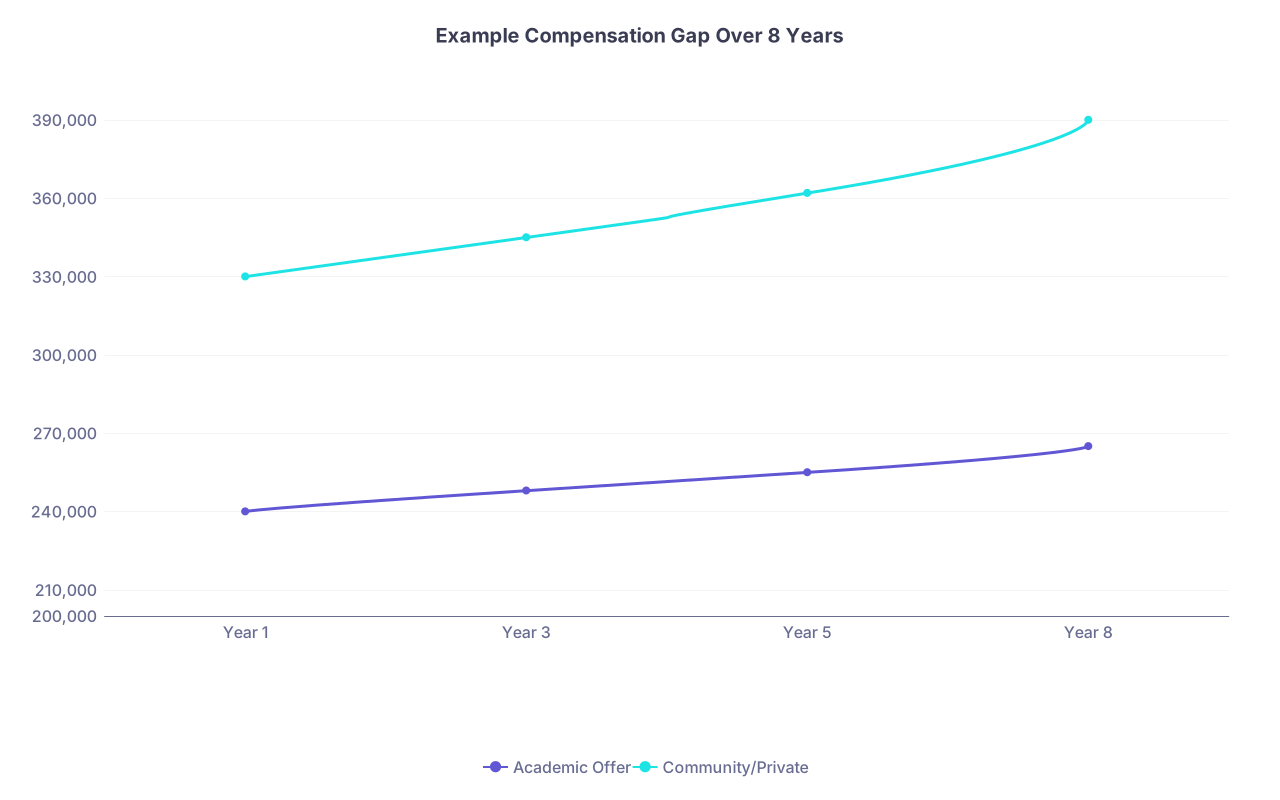
| Category | Academic Offer | Community/Private |
|---|---|---|
| Year 1 | 240000 | 330000 |
| Year 3 | 248000 | 345000 |
| Year 5 | 255000 | 362000 |
| Year 8 | 265000 | 390000 |
How to keep mission and money from working against you
- Decide in advance what discount you are willing to accept for:
- Mission
- Teaching
- Lifestyle
- Then check:
- Is that discount still the same 5 years later given your expanded responsibilities?
- Do not let anyone shame you for asking:
- “Given my clinical, teaching, and admin contributions, how does my total compensation compare to benchmarks for my role and productivity?”
You can care deeply about patients and still refuse to subsidize a system with your underpayment.
6. Flying Blind: No Data, No Legal Review, No Second Opinion
The final, preventable mistake is signing and renewing contracts without:
- Independent compensation data
- Independent legal review
- Independent financial perspective
You would never tell a patient to choose chemo based on a brochure and a verbal summary. Yet I routinely see physicians sign 20‑page contracts after a 30‑minute review alone at their kitchen table.
What happens when you fly blind
You miss:
- Small but expensive clauses (notice periods, tail, bonus clawbacks).
- Benchmark misalignments (RVU rates, base vs market).
- “Subject to discretion” phrases that can erase bonuses.
You underestimate:
- How hard it will be to leave.
- How little leverage you will have once you are established but underpaid.
You never realize:
- You could have negotiated almost every “standard” clause.

| Step | Description |
|---|---|
| Step 1 | Receive Contract |
| Step 2 | Personal Review |
| Step 3 | Get Healthcare Attorney Review |
| Step 4 | Compare to Market Data |
| Step 5 | Negotiate Changes |
| Step 6 | Consider Signing |
| Step 7 | Understand Comp and Clauses |
| Step 8 | Below Market or Risky Terms |
How to stop underpaying yourself with ignorance
Spend a few hundred dollars on:
- A healthcare attorney who reads physician contracts regularly.
- A CPA or financial planner who understands physician compensation structures.
Ask them specifically to flag:
- Anything that:
- Limits future bargaining power.
- Creates large financial obligations upon exit.
- Ties compensation to vague or discretionary metrics.
- Anything that:
Pay for current compensation data:
- Your lawyer or advisor may already have access.
- If not, many specialty societies publish summaries or can point you to sources.
That $800–$1,500 you spend on review can literally be a 100x return if it leads to fixing a $20k–$40k annual underpayment. Every year.
FAQ (5 Questions)
1. How do I know if my current salary is below market for my specialty?
Start with real data, not anecdotes from colleagues. Get access to MGMA, AMGA, SullivanCotter, or at least robust survey data from your specialty society. Compare:
- Your total comp vs median and 75th percentile for:
- Your specialty
- Your region
- Your practice type (academic, employed, private)
- Your productivity (RVUs or panel size) vs those same benchmarks
If your productivity is at or above median but your pay is 15–20% below median, that is a strong sign you are underpaid.
2. My contract is already signed. Am I stuck with my low salary until it ends?
Not necessarily, but your leverage is lower than before signing. You still have options:
- Use your upcoming evaluation or term anniversary as a formal point to request a compensation review.
- Bring benchmark data plus your productivity numbers.
- Frame it as alignment with fair market value, not a personal complaint.
If they refuse outright or delay indefinitely, that is your signal to start exploring other opportunities before your notice period clock becomes a barrier.
3. Are non‑compete clauses always enforceable, or can I ignore them?
Ignoring a non‑compete is a good way to end up in a lawsuit or at least with a threatening letter. Enforceability depends on:
- State law (some states are hostile to physician non‑competes, others enforce them aggressively).
- Specifics of your clause: geographic scope, time length, and what activities are restricted.
You do not guess here. You pay a healthcare attorney in your state to read your actual contract and tell you how risky it is before you sign—or before you plan an exit.
4. My employer says my comp is “fair” but refuses to show benchmarks. What now?
That is a red flag. When they will not show data, it usually means the numbers are not flattering. You can:
- Bring your own benchmark data to the meeting.
- Ask directly: “Is there a specific reason we cannot compare my current comp to this third‑party data?”
- Document the conversation by email afterwards.
If they still stonewall, assume they are more interested in preserving margin than fairness. Start quietly exploring alternatives; nothing increases your leverage like a credible outside offer.
5. How often should I be reassessing my compensation and contract terms?
At least once a year, and more formally:
- 6–9 months before the end of any contract term.
- Whenever your role changes significantly (more call, leadership, teaching, new service line).
A simple annual ritual: - Pull updated benchmarks.
- Compare your comp and productivity.
- Identify any large gaps or creeping mismatches.
- Decide if this year you will:
- Ask for adjustment,
- Accept the current gap as a conscious trade‑off,
- Or start preparing an exit.
Do not wait 7 years to “finally check” and then discover you have been underpaid by six figures. By then, the money is gone.
Key points to remember:
- Underpayment is usually self‑inflicted through the contracts you sign and the renegotiations you avoid.
- Complexity, long terms, and restrictive clauses are not accidents; they exist to keep you from leaving and from questioning your pay.
- The only reliable antidotes are: hard data, independent legal/financial review, and the willingness to walk away from a bad deal—before it locks you in for years.