
The biggest threats to your physician salary are not your RVU target or your base pay. They’re buried in the non-compete and tail coverage sections you skim at midnight after a 14‑hour shift.
If you underestimate those two clauses, you’re handing someone else control over your future income.
The Two Contract Clauses That Quietly Eat Your Salary
You can negotiate a $350k base, a $40k sign‑on bonus, generous CME, and still lose six figures because of:
- A restrictive non‑compete that forces you to move or sit out from work
- An unpaid tail coverage requirement that drops a $60k+ bill in your lap when you leave
Let me break it down the way I’ve seen it play out for real physicians, not in theory.
I’ve watched:
- A hospitalist in the Midwest forced to move his entire family 200 miles because every hospital in his city was inside his non‑compete radius.
- An outpatient neurologist get hit with a $72,000 tail coverage bill when she resigned after two years. Her “great offer” suddenly became a lousy deal in hindsight.
- An EM doc realize too late that his “partnership track” group required him to buy his own tail if they didn’t make him partner. They didn’t. He paid.
Those doctors didn’t fail to negotiate base salary. They failed to protect themselves from contract landmines.
Non-Compete Clauses: The Salary Killer Masquerading as “Standard”
Non‑competes (restrictive covenants) are not harmless boilerplate. They are economic shackles.
They usually say something like:
If you leave, you may not practice medicine within X miles of any facility of Employer for Y years.
Sounds abstract when you’re a PGY‑3 signing your first job. It becomes very concrete when you hate your job and discover you can’t work anywhere near your kids’ school.
Here’s where physicians screw this up repeatedly.
Mistake #1: Looking Only at Base Pay, Ignoring Geography
You see $300k vs $280k and jump at the bigger number.
But:
- Job A: $300k, 2‑year non‑compete, 50‑mile radius from any clinic site
- Job B: $280k, no non‑compete
If you stay and love Job A for 10 years, great. But if you burn out in 18 months—as many do—Job A might cost you:
- Moving expenses
- Spouse’s lost job if they can’t relocate
- Kids changing schools
- Months of unemployment or long commute
That “extra” $20k/year evaporates instantly.
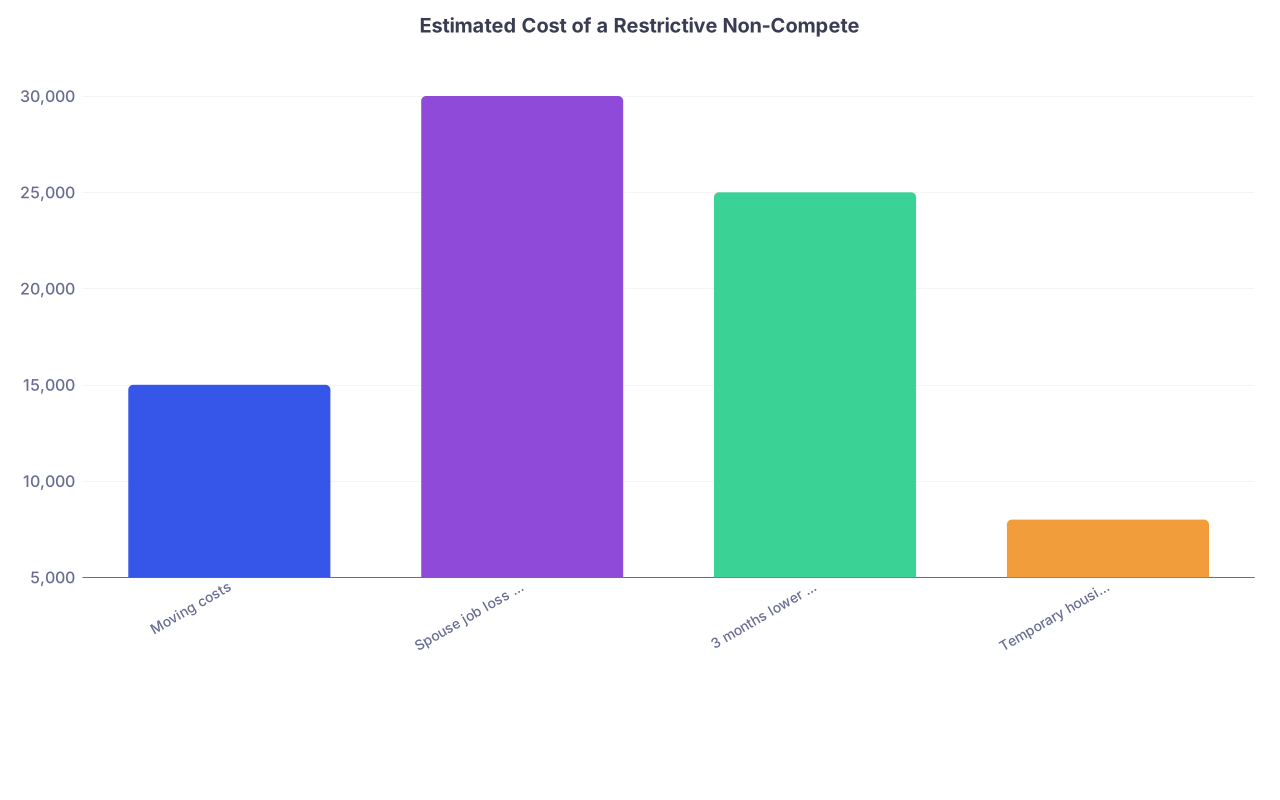
Let’s visualize the real cost.
| Category | Value |
|---|---|
| Moving costs | 15000 |
| Spouse job loss (6 mo) | 30000 |
| 3 months lower salary | 25000 |
| Temporary housing | 8000 |
That toy example is ~$78,000 gone. For leaving a job that didn’t work out.
Mistake #2: Not Realizing the Radius is From All Sites
Nasty trick I see constantly:
- “You may not practice within 25 miles of any facility at which you or Employer provide services.”
That sounds like: 25 miles from where you work.
What it really means: 25 miles from every clinic, ASC, outreach site, or satellite your group touches. You think you’re protecting a single hospital footprint; in reality, they just quietly knocked out an entire metro area.
Question you must ask in writing (not verbally):
- “Please list all current facilities, clinics, and locations that are subject to the restrictive covenant.”
- “Does this include locations added in the future, or only those existing at the time of execution?”
Red flag: If they refuse to specify locations, assume the worst.
Mistake #3: Accepting a Multi-Year Ban as “Standard”
Common patterns I see:
| Employer Type | Radius (miles) | Duration (years) |
|---|---|---|
| Large hospital system | 20–50 | 1–2 |
| Private specialty group | 10–30 | 1–3 |
| Academic center | 5–15 | 0–2 |
| Telemedicine company | Multi-state | 1–2 |
| Urgent care chain | 5–20 | 1–2 |
What’s “standard” doesn’t matter. What matters is whether:
- You can realistically stay if the job is tolerable
- You can realistically leave without detonating your finances
You mess up when you assume:
- “Everyone signs this, so it must be fine.” No. Everyone also signs bad apartment leases.
- “I’ll definitely stay here at least five years.” Says every new attending. Many last 18–24 months.
Reasonable targets to push for (varies by state and specialty):
- 5–10 miles from your primary work site only
- 6–12 months max
- No non‑compete at all if you’re employed by a non‑profit system in a state where enforcement is shaky
Will you always get that? No. But if you don’t even ask, you’re volunteering for the worst version.
Mistake #4: Ignoring How It Interacts With State Law and the FTC Noise
You’ve probably heard, “Non‑competes are going away. The FTC banned them.”
Dangerous misunderstanding.
Reality:
- Enforcement varies wildly by state
- Some states (e.g., California, Oklahoma, North Dakota) basically ban most non‑competes
- Many states still enforce them, especially for physicians
- FTC rules are being challenged and may not protect you at all
The mistake is assuming “this might not be enforceable” means “I can ignore it.” Even a questionable non‑compete can:
- Scare off potential employers who don’t want legal drama
- Lead to expensive litigation you can’t afford
- Be used as leverage against you (“We’ll ‘allow’ you to join Competitor X if you waive your bonus/tail/etc.”)
You do not want your next job contingent on your current employer’s mood.
Get a local healthcare attorney to review. Not your cousin who does real estate. Not your med school buddy who “heard non‑competes are dead.”
Mistake #5: Not Negotiating Non-Compete Relief When They Terminate You
Big blind spot: what happens if they fire you without cause, or they breach the contract?
If the contract says:
- “Restrictive covenant applies regardless of the reason for termination.”
You are exposed.
You could be:
- Let go because the hospital loses a big contract
- Terminated without cause for “restructuring”
- Pushed out by new leadership
…then still banned from working in the area.
Better options you should push for:
- Non‑compete only applies if you resign without cause or if you are terminated for cause
- Non‑compete is void if they terminate you without cause
- Non‑compete is void if they materially breach the contract (e.g., fail to pay, change location or duties wildly)
If they refuse any modification at all and you live in a one‑hospital town? That’s not just a job risk. That’s a family‑level, zip‑code‑level risk.
Tail Coverage: The $30k–$120k Surprise That Wipes Out Your “Sign-On Bonus”
Now let’s talk about the other silent salary killer: tail insurance.
If you do not understand your malpractice coverage type before you sign, you’re gambling with your future savings.
In plain English:
- Claims-made policy: Only covers you while the policy is active. When you leave, any future claims about your past work are not covered unless you buy tail coverage.
- Occurrence policy: Covers you for events that occurred during the policy period, even if the claim is filed later. No tail needed.
Most employed physicians these days are on claims‑made policies. That means tail matters. A lot.
Mistake #6: Not Knowing Who Pays for Tail (or What Tail Even Is)
I still see attendings—five years in—who say, “I think my malpractice is covered by the group?” and have no idea whether they’re on the hook for tail when they leave.
That’s how you end up with the $70k bill on your way out.
Your contract should answer explicitly:
- What type of malpractice policy is in place? (claims‑made vs occurrence)
- If claims‑made, who pays for tail coverage when the contract ends?
- Does the answer change depending on how it ends? (you resign, they fire you for cause, they fire you without cause, group dissolves, etc.)
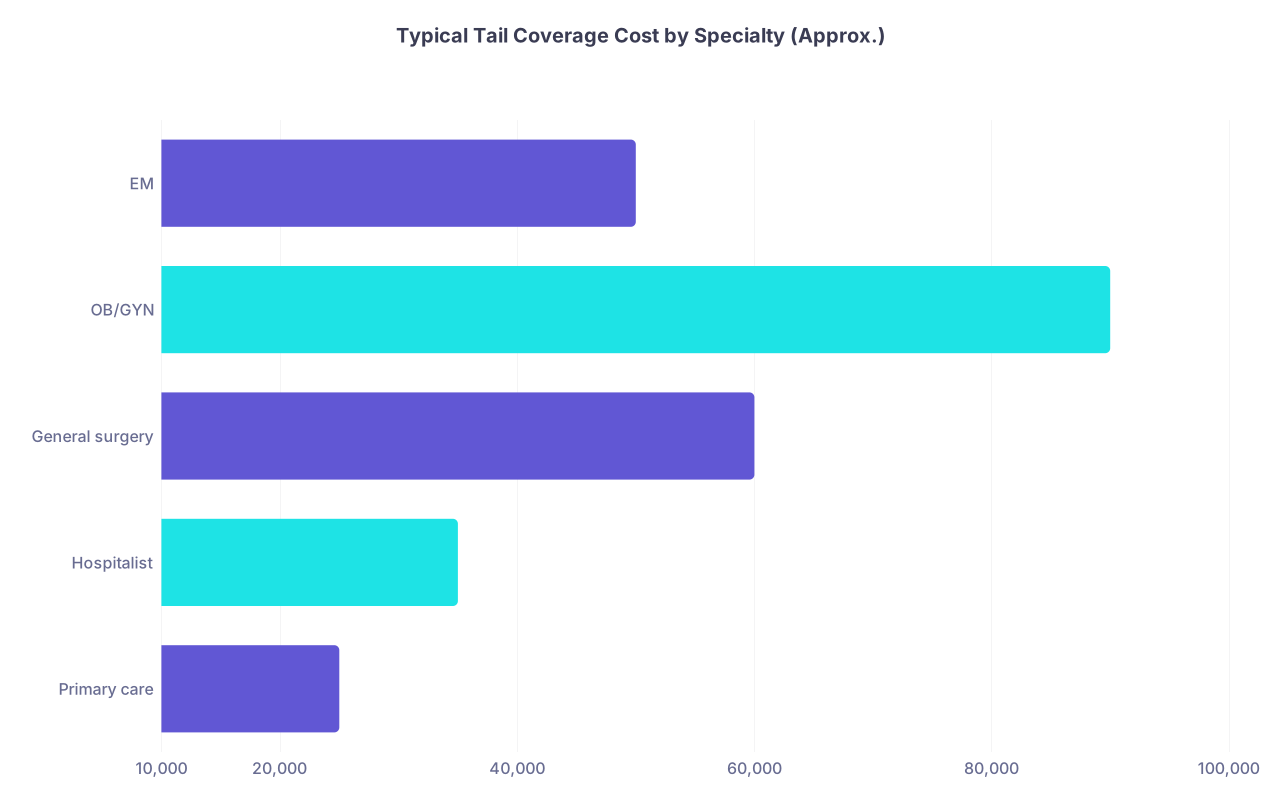
Typical cost range I see for tail on a claims‑made policy:
| Category | Value |
|---|---|
| Primary care | 25000 |
| Hospitalist | 35000 |
| General surgery | 60000 |
| OB/GYN | 90000 |
| EM | 50000 |
Numbers vary by region and carrier, but you get the idea. This is not a $2,000 annoyance. It’s a new car.
Mistake #7: Ignoring How Termination Triggers Tail Responsibility
Smart employers structure tail so that:
- If you resign, you pay
- If they fire you for cause, you pay
- If they non‑renew or terminate without cause, they pay
But many contracts quietly say:
Physician shall be responsible for all costs associated with tail coverage upon termination of employment, regardless of the reason for termination.
That’s employer-speak for “You’re paying no matter what.”
You need a clause that spells out scenarios.
For example (simplified):
- If physician resigns without cause → physician pays tail
- If employer terminates without cause → employer pays tail
- If physician is terminated for cause → physician pays tail
- If employer breaches contract or loses malpractice coverage → employer pays tail
You don’t have to win every line. But if your contract currently says “physician always pays” and you don’t push back, you’re volunteering to fund their risk.
Mistake #8: Forgetting That Tail Can Erode Every Financial “Win”
Run the math on a common situation:
- You get a $30,000 sign‑on bonus, 3‑year forgiveness (repayment if you leave before 3 years)
- Your starting salary is $20,000 higher than a competing offer that covered tail
- Tail estimated: $60,000
If you leave after 2 years because the job is toxic:
- You might owe:
- $10,000 of unvested sign‑on repayment
- $60,000 tail coverage
That’s $70,000 out of pocket. Meaning your “better offer” was actually catastrophic.
Do not compare offers based solely on base pay and sign‑on. Compare all-in cost:
- Tail exposure
- Non‑compete impact (relocation, time off, etc.)
- Penalties for leaving early (bonus clawbacks, relocation repayment)
How Non-Compete and Tail Coverage Work Together to Trap You
Here’s where it gets really ugly: these two clauses magnify each other.
Scenario I’ve actually seen:
- Non‑compete: 25 miles, 2 years, applies no matter who terminates
- Tail coverage: physician pays, always
- Sign‑on: $40k, forgiven over 4 years
You join. Two years later:
- You’re miserable
- Your spouse can’t get a job locally
- The group doesn’t follow through on partnership
You decide to leave.
Your reality:
- Can’t work within 25 miles for 2 years unless your old group agrees
- If you leave anyway:
- You owe remaining sign‑on: maybe $20k
- You owe tail: maybe $80k
- You might have months of unemployment or a 90‑minute commute to avoid violating the non‑compete
I’ve watched people stay in bad jobs purely because they couldn’t afford tail and non‑compete fallout. That’s not professional freedom. That’s indentured employment with CME.
Here’s the basic flow of how this traps you:

| Step | Description |
|---|---|
| Step 1 | Sign contract |
| Step 2 | Discover job mismatch |
| Step 3 | Consider leaving |
| Step 4 | Must move or commute far |
| Step 5 | Large out of pocket cost |
| Step 6 | Financial strain |
| Step 7 | Decide to stay in bad job |
| Step 8 | Non compete restricts local jobs |
| Step 9 | Tail coverage owed |
That’s the trap you’re trying to avoid. Not just a few thousand in “bad negotiation.”
Concrete Ways to Protect Yourself Before You Sign
Let’s get practical. Here’s how to not be the cautionary tale.
1. Treat Non-Compete and Tail as Core Compensation Terms
Stop thinking:
- “Salary, bonus, RVU rate = compensation”
- “Non‑compete, tail = legal fine print”
They are both compensation. Just negative compensation if structured badly.
When comparing offers, build a simple matrix:
| Factor | Offer A | Offer B |
|---|---|---|
| Base salary | $320,000 | $300,000 |
| Sign-on bonus | $25,000 (3-yr) | $10,000 (2-yr) |
| Non-compete | 20 mi / 2 yrs | 10 mi / 1 yr |
| Tail coverage | Physician pays | Employer pays |
| Termination w/o cause | Non-compete + tail still apply | Non-compete void, tail paid by employer |
Then ask: “What does it cost me to leave this job if it’s bad?” That’s the reality check.
2. Push Back on the Worst Parts (Even If You Don’t Win Them All)
You do not have to accept the first draft. And no, you won’t “blow the offer” by asking reasonable questions.
Reasonable asks:
- Narrow the radius
- Shorten the duration
- Tie non‑compete enforceability to specific causes of termination
- Shift tail responsibility if they terminate you without cause
- Add a buy‑out clause (e.g., you can pay $X to be released from the non‑compete)
If they refuse everything and tell you “this is completely standard,” that’s information. It tells you how they’ll treat you later.
3. Get a Real Healthcare Contract Review
Here’s a mistake that costs people more than the lawyer fee:
- They ask their program director “Does this look okay?”
- They email an uncle who does corporate law and get a thumbs up
- They post redacted screenshots in a physician Facebook group and crowdsource legal advice
Pay a healthcare contract attorney who actually reads physician contracts every day. Usually a few hundred to maybe a thousand dollars. It’s less than one month of salary. And far cheaper than a $60k tail bill.
4. Plan Your Exit on Day One
This sounds cynical, but it’s how professionals protect themselves.
Before you sign, know:
- How you can leave
- What notice you must give
- Whether tail coverage and non‑compete change based on how you leave
- How likely you are to stay in that geographic area long term (family, spouse job, kids, etc.)
You are not planning to fail. You’re refusing to be trapped if things change—which they will.
The Bottom Line: What You Actually Need to Remember
Do not let a nice‑sounding base salary blind you to long‑tail costs baked into your contract.
If you remember nothing else, hold onto this:
- A restrictive non‑compete can silently wipe out your ability to earn a living where you actually want to live. Treat radius, duration, and trigger conditions as core salary terms—not “legalese.”
- Tail coverage on a claims‑made policy is a massive hidden liability. If you’re expected to pay it no matter what, every bonus and raise is partially fake.
- The real cost of a job isn’t what you earn when you’re happy; it’s what it costs you to leave when you’re not. Protect that exit, or your “great offer” can become an expensive trap.