You just got the email: “Attached is your employment agreement, please review and return within 5 business days.”
You’re post-fellowship or finishing residency. You’ve been living on $60k–$75k for years. Now there’s a base salary that starts with a 3, 4, or maybe even a 5. Signing bonus. Relocation. RVU numbers you pretend to understand.
Here’s the trap: the number on the front page is distracting you from the landmines buried in the rest of the document.
I’ve watched new attendings lose six figures (sometimes per year, sometimes over a few years) because of clauses they either:
- Didn’t understand
- Didn’t think they could negotiate
- Or never even saw because they skipped past page 7 and 12 and 19
You are not going to be that person.
Below are 9 contract clauses that quietly drain your income and box you in. If you sign them blindly, you will regret it.
1. The “Generous” Base Salary That Hides a Production Trap
The classic mistake: you anchor on a base salary that looks amazing… for a trainee. Meanwhile, the contract quietly sets production expectations that either:
- Are unrealistic for a new attending
- Or are pegged to RVU rates that are embarrassingly low
So you sign what feels like a huge upgrade without realizing you just agreed to be underpaid for every unit of your work.
| Structure | RVU Rate | Annual RVUs | Total RVU Pay |
|---|---|---|---|
| Market-Fair Clinic A | $55 | 6,000 | $330,000 |
| Lowball Clinic B | $40 | 6,000 | $240,000 |
| Your Base-Only Offer | N/A | 6,000 | $250,000 |
Here’s how people get burned:
- They see: “Base salary: $300,000” and stop thinking.
- Hidden inside: “Comp plan will convert to 100% production after year 1” with $38/RVU in a market paying $55–$65.
- Or: “Productivity bonus” that doesn’t kick in until you exceed an absurd threshold (like 7,500 RVUs in year 1 of outpatient primary care).
Red flags:
- No clear RVU rate spelled out—just vague “per employer compensation plan” language.
- No specific wRVU targets or benchmarks.
- “Compensation will be adjusted annually at employer’s discretion.” Translation: you have no idea what year 2 looks like.
Avoid this trap:
- Demand the actual compensation formula, including:
- RVU rate
- Thresholds
- How and when it changes
- Compare it to MGMA or other benchmark data for your specialty and region.
- Do the math out loud: “If I produce 5,000 / 6,000 / 7,000 RVUs, what is my total comp?” Get it in writing.
If they refuse to show you the math, that is your answer. Walk.
2. Productivity Formulas With Asymmetric Risk (You Lose, They Don’t)
Productivity-based pay is not evil. But bad productivity language is.
Common disaster:
- Year 1: Guaranteed salary.
- Year 2+: “Your salary will be adjusted to reflect actual productivity according to formula X.”
- Formula X includes:
- Retroactive “true-up”
- Collections-based adjustments
- Or clawbacks if you don’t hit target
I’ve seen contracts where a new attending ended year 2 owing the group money on paper, which they “helpfully” forgave… while slashing future pay and leverage.
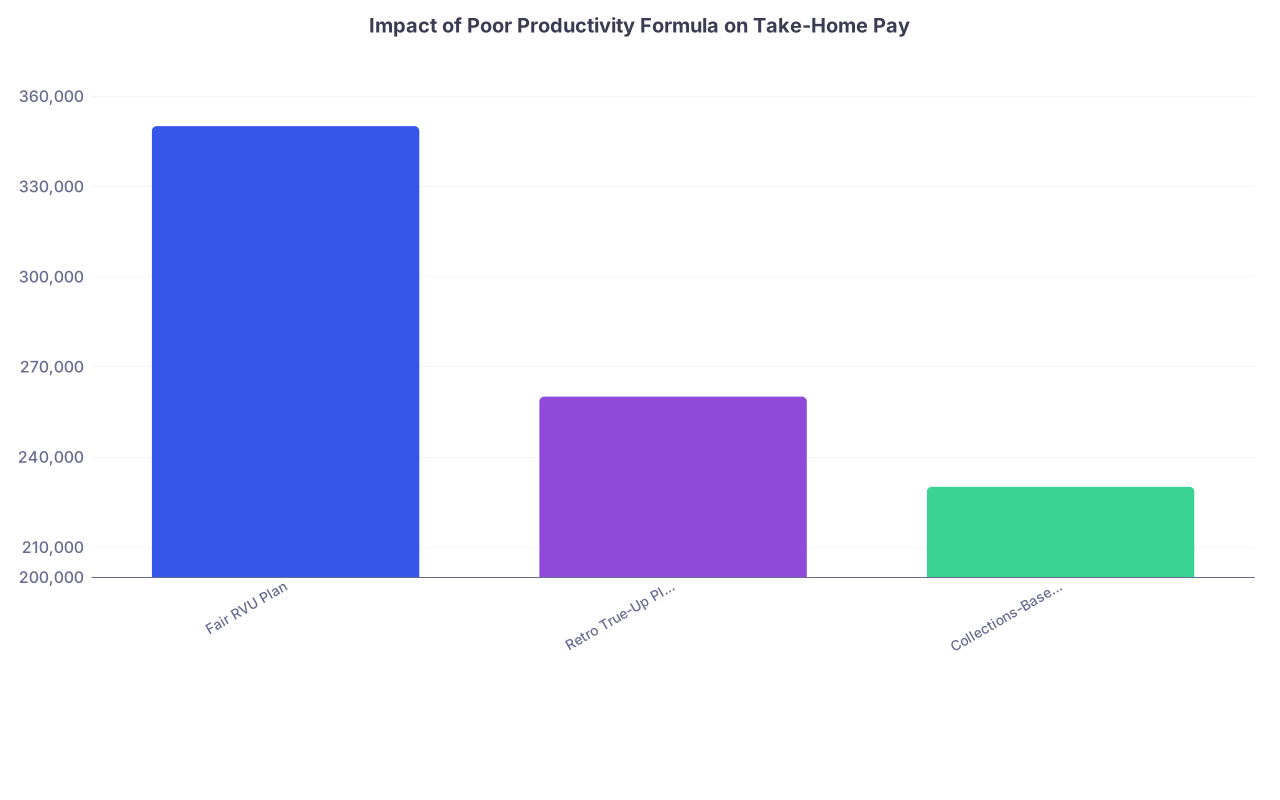
| Category | Value |
|---|---|
| Fair RVU Plan | 350000 |
| Retro True-Up Plan | 260000 |
| Collections-Based Plan | 230000 |
Red flags:
- Any mention of “true-up,” “reconciliation,” or “salary advance subject to adjustment based on productivity.”
- Collections-based comp in a setting where you don’t control billing, coding, or payer mix.
- Bonuses based on “net profit” or “department margin.” You won’t see the real numbers.
Avoid this trap:
- Prefer wRVU-based formulas over collections for employed positions.
- Refuse clauses that allow retroactive reduction or clawbacks. Compensation should only adjust going forward.
- Confirm how often they’ll measure productivity: quarterly is sane, annually with retroactive recalculation is not.
If the formula takes a paragraph to explain out loud and still sounds confusing, assume it’s bad for you.
3. Non-Compete Clauses That Turn a Move Into a Financial Hit
The quickest way to destroy your future earning power? Sign a non-compete so broad you can’t practice in a 50-mile radius for 2 years.
New attendings think: “I won’t leave. I like these people.”
Then:
- Leadership changes
- Volume dries up
- Your spouse’s job moves
- Or they simply treat you like a billable widget
Suddenly that non-compete becomes a six-figure problem.

| Step | Description |
|---|---|
| Step 1 | Unhappy at Job |
| Step 2 | Move to Better Job Nearby |
| Step 3 | Limited Options Same City |
| Step 4 | Must Relocate or Take Pay Cut |
| Step 5 | Non-compete? |
| Step 6 | Radius Reasonable? |
Red flags:
- Radius more than 10–15 miles in dense urban areas or 25–30 in rural.
- Time period longer than 1 year post-termination.
- Applies to any clinical services, not just your subspecialty.
- Applies even if they terminate you without cause.
Why this costs you six figures:
- You’re forced to either:
- Relocate (moving costs, spouse job loss, kids school disruption)
- Or take a lower-paid, non-ideal role outside of your expertise or preferred hospitals
- Recruiters know you’re boxed in and lowball accordingly.
Avoid this trap:
- Narrow the scope:
- Shorten duration to 6–12 months.
- Limit to your subspecialty.
- Tighten radius appropriate to actual catchment area.
- Demand non-compete waived if:
- They terminate you without cause
- Or you leave due to documented breach by employer
- At minimum, get carve-outs for moonlighting, telemedicine, remote consults.
If their response is, “Everyone signs this, it’s standard,” translate that to, “We expect people to be trapped.”
4. Call Pay and “Additional Duties” Clauses That Steal Your Time for Free
This one is sneaky. The base salary looks fine. RVU terms are ok. Then, buried in the middle:
“Physician agrees to take call, provide medical directorship services, participate in committees, and perform other duties as reasonably requested, which are deemed included in the base salary.”
You just agreed to:
- Unpaid extra call
- Unpaid admin hours
- Unpaid committee work
- Possibly unpaid moonlighting-esque coverage at affiliate locations
I watched a hospitalist sign this, assuming “reasonable” meant 7–8 calls/month. He ended up at 15 nights of pager call plus weekend rounding “because that’s how we all do it.” Nobody was getting paid extra.
Red flags:
- No specific language on:
- Number of call shifts
- Call pay rate (if any)
- Max number of weekends/holidays
- Catch-all “other duties as assigned” language with no cap.
- Medical director titles with no dedicated admin time or additional stipend spelled out.
Avoid this trap:
- Get specific:
- “Physician will take no more than X weekday and Y weekend call shifts per month.”
- “Additional call beyond that will be compensated at $___/shift.”
- For leadership/admin roles:
- Define FTE split (e.g., 0.8 clinical / 0.2 admin).
- Spell out stipend separately.
- If they say, “We can’t put that in writing,” that means they want flexibility—to your detriment.
Unlimited “reasonable” duties is how your effective hourly rate quietly drops into the resident range.
5. Tail Coverage and Malpractice Traps That Can Cost You Years of Savings
Tail coverage is boring until you get the bill.
New attendings sign contracts assuming, “Malpractice is covered.” Then they leave 3 years later and discover:
- The underlying policy was claims-made
- There’s no tail
- Their contract explicitly states they pay for tail on departure
That bill can easily be $40k–$150k+ depending on specialty and risk profile. I have literally seen OB/GYNs and surgeons stuck in toxic jobs because they couldn’t afford to leave.
Red flags:
- Language like “Employer will provide malpractice insurance” with no mention of:
- Claims-made vs occurrence
- Who pays for tail
- Clause stating: “Upon termination, physician shall be responsible for all costs related to extended reporting endorsement (tail).”
Avoid this trap:
- Require:
- Occurrence coverage or
- Employer-paid tail for any termination not “for cause”
- If they won’t budge, at minimum:
- Get shared cost (e.g., pro-rated based on years of service)
- Have clear written quotes from a broker on what tail will cost for you, right now
- Do not assume an $80k tail bill “won’t happen to you.” It happens all the time.
Tail can wipe out an entire year of aggressive saving. Or delay leaving a bad fit by years. Both are expensive.
6. Bonus and “Incentive” Language That Never Actually Pays Out
You will see bullet points like:
- “Up to $50,000 productivity bonus annually.”
- “Quality incentive up to 10% of salary.”
- “Sign-on bonus of $30,000.”
Here’s what they don’t tell you:
- “Up to” often means “never.”
- Quality metrics are vague, shifting, or depend on system-level factors you do not control.
- Productivity bonuses require numbers that current attendings never actually hit.
| Bonus Type | Promised Max | Actual Typical Payout |
|---|---|---|
| Productivity Bonus | $50,000 | $0–$15,000 |
| Quality Bonus | 10% salary | 0–3% salary |
| Sign-On Bonus | $30,000 | $30,000 (but with clawbacks) |
Red flags:
- Vague metrics: “productivity and quality as determined by employer policy.”
- No historical data available on what current physicians actually earn in bonuses.
- Sign-on bonus tied to repayment if you leave for any reason within 2–3 years.
Avoid this trap:
- Ask: “What did the average attending actually receive last year?”
- Get the bonus inputs in writing:
- RVU target, per-RVU bonus rate
- Exact quality measures, benchmarks, and weighting
- Treat sign-on bonus as a forgivable loan with a repayment schedule:
- Confirm how much you owe if you leave at 12, 18, 24, 30 months.
If they can’t or won’t show historical bonus payout data, assume the ceiling is marketing, not reality.
7. Termination and “For Cause” Definitions That Box You In
People look at salary and forget to ask: “How hard is it for them to fire me? And what happens if they do?”
You should be more worried about the back half of the contract than the front page.
Common nasty pattern:
- “Without cause” by either party with 60–90 days’ notice. Fine.
- But “for cause” is defined so broadly they can label almost anything as your fault and:
- Fire you immediately
- Avoid paying bonuses or tail
- Enforce repayment of sign-on and relocation
Examples of abusive “for cause” language:
- “Failure to maintain satisfactory relations with staff.”
- “Failure to meet productivity expectations, as determined by employer.”
- “Any conduct deemed detrimental to the best interests of the practice.”
That’s not “for cause.” That’s “whenever we feel like it.”
Why this costs you real money:
- You lose eligibility for bonuses, tail coverage, severance.
- You may trigger repayment obligations (sign-on, relocation, loan forgiveness).
- You lose leverage to contest termination or negotiate exit terms.
Avoid this trap:
- Tighten “for cause” to serious, objective events:
- Loss/restriction of license
- Exclusion from Medicare/Medicaid
- Felony conviction
- Gross misconduct with due process
- Ensure:
- Bonuses already earned are still payable
- Non-compete is limited or waived in certain termination scenarios
- Tail is employer-paid unless termination is for true, egregious cause
If “for cause” reads like a personality clause instead of a legal standard, fix it or walk.
8. Compensation “Revisions” and Unilateral Change Clauses
Buried near the end you’ll often see something like:
“Employer reserves the right to modify compensation structure, call schedule, and duties based on business needs upon 30 days’ notice.”
Translation: that tidy schedule and fair RVU rate? Optional. For them, not for you.
I’ve seen this play out:
- Group recruits aggressively with strong comp.
- Once they have enough warm bodies, they “align” comp to a “new system standard.” Translation: lower.
- The contract lets them do it without your consent.
Red flags:
- Compensation “subject to change per employer policy.”
- Duties/call/vacation subject to change “at employer’s discretion.”
- Auto-renewal terms that lock in their ability to change terms while making it a hassle for you to leave.
Why this drains your income:
- Your only real negotiation power is before you sign.
- If you give them unilateral modification rights, you basically gave that away.
- A 10–20% comp haircut a year or two in is brutal when you thought you were stable.
Avoid this trap:
- Tie modifications to mutual written agreement or at least:
- Clear, objective triggers (e.g., major regulatory change)
- Advance written notice with the right to terminate without penalty if you disagree
- Negotiate that significant comp changes open a new negotiation period or allow penalty-free departure without clawbacks.
If the contract says they can change your pay anytime and your only recourse is to “submit concerns,” that’s not a contract. That’s a wish list.
9. “Standard” Benefits That Are Quietly Below Market
Benefits are easy to brush off. Big mistake. Over a few years, bad benefits cost you six figures of net worth even if your salary looks ok.
Places folks get quietly hosed:
- 401(k)/403(b) match that’s:
- Tiny (e.g., 2% when market is 4–6%)
- Or delayed (“eligible after 1 year of service”)
- No disability insurance or a laughably low group policy
- Minimal CME allowance or unpaid CME days
- Weak health coverage with high premiums and deductibles

| Category | Value |
|---|---|
| Retirement Match | 20000 |
| Health Insurance Subsidy | 12000 |
| Disability Insurance | 5000 |
| CME + Licensing | 3000 |
Red flags:
- Retirement match that vests slowly (e.g., 5–6 year cliffs) when you might leave in 2–3.
- No short-term or long-term disability beyond statutory minimums.
- CME “reimbursement” that’s buried in admin approval hell and almost never paid in full.
Why this matters:
- A 4–5% better retirement match on a $350–$400k salary is easily $15k–$20k/year.
- Proper own-occupation disability can be the only thing between you and financial chaos.
- CME and licenses cost real money; paying them out of pocket adds up.
Avoid this trap:
- Ask for:
- Match of at least 4–6% if your market supports it.
- Immediate or rapid vesting (1–2 years).
- Confirmation of own-occupation disability coverage details.
- Put a dollar value on:
- Retirement match
- Health coverage subsidy
- CME/dues/licensing stipend
- Compare total compensation, not just salary.
The mistake is thinking “benefits are nice extras.” No. They’re part of your compensation. And they’re negotiable more often than they admit.
How to Not Be the Easy Target
A few non-negotiables if you don’t want to be the story other attendings tell in whisper tones in the physician lounge:
Get a physician contract attorney.
Not your cousin who does divorce law. Someone who reads physician employment agreements weekly. The fee (often $1–3k) is nothing compared to a single year of lost income.Refuse false urgency.
“We need this back in 72 hours” is a control move. Good employers expect you to review and negotiate.Talk to current and former physicians.
Ask specific questions:- “How does the bonus actually pay out?”
- “Anyone ever have to pay for tail?”
- “Have they changed the comp plan on you?”
- “How many left in the last 3 years and why?”
Do your own math. On paper.
Project 3 years: base + realistic bonus – tail risk – sign-on repayment risk – non-compete impact. If you don’t understand a clause, assume it benefits them, not you.
FAQ (Exactly 3 Questions)
1. Do I really need to pay a lawyer to review my first attending contract?
Yes. The hospital has lawyers. The group has lawyers. You’re the only one at the table without one if you skip this step. A good physician contract attorney will flag exactly the kinds of landmines we just walked through—non-compete scope, tail responsibility, vague “for cause,” hidden comp formulas. One missed clause can easily cost you $50k–$150k over a few years. Spending $1–3k once to avoid that is not optional if you’re serious about your financial future.
2. What’s the single most expensive clause new attendings overlook?
Tail coverage responsibility is probably the most quietly devastating, followed closely by a broad non-compete. Tail can hit you with a huge one-time bill right when you’re trying to leave a bad job. A non-compete can suppress your income for years by forcing relocation or accepting substandard offers. People obsess over a $10k difference in sign-on bonus and ignore a clause that can cost them $100k+ easily.
3. Is it normal to negotiate as a new grad, or will I look ungrateful and difficult?
It’s normal, and it’s expected by any mature organization. The idea that you should just be “grateful” and sign is exactly how employers prey on new grads. You’re not asking for anything unreasonable by pushing back on non-compete radius, tail coverage, bonus clarity, or call expectations. The right place will respect that you’re paying attention. The wrong place will be annoyed you read what they tried to sneak past you. That’s valuable information.
Key points to keep in your head as you stare at that contract PDF:
- The big salary number is bait; the real money is in the fine print.
- Non-competes, tail coverage, and vague “employer discretion” clauses are where six figures quietly disappear.
- If something isn’t crystal clear in writing, it does not exist—no matter what they “promise” you on the phone.