
What if you work like crazy for 20 years, never make partner, and then find out you’re permanently stuck making less than everyone else… forever?
That’s the fear, right?
You’re staring at these contracts with “partnership track” language and vague promises and you’re thinking:
“Okay but what if I’m the one who doesn’t make it? Am I screwing my entire lifetime earning potential right now?”
Let’s walk into the dark here, on purpose, and then back out of it.
1. What “Partner” Actually Means For Your Wallet (Not the Glossy Brochure Version)
Everyone throws around “partner” like it’s some magical word that automatically doubles your income and fixes your life.
Reality: it’s a specific financial structure. Not a personality trait. Not a moral badge.
Usually “partner” means some combo of:
- You’re an owner, not just an employee
- You share in profits (and sometimes losses)
- You may buy in (capital contribution or shares)
- You might get distributions on top of your base pay
- You have some say (in theory) over big decisions
And here’s the annoying part: the difference in income between associate vs partner is all over the map.
| Role | Salary Only | Total Comp (w/ bonus, RVUs, etc.) |
|---|---|---|
| Associate (low) | $220k | $250k |
| Associate (high) | $350k | $400k |
| Partner (low) | $350k | $450k |
| Partner (high) | $600k | $900k |
Sometimes partnership bumps you 20–30%.
Sometimes it’s 2x.
Sometimes it’s smoke and mirrors and a fancy title with minimal extra money.
The scary narrative in your head is usually this:
“If I don’t make partner, I’ll be stuck at $250k while my co-resident is at $800k, and over 20 years that’s millions and I’ve ruined my life.”
So let’s run that worst-case scenario with actual numbers in a second. But first: why you might not make partner.
And no, it’s not always because you “failed.”
2. Reasons People Don’t Make Partner (That Have Nothing To Do With Being Bad)
The anxious version of the story:
“If I don’t make partner, it’s because they secretly hate me, I’m not good enough, and I’ll be the one cut before the vote.”
Sometimes that happens. I’ve seen it. But a lot of the time, it’s way more boring and systemic.
Common reasons people don’t become partner:
The track is fake or constantly moving
You join as “partner track, 2–3 years”
Then it turns into “well, 5 years”
Then “we’re restructuring”
Translation: they like cheap labor and no ownership dilution.The buy-in is insane
“Congratulations, you’re eligible for partnership! Just write a check for $400,000.”
After you’ve barely dug out of med school debt. You’re allowed to say no. That’s not a personal failure.You don’t want the admin misery
With partnership comes meetings, HR garbage, reading 30-page payer contracts, partner politics. Some people take one step toward that and go, “Absolutely not.”Personal life reality
Kids. Illness. Caregiving. Fatigue. Burnout. You don’t have the appetite to grind an extra 10–20% to hit the RVU or productivity thresholds.The group is saturated
Older partners are hanging on (because the money is good and they don’t want to retire), and every new partner thins their slice. So suddenly… no one new makes partner.
None of those mean you’re incompetent, lazy, or doomed.
They mean the business model favors them, not you.
Still: how does that hit your lifetime income?
3. The Lifetime Income “Gap” If You Never Make Partner
Okay, let’s lean into the scary version and then dissect it.
Imagine two hospitalists in the same city:
- Dr. A – becomes partner at year 5
- Dr. B – never becomes partner, always an “employee” type role
Here’s a simplified, not-ridiculous example:
- Associate/employee comp: $275k/year
- Partner comp: $450k/year (salary + distributions)
Assume they both work 25 years clinically from the point they start that job.
| Scenario | Years at Lower Pay | Years at Higher Pay | Total 25-Year Income |
|---|---|---|---|
| Dr. A (Partner) | 5 years @ $275k | 20 years @ $450k | ~$9.25M |
| Dr. B (Non-Partner) | 25 years @ $275k | 0 years @ $450k | ~$6.88M |
Difference: about $2.37M over 25 years before taxes.
Looks huge. Your brain immediately screams:
“I’m going to be $2.4 MILLION BEHIND?!”
But here’s what that raw number hides:
- That’s total gross income, not what you keep
- Progressive taxes eat more of the high-income partner money
- Partner often means more risk, more unpaid admin time, more overhead games
- You can close a big chunk of that gap with investing and better job choices, even as a non-partner
Here’s the part nobody tells you: you don’t need partner money to end up “okay” or even “very comfortable” long-term. You need a decent income, some boundaries, and a half-sane savings rate.
Look at it this way:
If non-partner you makes $275k/year and saves 20% of gross (about $55k/year), invested at an average 5–7% real return over 25 years, you’re in multi-million net worth territory. Even if your colleague is richer on paper.
And if you bump that to 25–30% savings during good years? You’re absolutely fine. Like, “work optional in your 50s” fine.
The real danger isn’t “I never made partner.”
It’s “I spent all my non-partner income and saved nothing because I felt behind.”
4. The Tradeoffs You Don’t See From The Outside
Partnership doesn’t come free. Everyone focuses on the shiny part (bigger checks), and conveniently mumbles past the rest.
Here’s the stuff that gets glossed over:
Buy-in and debt risk
You might borrow $200k–$500k to buy into imaging centers, surgery centers, or the group itself. That can go very well. Or not.
If the market shifts, a hospital buys out the group, or reimbursements tank, that “equity” can magically shrink.Golden handcuffs
That higher partner income? It’s addictive. You expand your life to fit it—nicer house, private schools, luxury trips. Suddenly you need $600k/year.
Walking away gets a lot harder. Even when you’re miserable.Time cost
Being a real owner means you’re not just seeing patients. You’re in meetings about staffing, contract negotiations, quarterly performance.
Those hours don’t show up on your paycheck as “extra,” but you feel them in your body.Liability and responsibility
When something big goes wrong—compliance issues, billing problems, lawsuits—partners are in the blast radius more directly. Not always financially, but stress-wise, absolutely.
So yes, partners may end up with more lifetime income. But it’s not “more money for the same life.” It’s more money, more complexity, more risk.
For some people, that’s worth it. For others, not remotely.
5. What If I’m Already Realizing Partner Might Not Happen?
This is usually where the panic hits:
“I’m PGY-3 / early attending, and I’m realizing I might never be that rockstar partner type. Am I already behind? Do I need to brute force my way into some high-paying private group or I’m finished?”
No. You’re not finished. You’re early.
Here’s the part that calms the heart rate a bit:
Your financial life has way more levers than “partner vs not partner.”
You can:
- Pick a slightly higher-paying job even if it’s employed (academic vs community, hospital system vs smaller group, high-need region, etc.)
- Negotiate better from day one: sign-on bonus, RVU thresholds, relocation, retention bonuses
- Control lifestyle inflation: this one matters way more than your title
- Actually use retirement accounts aggressively (401k/403b, 457b, backdoor Roth IRA, HSA)
- Moonlight strategically early on if you have capacity (not forever, just enough to jump-start savings)
A non-partner making $325k who saves 25% beats a distracted partner making $500k who saves 5% and is on the edge of burnout.
I’ve seen that in real life. More than once.
And you’re allowed to pivot. If at 5 years you see your “partnership track” is a lie, you can walk. You’re not chained to that one fork in the road.
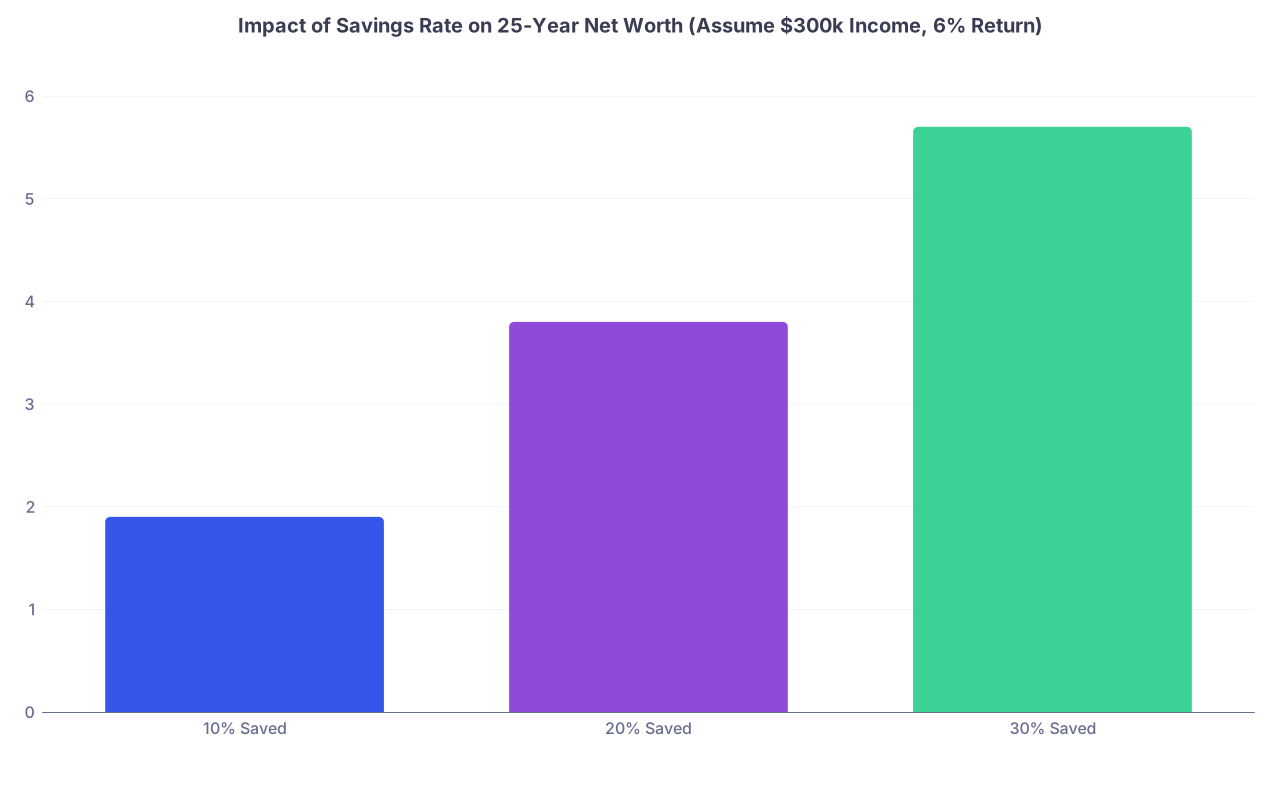
| Category | Value |
|---|---|
| 10% Saved | 1.9 |
| 20% Saved | 3.8 |
| 30% Saved | 5.7 |
(Values approximate in millions of dollars at 25 years)
This is the part your brain forgets when it’s spiraling over “partner” status:
Saving and investing a steady percentage matters more than maximizing every last dollar of income.
6. Hidden Upsides Of Never Being “Partner”
This feels like heresy in certain circles, but I’m going to say it: there are real upsides to never making partner.
You might not believe this now, but you might later.
Some genuine advantages of staying non-partner / employed:
You can walk away easier
Don’t like the hospital? New CEO ruins everything? You leave. No drama over buyout formulas or selling shares or clawbacks.Less admin burden
No sitting in 3-hour partner meetings about parking policies and call schedules and cost-cutting on nursing staff.Cleaner mental separation
When the shift ends, you’re done. You’re not thinking about the group’s debt ratio or last quarter’s EBITDA.Easier to change careers or downshift
Want to go part-time, locums, telemed, admin, or non-clinical? It’s less complicated when you’re not entangled in ownership structures.
For someone already prone to worst-case scenario thinking and anxiety (hi, us), sometimes adding more complexity and responsibility in exchange for money you could partially replicate another way… doesn’t actually make your real life better.

7. How To Protect Your Lifetime Income Even If You Never Make Partner
Let’s talk about what you can actually do so this doesn’t become a self-fulfilling nightmare.
Get brutally clear on numbers, not vibes
Look at actual offers or MGMA/AMGA data. What do associates vs partners in your specialty and region really make? Is it 20% difference or 100%? Don’t fill in blanks with fear.Decide what you’re optimizing for
Is your #1 goal maximum possible money? Or is it stable, good income plus sanity, time, flexibility? Be honest. “Everything” is not an option.Build an early savings habit like your hair’s on fire
The first 5–10 years of attending life are critical. If you’re not going to chase partner money, chase savings rate instead. Automate retirement contributions, pay down high-interest debt, don’t go house-drunk in year one.Keep optionality high
Don’t get stuck in a job that underpays and blocks your growth just because they dangle “maybe partner one day” language. If they’re vague, that’s a data point. Keep your CV up to date. Talk to recruiters. Know your market value.Don’t tie your self-worth to a title
There are partners who are clinically mediocre and associates who are absolute rockstars. The universe doesn’t actually care what your contract says.
If you never make partner and you’ve:
- Maintained a strong savings rate
- Avoided massive lifestyle creep
- Stayed flexible with jobs and location
- Used your retirement tools
You are not financially doomed. You’re probably in better shape than a surprising number of “big money” partners who never thought past next quarter’s distribution.

| Step | Description |
|---|---|
| Step 1 | Residency End |
| Step 2 | Join Private Group |
| Step 3 | Employed Role |
| Step 4 | Higher Income + More Risk |
| Step 5 | Stable Income Associate |
| Step 6 | Stable Income Employed |
| Step 7 | High Savings or Lifestyle Creep |
| Step 8 | Can Negotiate or Change Jobs |
| Step 9 | Focus on Savings and Flexibility |
| Step 10 | Chase Partnership? |
| Step 11 | Become Partner? |
FAQ (Exactly 4 Questions)
1. If I never make partner, will I always be way behind my peers financially?
Not automatically. Yes, over 20–25 years, a high-earning partner can out-earn you by millions on paper. But what actually matters is what each of you keeps and invests. A non-partner who lives on $180–200k and steadily saves/invests $60–80k/year will likely end up in very solid shape—often better than a partner making $600k and saving almost nothing. Income is one input. Behavior and choices are the compounding force.
2. Is it stupid to join a “partner track” job if I’m scared I won’t make partner?
No. What’s stupid is joining one without clear terms. You should know: expected timeline, typical percentages of people who actually make partner, buy-in amount, and how compensation changes. If they dodge specifics or act offended you’re asking, that’s your red flag. It’s perfectly rational to join a partner-track job and mentally treat it as a good associate role unless and until they prove the partnership is real and worthwhile.
3. Should I force myself to pursue partnership just for the money, even if I don’t want the extra responsibility?
I wouldn’t. Forcing yourself into more stress, meetings, risk, and admin work purely out of fear is a good recipe for burnout. Ask: if partnership gave me zero status points and was invisible on my CV, would the trade (more money + more responsibility) still be worth it? If the answer is no, then it’s okay to walk away from that path and instead focus on optimizing an employed/associate career plus strong personal finances.
4. When is it actually rational to walk away from a partnership track?
When the math, transparency, and culture don’t line up. Examples: the track keeps getting extended with no clear reason; buy-in costs jump dramatically; existing partners are unhappy or cagey; your call burden or admin load skyrockets without proportional pay; or you realize your health, family, or sanity is paying the price. At that point, leaving isn’t failure. It’s choosing a different financial strategy: earning a solid attending income elsewhere and using your own savings and investments as your “partnership.”
Key points:
You don’t need to make partner to have a strong lifetime income and real financial security.
Partnership can increase earnings, but it brings risk, complexity, and tradeoffs that aren’t automatically “better.”
Your savings rate, lifestyle choices, and willingness to change jobs matter more than a single word in your job title.