
The biggest lie in physician contracts is that “everything is standard and non-negotiable.” It is not. But what is negotiable is not what most residents and new attendings think.
Let me walk you through what actually moves and what is basically theater: signing bonuses, relocation assistance, and loan repayment. I have sat in the room with CMOs, CFOs, practice owners, and physician recruiters while they decide what to offer and what they’re secretly willing to bend on. The public story and the real story are not the same.
The Truth About Signing Bonuses
Here’s the part nobody puts in the brochure: your signing bonus is mostly a recruiting tool, not a reward for your brilliance. It exists because somebody on the business side is worried they will not fill a clinical need in time, and that has a dollar value.
The more pain they feel about that vacancy, the more negotiable your signing bonus becomes.
How signing bonuses are actually set
Most hospitals and large groups don’t pull numbers out of thin air. They usually have a “comp grid” or “recruitment incentive” policy that looks something like this behind the scenes:
| Candidate Type | Common Range |
|---|---|
| Primary Care, abundant area | $10k – $20k |
| Primary Care, short supply | $20k – $40k |
| Hospitalist, common market | $15k – $25k |
| Surgical subspecialty | $30k – $75k |
| High-demand specialty | $50k – $100k+ |
Those ranges don’t show up in your contract. But HR and the recruiter have them on a spreadsheet. The program director doesn’t. Your future partners probably don’t. The people with actual power over that number are usually the CMO, CFO, and sometimes a regional VP.
The default play: recruiter offers you the lower half of that internal range and calls it “standard.”
The real play: if they’re feeling time pressure (retirement, coverage gap, service line launch, competitor hiring nearby), they will absolutely creep toward the top of that range for the right candidate. Especially if you present like someone who will actually show up, stay, and produce.
What actually moves in signing bonus negotiations
A few hard truths:
You are almost never going to double a signing bonus. If they open at $25k, you’re not getting $50k. But going from $25k to $35k? Very possible if you have leverage or competitors.
The structure is often more negotiable than the headline number. Timing, clawback terms, and how it interacts with your tail coverage or non-compete can matter more than an extra $5k.
“This is our standard bonus” usually means “This is what we give people who do not negotiate.”
What I’ve watched get changed in real time:
- Bonus raised by $5k–$20k when candidate had another offer in hand with documentation.
- Bonus split into two payments (at signing and at start) so the physician could cover relocation and board fees.
- Clawback shortened from 3 years to 2 years of service.
- A partial prorated repayment instead of all-or-nothing.
I was once in a meeting where a hospitalist candidate asked for more base pay. The CFO shut that down immediately—base salary hit long-term budget and RVU alignment. Then she looked at the recruiter and said, verbatim: “Just make the sign-on bigger, it’s a one-time hit.” Candidate walked away with an extra $15k signing bonus. Same RVU terms. Same salary. That’s how they think.
The clawback landmine
This is where many new attendings get burned. The bonus looks nice until you realize it’s just a loan disguised as a gift.
Common patterns:
- 2–3 year commitment.
- Straight-line forgiveness (e.g., 1/36 of the bonus forgiven each month for 3 years).
- Full repayment if you are terminated “for cause” or resign early.
Your negotiating priorities here:
- Shorten the commitment period (3 years → 2 years).
- Ensure prorated forgiveness (no “all or nothing” traps).
- Clarify what counts as “for cause” and “without cause.”
You should be much more aggressive negotiating clawback terms than chasing an extra $5k. I’ve seen people trapped in miserable jobs because they “couldn’t afford” to repay a $25k bonus with brutal clawback language. That is not a win.
Relocation Assistance: The Most Under-Negotiated Money on the Table
Relocation is where a lot of physicians leave thousands of dollars behind because they think it’s petty or “not worth asking.” That’s naïve. Relocation comes from a different budget line than base salary and is often easier for admin to fatten quietly.
And unlike base pay, nobody in the C-suite is benchmarking your moving costs to MGMA.
How relocation really works behind the curtain
Most organizations have a couple of standard buckets:
- Flat relocation stipend (e.g., $10k taxable payment).
- Reimbursable expenses up to a cap.
- Third-party relocation company (which often overcharges the system, by the way).
What they do not tell you: they usually have an internal max, which is often higher than what they first offer.
I’ve seen internal policies like:
- “Standard relocation up to $10k; director can approve up to $15k; VP up to $20k with justification.”
- “Physicians >1000 miles and with family may qualify for enhanced relocation up to $20k.”
Those are real lines from internal docs I’ve read.
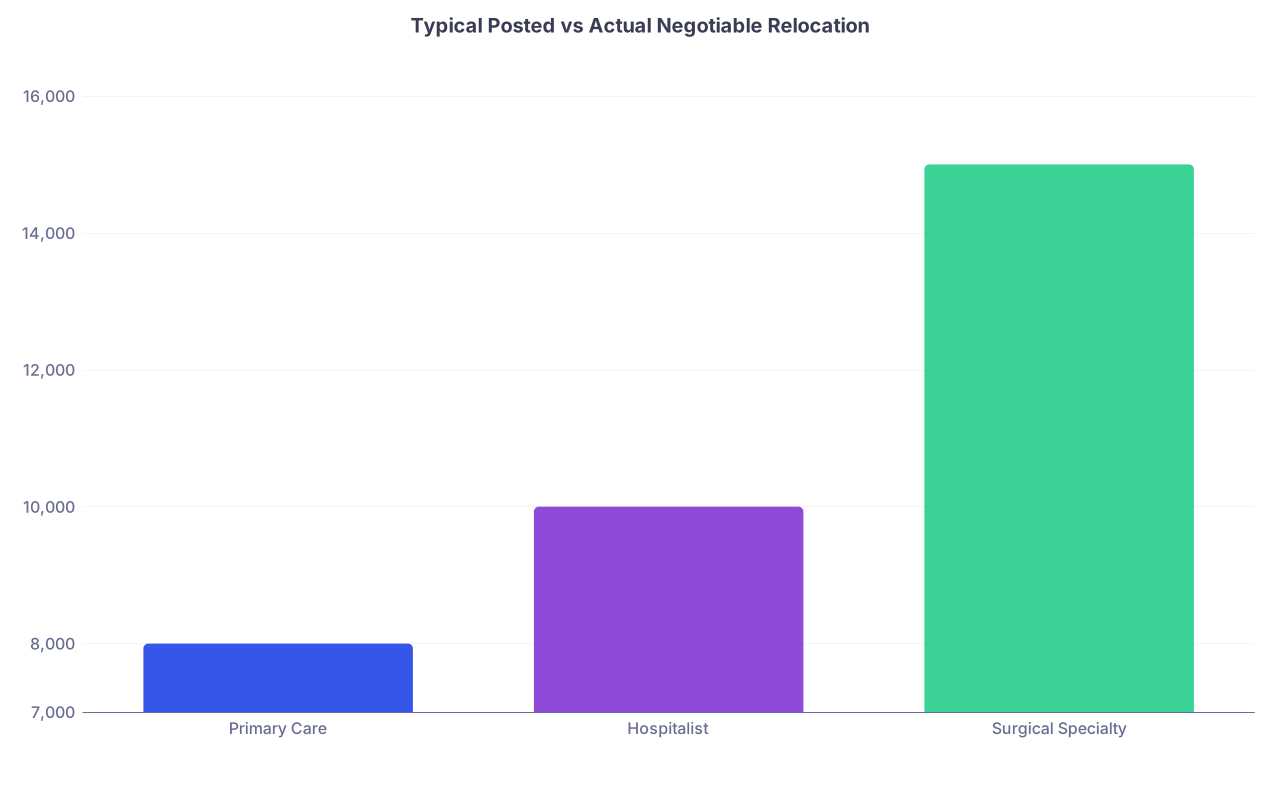
| Category | Value |
|---|---|
| Primary Care | 8000 |
| Hospitalist | 10000 |
| Surgical Specialty | 15000 |
(The “actual negotiable” max often runs 25–50% higher than the posted default, especially for hard-to-fill roles.)
What is usually negotiable in relocation
You can often move:
- The cap. Getting from $8k to $12k–$15k is common if you’re moving cross-country or with a family.
- The format. Turning a reimbursement model into a lump sum payment so you are not floating costs on your credit card.
- The timeline. Getting funds before your actual move rather than months afterward.
- Extra benefits: temporary housing for 1–3 months, extended hotel stay, rental car, help with lease break fees.
I watched a candidate quietly pick up an extra $7,500 just by sending a detailed relocation budget: movers’ quote, car shipping, lease break, travel for spouse, short-term housing. The recruiter went to the VP with the email and said, “We’re short by about $7k to get him here.” VP: “Fine, approve it. We need him by July.”
The physicians who get crushed are the ones who:
- Accept the first number presented.
- Don’t spell out actual costs.
- Are afraid to ask for short-term housing help because it “sounds greedy.”
Beware the tax and reimbursement traps
Two inside points people miss:
Taxes: Since 2018, relocation assistance is usually taxable to you. A $10k relocation stipend might net you ~$6–7k after taxes. You can ask for a gross-up so you net a certain amount. I’ve seen contracts where they agree to “gross up relocation assistance so physician nets $10,000.”
Reimbursement-only policies: Admin loves these because most people never submit everything. They count on your disorganization. If you’re stuck with reimbursement, clarify:
- What counts as eligible (temporary housing, storage, lease break?).
- The submission deadline.
- Whether they’ll front some costs as an advance.
You do not impress anyone by silently eating thousands of dollars in un-reimbursed relocation because you “didn’t want to bother them.” You just make their finance people happy.
Loan Repayment: The Most Misunderstood “Benefit”
Loan repayment is where a lot of physicians get hypnotized and stop thinking clearly. A $100,000 loan repayment commitment looks huge on paper. But the details are where people get trapped or misled.
Here’s the inside reality: loan repayment usually functions as a retention tool and golden handcuff. It’s almost always structured to keep you put.
Two very different “loan repayment” animals
There are two main categories, and mixing them up is how you get burned.
True loan forgiveness / repayment
Money goes directly to your lender or as taxable income with clear forgiveness terms. Usually tied to years of service. E.g., “$20k/year for 5 years toward qualified educational loans.”Disguised signing bonus with loan language
They give you a lump sum labeled as “loan repayment” with the exact same clawback as a signing bonus. Money may not even be required to go to loans.
Recruiters will talk about both as “we have a generous loan repayment program.” Those are not the same thing.
I’ve seen fake “loan repayment” that was literally:
- One $30k payment at start, taxed like a bonus, with 3-year full clawback.
- No requirement that it be used for loans.
- Zero separate forgiveness schedule; it was just the sign-on bonus under a different label.
What actually moves in loan repayment negotiations
This is where systems are more rigid than with sign-on or relocation. Loan repayment often interacts with:
- Stark/Anti-kickback rules (especially with hospital-employed positions).
- Institutional policy tied to recruitment incentives.
- External programs (NHSC, state programs, etc.).
But you still have room to maneuver.
Things I’ve watched get changed:
- Annual amount increased (e.g., $15k/year → $20k/year).
- Total years extended (3 → 5), which can add up quietly.
- Combining employer repayment with eligibility for federal or state programs.
- Making the benefit front-loaded (more in early years when it actually matters).
What you will almost never get:
- Some wild, one-off, six-figure lump-sum forgiveness that violates their policy. The compliance people kill that instantly.
If you’re going to pick a battle here, pick structure and timing, not just raw total.
Tax treatment and PSLF traps
Another detail admin rarely explains clearly:
- Most employer loan repayment is taxable income to you. They might or might not gross it up. So that “$20k/year” is effectively more like $12k–$15k in your pocket unless they explicitly say otherwise.
- If you are pursuing Public Service Loan Forgiveness (PSLF), big lump-sum payments from them might not be nearly as valuable as they look. You could be better off with higher salary and smaller payments while counting qualifying months.
From the system side, I’ve watched finance people say, “We’ll keep their base a bit lower but sweeten the loan repayment—residents love that.” Translation: they’re using a shiny benefit to distract you from lifetime earnings.
You need to run the math on:
- Higher salary with minimal loan repayment, vs
- Lower salary and aggressive loan repayment.
Often, over a 5–10 year horizon, the first option wins, especially if you’re not fully committed to staying for the entire retention period.
What’s Really Negotiable vs. What’s Mostly Fixed
Let me be blunt: there are tiers to what moves and what doesn’t.
From the admin side, here’s roughly how it looks for most hospital-employed jobs:
| Component | Typical Flexibility |
|---|---|
| Base Salary | Low–Moderate |
| RVU Targets/Rates | Low |
| Signing Bonus | Moderate–High |
| Relocation | High |
| Loan Repayment | Low–Moderate |
Group practice and private equity–backed outfits play similar games but may hide it more in productivity or equity language. But the hierarchy holds: one-time money is easier to move than ongoing compensation.
If you come in guns blazing demanding a massive base-salary jump, admin will dig in. If you say, “Base seems reasonable, but I’ll need more support around transition costs and loans,” they hear: inexpensive long-term, easy short-term concession.
You win by understanding which asks are high-friction vs low-friction from their perspective.
How to Actually Negotiate This Stuff (Without Being “That” Candidate)
Here’s the part you will not hear on residency noon conference: the people on the hiring side are rating you on two hidden scales:
- Clinical value (can you do the job we need done).
- Hassle factor (are you going to be a constant problem).
You want to push on the money while staying in the “low hassle, high value” quadrant.
The sequence that actually works
The physicians who do best usually follow a rough script like this:
Express genuine interest in the job first.
“I like the clinical mix and the team; I think this could be a good fit.”Ask for the full compensation picture in writing.
Signing bonus, relocation, loan repayment, CME, call pay, etc. Get it all.Do your homework on the market.
MGMA data if you have it, online surveys, what co-fellows are getting. You need a frame of reference.Pick 2–3 priorities instead of fighting on 10 fronts.
For many new attendings, that’s:- Relocation and signing bonus structure.
- Clawback/commitment periods.
- Reasonable loan repayment structure.
Make one consolidated, professional ask.
Not piecemeal nickel-and-diming. Something like:“I’m very interested and ready to move forward if we can address three areas:
– Increase signing bonus from $25k to $35k to help with a cross-country family move.
– Provide relocation up to $15k as a lump sum prior to relocation.
– Adjust the signing bonus clawback to a 2-year term with prorated forgiveness.”
That’s the sort of email that actually goes to the CMO/CFO with a decent chance of a yes or a partial yes.

| Step | Description |
|---|---|
| Step 1 | Receive Offer |
| Step 2 | Request Full Details In Writing |
| Step 3 | Research Market Data |
| Step 4 | Identify Top 2-3 Priorities |
| Step 5 | Craft Consolidated Counter |
| Step 6 | Accept Offer |
| Step 7 | Minor Revisions or Decide |
| Step 8 | Walk Away or Deprioritize |
| Step 9 | Admin Response |
The “multiple offers” reality
Nothing moves numbers faster than credible alternatives. Recruiters know when you’re bluffing. They also know when you actually have another offer in a nearby market with a better package.
I’ve watched exact conversations like this in offices:
- Recruiter: “She has another offer in the region at $30k sign-on and $15k relocation. We’re at $20k and $8k.”
- CMO: “She any good?”
- Recruiter: “Yes, strong references.”
- CMO: “Match it. Tell her that’s our best and final.”
No lengthy debate. They just did not want to reopen a search.
If you walk in with zero other options lined up and tell them “I need $50k more in loan repayment,” they know you are negotiating from fear. They will not stretch far for you.
Red Flags and Non-Negotiables You Should Respect
I’ll leave you with some internal lines you do not see, but they absolutely exist.
Things systems almost never budge on:
- Anything that looks like illegal inducement for referrals (yes, Stark and anti-kickback laws still haunt them).
- Wild custom RVU deals outside their normal range.
- Completely waiving clawbacks with huge bonuses.
- “Side letters” that contradict official policy in obvious ways.
Big red flags on your side:
- Loan repayment or bonus structures that require full payback if they terminate you without cause.
- Relocation or sign-on language that doesn’t spell out the forgiveness schedule.
- “Discretionary” benefits that are not spelled out in the contract.
If an admin ever says, “Don’t worry, that’s just our standard language, we’d never enforce it,” assume the opposite. You negotiate as if the strictest interpretation will be used by the most hostile future administrator, not the nice recruiter you like right now.
FAQs
1. Is it better to push for higher base salary or a bigger signing bonus?
If you plan to stay somewhere more than 2–3 years, higher base salary almost always wins financially over time. However, hospitals are far more flexible on one-time money than permanent base. A smart play is to get your base into a fair market range and then push signing bonus and relocation harder, instead of obsessing over every last dollar of base.
2. How much can I realistically move a signing bonus?
If you’re in a moderately competitive specialty with at least one other offer, moving the signing bonus by 20–50% is not unusual. Going from $20k to $30k or $25k to $35k is very realistic. Doubling it is rare unless you are in a truly desperate market or a very high-demand subspecialty.
3. Can I negotiate both relocation and signing bonus, or will that annoy them?
You absolutely can and should address both, as long as you present it as a package and not a list of endless demands. Admin understands that moving is expensive and painful; framing it as “I need enough support to make this transition possible for my family” usually lands better than “I want more money.”
4. Is employer loan repayment always a good deal?
No. Sometimes it’s mediocre math wrapped in shiny packaging. You need to factor in taxes, the commitment period, and what it does to your flexibility. In many cases, a higher base salary plus your own aggressive repayment or PSLF strategy is better than locking into a long retention deal for modest annual loan payments.
5. When should I bring in a contract attorney, and will that hurt negotiations?
You should have a physician-focused contract attorney review any serious offer before you sign, especially if there are complicated clawbacks, non-competes, or loan repayment clauses. Most reputable systems are used to this and do not take it personally. The only people who get annoyed are the ones hoping you would not notice what’s buried in the fine print.
You’re not just trying to “get a job.” You’re setting the financial and legal foundation of the next several years of your life. Once you understand what’s truly negotiable—and how administrators actually think—you stop acting like a desperate trainee and start behaving like what you are: revenue they are trying to recruit and retain.
With that mindset in place, you’re ready to tackle the deeper game: how your productivity, RVUs, and contract structure will quietly shape your real income. But that’s a story for another day.