
You are sitting in a hospital conference room at 6:45 p.m. A recruiter just slid a three-page “Compensation Summary” across the table. One offer is per-shift. Another is per-visit. A third is salary with RVU bonus and “quality incentives.” The numbers look big. The details look vague. And you know this is where physicians get burned.
Let me break this down specifically: you are comparing payment models, not just dollar amounts. Per-shift, per-visit, and salary+bonus are three very different ways of slicing the same revenue pie. Each one shifts risk, workload, and upside in a predictable way. If you understand the mechanics, you can see through the sales pitch in about 60 seconds.
We will go through each model, then zoom into the legal/contract pieces that actually matter.
The Core Trade-off: Risk vs Stability vs Upside
At a high level:
- Per-shift = stability of payment per block of time; risk on your workload and pace.
- Per-visit = pay tied tightly to volume; you take much of the productivity risk.
- Salary + bonus = stability with a performance overlay; risk gets hidden in the bonus formula.
If you want a mental shortcut:
- Conservative, early-career, or burned-out? Per-shift or solid base salary.
- Hungry for volume and control? Per-visit or RVU-heavy.
- Academic or integrated system? Expect salary + fuzzy “incentives.”
Now let us go model by model.
Per-Shift Models: You Sell Time, Not Units
Per-shift pay means you are compensated a fixed amount for a defined time block. Common in:
- Emergency medicine
- Hospitalist medicine
- Anesthesia (especially call)
- Some telemedicine setups
- Urgent care (often hybrid shift + visit)
Think: “$2,500 per 12-hour shift” or “$220/hour, minimum 10 hours.”
How Per-Shift Actually Works
Despite the sales pitch, three details decide whether this model is good or miserable:
- How they define a “shift”
- How they handle “extra” work outside that shift
- How they adjust pay relative to volume and acuity
If the contract simply says: “Physician will be paid $2,400 per 12-hour shift” and nothing else, expect:
- Mission creep on start/stop time (“We need you here 30 minutes early for sign-out”)
- High volume problems (no extra pay, but more patients)
- Add-on responsibilities (admissions paperwork, extra teaching) quietly folded into the shift
The more vague the shift definition, the more leverage the employer has.
Common Pitfalls I See
I have watched people sign these without asking basic questions. Then regret it.
Undefined end-of-shift expectations
Classic: “You stay until all your charts are done.”
Translation: your 7–7 shift becomes 7–8:30 with no extra pay. Over a year, that is hundreds of unpaid hours.No volume protection
If volume spikes from 1.8 to 2.4 patients/hour and your pay is fixed, your effective per-patient revenue drops. You are doing more work for the same money, indefinitely.Hidden call or admin time
“Occasional phone calls” after shift, “committee work,” “QAPI meetings” – all buried as “part of regular duties” without extra pay. That is where your hourly rate gets quietly diluted.
Legal / Contract Terms to Look For
You want specifics in writing. Not “we usually” or “we aim to.”
Defined shift length and boundaries
“7:00 a.m. to 7:00 p.m., with up to 30 minutes unpaid sign-out time per shift” is clear. “12 hours” with no times is not.Documentation expectations
“All documentation related to patients seen during the shift shall be completed within the shift period, except rare exceptions” is what you want. If they expect routine unpaid charting, you are donating labor.Volume-based adjustments
Any mention of “productivity adjustments,” “rate review,” or “bonus based on volume” needs numbers: when, how, and how calculated.Call coverage
Is in-house call paid per shift? Home call paid per night? Or “included in base compensation”? The latter is a red flag.
Where Per-Shift Shines
Per-shift is strong when:
- Volume is highly variable or unpredictable (ED, small hospitalist programs).
- You value time control over max earnings.
- You want less pressure to churn patients.
You are basically selling a block of your life for a fixed price. If the block is well-defined and reasonably protected from creep, this is one of the sanest models for work-life balance.
Per-Visit Models: You Live and Die by Volume
Per-visit (or per-encounter) is exactly what it sounds like: you are paid a flat amount per patient seen. Typical in:
- Urgent care
- Telemedicine
- Some outpatient specialty clinics and walk-ins
- Occupational medicine
Think: “$10 per telehealth visit,” “$25 per urgent care visit,” “$40 per new patient, $30 per follow-up.”
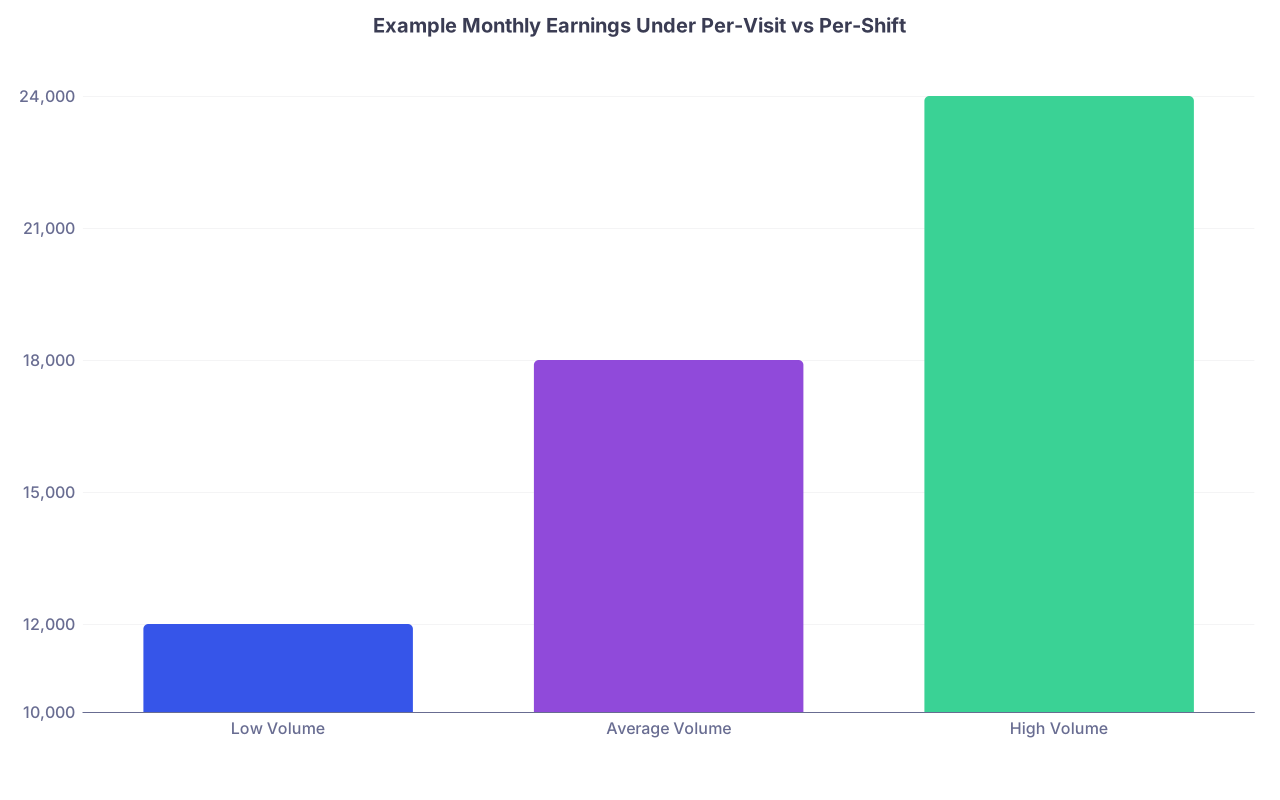
| Category | Value |
|---|---|
| Low Volume | 12000 |
| Average Volume | 18000 |
| High Volume | 24000 |
That chart assumes a per-visit model with volume swings. Same hours worked, different pay. That is the point: you carry the volume risk.
Mechanics of Per-Visit Pay
You get paid X dollars per “visit” or “encounter.” The contract then defines what counts as a visit:
- Does a no-show count? (Usually no.)
- Does a cancelled telehealth within 5 minutes count? Depends on platform.
- Do complex visits (multi-complaint, procedures) pay the same as simple ones?
Often they will throw in a small base guarantee (“$120/hour minimum”) plus per-visit above a baseline. That is effectively a per-visit system with a weak floor.
The Real Issues
This model creates very specific incentives and problems:
Speed bias
The faster you move, the more you earn. There is always a temptation to cut corners, see marginal complaints, or downshift on complexity.Acuity mismatch
If a chest pain workup pays the same as a simple UTI, you are underpaid for cognitive and risk-heavy work. Excellent way to burn out clinicians who care about quality.Employer gaming on volume
I have seen urgent care operators pack the schedule with 10-minute slots because “the docs are paid per visit, they will love it.” Until the day you are seeing 5–6 patients/hour and doing your own callbacks.No control over distribution
If the schedule is owned by the company, they decide how patients are routed, how much support you have, and what gets squeezed into your template.
Contract Language That Matters
On per-visit contracts, I look for:
Clear definition of "visit"
Does an asynchronous e-visit count? A refill-only interaction? Post-op wound check? Get it defined.Tiered payments
Are there higher fees for complex visits, procedures, after-hours, weekends? Or is it flat? Flat is worse for you if case mix is heavy.Minimum guarantees
Written minimum: “Physician shall be guaranteed $X per hour for any scheduled clinical time, regardless of visit volume.” Without that, you can sit for two dead hours and earn nothing.Visit ownership
If a patient is double-booked or mis-scheduled, do you get paid? How about if the system crashes mid-day?Non-compete and platform ownership
Telemedicine frequently buries wide non-competes: “Physician shall not provide similar services within X miles / platforms.” Combine that with per-visit and they lock your volume while holding pay rates flat.
Where Per-Visit Makes Sense
This model can be high-upside if:
- You have a high-volume, low-acuity environment.
- You have strong MA/NP/PA support.
- You trust the scheduler and leadership.
- You like direct line-of-sight between your effort and your paycheck.
For a young, fast urgent care doc with good systems, per-visit can beat salary. For complex internal medicine in an underserved clinic? It is often abusive.
Salary + Bonus Models: The “Standard” Hospital Offer
Now to the most common: a base salary plus some kind of bonus or incentive.
You see versions of this in:
- Large health systems
- Academic centers
- Many multi-specialty groups
- Employed primary care and specialties
Typical layout:
- Base salary: $240,000 (for FM or IM, for example)
- RVU bonus: Paid above 4,500 wRVUs at $40 per wRVU
- Quality bonus: Up to $10,000 based on metrics
- Maybe a signing bonus and relocation
The problem is not the idea. The problem is the opacity. People sign contracts with big, round “total potential compensation” numbers that they will never actually see.
The RVU Trap (and When It Is Fair)
Work RVUs (wRVUs) are the most common productivity metric. You are paid per “unit” of work based on CPT codes.
Basic structure:
- Base salary covers a certain RVU level (explicitly or implicitly).
- Above that, you are paid a set dollar per RVU.
- Sometimes there is a phase-in period (first year salary, second year RVU-based, etc.).
An example you might see:
- Year 1: Guarantee $260,000, no RVU target.
- Year 2: Base $230,000, target 5,000 wRVUs, bonus at $45 per wRVU above target.
- Year 3+: Fully RVU-based with lower base.
On paper it looks like a gentle ramp. In reality, you need to know whether that 5,000 wRVU target is realistic for the clinic, support level, and payer mix.
| Specialty | Contract Target wRVUs | Typical Realistic Range |
|---|---|---|
| Outpatient FM | 5,000–6,000 | 4,000–5,500 |
| Outpatient Cards | 8,000–10,000 | 7,000–9,000 |
| General Surgery | 9,000–11,000 | 8,000–10,000 |
| Hospitalist (7on) | 4,000–5,000 | 3,500–4,500 |
| EM (1.7–2.2 pt/hr) | 4,500–6,000 | 4,000–5,500 |
If the target is at or above the 75th percentile without 75th percentile support, they are shifting a lot of risk onto you under the banner of “productivity alignment.”
Quality and “Value” Bonuses: Mostly Window Dressing
You will see another line: “Up to $20,000 in quality incentives.”
Sounds great. Here is what it usually actually means:
- Many small, binary metrics: mammography uptake, A1c control, portal usage, etc.
- At least some metrics depend more on system-level issues than your individual performance.
- First couple of years: system pays out a decent chunk to look “competitive.”
- Later years: thresholds ratchet up, or metrics change; payout shrinks.
You want specific metric lists and last year’s actual payouts if you can get them. If they dodge that question, assume theoretical only.
How Salary + Bonus Shifts Risk
Compared to per-shift / per-visit:
- The base salary gives you stability.
- The RVU threshold is where they claw back risk. If they set it too high, you are effectively on per-RVU piecework but without per-visit-style transparency.
- Quality metrics shift population health and cost pressures onto you, sometimes without the tools to change them.
Hospitals like this model because:
- It looks compliant from a Stark/AKS perspective (FMV, wRVU based).
- It lets them advertise high “total comp” numbers without guaranteeing them.
- They can quietly tighten bonuses and targets in later contract cycles.
Key Contract Items to Nail Down
For salary + bonus, you should not sign without clarity on:
Exact RVU conversion rate and threshold
“$50 per wRVU above 4,000” is clear. “Competitive RVU-based productivity bonus” is garbage language.How RVUs are counted
Are advanced practice provider (APP) RVUs shared? Who owns procedures? What about split/shared visits?Ramp-up and reset rules
Some contracts reset RVU totals annually, others use rolling periods. Some give ramp-up adjustment in year 1 then yank it.Quality metric definitions and scoring
You want a schedule or appendix listing measures, weights, thresholds, and how often they are revised.Changes to the compensation plan
Many contracts say: “Compensation plan may be modified annually at employer discretion.” That is where they can quietly shift dollars from base to bonus, or drop the RVU rate.
Comparing Models Directly: Money, Control, and Burnout Risk
Let us compare across three axes: income predictability, workload control, and burnout exposure.
| Factor | Per-Shift | Per-Visit | Salary + Bonus |
|---|---|---|---|
| Income Predictability | High per hour/shift | Low–Medium | Medium–High |
| Volume Risk | Employer-heavy | Physician-heavy | Shared (via RVU target) |
| Workload Control | Low–Medium | Medium (by speed) | Low–Medium (system controlled) |
| Upside Potential | Low–Medium | High (if volume strong) | Medium–High (if RVU achievable) |
| Burnout Risk | Medium | High (if misaligned) | Medium–High (if targets excessive) |
Real-World Scenario Comparison
Take a hospitalist job:
Per-shift model
- $2,400 per 12-hour shift, 15 shifts/month.
- You admit 12–18 patients on busy days, 6–8 on light ones. Pay is identical.
Per-visit model (rare for hospitalists, but you see RVU-heavy)
- Essentially paid per admission and per subsequent day.
- Light census? Your pay drops. Massive flu season? You get crushed but at least get paid more.
Salary + bonus
- Base $260,000, RVU target 4,000, bonus $50 per RVU above.
- If census is low or inefficient throughput, you miss the target. Your “total comp” shrinks without any obvious change in your perceived effort.
There is no universally best model. There is only “best for your risk tolerance and environment.”
Legal and Compliance Angles You Cannot Ignore
This is the “financial and legal aspects” part that most residents sleep on and then rediscover the hard way.
Stark, Anti-Kickback, and “Fair Market Value”
For employed docs (especially in hospital systems), comp has to be:
- Fair Market Value (FMV)
- Commercially reasonable
- Not tied directly to the volume or value of referrals in certain ways
That is why admin loves wRVUs and vague quality bonuses; they feel safer under compliance review.
Red flags:
- Very high per-visit or per-RVU rates with explicit referral-based incentives (“extra if you refer to our ASC”).
- Bonuses contingent on hitting downstream revenue numbers (MRI orders, surgical cases, etc.). Lawyers hate that.
You care because:
- If the arrangement is blatantly non-compliant and someone cracks down, it can vanish. Overnight.
- You do not want your name anchored to something that screams “overcompensated for referrals.”
Non-Competes and Restrictive Covenants
Comp model and non-compete interplay matters.
- Heavy per-visit / RVU upside + wide non-compete = they can cut rates later and you are stuck.
- High base salary + tight region non-compete = if you hate the job, you may have to move to change employers.
Read for:
- Geographic scope (“within 20 miles of any clinic site” is a massive footprint in some areas).
- Duration (1 year is typical; 2+ years is aggressive).
- Trigger (only if terminated “for cause”? Or also if you leave voluntarily?).
Some states are limiting or banning non-competes for physicians. Do not assume your offer complies with those changes; many templates lag behind the law.
Flexibility Clauses: The Silent Killer
Beware any clause like:
- “Compensation structure may be adjusted at employer discretion with 60 days’ notice.”
- “Physician agrees to abide by current and future compensation policies as adopted by the Board.”
Those phrases mean the nice, clean model you sign up for today can quietly morph into something much worse. Without re-negotiating the entire agreement.
You want either:
- A fixed comp schedule for the contract term, or
- A clear process for changes that requires mutual agreement, not unilateral employer action.
Strategic Choices: How to Choose the Right Model for You
You are not just choosing a paycheck. You are choosing how stress will show up in your life.
If You Want Maximum Stability
You lean toward:
- Strong base salary with modest RVU / bonus upside.
- Per-shift with well-defined hours and volume controls.
You will usually give up some top-end earning potential. In exchange, you can predict your monthly cash flow and your daily burden.
Make sure:
- The base is not a loss-leader that will collapse in year 2 or 3.
- There are no hidden “we will move you fully to RVU after X months” clauses.
If You Want Maximum Upside
You lean toward:
- Per-visit or high RVU upside with reasonable targets.
- Transparency in how volume is generated and distributed.
You accept income volatility and workload pressure, in exchange for high earnings if your environment is efficient and stacked in your favor.
Non-negotiable:
- You must see historic volumes, not projections.
- You must understand support staff ratios, template design, and scheduling control.

| Step | Description |
|---|---|
| Step 1 | Start - Job Offer |
| Step 2 | Prefer Stability |
| Step 3 | Chase Upside |
| Step 4 | Salary plus modest bonus |
| Step 5 | Per-shift with strong protections |
| Step 6 | Per-visit or RVU-heavy |
| Step 7 | Salary with clear RVU plan |
| Step 8 | Risk Tolerance High or Low |
| Step 9 | Clinical Volume Predictable? |
| Step 10 | Control Over Volume? |
If Burnout Is Already on Your Doorstep
Avoid pure per-visit and RVU-heavy models unless the environment is unusually sane. Choose:
- Per-shift with strong limits, or
- Base-heavy salary with clear, optional bonus
Then negotiate:
- Reasonable panel sizes / template caps
- Protected admin time that is actually protected
- Explicit language about duties (don’t let them “by the way” you into second jobs)
Practical Steps Before You Sign Anything
Here is what a smart attending or fellow actually does before committing:
Get historical data
- Average and range of visit volumes by month
- RVUs per FTE for existing physicians
- Actual bonus payouts for the last 2–3 years
Talk to current physicians one-on-one
Ask them:- “Is the bonus real or theoretical?”
- “Has the comp plan changed in the last 3 years?”
- “What is the unspoken expectation on staying late, charting at home?”
Map it into a real-world income range
Do not just look at the “target” comp. Ask:- “What is a bad year realistically?”
- “What is an average year?”
- “What is a very good year?”
Run the legal language by an actual physician contract attorney
Not your cousin who does real estate. Someone who reads these daily. The $500–$1,500 you spend there is trivial if they catch a non-compete, clawback, or flexible-comp trap.Simulate your life
Imagine: volume up 20%, volume down 20%, administration changes comp plan. How exposed are you in each model?
Looking Ahead
You are not just signing for year one. Compensation models tend to creep. RVU targets inch upward. “Temporary” quality metrics become mandatory. Per-visit rates get quietly trimmed.
If you understand how per-shift, per-visit, and salary+bonus designs move risk and money around, you stop being a passenger. You can push on specific clauses, ask targeted questions, and choose a structure that matches your actual life priorities instead of the recruiter’s slide deck.
The next phase, once you can read these models, is learning how to renegotiate after you have real productivity data and some leverage. That is where significant jumps in your effective hourly rate usually happen. But that is another conversation entirely.