
The way most physicians “understand” their pay is wrong. Base salary is the least interesting part; the real story lives in how wRVUs, cFTE, and panel size are engineered to control your final compensation.
Let me break this down precisely. Because this is where a lot of smart physicians get quietly underpaid for years.
The Three Levers: wRVUs, cFTE, Panel Size
Think of your compensation model as a machine with three main knobs:
- wRVUs – “How much work did you do?”
- cFTE – “How much of you did we actually buy?”
- Panel size – “How many lives are you accountable for?”
Each knob can be set in your favor or against you. Most contracts combine at least two of these; many academic or large system contracts subtly use all three.
First, quick definitions in plain language.
wRVU (work Relative Value Unit)
Measures the professional work component of a service: time, technical skill, mental effort, risk. A 99213 has fewer wRVUs than a 99214. Colonoscopy more than an office visit. You know the idea.cFTE (clinical Full-Time Equivalent)
What fraction of a full-time clinical schedule you are expected to work. “1.0 cFTE” usually means “this is a full clinical load at our institution.” 0.8 cFTE means 80% of that. Crucially: the expectation (target wRVUs) and the pay basis (salary) are both built off this number.Panel size
Mostly in primary care / risk-bearing models. How many active patients (or attributed lives) are on “your” panel. Used to justify base salary, support staff, or value-based bonuses.
The trick: your final pay is not just each of these in isolation. It is how your employer ties them together, and where they quietly move the goalposts.
How Compensation Is Actually Computed
Strip the fluff away. Most employed physician pay models boil down to:
- A base salary (often tied to cFTE and “expected” wRVUs or panel size), plus
- A productivity component (usually per-wRVU), plus
- Quality / value-based / panel or population health bonuses.
Let’s look at a simplified but realistic structure.
| Component | Common Basis |
|---|---|
| Base salary | cFTE × benchmark |
| Productivity bonus | wRVUs above threshold |
| Quality bonus | Metrics per panel |
| Panel-based bonus | Panel size & risk |
| Admin/academic pay | non-clinical FTE |
Step 1: cFTE sets your “full-time” target
Example:
A system decides:
- 1.0 cFTE internist = 5,000 wRVUs/year target
- Benchmark compensation = $250,000 for 1.0 cFTE
So:
- 0.8 cFTE → 4,000 wRVU target, $200,000 base
- 1.0 cFTE → 5,000 wRVU target, $250,000 base
On paper that looks fair. But here is where this gets manipulated:
- They set cFTE based only on clinic sessions. Not total workload.
- They keep your target wRVUs high while quietly expanding non-RVU work (inbox, care gaps, quality tasks).
- They count “panel size” when designing templates (“you have 2,000 patients, so you need 22 slots/day”) but they still judge you purely by wRVUs.
In other words, cFTE is used to claim “we are paying you appropriately for part-time,” but your actual RVU expectation may still be functionally full-time.
Step 2: wRVUs calculate your “productivity”
Most models:
- You get base salary for hitting some threshold number of RVUs (often your “target”)
- RVUs above that threshold pay at a conversion factor (e.g., $40/wRVU)
Example:
- Base salary: $250,000 at 1.0 cFTE
- RVU threshold: 5,000 wRVUs
- Conversion factor: $45 per wRVU above 5,000
If you generate 6,000 wRVUs:
- 1,000 wRVUs above threshold × $45 = $45,000 bonus
- Total comp = $295,000
If you only hit 4,000 wRVUs, some contracts claw back or reset salary next year. Others do not. That clause matters.
Step 3: Panel size drives expectations without always driving pay
Primary care especially:
- Admin says: “Your panel of 2,200 patients justifies hiring another MA; you are growing nicely.”
- Finance says: “Based on your panel size, you are a 1.0 cFTE physician and we expect 5,000 wRVUs.”
- Value-based team says: “Your quality bonus depends on closing care gaps on that panel.”
But your actual wRVUs may lag because your complex, older panel needs longer visits, many non-billable touches, and constant inbox work. Classic mismatch.
Panel size can affect:
- How many new patients they keep assigning you
- Your clinic template (more short visits to “accommodate access”)
- Benchmarks for quality and cost metrics
But unless your contract explicitly has panel-based compensation, it may not increase your pay at all. It just increases pressure.
The Core Interaction: cFTE vs wRVU Expectations vs Panel Reality
Let’s walk through a concrete, very common scenario. This is where people get burned.
You are a general internist joining a large health system. The offer:
- Title: Assistant Professor / Primary Care Physician
- cFTE: 0.8 clinical, 0.2 academic
- Base salary: $210,000 (stated to be “competitive”)
- wRVU target: 4,000 wRVUs/year
- Productivity bonus: $40/wRVU above 4,000
- Panel size expectation: Build to ~1,800 adult patients over 2–3 years
- Quality bonus: Up to $15,000 based on population health metrics
Looks reasonable. Until you look at interactions.
Where the math hides
- On paper: 1.0 cFTE internist = 5,000 wRVUs; you at 0.8 cFTE = 4,000 target.
- But your clinical time is 0.8 cFTE, while your non-clinical 0.2 FTE will be eaten by meetings, teaching, and “just answer some patient messages.”
- Panel expectation of 1,800 means heavy inbox volume, care coordination, and chronic disease management. Much of that is non-RVU.
End result in real life:
- You are clinically booked like a full 1.0 FTE PCP (full templates, same panel size).
- You are paid like 0.8 cFTE.
- Your RVUs come in at 3,500–3,800 because complexity is high and visit lengths are long.
- You “underperform” your wRVU target, so no productivity bonus, and admin subtly frames you as less productive.
This is not rare. I have seen this exact pattern across multiple systems.
Risk Profiles and How They Distort the Equation
Panel size alone is meaningless. Panel risk matters: age, comorbidities, social complexity.
Two internists:
- Dr. A: 1,900 relatively healthy, younger commercially insured patients
- Dr. B: 1,900 older, multi-morbid, dual-eligible, high social needs patients
Same panel size, totally different workload. If both are held to:
- Same wRVU target (5,000)
- Same access / visit expectations
- Same quality / cost metrics
Dr. B’s actual time demand is 20–40% higher for the same RVUs. Inbox, phone calls, care coordination swallow hours that do not generate wRVUs.
So if compensation is mostly:
- Base tied to cFTE
- Productivity tied to wRVUs
- Value-based/quality bonuses vaguely tied to “outcomes per panel”
Then the high-complexity physician is structurally disadvantaged, unless risk adjustment is built into the compensation formula (it usually is not, or not transparently).
How Employers Blend These to Their Advantage
Let me be blunt: institutions use wRVUs, cFTE, and panel size like knobs to dial in your cost-to-revenue ratio. They are not neutral.
Common patterns:
Inflated RVU targets at reduced cFTE
“We support work–life balance; you are 0.9 cFTE.” Then they quietly set your RVU target very close to the prior 1.0 FTE numbers, especially as “group averages” creep up over time.Panel size used for workload, not compensation
Your panel is used to justify longer hours, tighter templates, and more tasks. But your pay is linked only to RVUs and cFTE. Panel-based bonuses, if any, are a small fraction (<10%) of total comp.Quality metrics layered on top without time credit
You are expected to close care gaps for your entire panel, run population health outreach, complete extra documentation. That work is not RVU-generating, not accounted for in cFTE, and the bonus pool is often capped.Administrative/academic FTE that bleeds
You are 0.7 clinical, 0.3 admin or academic. The administrative meetings land in clinic days or early mornings; you still carry nearly full clinical panel expectations. So your real clinical effort is ~0.9, but you are paid at 0.7.
This is how people end up feeling like they are always underwater. Because they are.
A Concrete Compensation Build-Out Example
Let’s run a more detailed example for a hospital-employed primary care physician with a hybrid model.
Offer Letter Summary:
- 1.0 FTE total
- 0.9 cFTE clinical
- 0.1 FTE administrative (clinic lead)
- Base salary: $260,000
- Expected annual wRVUs at 0.9 cFTE: 4,500
- cFTE 1.0 benchmark: 5,000 wRVUs / $290,000
- Productivity bonus: $45 per wRVU above 4,500
- Panel size target: 2,000 adult patients
- Quality and panel-based bonus: Up to $20,000
Year 2 actuals:
- You build a panel of 2,150 patients (high demand area).
- You generate 4,300 wRVUs (busy, but complex patients, lots of non-billable time).
- Quality metrics: You hit 80% of targets and earn $12,000 of the $20,000 potential.
Final comp:
- Base salary: $260,000
- Productivity bonus: 0 (you did not hit 4,500 wRVU threshold)
- Quality/panel bonus: $12,000
- Total cash comp: $272,000
From the employer’s perspective:
- Your professional collections at, say, $80 per wRVU: 4,300 × $80 = $344,000
- They paid you $272,000 → good margin.
- Plus, you are helping them hit system-level value-based contract bonuses by managing a large attributed panel.
From your perspective:
- You worked like a full-load PCP (panel >2,000, constant inbox, after-hours work).
- Your comp is slightly below MGMA median for similar workload in your region.
- You get labeled as “under target” on RVUs, even though your system is profiting.
The gap is exactly where wRVUs, cFTE, and panel size misalign.
Where Panel Size Directly Drives Pay (and Where It Does Not)
Sometimes panel size is explicitly monetized. Often in these ways:
Panel management stipends
“$5 per attributed life per month for care management, split between the system and physicians.” If you get even $1–2 PMPM directly, and you have 1,800 patients, that adds up.Panel-based salary scales
Some integrated systems pay PCPs a base rate per risk-adjusted panel member. Example: “Effective base = $X per risk-adjusted patient per year,” adjusted for cFTE.Shared savings models
If your panel’s total cost of care is below benchmark (and quality metrics are acceptable), you share in “savings.”
Most employed physicians, though, are only lightly exposed to true panel-based income. They are still mainly in a wRVU world with a layer of panel/quality fluff on top.
So ask directly:
“Is my compensation primarily based on wRVUs, or on panel size / risk-adjusted population metrics? Show me the weight of each.”
If the answer is vague, assume wRVUs dominate.
How to Read a Contract Through This Lens
You should be dissecting three things:
How is cFTE defined and counted?
- Does cFTE include inbox time, documentation, pre/post-visit work?
- How many half-days or sessions per week is 1.0 cFTE?
- Are non-clinical duties carved out as non-clinical FTE, or just piled on top?
How are wRVU expectations set and adjusted?
- Is there a clear annual wRVU target tied to your cFTE?
- Can the target be unilaterally changed each year (based on “group averages”)?
- What is the per-wRVU rate for bonus? Is it guaranteed or “subject to change”?
How is panel size defined and used?
- What counts as an “active” panel member?
- Are panel expectations explicitly stated (numbers, time to build, max size)?
- Are value/quality bonuses tied to risk-adjusted panel, or crude metrics only?
You want the relationships to be explicit, not fuzzy.
Visual: How These Elements Feed Final Compensation

| Step | Description |
|---|---|
| Step 1 | cFTE Assigned |
| Step 2 | RVU Target Set |
| Step 3 | Base Salary Determined |
| Step 4 | Actual wRVUs Produced |
| Step 5 | Productivity Bonus |
| Step 6 | Panel Size and Risk |
| Step 7 | Quality and Value Metrics |
| Step 8 | Quality or Panel Bonus |
| Step 9 | Total Compensation |
That diagram is how your admin team thinks, even if they never show it to you.
Practical Levers You Actually Control
You cannot rewrite Medicare’s RVU schedule or your system’s internal politics. You can, however, negotiate and manage a few critical things.
1. Nail down realistic cFTE and protected time
If you have non-clinical roles:
- Get explicit FTE for admin/teaching/research.
- Get written language that wRVU targets scale with clinical cFTE only.
- Push back on “just help with this committee” without FTE credit.
0.8 cFTE clinical must not come with de facto 1.0 cFTE clinic expectations.
2. Match panel expectations to visit templates
If they want a 2,000+ panel:
- You need adequate visit slots (new vs established balance),
- Reasonable visit lengths,
- And some mechanism to handle inbox volume.
Outrageously tight templates (15 min complex visits all day, daily overbooks) paired with big panel expectations are a signal that your RVU target is unrealistic.
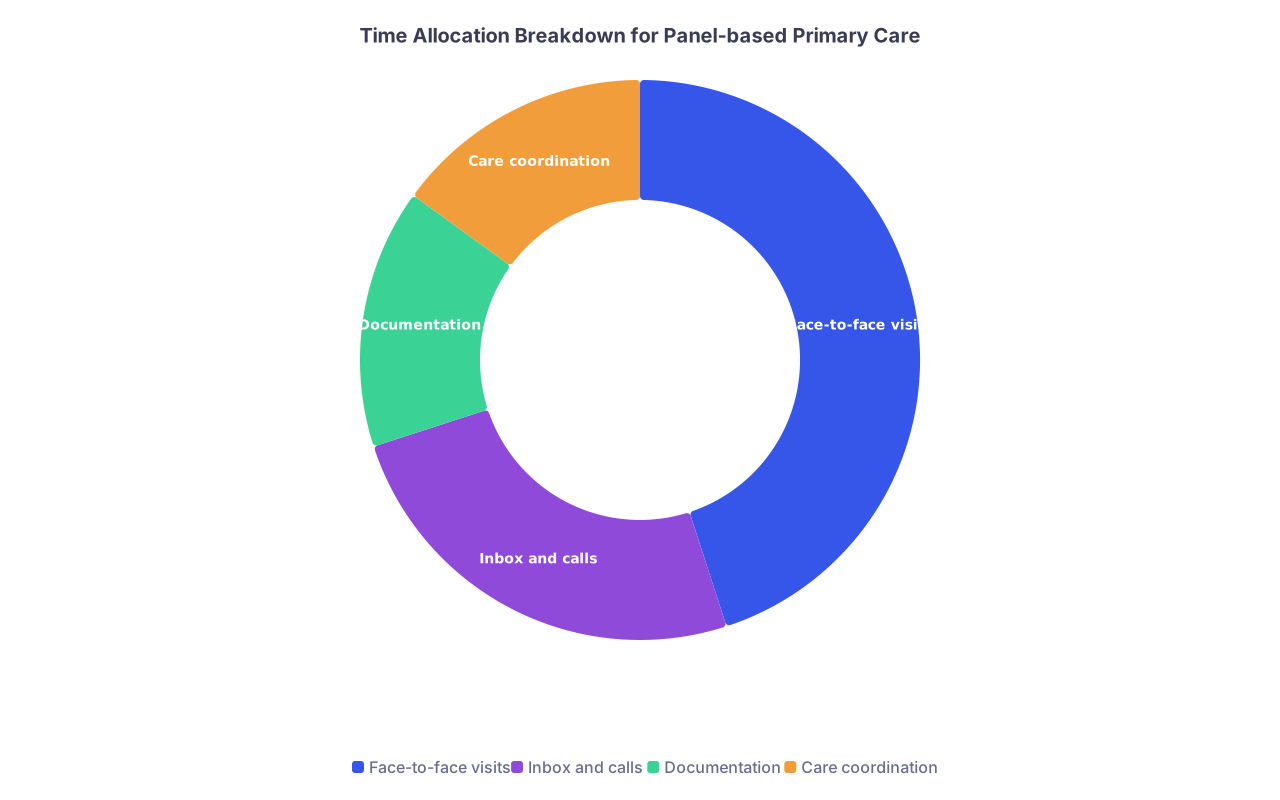
| Category | Value |
|---|---|
| Face-to-face visits | 45 |
| Inbox and calls | 25 |
| Documentation | 15 |
| Care coordination | 15 |
That rough breakdown is what many PCPs actually live. Most compensation models pretend that only the 45% matters.
3. Clarify what happens if you miss wRVU targets
You need to know:
- Is your base guaranteed for the contract term, or “reconciled” to actual productivity yearly?
- If you are below target wRVUs but have a large, complex panel with excellent quality scores, is there any adjustment or just “you are not productive”?
This is where you negotiate some recognition that panel and complexity matter.
4. Push for explicit value-based / panel-based components
You will not single-handedly change the entire comp philosophy, but you can ask:
- “What percentage of my compensation is potentially panel / quality based vs RVU based?”
- “Are panel and complexity formally recognized anywhere in the formula?”
- “If I agree to take on a high-need cohort (e.g., complex geriatrics), how is that compensated?”
Even modest panel-based stipends or quality pools can make a meaningful difference if structured well.
Specialty Differences: Who Lives Where on This Triangle
Not every specialty has the same balance of wRVUs, cFTE, and panel size.
| Specialty | wRVU Weight | Panel Relevance | Common Issues |
|---|---|---|---|
| Primary Care | High | High | Inbox vs RVU mismatch |
| Hospitalist | High | Low | cFTE vs shifts misaligned |
| Procedural (GI) | Very High | Low | RVU pressure, add-on cases |
| Hem-Onc | High | Medium | Infusion vs clinic balance |
| Psych (outpt) | Medium | Medium | Time vs RVU imbalance |
Primary care is where panel size and wRVUs collide most brutally. Proceduralists mostly live in a wRVU world with cFTE defining session expectations; panel is peripheral.
But you should still ask, in any specialty:
- “How is my FTE defined?”
- “What is my RVU target for that FTE?”
- “What metrics beyond RVUs influence my pay, if any?”
Same three levers. Different weights.
Red Flags That Your Model Is Misaligned
You are in trouble if you see combinations like these:
- RVU target scaled for 1.0 cFTE, but your contract lists 0.8–0.9 cFTE “for work–life balance.”
- Panel expectations over 2,000 adult patients with no explicit panel-based compensation.
- Huge inbox burden with no adjustment to visit templates or FTE.
- Vague quality bonus language with tiny dollar amounts (“up to 3% of salary”) but major ongoing work.
Those are structural pay cuts disguised as “opportunities” or culture.
FAQs
1. How do I know if my wRVU target is reasonable for my cFTE?
Compare your contract numbers to:
- Published MGMA / AMGA / specialty society benchmarks for your specialty and region.
- Local colleagues at similar cFTE.
For example, if 1.0 FTE internists in your system average 4,800 wRVUs and you are 0.8 cFTE, a 4,000 target is aggressive. Reasonable range would be 3,600–3,900. Anything near 1:1 scaling is suspect.
2. My employer keeps increasing my panel size but says my pay is “based on RVUs.” Is that normal?
Yes, it is common. No, it is not automatically fair. Large panel size usually increases non-billable work, which depresses your RVUs per hour of total work. If panel size is being used to justify more work, it should be explicitly tied to compensation or support (e.g., extra staff, protected inbox time, or panel stipends).
3. Can I negotiate panel-based compensation if the system is mostly RVU-based?
You probably will not rewrite the whole comp model, but you can negotiate edges:
- A defined stipend if your panel exceeds a given threshold.
- Slightly lower RVU targets in exchange for taking on high-risk or complex patients.
- Formal recognition of care management duties in your FTE, especially if they want you leading population health efforts.
You will get farther if you tie this to their own value-based contracts and quality scores.
4. How does part-time (0.5–0.7 cFTE) work in this framework?
Part-time is where misalignment gets worst. Systems often:
- Pro-rate your base salary nicely,
- But fail to proportionally reduce panel expectations or “fixed” duties (meetings, call, committees),
- And then expect near full-time engagement in inbox and continuity care.
If you are part-time, you must push for:
- Pro-rated RVU targets consistent with true cFTE,
- Pro-rated panel size expectations,
- Clear rules around inbox coverage and access when you are not in clinic.
Key takeaways:
- cFTE sets your “percentage of full-time,” but employers often quietly expect full-time output; force them to align targets and workload with true clinical FTE.
- wRVUs still drive most physician compensation; panel size and value metrics are usually layered on top, often increasing work more than pay.
- Your job in any negotiation is to make the interactions explicit: how cFTE, wRVU targets, and panel size are defined, measured, and tied—mathematically—to your final compensation.