
It is late May. You just got two offers in your inbox.
One from a large health system for a “hospital-employed” position.
One from a 12‑physician multispecialty group offering partnership track.
Both base salaries look similar on the surface. But the comp structures? Completely different animals.
This is where people make expensive mistakes. Because they compare "$350K vs $360K" and ignore how the money is actually generated, protected, and grown over 3–7 years.
Let me break this down specifically.
1. Core Structural Differences: How the Money Flows
Forget marketing language. Strip it down to the mechanics.
In almost every scenario:
- Hospital-employed = you are a cost center on a hospital’s spreadsheet, usually paid from hospital/health system revenue, with productivity and/or quality incentives layered on.
- Group-owned private practice = you are either an employee of a physician-owned entity or an owner (partner) sharing the practice’s profits, after overhead.
Those different revenue sources and incentives drive everything.
1.1 Who actually gets paid by whom?
In a standard hospital-employed model:
- Hospital bills for professional fees (and sometimes facility fees).
- Hospital keeps collections.
- You are paid a salary + incentives, not directly tied to net collections.
- You rarely see detailed accounts receivable (A/R) reports.
In a group-owned practice:
- Group bills for professional fees (and sometimes ancillaries: imaging, labs, procedures).
- Group keeps collections, minus overhead.
- Excess (profit) is shared among owners, often using a formula.
- You will see (or eventually see) how money actually flows.
| Feature | Hospital-Employed | Group-Owned Practice |
|---|---|---|
| Who bills professional fees | Hospital/health system | Physician group entity |
| Who controls ancillaries | Typically hospital | Often group-owned or shared JVs |
| Your relation to revenue | Salary + formula-based bonus | Salary then share of profits as partner |
| Transparency of financials | Limited | Moderate to high (especially for partners) |
If you only remember one thing: hospital-employed comp is usually “downstream” from hospital strategy and regs; group-owned comp is “closer to the top of the pipe” where revenue enters.
2. Hospital-Employed Compensation: Components and Traps
Hospital offers tend to look cleaner on paper. Stable base, clear bonus grid, nice benefits. But the details matter.
2.1 Common building blocks
Most hospital-employed packages mix several elements:
- Base salary (often guaranteed for 1–3 years)
- RVU-based productivity incentives
- Quality / value / citizenship bonuses
- Call pay (sometimes)
- Sign-on bonus / relocation / loan repayment
2.1.1 Base salary
Typical pattern:
- Years 1–2: Guaranteed base, often pegged loosely to MGMA median or 75th percentile.
- Year 3+: Shift toward wRVU-based or hybrid model with a lower “base” and higher variable component.
For example:
- Year 1–2: $280K guaranteed, no clawback unless you totally implode.
- Year 3+: $225K base + wRVU incentive above a threshold.
The trap: people focus on the guarantee and ignore what year 3 will actually look like when the training wheels come off.
2.2 wRVU-based pay: how it actually works
Most systems pay physicians based on work RVUs (wRVUs), not collections. The typical structure:
- Assumed productivity baseline = expected annual wRVUs (e.g., 5,000 for IM, 7,000 for GI, 9,000 for ortho – numbers vary by region and specialty).
- Conversion factor = dollars per wRVU (e.g., $45–$70+, depending on specialty and market).
- Compensation = (Your wRVUs × $/wRVU) ± base / true-up arrangement.
Simplified example (IM outpatient):
- Expected 5,000 wRVUs.
- Conversion factor: $50/wRVU.
- “Target” comp at 100% productivity: 5,000 × $50 = $250,000.
Options the hospital might present:
Scenario A – Pure production
You earn: wRVUs × $50. No fixed base. Risky, rare for new grads.
Scenario B – Hybrid with guarantee
- Base: $200K.
- Bonus: $50/wRVU for wRVUs above 4,000.
- If you produce 5,000 wRVUs:
– Bonus = (5,000 – 4,000) × $50 = $50,000
– Total comp = $250,000
Scenario C – True-up model
- They estimate you will hit 5,000 wRVUs.
- They pay you $20,833/month (annual $250K).
- End of year: They “true up” your actual wRVU production.
– If you produced 5,200 wRVUs:
Earned = 5,200 × $50 = $260K → they owe you $10K.
– If you produced 4,500 wRVUs:
Earned = 4,500 × $50 = $225K → you “over-collected” $25K.
Now the key question: is there a downside reconciliation? Do you have to pay back or take a haircut next year? Many contracts hide that in dense language.
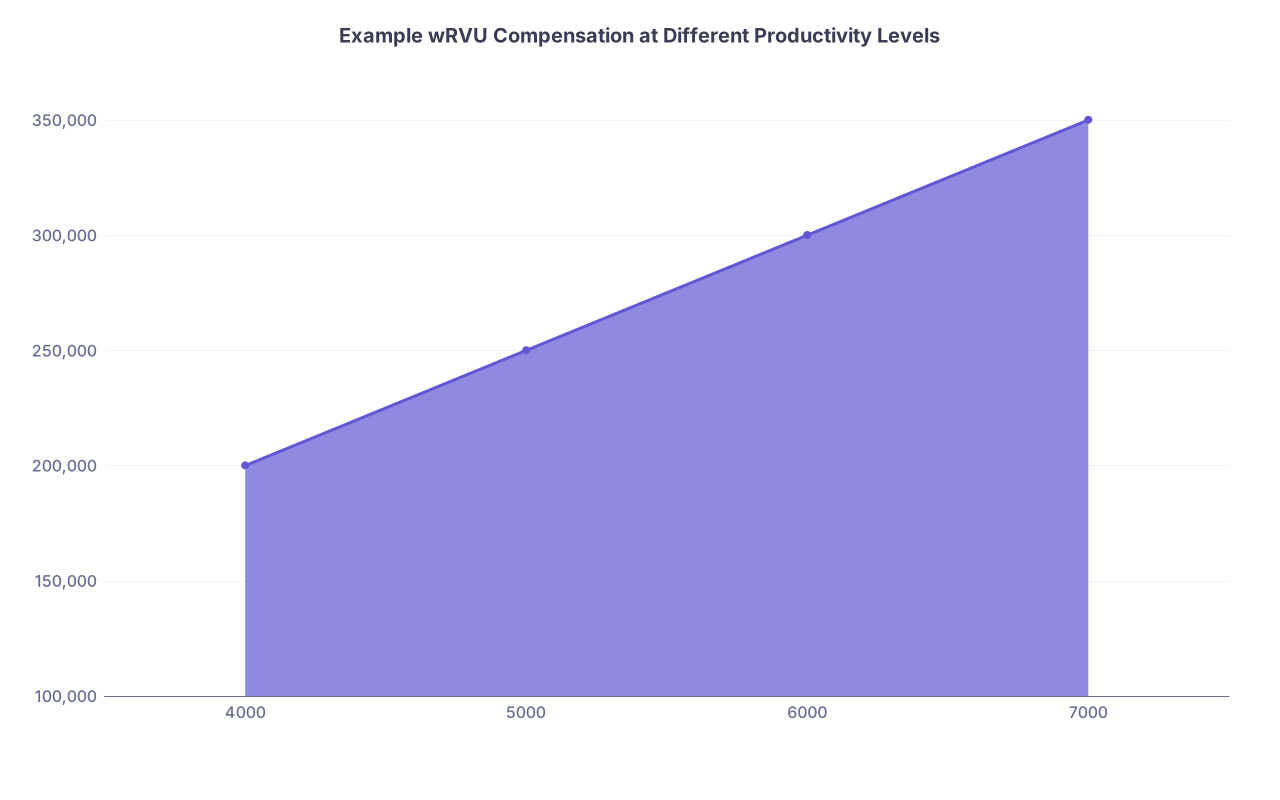
| Category | Value |
|---|---|
| 4000 | 200000 |
| 5000 | 250000 |
| 6000 | 300000 |
| 7000 | 350000 |
That chart is the mental picture you need: linear pay slope. Your job is to understand:
- At what point does the line start (threshold)?
- How steep is it (conversion factor)?
- Is there a floor if you have a bad year?
2.3 Quality and “value-based” bonuses
Hospitals love attaching buzzwords:
- HCAHPS scores
- Readmission rates
- Meaningful use / documentation metrics
- Panel size and care gap closure (for primary care in value-based contracts)
The structure:
- 5–15% of base salary at risk.
- Multiple metrics with weighted scores.
- Often tied to system-wide performance you barely influence.
You might see: “Up to 10% of base for quality metrics.” In practice, most physicians see 2–6% because the bar is set aggressively and you depend on organizational performance.
2.4 Call pay and stipends
Some hospitals roll call into base salary (“expected as part of duties”). Others pay:
- Flat nightly rate (e.g., $300/weekday, $600/weekend).
- Per-shift rate.
- Per “backup” call rate.
For procedural specialties, separate call pay from base is a big lever. Seen plenty of surgeons add $40–80K per year through call alone.
2.5 Where hospital-employed comp shines (and where it fails)
Strengths:
- Income stability early on, especially for primary care, peds, hospitalists.
- Benefits usually richer: retirement match, health insurance, CME, malpractice with tail.
- Less financial exposure to overhead and collections.
Weaknesses:
- Ceiling on income if you are highly productive – hospital will almost never pay you what a high-producing partner can pull from a lean private group.
- Less transparency; you get a spreadsheet, not a profit-and-loss statement.
- Vulnerable to system “restructuring” and comp plan overhauls every 2–4 years.
If you want predictable income and do not care about squeezing every dollar, hospital employment is usually fine. If you plan to grind and build volume? The model may cap you.
3. Group-Owned Practice Compensation: Employee vs Partner
Now the other side.
Group-owned practices are not one monolith. There are big differences:
- Independent single-specialty group (e.g., 10‑doc ortho group).
- Multispecialty clinic with shared ancillaries.
- “Group” that is actually owned by private equity or a management company (you need to sniff these out).
But the compensation architecture usually follows a pattern: employee phase, then partner phase.
3.1 Employee phase (pre-partnership)
Initially, you are a straight employee of the group:
- Base salary (often guaranteed for 1–2 years).
- Production bonus (based on collections, wRVUs, or profit share).
- Path to partnership spelled out (or not, which is a red flag).
Compare how groups anchor comp:
- Collections-based:
– You receive a % of your net collections after overhead.
– Example: You keep 40–45% of your collections as an employee, group keeps rest. - RVU-based (less common in small private groups, more in large clinics):
– Similar to hospital model but with different $/wRVU and overhead handling. - Straight salary:
– Used when ramp-up volume is unpredictable.
– Look closely at what happens in year 2–3.
If your offer just says “$280K, partnership considered after 2 years” with no structure, that is not a plan. That is hand-waving.
3.2 Partnership: where private practice becomes financially interesting
Once you make partner, the compensation engine changes fundamentally.
At a high-functioning independent group, partner compensation is typically:
Profit share = (Your professional collections + allocated ancillaries) – (Your direct costs + allocated overhead)
Translated: you eat what you kill, minus your share of the rent, staff, and other joint expenses.
Typical structure:
- Each partner gets: – Their pro rata share of practice profits (based on productivity formula). – A fixed “draw” monthly, reconciled at year-end.
- Some groups pool specific revenues (e.g., imaging, ASC profits) and split equally among partners.
| Model Type | How It Works Briefly | Who It Favors |
|---|---|---|
| Pure Eat-What-You-Kill | You keep your collections minus costs | High producers |
| Hybrid Productivity/Equal | Base on production, some equal profit share | Balanced, cohesive groups |
| Seniority-Weighted | Older partners get bigger share | Existing senior partners |
| Ancillary Pooling | Ancillary profits split evenly | All partners if ancillaries big |
Where group-owned shines:
- High ceiling if you are efficient and busy.
- Direct access to ancillary revenue (imaging, PT, endoscopy center, ASC ownership).
- Actual equity: sale events (to PE or hospital) can produce large capital payouts.
Where it fails:
- Risk. Overhead, poor payer mix, bad billing company can all hit your income.
- Politics. Partnership votes, buy-ins, and senior partners protecting their slice.
- Slower ramp. Year 1–2 comp can lag hospital offers in some markets.
4. Comparing Money: Realistic Scenarios
Let’s walk through an example. Two internal medicine physicians in the same metro area.
- Dr. A: Hospital-employed outpatient internist.
- Dr. B: Joins 10‑physician independent IM group with 2‑year partnership track.
4.1 Hospital-employed IM (Dr. A)
Year 1–2:
- Base salary: $260K guaranteed.
- Quality bonus potential: 10% of base (realistically 4–5% paid).
- Call included, no extra pay.
- Benefits: 5% retirement match, good health insurance.
Assume she hits moderate productivity:
- Year 1: $260K + $10K quality = $270K.
- Year 2: $270K (slight bump) + $12K quality = $282K.
Year 3 – RVU plan activates:
- Target wRVUs: 5,200.
- Conversion: $52/wRVU.
- Base now shifted: $220K + production above 4,000 wRVUs.
She produces 5,500 wRVUs (busy clinic):
- wRVU value = 5,500 × $52 = $286K.
- She might see $286–295K total, plus a small quality bonus.
Total 5-year ballpark (assuming small annual raises): roughly $1.4–1.5M pre-tax.
4.2 Group-owned IM (Dr. B)
Year 1–2 employee:
- Base salary: $220K year 1, $240K year 2.
- Collections incentive: 40% of net collections above 3× base salary.
- Ramp-up: 3 days/week clinic initially, full by end of year 1.
Realistic working numbers (assuming strong work ethic):
Year 1:
- Total collections: $450K.
- Overhead share baked into base; incentive threshold high.
Result: She essentially sees just the $220K.
Year 2:
- Total collections: $650K.
- Threshold: 3 × base = 3 × $240K = $720K.
She does not hit threshold → $240K.
On paper, she is “losing” compared with Dr. A those first 2 years.
Partnership Year 3–5:
Now she buys in:
- Buy-in: $150K over 3 years ($50K/year), out of distributions.
- Partner split: She keeps 50% of her professional collections (covers her comp), rest feeds overhead and shared profit. Plus she gets equal share of ancillaries (lab, imaging, etc.).
Let us run conservative numbers:
Year 3 collections: $750K. – Direct comp portion: 50% of $750K = $375K.
– Overhead and group profit paid from remaining $375K. – Her net partnership distribution after all adjustments: $360K.
– Minus $50K buy-in payment → she sees $310K cash.Year 4 collections: $800K, ancillaries strong.
– Her share: $400K professional + $40K ancillaries = $440K.
– Minus buy-in $50K → $390K.Year 5 collections: $825K stable.
– Her share: ~$450K total (pro + ancillary).
– Buy-in complete → she keeps full $450K.
Total 5-year ballpark:
- Y1: $220K
- Y2: $240K
- Y3: $310K
- Y4: $390K
- Y5: $450K
Total ≈ $1.61M pre-tax.
On a pure 5-year income basis, the independent route edges out. But it asks more of her and carries more risk.
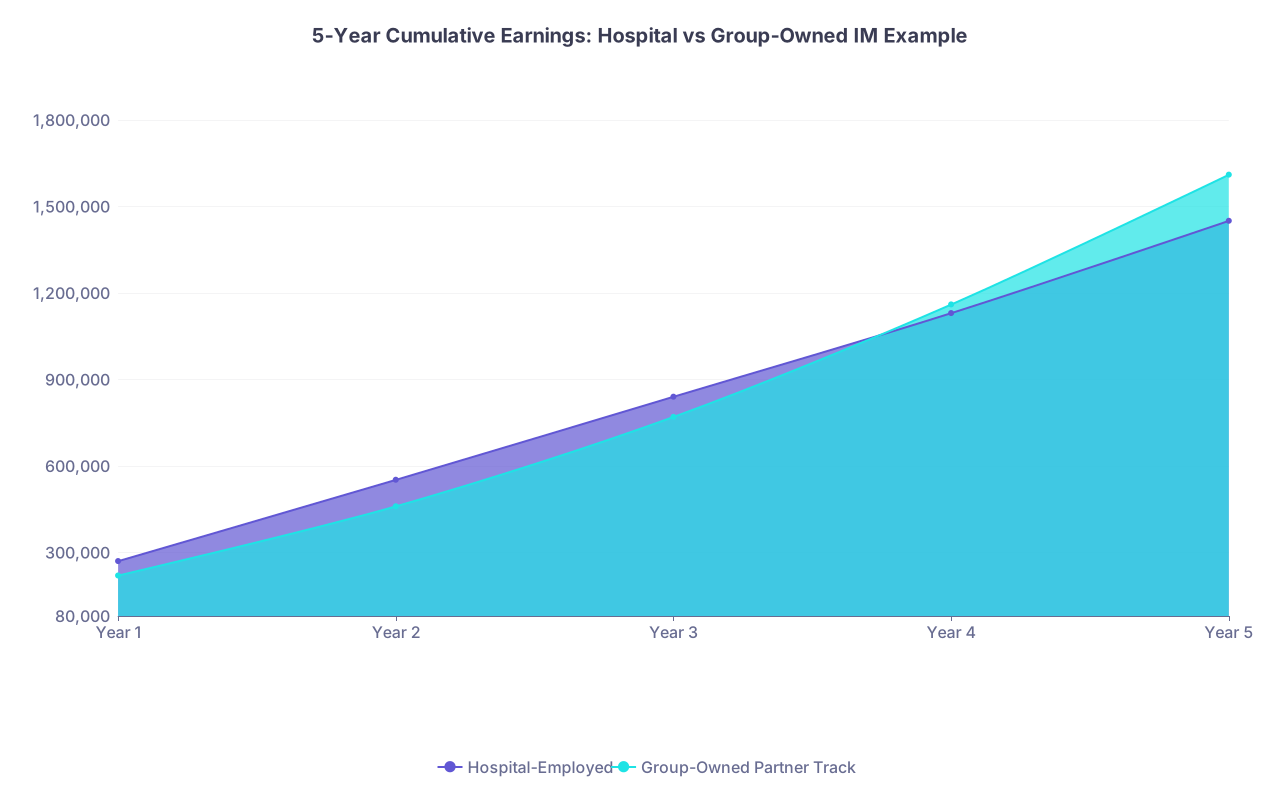
| Category | Hospital-Employed | Group-Owned Partner Track |
|---|---|---|
| Year 1 | 270000 | 220000 |
| Year 2 | 552000 | 460000 |
| Year 3 | 840000 | 770000 |
| Year 4 | 1130000 | 1160000 |
| Year 5 | 1450000 | 1610000 |
Now extend that over 10–15 years and add:
- Equity in ancillaries.
- Possible practice sale with a 7‑figure payout.
That is where private practice can absolutely crush hospital employment financially. Not always. But often.
5. Non-Salary Pieces That Quietly Change the Math
You cannot evaluate salary without looking at these “non-salary” levers. They are often worth six figures over time.
5.1 Benefits and retirement
Hospitals:
- Higher 401(k)/403(b) matches frequently (4–7%).
- 457(b) options for additional tax-deferred savings.
- Subsidized health insurance, sometimes with lower premiums.
Groups:
- Smaller practices often have leaner retirement matches (2–4%).
- Health insurance may be more expensive or narrower network.
- Some groups offer cash in lieu of benefits, which bumps effective salary.
If a hospital offers a 7% match and the group offers 3%, on a $300K income over 10 years that is a ~$120K difference in employer contributions alone, before investment growth.
5.2 Malpractice and tail coverage
Hospital-employed:
- Usually claims-made coverage with tail paid by the system, or occurrence coverage.
- Less personal exposure when leaving.
Group-owned:
- Many groups carry claims-made with tail cost split or assigned.
- Tail can be 1.5–2.5× annual premium. For some specialties, that is $80–150K when you exit or change jobs.
A “great” salary with no tail coverage protection can evaporate fast if you leave after 5 years and have to write a $90K check.
5.3 Autonomy and schedule control (which eventually becomes money)
You are not a robot. Autonomy eventually feeds into compensation:
- Ability to adjust template and visit lengths.
- Control over adding a PA/NP to expand your capacity.
- Deciding how much call and how many procedures you take on.
Hospitals:
- More bureaucracy. Standardized templates. Productivity levers often limited.
- Operational bottlenecks (scheduling, MA turnover, EHR rules) that you cannot fix yourself.
Groups:
- When you are a partner, you actually control levers: hire another MA, tweak hours, create an access clinic.
- Those changes translate into more RVUs or collections. Which translate into direct dollars.
6. Legal, Contract, and Negotiation Realities
You are in the “Financial and Legal Aspects” phase. Means you should not sign anything blind.
6.1 Specific contract clauses that directly affect your income
I have seen smart physicians miss these and donate hundreds of thousands over a few years.
Key things to scrutinize (and preferably have an attorney review):
Compensation formula language
- Exact definitions of “wRVU,” “collections,” “net collections,” and “overhead.”
- What happens in down years: true-ups, recoupment, minimum guarantees.
Term and termination
- Without cause termination periods (90–180 days).
- What happens to bonuses and deferred comp if you leave mid-year.
Non-compete and non-solicit
- Radius and duration.
- Real impact: can you realistically work anywhere nearby if the job sours?
Partnership track details (for group practices)
- Is there a written policy?
- Fixed buy-in formula or “to be determined by partners later”?
The latter is a bright red flag.
Ancillary revenue and equity
- Are you eligible for ownership in ASC, imaging center, etc.?
- Are new partners excluded from existing JV deals? (Common and painful.)
6.2 Where negotiation actually moves the needle
Hospitals:
- Base salary: modestly negotiable, especially in shortage specialties.
- Sign-on bonus / loan repayment: often more flexible than base.
- RVU threshold and conversion factor: sometimes negotiable, especially thresholds.
- Tail coverage in buyout clauses: rarely, but occasionally adjustable.
Groups:
- Path to partnership: timeline and buy-in structure can often be clarified and sometimes improved.
- Initial base vs production split: negotiable, especially if you bring something unique (language skills, subspecialty training).
- Ancillary access: in some cases, you can negotiate earlier or partial access.
If an employer refuses to put the compensation formula in writing and only offers “expected ranges,” assume the lower end is your reality.
7. How to Decide: Hospital-Employed vs Group-Owned
This is where people expect a tidy answer. There is not one. But I will give you the framework I actually use when advising.
You choose hospital employment when:
- You want income stability and do not care to run a business.
- You are early in life, heavy on loans, and want a predictable 5-year income arc.
- Your specialty is hospital-centric (hospitalist, intensivist, many subspecialties) and private options are weak or controlled by hospital anyway.
You lean group-owned / private practice when:
- Your specialty is outpatient or procedure-heavy (IM, cards, GI, ortho, ENT, derm, ophtho, etc.).
- You tolerate some risk and want upside above the 75th percentile.
- You actually care about ownership, autonomy, and long-term equity.
Most people screw up by:
- Comparing Year 1–2 salary only.
- Ignoring partnership, ancillaries, and equity.
- Ignoring non-competes and tail coverage.
- Underestimating how comp plans change in hospital systems every few years.
If you are within 6–12 months of signing, you should be modeling 5–10 year income based on realistic productivity and asking current docs quietly: “What do your W2s actually look like?”
If they will not show you ranges, that is your answer.
FAQ (exactly 6 questions)
1. Is hospital-employed or private group practice usually higher paying in the long run?
For many outpatient and procedural specialties, a well-run independent group with partnership typically pays more over a 10–15 year horizon, especially once you factor in ancillaries and potential equity events. Hospital employment often wins on years 1–3 and on benefits, but tends to cap out near MGMA 50–75th percentile productivity, while productive partners in lean practices can exceed that significantly. There are exceptions in very aggressive hospital markets or for certain specialties where the hospital heavily subsidizes comp.
2. How do I realistically estimate my future wRVUs or collections as a new attending?
You do not guess alone. You ask existing physicians in that exact practice: “What are the typical wRVUs / collections for someone 2–3 years out, full time, doing what I will be doing?” Then you ask at least 2–3 different people, including one who is not the department cheerleader. You also check published benchmarks (MGMA, AMGA) for your specialty and region, but you weigh local data more heavily. Finally, you factor ramp time: expect 6–12 months before hitting steady-state volume.
3. How important is the partnership buy-in amount in a group practice?
Very. A “cheap” salary with a fair buy-in can be much better than a slightly higher salary with a predatory buy-in. Key questions: How is the buy-in calculated (assets? AR? goodwill?)? Is it financed through your future distributions or upfront cash? Does the amount make sense compared with the tangible assets and earnings of the practice? A buy-in that is 0.8–1.5× your expected partner annual take-home is common; much beyond that deserves scrutiny.
4. Should I avoid any group that pays based on collections instead of wRVUs?
No. Collections-based comp is standard in many independent practices and can be perfectly fair. The key is transparency around overhead and payer mix. If you are in a low-overhead, well-run group with good contracts, keeping 40–50% of your collections can translate into strong income. Where it gets dangerous is when overhead is bloated, collections are poor, or you have no visibility into AR and denial rates. Collections-based is not the problem; opaque finances are.
5. How big of a deal are quality bonuses in hospital-employed jobs?
For most physicians, quality bonuses are a small side dish, not the main course. Typical ranges are 5–15% of base “at risk.” In practice, payout is often 2–6% depending on how aggressive the targets are and how much depends on system-wide performance beyond your control. You should understand the metrics, but you should not let a hypothetical 10% quality bonus distract you from a weak base or an unfavorable wRVU threshold/conversion factor.
6. Is it worth hiring a lawyer just to review the compensation and partnership language?
Yes. Especially for group-owned practices and any job involving partnership, ancillaries, or complex bonuses. A physician contract attorney will not magically double your salary, but they will flag dangerous clauses: unrestricted non-competes, vague partnership promises, one-sided tail obligations, and compensation formulas that allow the employer to change the rules midstream. The few thousand dollars you spend can easily prevent six-figure mistakes over the life of the contract.
With this level of clarity on how money actually moves in hospital-employed versus group-owned practices, you are no longer just comparing headline salaries; you are evaluating business models. Once you lock that mindset in, you are ready for the next step in the journey: dissecting specific offers, line by line, with real numbers and real leverage. That is where your financial trajectory as an attending truly starts.