Most physicians are underpaid for call—and many do not even realize it.
Let me break this down specifically: on‑call pay in the United States is one of the most opaque, inconsistent, and poorly structured parts of physician compensation. It is also where hospitals quietly save millions and physicians quietly lose them.
If you are signing a new contract, renegotiating, or trying to understand whether your current deal is fair, you cannot just look at your base salary and RVU rate. You have to dissect call stipends, shift differentials, and bonuses with the same precision you bring to a complicated case.
This is the financial and legal anatomy of on‑call pay.
1. The Three Pillars of “Extra” Pay: What We Are Talking About
I am going to define terms in practical, contract-level language, not HR jargon.
Call stipends
Call stipends are flat payments for being on call, usually quoted as:
- Per 24‑hour call
- Per night call
- Per weekend call (often Friday night–Monday morning)
- Per week of beeper call
You get the stipend whether or not you are called in (unless the contract is a sham and conditions it on work RVUs; more on that later).
Typical examples I have seen:
- Community hospital general surgery: $500–$1,000 per 24‑hour in‑house call.
- Cardiology STEMI call: $1,500–$3,500 per 24 hours in some markets.
- Small rural hospital neurology stroke call: $1,000 per night beeper call (no in‑house requirement).
These are not RVU-based. They are “availability” pay. Legally, that matters.
Shift differentials
Shift differentials are hourly or percentage bumps for undesirable hours:
- Nights (e.g., +$20/hour or +15% over base)
- Weekends
- Holidays
These are baked into shift work models: EM, hospitalist, nocturnist, intensivist. Classic example:
- Hospitalist base: $150/hour days, $180/hour nights (20% night differential).
- Nurse practitioners and PAs in some systems: +$8–$15/hour weekends / nights.
Physician contracts sometimes hide the differential in a separate rate sheet or internal policy document, not always the contract itself. That is risky for you.
Bonuses related to call / shifts
Bonuses in this arena come in a few flavors:
- Extra-shift bonuses: an additional lump sum per shift beyond a baseline (e.g., “Above 15 shifts/month, each additional night shift gets a $500 bonus”).
- Quality / availability bonuses: if you meet certain call coverage metrics (no unfilled shifts, response times, etc.).
- RVU triggered bonuses that only occur because you are on call and taking extra volume.
These are where administration likes to say, “We make it up with bonuses.” Often, they do not.
2. How Hospitals Actually Structure Call Pay
Forget the myth that there is a standard. There is not. But there are patterns.
| Model Type | Typical Use |
|---|---|
| Pure stipend per call | Surgical, neuro, cards |
| Stipend + RVU credit | Procedural subspecialties |
| RVU only, no stipend | Employed hospital groups |
| Shift rate with diff | EM, hospitalist, ICU |
| Rotating pool fund | Multispecialty call group |
Model 1: Flat per‑call stipends
You see this with:
- Independent specialists covering a hospital: orthopedics, ENT, neurosurgery, GI.
- Small community hospitals buying call from private groups.
Example:
- $800 per 24‑hour weekday call
- $1,200 per 24‑hour weekend or holiday call
Sometimes tiered:
- First call: higher rate.
- Backup call: lower rate (e.g., $300 vs $1,000).
Key legal issue: OIG and Stark. The hospital cannot pay “whatever” it wants. It has to be “fair market value” and “commercially reasonable” for call, not tied to downstream referrals. That is why many administrators hide behind MGMA “call pay” tables (which are often outdated or misused).
Model 2: Stipend plus RVU compensation
Common in:
- Employed cardiology, GI, pulmonary groups
- Hospital-employed surgical subspecialties
Structure:
- You get a base salary plus RVU bonus.
- You also get a separate call stipend (e.g., $500 per call day).
- All work done while on call still generates RVUs.
This is the best-case employed model from a compensation perspective. You are paid to be available and paid again to work.
Be suspicious of any contract that says the stipend “includes” RVU compensation or that RVUs generated on call are not credited to you. That is revenue leakage from you to the employer.
Model 3: RVU-only call (no stipend)
This is the “you’re salaried, call is part of the job” play.
Common in:
- Academic centers
- Large integrated systems with “total comp” language
- Hospitalist/EM models where nights/weekends are just considered different shifts
Manifestations:
- “Call is considered part of your regular duties and is compensated through your base salary and RVU incentive plan.”
- No separate call pool line item in the budget.
If call is heavy or high-acuity, this structure is usually a bad deal unless the base salary is clearly inflated for that burden. Most of the time, it is not.
Model 4: Shift-based models with differentials
Think emergency medicine, hospitalists, nocturnists, many ICUs.
You do not have “call” in the traditional sense; you have scheduled shifts. The compensation questions are:
- Day vs night rate difference?
- Weekday vs weekend difference?
- Holiday pay structure (1.5x? 2x? Flat bonus?)
Example setup:
- Day hospitalist: $165/hour
- Night hospitalist: $200/hour
- Weekend day: +$10/hour on top of base
- Major holiday: 2x rate
Or more commonly (and worse):
- Flat rate: $160/hour regardless of shift.
- Nights/weekends: “We rotate fairly, so we do not differentiate.” Translation: you are subsidizing the schedule.
3. What “Fair” Call Pay Actually Looks Like (And What It Does Not)
You cannot answer “Is my call pay fair?” in isolation. You must look at:
- Market data
- Call intensity
- Frequency of call
- In-house vs beeper
- Specialty risk and scope
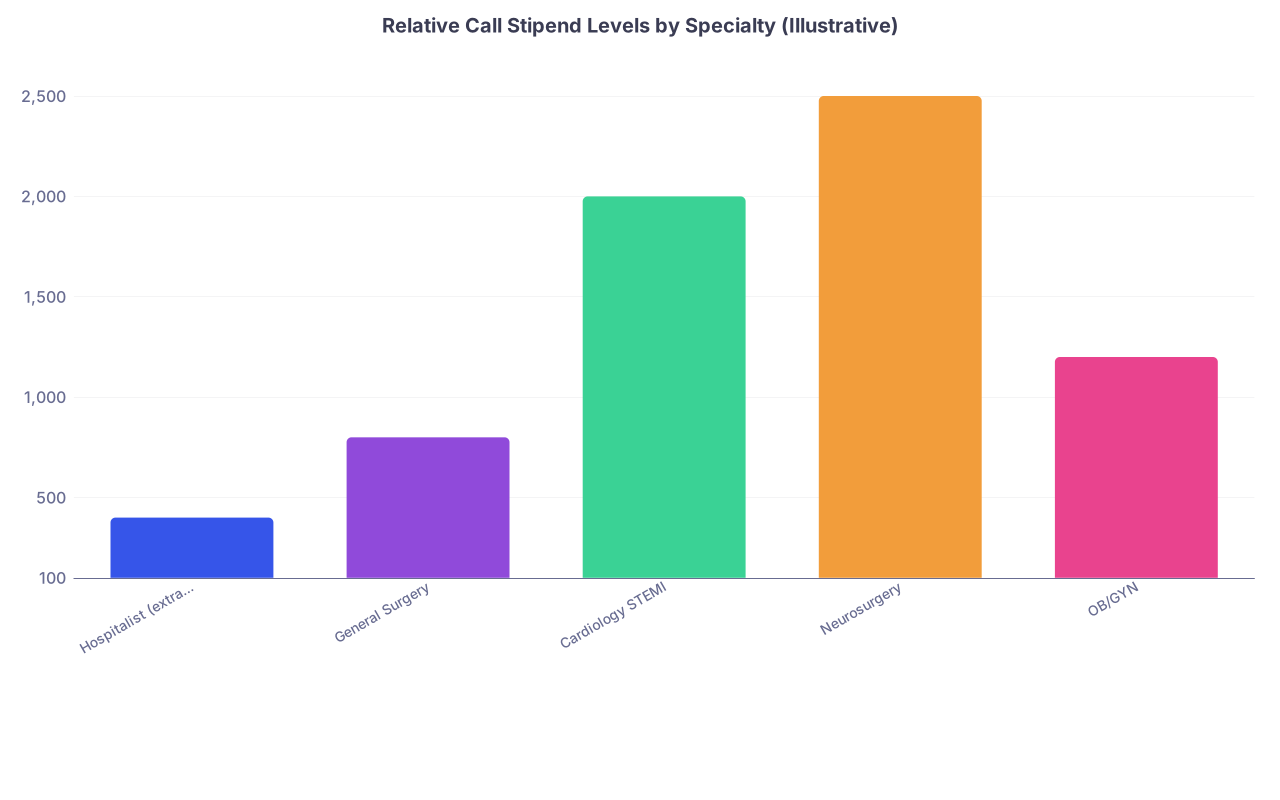
| Category | Value |
|---|---|
| Hospitalist (extra night) | 400 |
| General Surgery | 800 |
| Cardiology STEMI | 2000 |
| Neurosurgery | 2500 |
| OB/GYN | 1200 |
These are ballpark “reasonable” norms I have seen across multiple regions, not hard standards:
- Hospitalist extra in‑house night: $300–$600 per extra 12‑hour shift beyond baseline.
- General surgery 24‑hour call: $500–$1,500 depending on volume and trauma level.
- Invasive cardiology STEMI call: $1,500–$3,500+ per 24 hours for primary call.
- Neurosurgery: often $2,000–$4,000+ per 24 hours given rarity and liability.
- OB/GYN L&D in‑house call: $800–$1,800 per 24 hours, heavily market-dependent.
Low‑intensity beeper call (e.g., outpatient neurology answering a few pages) is obviously lower: $250–$800 per 24 hours can be reasonable.
Red flags:
- Call is “included” in a base salary that is at or below 50th percentile for your specialty.
- There is no distinction between weekday, weekend, and holiday rates.
- You are the only specialist taking call for a hospital service line and are not paid separately.
- Backup call is unpaid “because you rarely come in.”
4. Legal and Regulatory Guardrails You Cannot Ignore
You cannot negotiate call pay intelligently if you do not understand the compliance skeleton behind it.
Stark, Anti‑Kickback, and fair market value
Hospitals cannot legally:
- Pay you for call in proportion to the dollar value of admissions and procedures you refer to the hospital.
- Push call stipends to absurd levels “just to lock you in” if it is not commercially reasonable.
So they hide behind “fair market value” (FMV).
How it works in the real world:
- A valuation firm (e.g., PYA, HSG, etc.) issues an FMV analysis: “reasonable call pay ranges from $X–$Y per 24-hour period for this specialty and market.”
- Administration uses that as gospel. Often selectively.
You will never see all the raw data. But you can:
- Ask specifically: “Is this call stipend based on a formal FMV opinion? When was it last updated?”
- Ask whether other comparable local specialties received updated FMV and how long ago.
If the answer is fuzzy, there is often room to move. If they clearly have a recent FMV opinion that boxes them in, you shift your leverage to other axes (reduced frequency, more backup coverage, extra FTEs, etc.).
Employed vs independent: why the structure changes
Independent group:
- Hospital pays your group a call stipend under a separate services agreement.
- Group decides internal distribution (which is often a source of quiet war within the group).
- Stark and AKS still apply, but the leverage dynamics are different.
Employed physician:
- Call is usually addressed in your individual employment contract or in a separate call coverage policy referenced in the contract.
- You have less ability to “walk” as a group and so less collective bargaining power.
I have seen more abusive call structures with employed physicians than with private groups, simply because of weaker negotiating position and “we all share the burden” language.
In‑house vs beeper: legal classification vs practical reality
From a compliance standpoint:
- In‑house call has a clearer argument for higher pay: you are physically present, cannot use your time freely, and the hospital is extracting a defined service.
- Beeper call can be lower, but if call intensity is high—where you are effectively working full nights from home—the stipend should reflect that.
If your beeper call involves multiple middle‑of‑the‑night trips to the hospital, you should be tracking that. Administrators love the phrase “low-intensity call” until you put actual data in front of them.
5. How Shift Differentials Are Played Against You
Shift differentials are more subtle than call stipends, and often hidden.
The classic games
No formal differential, “just rotate fairly”
Translation: Nights and weekends are priced at exactly the same rate as day work, even though the lifestyle and health impact are far worse. This is essentially unpaid differential.
Tiny nominal differential
Example:
- Day rate: $160/hour
- Night rate: $165/hour
A $5/hour bump for a night shift that wrecks your circadian rhythm is not serious compensation.
Differentials without transparency
Sometimes the contract will say, “Shift differentials are determined by hospital policy,” and then policy documents are not attached. That allows HR to alter the differentials later without contract renegotiation.
Reasonable differential structures
I have seen these as reasonable in many markets:
- Nights: 15–30% above base hourly rate.
- Weekends: +$10–$30/hour depending on specialty and supply.
- Major holidays: 1.5x–2x base hourly rate or a significant flat bonus ($500–$1,500+ per shift).
Compare your situation against that. If you are working repeated nights and weekends for essentially the same rate as weekday days, your effective hourly value is lower than it appears on paper.
6. The “Hidden” Cost of Call: Effective Hourly Pay
You have to calculate this, or you will be fooled.
The formula is simple when you force yourself to be honest:
- Total compensation attributable to call (stipends + extra RVUs + extra shift bonuses)
divided by - Total call time burden (hours on call + actual hours spent working during call).
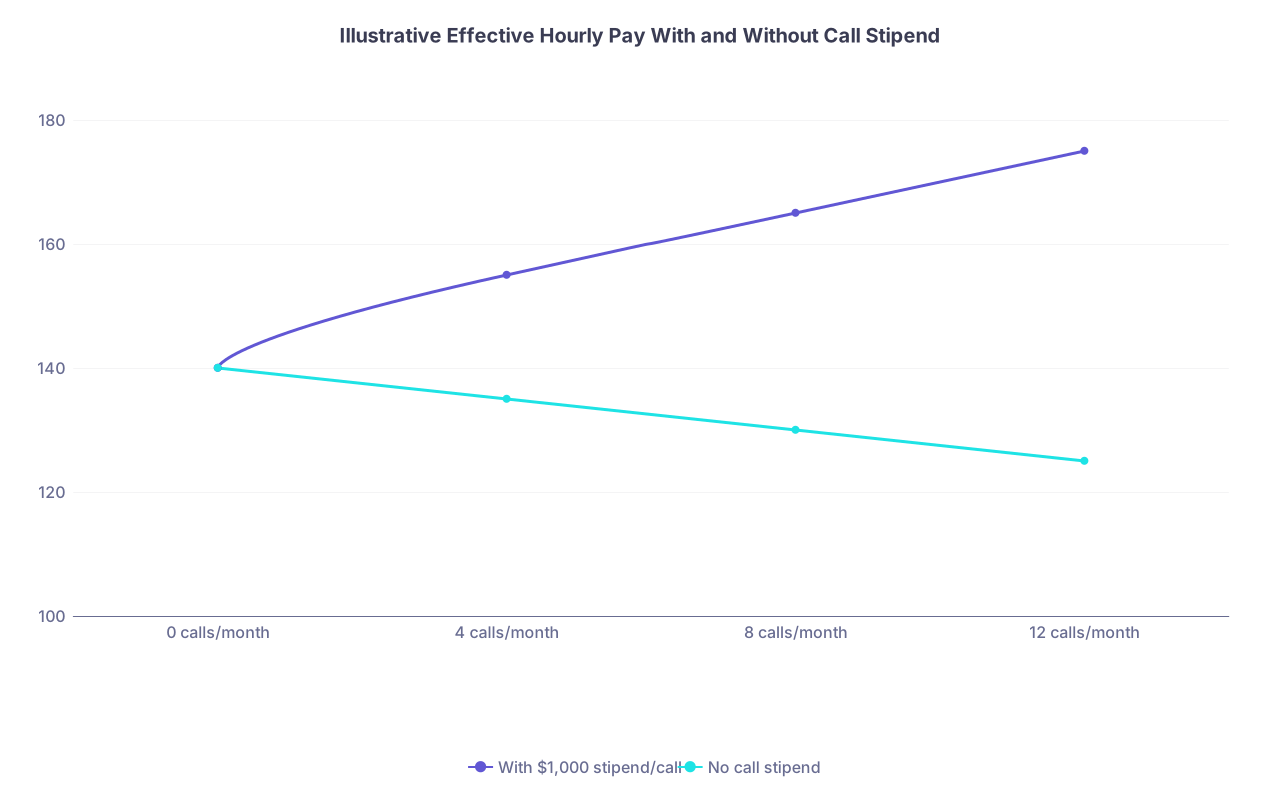
| Category | With $1,000 stipend/call | No call stipend |
|---|---|---|
| 0 calls/month | 140 | 140 |
| 4 calls/month | 155 | 135 |
| 8 calls/month | 165 | 130 |
| 12 calls/month | 175 | 125 |
Quick example:
- Base salary: $350,000
- Call stipend: $800 per 24‑hour call
- You take 8 calls per month → 96 per year → $76,800 call stipend.
- Total comp: $426,800
Now the time:
- 96 days of call at 24 hours = 2,304 call hours.
- Suppose during call you actually work an average of 6 hours physically in the hospital and 2 hours handling calls, so 8 “active” hours per call day.
If you look at just active hours:
- Active hours: 96 calls × 8 hours = 768 active hours.
- Call comp only: $76,800 / 768 ≈ $100/hour.
If you consider the full 24 hours you are constrained:
- 2,304 call hours.
- $76,800 / 2,304 ≈ $33/hour.
The truth lies somewhere between. But you need to know both numbers. Because administration definitely will not do that math for you.
7. Negotiating on‑Call Pay: Tactics That Actually Work
Vague complaints about “unfair call” get you nowhere. You need specifics.
1. Start with workload and coverage
Collect data for 3–6 months:
- Number of calls per month.
- Average pages per call night.
- Number and duration of in‑house trips.
- Procedures performed, admissions, consult volume.
You do not present this as “I have a spreadsheet of my suffering.” You present it as:
- “Here is the service line demand that is currently being covered by X physicians with Y calls per month each, with Z average interventions per call.”
That turns your ask into a system capacity problem. Administrators listen to that.
2. Anchor on something: FMV, regional comparators, or internal parity
Pick one or two anchors:
- FMV: “I understand we need to stay within FMV. My ask is for the upper half of FMV range given our trauma level / volume.”
- Regional comparators: You will not always have hard data, but you can say, “Surgeons at Hospital B are at $1,200 per call with lower trauma status.”
- Internal parity: “Cardiology and GI call are at $X. Our volume and risk profile is comparable if you look at ED arrivals and overnight procedures.”
You do not need perfect data. You need enough plausible structure to make “No” uncomfortable.
3. Negotiate on structure, not just dollar amount
If they are firm about the per‑call stipend, push alternative levers:
- Fewer calls per FTE (hiring another partner, locums, tele‑coverage).
- Tiered compensation for high‑volume calls vs low‑volume (weekends at a higher rate; holidays at 1.5x–2x).
- Extra pay for in‑house requirement vs beeper.
- Clear backup call compensation if you are pulled in regularly.
Sometimes the win is: same stipend but fewer calls. Your lifestyle is worth more than a marginal stipend bump.
4. Get the right details in writing
Verbal “understandings” about call are worthless.
Your contract or an attached exhibit should state:
- Type of call (in‑house vs beeper).
- Expected frequency (e.g., “Approximately 1 in 4 weekends and 7 weekdays per month” or at least “equitable distribution among group members”).
- Stipend structure clearly itemized (weekday, weekend, holiday rates).
- How often stipends and differentials are reviewed for adjustment (e.g., annually with FMV review).
Also protect yourself from silent policy changes:
- If shift differentials are in a policy, push to have the current policy attached or incorporated by reference with a requirement that adverse changes require your written consent or at least prior notice and an opportunity to discuss.
8. Special Cases: Academic, Rural, and Hospitalist/EM Models
Not all call is created equal. Three settings deserve special mention.
Academic physicians
Reality: Academic physician salaries are often below community rates, and departments lean heavily on the “mission” and “academic time” argument.
Common structures:
- Base academic salary with RVU threshold.
- Call implicitly wrapped into the base.
- Small or no separate call stipend.
Where you have leverage:
- Service-heavy roles (e.g., transplant, trauma, interventional) where losing you would cripple the program.
- Grants and clinical productivity that materially subsidize the department.
Ask for:
- Dedicated call stipend separate from academic base.
- At minimum, a reduced clinical FTE expectation when call burden is heavy.
Do not let “you get teaching time” be the catch-all excuse for structurally undercompensated call.
Rural physicians
Rural call is a different beast:
- Fewer physicians → more frequent call (1:2, 1:3 is common).
- Sometimes lower intensity, sometimes brutal, depending on ED volume and hospital capabilities.
The danger is that rural physicians are often "company town" captive and accept outrageous call burdens folded into modest salaries.
For rural call, I like to see one or more of:
- Higher base salaries that clearly exceed urban peers for same specialty.
- Strong per‑call stipends.
- Significant time off or reduced clinic load to offset call.
If you are on 1:2 or 1:3 call with a salary below median for your specialty, you are subsidizing the hospital.
Hospitalist and emergency medicine
For shift-based fields, the analogs of call stipends are:
- Extra-shift bonuses
- Night/weekend/holiday differentials
- “Surge” pay when volume is high or coverage gaps exist
Healthy structures:
- Defined base number of shifts per month (e.g., 14 shifts).
- Clear premium for optional extra shifts above that baseline.
- Transparent, written differential tables.
Unhealthy structure: “We all pitch in,” with pressure to cover extra nights and holidays at the same basic rate. Over time that erodes your effective pay and burns people out.
9. Where Physicians Commonly Get Burned
Let me be blunt. I have seen the same traps dozens of times.
“Call included in salary” with no adjustment when call frequency explodes.
Hospital closes a neighboring unit, volume doubles, call expectations triple, salary does not move.Mid‑career creep.
You join at 1:6 call, which feels fine. Two partners leave, recruitment lags, you live at 1:3 call for two years without any temporary stipend increase.Backup call is unpaid or grossly underpaid.
“You rarely come in” turns out to be wrong. You come in every second night, uncompensated.Shift differential quietly cut.
Policy changes; differentials shrink or vanish. Contract references “current hospital policy,” and now you are stuck.Tele‑coverage replacing local call without proper adjustment.
You still take call for certain complex cases or in-house emergencies, but now tele‑neuro or tele‑ICU gets paid separately and your stipend is reduced “because coverage is shared.”
The theme in all of these: physicians under-measure and under-document their call burden. Administration over-utilizes and under-compensates.
FAQs
1. Is it ever reasonable for call to be “included” in my base salary with no separate stipend?
Yes, but only if one of two things is true:
- Your call burden is minimal (e.g., 1:6+ low-intensity beeper call, rare callbacks).
- Your base salary is clearly and measurably above market median for your specialty and region, and the contract explicitly acknowledges that this is in exchange for call responsibilities.
If you are at median or below and call is heavy, “included” is code for “unpaid.”
2. How often should call stipends and shift differentials be reviewed or updated?
Every 2–3 years at minimum, ideally pegged to:
- Updated FMV opinions, and
- Meaningful changes in call intensity (new service lines, trauma designation upgrades, ED volume growth).
You can push for contract language stating that the parties will review call compensation at set intervals or when material workload changes occur. You will not always get automatic increases, but at least you force structured discussions.
3. Can I negotiate call pay as a single physician, or do I need my whole group involved?
You can negotiate as an individual, especially:
- In high-demand specialties
- In rural or underserved areas
However, hospitals prefer uniformity across a group. If you push for special treatment, you may get resistance framed as “fairness” concerns. Practically:
- It is more effective if the group aligns on a unified position about call.
- For new hires, you might secure modest improvements (reduced call for first year, limited holidays) even if stipends are fixed.
I tell people: negotiate what you can as an individual, but do not undermine your group’s cohesion. Burning your partners to get a slightly better call deal never ends well.
4. How do I handle a situation where call volume has increased significantly but pay has not?
Take a disciplined approach:
- Gather 6–12 months of data quantifying the change: volumes, pages, returns to hospital, procedures.
- Frame it as a patient safety and sustainability issue, not just money.
- Propose specific remedies: increased stipends, more FTEs, locums, tele‑support, or restructured call tiers.
If administration refuses to engage after a good-faith data‑driven approach, that is a bright red flag about long‑term culture. At that point, you quietly start looking elsewhere.
5. Are holiday call and regular weekend call usually paid differently?
They should be. You are sacrificing different things:
- Normal weekend call: undesirable, but part of standard rotation.
- Major holiday call (Christmas, New Year’s, Thanksgiving): higher emotional and social cost.
Common reasonable structures:
- 1.5x–2x the normal call stipend, or
- A significant flat holiday bonus per shift (e.g., +$500–$1,500 on top), or
- Holiday call counts as 2 “credits” when dividing call among partners.
If your group or hospital treats Christmas Day call exactly the same as a random Tuesday, that is negotiable terrain.
6. What red‑flag contract phrases about call should make me pause?
A few that I always circle in red:
- “Call duties are included in the base salary and are not separately compensated.”
- “Physician agrees to cover call as reasonably requested by Employer.” (With no upper limit.)
- “Call compensation may be revised at Employer’s discretion pursuant to current policies.”
- “Shift differentials are governed by hospital policy, which may be modified from time to time.”
None of these are automatic deal‑breakers, but they all require clarification and, ideally, tightening. You want scope, frequency, and compensation for call spelled out in detail, not left to vague “policies” that can be altered unilaterally.
If you remember nothing else:
- Call stipends, shift differentials, and bonuses are not “extras.” They are core parts of your real hourly compensation.
- You have to quantify call burden and structure—on paper—before you can judge fairness or negotiate effectively.
- Vague contract language about call almost always favors the hospital, not you. Tighten it or expect to pay for it later, usually at 2 a.m. when nobody from administration is answering the phone.