

RVU-based pay is the most misunderstood part of physician compensation, and it is exactly where many physicians leave tens of thousands of dollars on the table every year.
Let me be blunt: if you do not understand the specific RVU formulas in your contract—down to the dollar per RVU and how they count them—you are flying blind in negotiations and in your day-to-day work.
I will walk you through the mechanics like I would a new attending about to sign their first employed contract. Formulas, numbers, realistic examples. No fluff.
1. The RVU System in Plain Language
wRVUs are the backbone of productivity-based physician compensation in the United States. If you are employed by a hospital system, large group, or academic center, your salary almost certainly ties back to RVUs somewhere—either explicitly or behind the scenes in “market-based” salary tiers.
The three types of RVUs
Every CPT code has three RVU components:
- wRVU (work RVU) – your personal labor: time, technical skill, mental effort, and stress.
- peRVU (practice expense RVU) – costs of running the practice: staff, equipment, rent, supplies.
- mpRVU (malpractice RVU) – cost of malpractice insurance risk for that service.
For your paycheck, 95% of the time only one number really matters:
Work RVU (wRVU)
When a contract says “$55 per RVU” or “productivity bonus of $70 per RVU over threshold,” they mean dollars per work RVU, not total RVUs.
How a CPT becomes wRVUs
Every CPT code is assigned wRVUs by CMS. These values are public.
Typical examples:
- 99213 (established office visit, low complexity): 0.97 wRVU
- 99214 (mod complexity): 1.92 wRVU
- 99215 (high complexity): 2.80 wRVU
- 93000 (ECG w interp & report): 0.17 wRVU
- 45385 (colonoscopy, polypectomy): 3.36 wRVU
- 99223 (initial hospital care, high complexity): 3.50 wRVU
- 27447 (total knee arthroplasty): 20.72 wRVU
You do the work → you document correctly → the billers submit the CPT code → your employer’s system assigns that many wRVUs to your name.
The core pay formula for production is surprisingly simple:
Production Pay = (Total wRVUs) × (Conversion Factor $/wRVU)
The rest of the complexity is games people play with thresholds, guarantees, and “true-ups.”
2. Core Compensation Formulas You Must Know
There are three standard structures you will see over and over:
- Straight salary
- Salary + RVU bonus
- Pure RVU-based production
Let’s go through the exact math of each.
2.1 Straight salary (no explicit RVU tie)
Formula:
Total Compensation = Base Salary
Even if your contract says nothing about RVUs, administration absolutely tracks your wRVUs and compares you to MGMA, AMGA, or other benchmarks. You are already in the RVU game whether you like it or not.
You should still ask:
- What is the expected annual wRVU target for this salary?
- What percentile wRVU production is this salary based on?
If you’re being paid like 25th percentile but expected to produce at 75th, that is a bad deal.
2.2 Salary + RVU productivity bonus
This is the most common structure for employed physicians.
Basic formula:
Total Compensation = Base Salary + Bonus
Where:
Bonus = max(0, (Total wRVUs – Threshold wRVUs)) × Bonus Rate ($/wRVU)
Key elements:
- Base salary – guaranteed amount (often for 1–3 years)
- wRVU threshold – the number of wRVUs you must produce before any bonus triggers
- Bonus rate – dollars per wRVU above the threshold
Example 1 – General internist
- Base salary: $240,000
- Threshold: 4,500 wRVUs
- Bonus rate: $50 per wRVU above 4,500
- Actual year production: 5,200 wRVUs
Step-by-step:
- wRVUs above threshold = 5,200 – 4,500 = 700 wRVUs
- Bonus = 700 × $50 = $35,000
- Total comp = $240,000 + $35,000 = $275,000
Now change one number.
Example 2 – Same doc, different threshold
- Base: $240,000
- Threshold: 5,500 wRVUs (less favorable)
- Rate: $50 / wRVU
- Production: 5,200 wRVUs
- wRVUs above threshold = 5,200 – 5,500 = –300 → use max(0, …) = 0
- Bonus = $0
- Total comp = $240,000
Exact same work. Zero bonus. The higher threshold silently cost this physician $35,000.
This is why you must negotiate both the rate and the threshold, not just one.
2.3 Pure RVU-based production
Here your entire pay is a direct function of your wRVUs:
Total Compensation = (Total wRVUs) × (Conversion Factor $/wRVU)
Example – Hospitalist on pure RVU model
- Rate: $70 per wRVU
- Annual production: 4,000 wRVUs
Pay:
- 4,000 × $70 = $280,000
If you work more:
- 4,500 wRVUs → 4,500 × $70 = $315,000
Simple, but risky. If volume drops, your pay craters.
2.4 Blended guaranteed + RVU “true up”
Many hospital systems use a guarantee plus reconciliation model:
- You are paid a fixed salary during the year based on an assumed wRVU level.
- At year-end, they “true up”:
Year-End Total Pay = max(Guaranteed Salary, (Total wRVUs × Conversion Factor))
If your RVU production value is higher than your guarantee, you get a bonus.
If it is lower, some contracts allow them to claw back overpayments.
Example – True-up scenario
- Guaranteed salary: $300,000
- Implied wRVU target: 6,000 wRVUs
- Conversion factor: $50 / wRVU
Case A: You produce 7,000 wRVUs
- RVU value: 7,000 × $50 = $350,000
- You already received $300,000
- True-up bonus: $350,000 – $300,000 = $50,000
- Final total: $350,000
Case B: You produce 5,000 wRVUs and contract allows clawback
- RVU value: 5,000 × $50 = $250,000
- You were paid $300,000
- Overpayment: $50,000
- They may either:
- Reduce next-year base to recoup, or
- Bill you / withhold from any bonus
This clawback language is buried in many “guarantee” contracts, especially for new grads.
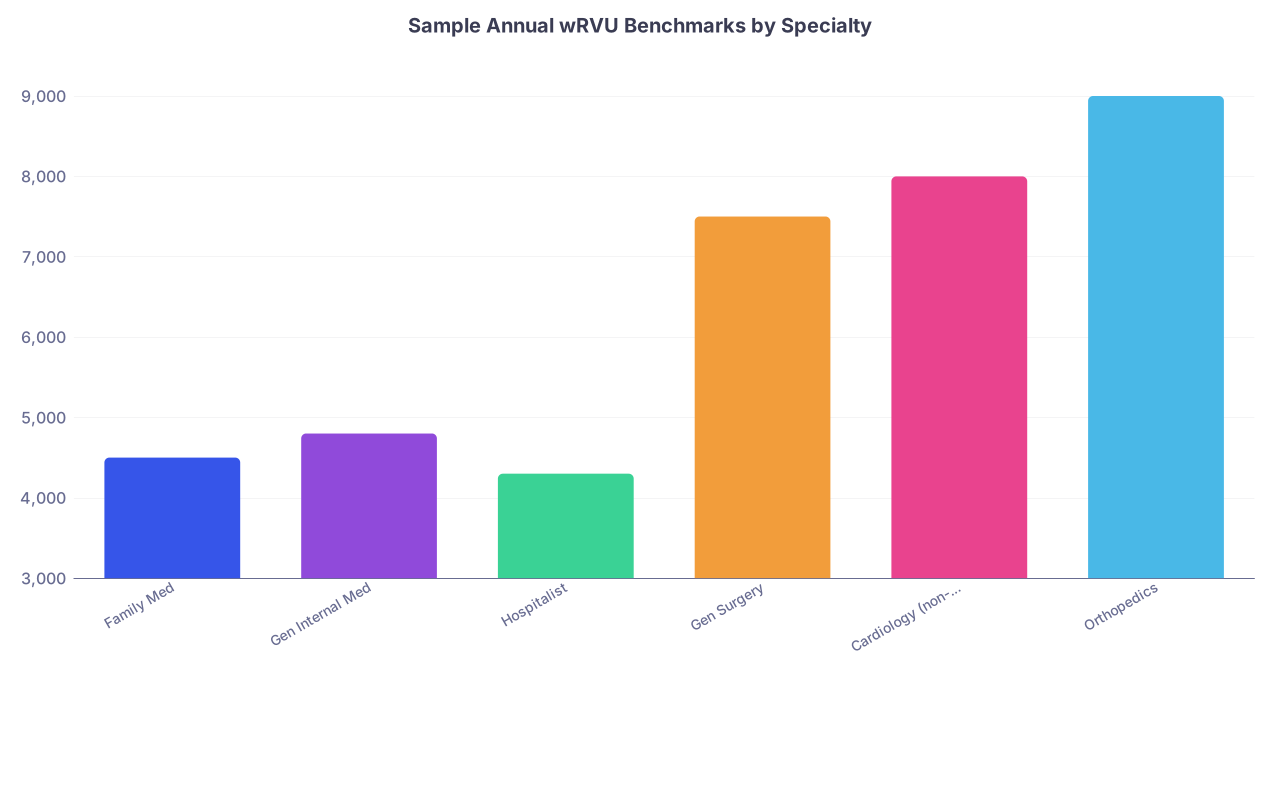
3. Benchmarking: What is a “Good” wRVU Target?
Your leverage depends on knowing whether your expected wRVUs are reasonable for your specialty.
| Category | Value |
|---|---|
| Family Med | 4500 |
| Gen Internal Med | 4800 |
| Hospitalist | 4300 |
| Gen Surgery | 7500 |
| Cardiology (non-int) | 8000 |
| Orthopedics | 9000 |
Those numbers are representative mid-career MGMA-ish targets, not absolutes, but they give you a sense of scale.
Typical ranges:
- Primary care (FM/IM outpatient): 4,000–6,000 wRVUs
- Hospitalists: 3,500–5,000 wRVUs
- Non-procedural subspecialties (Rheum, Endo, ID): 4,000–6,500 wRVUs
- Procedural subspecialties (GI, Cards, Pulm): 7,000–12,000+ wRVUs
- Surgical: 7,000–12,000+ wRVUs, sometimes higher in high-volume ortho, neurosurg
If your “expected” wRVUs are at 75th percentile but your salary is at 25–50th percentile, your contract is weak. Period.
4. How a Clinic Day Actually Turns into wRVUs
Let’s take a real-world clinic day and translate it into RVUs and then into cash.
Example – Outpatient internal medicine clinic
You are an internist in a hospital-employed group.
- Contract: Base $240,000, threshold 4,500 wRVUs, bonus rate $50 / wRVU above threshold.
- Typical clinic schedule: 18 patients per day, 4 days a week, 46 weeks a year.
Assume your coding mix per day is:
- 6 patients at 99213 → 0.97 wRVU each
- 10 patients at 99214 → 1.92 wRVU each
- 2 patients at 99215 → 2.80 wRVU each
Daily wRVUs:
- 6 × 0.97 = 5.82
- 10 × 1.92 = 19.2
- 2 × 2.80 = 5.6
- Total = 5.82 + 19.2 + 5.6 = 30.62 wRVUs/day
Annual wRVUs:
- 30.62 × 4 days/week × 46 weeks = 30.62 × 184 ≈ 5,630 wRVUs/year
Now apply your contract formula:
- Above threshold = 5,630 – 4,500 = 1,130 wRVUs
- Bonus = 1,130 × $50 = $56,500
- Total comp = $240,000 + $56,500 = $296,500
Now look at how small changes move that number.
Change 1 – You start undercoding
Same patient mix, but you code:
- 10 visits as 99213 (0.97)
- 8 visits as 99214 (1.92)
- 0 visits as 99215
New daily wRVUs:
- 10 × 0.97 = 9.7
- 8 × 1.92 = 15.36
- Total = 25.06 wRVUs/day
Annual:
- 25.06 × 184 ≈ 4,610 wRVUs/year
Bonus:
- Above threshold = 4,610 – 4,500 = 110 wRVUs
- Bonus = 110 × $50 = $5,500
- Total comp = $240,000 + $5,500 = $245,500
You just lost ~$51,000/year by undercoding, without seeing fewer patients.
That is why I push coding education so aggressively for new attendings.
5. Understanding Conversion Factors and “Fair” $/wRVU
The $/wRVU number is the core lever of RVU-based pay.
In decent markets, typical conversion factor ranges (as of recent years):
- Primary care / non-procedural IM: $45–$60 / wRVU
- Hospitalist: $55–$80 / wRVU
- Procedural subspecialties: $55–$90+ / wRVU
- Surgical: $60–$100+ / wRVU, sometimes more with call-heavy roles
| $/wRVU | Total RVU-Based Pay |
|---|---|
| $45 | $270,000 |
| $55 | $330,000 |
| $65 | $390,000 |
| $75 | $450,000 |
| $85 | $510,000 |
You can see why a 10–15 dollar difference per wRVU is massive for high producers.
How employers justify low $/wRVU
Common lines you will hear:
- “We also provide excellent benefits”
- “We’re in a saturated market”
- “We pay higher base and lower bonus rate”
- “We can’t match private practice, but we offer stability and no overhead”
Translation: they are banking margin on your labor.
Your counter should be data-based:
- What wRVU target is this comp level based on?
- What MGMA percentile of wRVUs and compensation does this represent?
- How many physicians in the group actually hit or exceed this target?
If their answer to that last question is “almost nobody,” you know exactly what is going on.
6. Multi-Year Models: How the Numbers Shift Over Time
Many systems structure contracts over 3 years:
- Year 1 – pure guarantee (salary only)
- Year 2 – guarantee + small productivity bonus
- Year 3 – full productivity model or true-up
Let’s run an actual 3-year trajectory.
Scenario – New cardiologist joining hospital group
Contract:
- Year 1: $500,000 guaranteed, no bonus.
- Year 2: $450,000 base + $70/wRVU over 7,000.
- Year 3: Pure RVU model at $70/wRVU, no base.
Production:
- Year 1: ramp up, 6,000 wRVUs
- Year 2: 8,000 wRVUs
- Year 3: 10,000 wRVUs
Year 1:
- Guaranteed: $500,000
- Implied value at RVU rate: 6,000 × $70 = $420,000
- You are effectively being subsidized $80,000 during ramp-up.
Year 2:
- Base: $450,000
- Above threshold: 8,000 – 7,000 = 1,000 wRVUs
- Bonus: 1,000 × $70 = $70,000
- Total: $520,000
Year 3:
- Pure RVU: 10,000 × $70 = $700,000
So the trajectory is:
- Y1: $500k
- Y2: $520k
- Y3: $700k
If you are the kind of cardiologist who will reliably generate 10,000+ wRVUs, you absolutely want to get to the pure RVU model with a strong conversion factor as soon as possible.
If you expect to be more lifestyle-limited and produce fewer wRVUs, you might prefer a higher base and lower conversion factor.
7. Common Contract Traps Hidden in RVU Language
This is where new attendings get burned.
7.1 “Total RVU” vs “work RVU”
This one is sneaky.
Some contracts say “$45 per RVU” without the word “work.” If they are basing that on total RVUs (work + practice expense + malpractice), the effective pay per wRVU is much lower.
Example:
- CPT code total RVUs: 6.0
- Work RVUs: 3.0
- Practice expense + malpractice: 3.0
- Contract: $45 per total RVU → $45 × 6.0 = $270 total
- Effective pay per work RVU = $270 / 3.0 = $90 per wRVU
Now compare a different contract:
- $60 per work RVU only
On the surface, $45 vs $60 looks like $60 is better. But for that CPT:
- First contract: effective $90 per wRVU
- Second contract: $60 per wRVU
Different procedure mix will change this, but the main point: you need explicit language:
“All productivity-based compensation is calculated on work RVUs (wRVUs), not total RVUs.”
If they fight you on that wording, that is a red flag.
7.2 Changing conversion factor or thresholds mid-contract
Many systems sneak in language allowing them to:
- “Adjust $/wRVU based on changes to CMS fee schedule”
- “Adjust thresholds annually based on updated market benchmarks”
If you do not cap that, they can:
- Increase your threshold by 10–20% after you are locked into the job.
- Decrease your $/wRVU using some vague market study you never see.
You want:
- Explicit $/wRVU protection for the term of the contract, or
- A defined formula for adjustments, not “administration discretion.”
7.3 Excluding certain work from RVUs
Some contracts carve out:
- Call coverage
- Medical director time
- Committee work
- Teaching residents
- Supervision of APPs
Sometimes they pay a small stipend for these. Sometimes they just say “other duties as assigned” with no compensation.
If something takes substantial time and is a recurring obligation, either:
- It generates wRVUs (e.g., you bill for your involvement), or
- It should have explicit stipend or hourly pay enumerated.
8. Realistic Specialty Examples
Let me walk through two more full scenarios with exact numbers so you can see how this looks in the wild.
8.1 Example – GI physician with hybrid model
Contract:
- Base: $500,000
- Threshold: 9,000 wRVUs
- Bonus rate: $80 / wRVU above threshold
- Call: separately compensated at $1,000 per call night, average 6 per month.
Production scenario:
- Clinic + procedures yield 11,000 wRVUs/year
- Call: 6 nights/month × 12 months = 72 nights/year
RVU pay:
- Above threshold: 11,000 – 9,000 = 2,000 wRVUs
- Bonus: 2,000 × $80 = $160,000
- Base + bonus: $500,000 + $160,000 = $660,000
Call pay:
- 72 × $1,000 = $72,000
Total annual compensation:
- $660,000 + $72,000 = $732,000
If the same GI was given a pure RVU model at $80/wRVU and no base, plus same call pay:
- 11,000 × $80 = $880,000 RVU pay
- $72,000 call = $952,000 total
That base salary tied to a high threshold is costing this high producer over $200k/year versus a strong pure RVU model. For a lower producer, it might be protective. For a workhorse, it is a leash.
8.2 Example – Hospitalist with day/night differential
Contract:
- Day shift: 12-hour shift, avg 10 wRVUs
- Night shift: 12-hour shift, avg 6 wRVUs
- Compensation: $65 per wRVU, no base salary.
- Schedule: 15 shifts per month
- 10 days, 5 nights
Monthly wRVUs:
- Day: 10 shifts × 10 wRVUs = 100 wRVUs
- Night: 5 shifts × 6 wRVUs = 30 wRVUs
- Total: 130 wRVUs/month
Annual wRVUs:
- 130 × 12 = 1,560 wRVUs/year
Annual pay:
- 1,560 × $65 = $101,400 → obviously too low for a realistic hospitalist job, which tells you immediately that either:
- The wRVU estimate is wrong, or
- The $/wRVU is much higher, or
- There is also a base or shift stipend.
Let’s fix it to something more realistic.
Realistic scenario:
- Day shift: 18 wRVUs per 12-hour shift
- Night shift: 12 wRVUs
- 15 shifts/month, same distribution
- $65 per wRVU, no base.
Monthly:
- Day: 10 × 18 = 180 wRVUs
- Night: 5 × 12 = 60 wRVUs
- Total: 240 wRVUs
Annual:
- 240 × 12 = 2,880 wRVUs
Compensation:
- 2,880 × $65 = $187,200
Still low for a full-time hospitalist in most markets. So either:
- The rate is more like $80–$100 / wRVU, or
- Typical annual wRVUs are closer to 4,000–5,000, or
- There is a base plus RVU bonus layered on top.
Why does this matter? Because if HR hands you a contract saying “$65 per wRVU, no base,” and they promise you “Our hospitalists make $280k,” you can immediately see whether the math even vaguely lines up.
Back-of-envelope checking like this protects you from fantasy numbers.
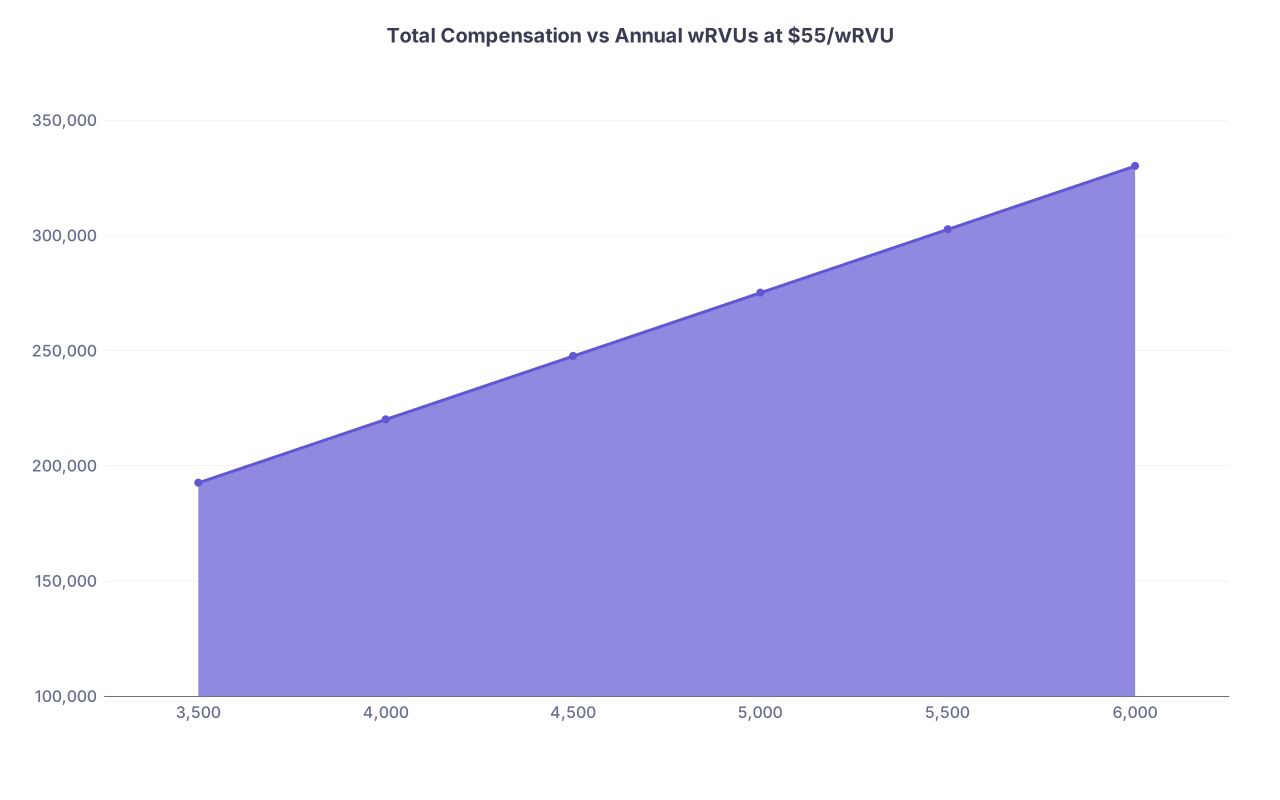
9. Visualizing How Your Choices Move Your Pay
Let’s look at a simple productivity scenario for a primary care physician at different production levels with a fixed $/wRVU.
Assumptions:
- $55 per wRVU
- No base salary (pure production, just to illustrate the math)
| Category | Value |
|---|---|
| 3,500 | 192500 |
| 4,000 | 220000 |
| 4,500 | 247500 |
| 5,000 | 275000 |
| 5,500 | 302500 |
| 6,000 | 330000 |
You can see the pattern:
- 4,000 wRVUs → 4,000 × $55 = $220,000
- 5,000 wRVUs → 5,000 × $55 = $275,000
- 6,000 wRVUs → 6,000 × $55 = $330,000
The key insight: You do not need to double your patient volume to move your pay meaningfully. Improving coding accuracy, panel management, and clinic efficiency enough to go from 4,500 → 5,500 wRVUs might add $55,000 without working 80-hour weeks.
10. Negotiation Priorities: What Actually Moves the Needle
You cannot fix every line in a hospital contract. But there are specific knobs that actually matter.

| Step | Description |
|---|---|
| Step 1 | Start Review Contract |
| Step 2 | Ask for target wRVUs and benchmarks |
| Step 3 | Check wRVU Threshold |
| Step 4 | Check $ per wRVU |
| Step 5 | Confirm uses work RVUs only |
| Step 6 | Look for clawback language |
| Step 7 | Clarify call and admin pay |
| Step 8 | Decide negotiate or walk |
| Step 9 | RVU Model Present |
Priority items:
- wRVU threshold – Lower is almost always better.
- $/wRVU – Higher is better, but compare to realistic benchmarks.
- Use of work RVUs only – No total RVU games.
- Clawback language – Try to limit or eliminate.
- Treatment of non-clinical time – Teaching, admin, call, supervision.
You do not need to win every point. You need to win the ones that have 5–6 figure annual impact.
11. Quick Sanity Check Exercise
If you already have an offer, do this:
Get your:
- Base salary
- wRVU threshold (if any)
- $/wRVU rate
- Any clawback language
Estimate realistic annual wRVUs for your specialty. For a starting point:
- Primary care: 4,500–5,000
- Hospitalist: 4,000–4,500
- Non-procedural subspecialist: 5,000–6,000
- Procedural or surgical: 8,000–10,000
Plug into:
Total Comp = Base + max(0, (Estimated wRVUs – Threshold)) × $/wRVU
- Compare that number to:
- MGMA or AMGA compensation medians for your specialty and region
- State or regional physician comp survey data
If that putative total compensation is at 25th percentile while your expected wRVUs are at 75th percentile, you have a leverage problem. Either:
- Push for lower threshold
- Push for higher $/wRVU
- Ask for stronger guarantee years
- Or walk
You are a scarce, revenue-generating asset. Get paid like it.
Key Takeaways
Your effective formula is almost always some version of:
Total Pay = Base Salary + (wRVUs – Threshold) × $/wRVU, using work RVUs only. If the contract deviates, understand exactly how.Two numbers drive everything: the wRVU threshold and the $ per wRVU. Small changes in either can swing your income by $50,000–$200,000 per year.
If you cannot sit down and, with a calculator, predict your pay based on your anticipated wRVUs, you do not actually understand your contract yet. Fix that before you sign.


