
The biggest mistake physicians make with job offers is simple: they look at the salary and ignore the malpractice line. That is how you quietly lose six figures of net worth without realizing it.
Let me break this down specifically. Tail coverage, occurrence vs claims-made policies, and who pays the malpractice premium will change your real compensation as much as RVUs or call pay. If you do not understand them, you are negotiating blind.
1. The Core Concepts: Malpractice Policy Types and Tail
Before you touch tail coverage, you need the vocabulary straight. Most contracts bury this in two vague sentences. That is not an accident.
Claims-Made vs Occurrence: The One Distinction That Matters
Professional liability (malpractice) policies for physicians are usually one of two types:
- Claims-made
- Occurrence
Here is the blunt summary.
Occurrence policy:
You are covered for any incident that happens while the policy is active, even if the lawsuit is filed years later. No tail needed.Claims-made policy:
You are covered only if:- the incident occurred while the policy was active, and
- the claim is filed while the policy is active.
If the policy ends and a patient sues you later for an event that happened during your employment, you are exposed. That is where tail coverage comes in.
What Tail Coverage Actually Is
Tail coverage (a.k.a. Extended Reporting Endorsement) extends a claims-made policy to cover future claims for past acts. Think of it as: “I stopped working here in 2026, but if someone sues me in 2029 for a 2025 encounter, I am still covered.”
Key points about tail:
- It is usually a one-time lump-sum premium.
- It is tied to your last claims-made policy at that employer.
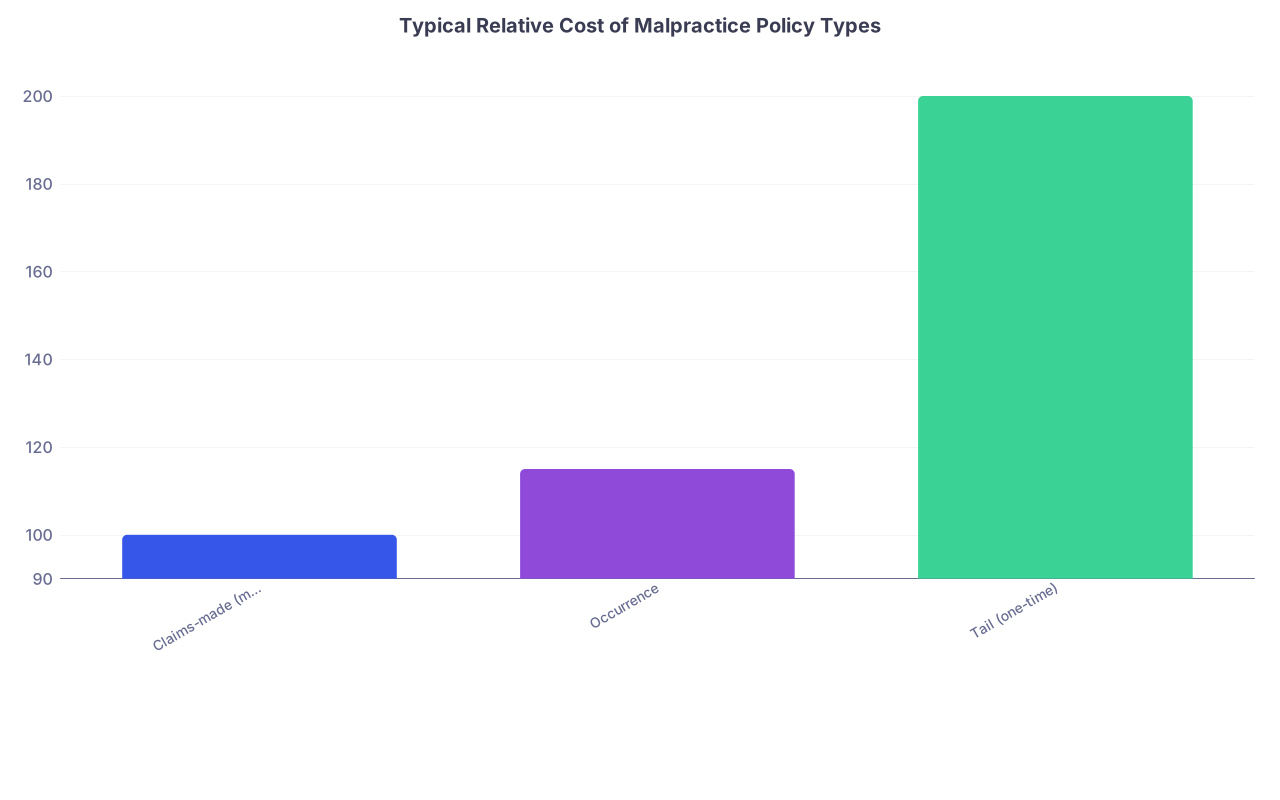
- It often costs between 150–300% of your final annual premium. That number matters. We will quantify it in a bit.
If you are on an occurrence policy, tail is usually irrelevant. If you are on claims-made and you leave, tail is a bill waiting to happen. The question is: who pays it?
| Category | Value |
|---|---|
| Claims-made (mature) | 100 |
| Occurrence | 115 |
| Tail (one-time) | 200 |
In many markets, occurrence coverage has a higher annual premium (say 10–20% more), but eliminates that massive one-time tail bomb. Employers know this. Some use it strategically.
2. How Malpractice Premiums Are Structured
Malpractice premiums are not random. They are driven by:
- Specialty
- Geography
- Policy limits
- Claims history (individual and group)
- Policy type (claims-made vs occurrence)
High-risk specialties pay more. No surprise. But the timing of claims-made premiums is often misunderstood.
The “Step” Pattern in Claims-Made Premiums
Claims-made policies usually “step up” for a few years:
- Year 1: Discounted (you have little exposure history)
- Year 2: Higher
- Year 3–5: Increase until “mature” premium level
- After that: Mature rate each year, adjusted for market
Example for a mid-risk specialty (numbers simplified but realistic):
- Year 1: $12,000
- Year 2: $18,000
- Year 3: $22,000
- Year 4+: $25,000 (mature)
Tail is typically calculated off that mature premium (e.g., 200% of $25,000 = $50,000).
So if you are looking at a job in year 5+ of your career and the group runs claims-made and you are responsible for tail, assume a tail bill in the 1.5–3x mature premium range when you leave.
Specialty Differences: This Is Where Net Pay Gets Hit Hard
Let’s put some rough typical annual mature premiums on paper. These are ballpark and vary by state, carrier, and limits, but they give you order-of-magnitude reality.
| Specialty | Low-Premium State | High-Premium State |
|---|---|---|
| Family Medicine | $6,000–$10,000 | $12,000–$18,000 |
| Hospitalist IM | $10,000–$18,000 | $20,000–$30,000 |
| General Surgery | $30,000–$50,000 | $60,000–$90,000 |
| OB/GYN | $40,000–$70,000 | $80,000–$120,000 |
| Neurosurgery | $60,000–$90,000 | $120,000–$180,000 |
Now imagine tail at 200% of those numbers. A tail bill for an OB/GYN leaving a high-risk state? $160,000–$240,000 is not unusual. I have seen tails quoted higher.
You cannot pretend that is irrelevant to your “$400k base salary” job offer.
3. Who Pays For What: Employer vs Physician vs Hybrid
This is where contracts get slippery. The salary looks great, and then in Section 10.3 they quietly assign tail to you and call that “standard.”
There are a few common setups.
Model 1: Employer Pays All Malpractice and Tail
Often seen in:
- Large hospital systems
- Academic centers
- Some larger multispecialty groups
Structure:
- Employer pays annual malpractice premium.
- Employer pays tail when you leave (or policy is structured to avoid tail, such as occurrence or occurrence-like).
This is financially clean for you. When you compare offers, these are generally safer, especially in high-risk specialties or high-premium states. But watch for this trick: lower base salary “because we pay your malpractice.”
Sometimes that is fair. Sometimes they are over-discounting your salary for a risk they are already pooling cheaply.
Model 2: Employer Pays Annual Premium, Physician Pays Tail
Common in:
- Smaller private practices
- Some hospital-employed jobs in competitive markets
- Groups where turnover is frequent and they do not want legacy costs
Structure:
- Employer covers annual claims-made premium.
- When you leave, you must purchase tail (often due within 30–60 days of termination).
This setup quietly transfers significant future liability to you. The younger you are, the worse the math tends to be, because you are more likely to change jobs more often.
Model 3: Shared or Conditional Tail
More complex language, for example:
- Employer pays tail if you are terminated without cause or the employer non-renews.
- You pay tail if you resign or are terminated for cause.
- Or a sliding scale:
- Leave within 1 year → you pay 100% of tail
- Leave 1–3 years → 50%
- Leave after 3 years → employer pays 100%
This is actually a reasonable compromise in many situations, but the details matter. A vague definition of “cause” or “non-renewal” can flip six figures of liability back onto you.
Model 4: Occurrence Policies (No Tail) With Higher Annual Premium
Common when:
- Employers want simplicity
- States or carriers make occurrence competitive
- Groups sell “no tail!” as a recruiting pitch
Here, what you care about is:
- Is your compensation being quietly adjusted downward because of that higher occurrence premium?
- Are you indirectly paying it through a lower base or RVU rate?
Often you are. That is not necessarily bad. It just has to be quantified.
4. How Tail and Premiums Change Your Real Net Pay
Let’s stop talking theory and run numbers. This is where you see why ignoring tail is financial malpractice against yourself.
Scenario A: Hospitalist – Two Job Offers
You are a hospitalist in a mid-risk state. Typical mature claims-made premium: $20,000/year. Tail roughly 200% of mature: $40,000.
You have two offers:
Offer 1 – Big hospital system
- Base salary: $300,000
- RVU bonus: modest
- Malpractice: occurrence, employer pays everything, no tail.
Offer 2 – Private group
- Base salary: $330,000
- Malpractice: claims-made, employer pays annual premium, you pay tail on exit.
- Expected tail cost: $40,000 at departure.
Most people look at this and say: “Offer 2 is $30k more per year. Easy choice.”
Not so fast.
Assume you stay 4 years.
Total base pay over 4 years:
- Offer 1: 4 × $300k = $1,200,000
- Offer 2: 4 × $330k = $1,320,000
So far, Offer 2 is ahead by $120k.
Now insert tail:
- Offer 1: $0 tail
- Offer 2: -$40,000 (tail bill when you leave)
Net difference over 4 years:
Offer 2 ahead by $80k pre-tax.
That might still be worth it. But remember:
- That $40k tail is due as a lump sum at exit. Not amortized. Not gentle.
- If you leave EARLY (after 1–2 years), the salary differential may not be enough to offset that tail.
Let’s redo it for a 2-year stay:
- Offer 1: 2 × $300k = $600k, no tail
- Offer 2: 2 × $330k = $660k, minus $40k tail = $620k
Now Offer 2 is only $20k ahead. Pre-tax. That is not much compensation for the risk and the headache.
Scenario B: OB/GYN – Tail as a Six-Figure Landmine
You are an OB/GYN in a high-premium state. Mature claims-made premium is $100,000/year. Tail estimated at 200%: $200,000.
Two offers:
Offer A – Hospital employed
- Base salary: $330,000
- Hospital pays claims-made premium and tail.
Offer B – Private OB/GYN group
- Base salary: $380,000
- Group pays annual premium. You pay tail if you leave.
Everyone loves to say, “Private practice pays more.” Sometimes it does. Sometimes it just shifts risk to you.
Stay 3 years:
- Offer A: 3 × $330k = $990k, no tail
- Offer B: 3 × $380k = $1,140k; minus $200k tail = $940k
Now the “higher-paid” private practice job is actually $50,000 worse over 3 years, before tax. And your worst-case scenario is ugly: if the group becomes toxic, or the hospital pulls the contract and you are pushed out, you might owe $200k right when you least want it.
Translating Tail Into “Effective Salary”
The smarter way to compare jobs is to amortize expected tail over your likely tenure.
If tail = $60,000 and you expect to stay ~3 years, then tail is effectively $20,000/year of additional cost borne by you.
So if:
- Job X = $300k with no tail risk
- Job Y = $320k but you will owe $60k tail
Job Y is effectively $320k - $20k = $300k/year in real terms. And that is before you account for the risk of staying shorter than expected (which makes the tail more expensive per year).
5. Reading the Contract: Where Malpractice Hides
Most of what matters is in a small section usually labeled something like “Professional Liability Insurance,” “Malpractice Coverage,” or “Insurance and Indemnification.”
You are looking for precise answers to a few questions.
Question 1: What Type of Policy?
You want explicit language like:
- “Employer shall provide professional liability insurance on a claims-made basis with limits of $1,000,000 per claim / $3,000,000 aggregate.”
- Or “on an occurrence basis…”
If it just says “professional liability coverage will be provided,” that is not enough. That is deliberate vagueness.
Question 2: Who Pays the Annual Premium?
Is there any language like:
- “Employer shall pay the premiums for such coverage”
- Or “Physician shall be responsible for all or part of the premiums”
You want it clearly on the employer side unless you are getting a very significant salary or partnership upside.
Question 3: Who Pays Tail, Under Which Circumstances?
This is the money sentence. It usually appears as:
- “Upon termination of this Agreement for any reason, Physician shall be solely responsible for purchasing tail coverage…”
- Or “Employer shall be responsible for any extended reporting endorsement (tail coverage) required due to termination of this Agreement, except in the case of termination for cause by Employer or voluntary resignation by Physician…”
Ambiguous or missing language is a problem. If the contract is silent on tail and the policy is claims-made, assume you may end up responsible by default or by later “policy.”
Question 4: What Are the Limits?
Typical limits look like $1M / $3M or $2M / $4M. Higher limits cost more. You will not usually be able to negotiate the limits, but:
- Very low limits (e.g., $500k / $1.5M) may be unacceptable in some markets.
- Very high limits drive up premiums and tail. If you are paying that, you need to realize the cost.

| Step | Description |
|---|---|
| Step 1 | Review Contract |
| Step 2 | Check who pays tail |
| Step 3 | Confirm no tail needed |
| Step 4 | Assess salary and terms |
| Step 5 | Estimate tail cost |
| Step 6 | Convert to effective salary |
| Step 7 | Policy type listed |
| Step 8 | Tail paid by employer? |
Use that flow mentally every time you look at an offer. It will save you real money.
6. Negotiating Tail and Premiums: What Is Actually Realistic
You are not going to rewrite the employer’s entire malpractice program. But you can usually move the needle on who pays for tail and under what conditions.
What You Can Reasonably Ask For
A few targeted asks that I have seen succeed:
Employer pays tail if they terminate you without cause or non-renew
You pay tail if you resign or are terminated for cause.This is fair and common. It protects you against unilateral changes or politics.
Sliding-scale tail responsibility
For example:- Leave in year 1 → you pay 100%
- Year 2 → 66%
- Year 3 → 33%
- After year 4 → employer pays 100%
This recognizes that you have already generated revenue to justify your risk to the group.
Tail forgiveness upon partnership (for private groups)
The group may agree to cover your tail if you become a partner and later separate on good terms.Sign-on or retention bonus earmarked for tail
If they will not budge on tail at exit, you can ask for:- Higher sign-on bonus
- Retention bonus at year 3 or 4
Explicitly to offset your eventual tail obligation.
If they refuse even to discuss it, that tells you something about how they value you and how flexible they are in general. That matters more than the exact dollar amount.
When Tail Should Be a Dealbreaker
There are situations where accepting full tail risk is frankly reckless:
- You are in a very high-premium specialty (OB, neurosurg, some surgical subspecialties) in a high-risk state, and tail will likely be $150k+
- The group has high turnover, opaque finances, or a history of contract instability
- You are early in your career and very likely to move (geographically or professionally) within a few years
- The salary differential versus safer offers is modest (< $20–30k/year)
In those settings, telling yourself “I will just stay long enough to make it worth it” is optimism, not a plan.
7. How This Plays Against Your Personal Financial Plan
Malpractice premiums and tail coverage do not exist in a vacuum. They hit:
- Cash flow
- Emergency fund needs
- Ability to change jobs or negotiate from strength
Cash Flow And Timing Risk
Remember two things about tail:
- It usually must be paid in one lump sum soon after termination.
- You will be paying it while possibly between jobs or relocating.
For a $60k tail, that might be survivable with a strong savings cushion. For a $200k tail, this can become a forced debt decision:
- Tapping taxable brokerage accounts
- Liquidating investments at a bad market time
- Taking on high-interest loans or credit lines
You should plan your emergency fund not just for “3–6 months expenses,” but for “3–6 months expenses plus anticipated tail.”
| Category | Value |
|---|---|
| Low-risk specialty | 15000 |
| Mid-risk specialty | 60000 |
| High-risk specialty | 180000 |
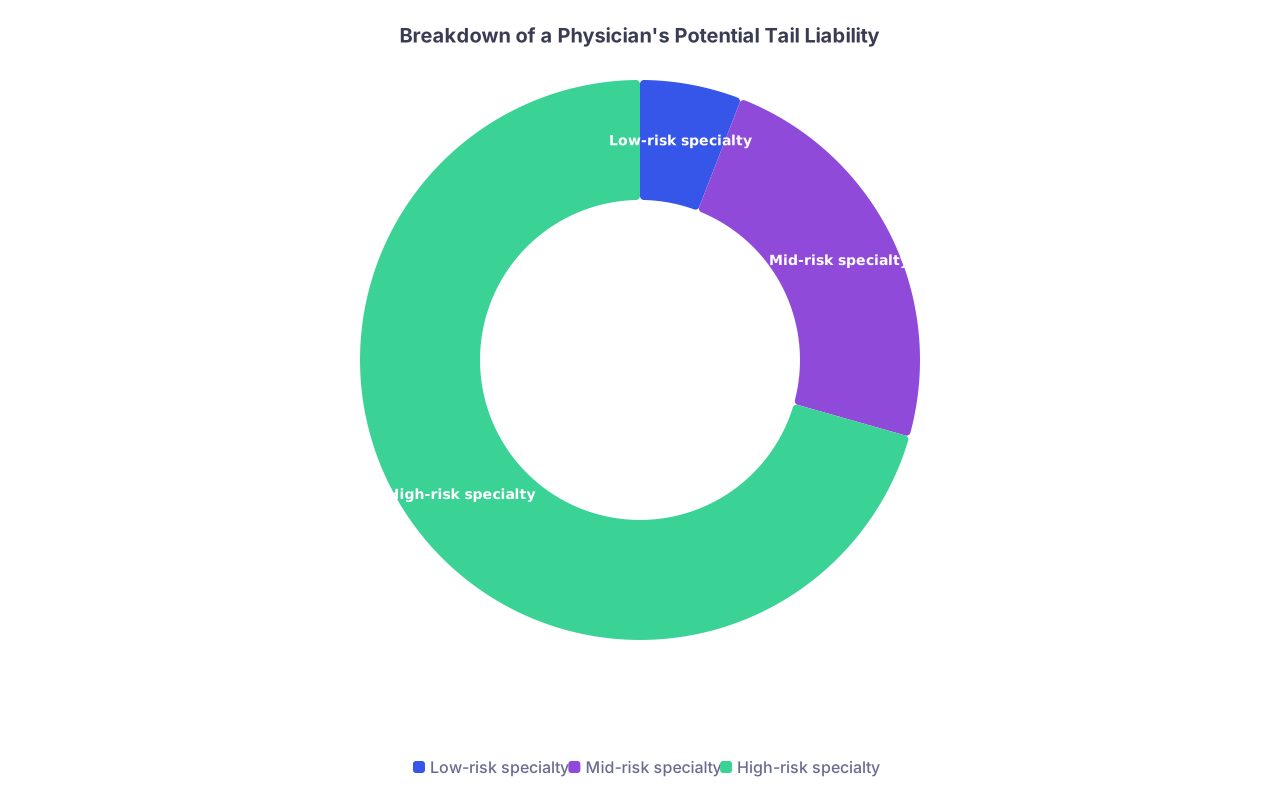
The chart’s point: as your risk profile goes up, tail is not a rounding error. It is a major liability line item.
Career Flexibility
If you know you are on the hook for a $120k tail, you are less likely to leave a toxic environment, stand up to abusive administrators, or change geography for family reasons. That is not a trivial side effect.
This is why I view massive physician-paid tail as a golden handcuff. It binds you to a job longer than is healthy, both financially and psychologically.
Tax Treatment (Quick but Important)
Premiums and tail coverage paid by the employer:
- Not taxable income to you (in normal structures).
- Deductible as a business expense to them.
If you are an employee (W-2) and you pay tail personally:
- Post-2017 U.S. tax law largely killed miscellaneous itemized deductions for unreimbursed employee expenses.
- You are typically paying tail with after-tax dollars.
If you are an independent contractor (1099):
- You can usually deduct malpractice and tail as a business expense on Schedule C.
- That softens the blow, but you are also paying both sides of FICA, etc.
Bottom line: a $60k tail as a W-2 employee is not “really” $60k. You had to earn maybe $90k–$100k pre-tax to net that amount. Keep that mental conversion in mind.
8. Practical Comparison: Putting Two Offers Side by Side
Let me give you a tight framework you can literally use with a spreadsheet.
For each offer:
- Estimate expected annual malpractice premium (ask the employer if needed).
- Identify who pays it.
- Determine policy type and whether tail is expected.
- Estimate tail amount = 1.5–3x mature premium (adjust by your specialty/region).
- Estimate how many years you realistically expect to stay.
- Amortize tail over those years: Tail / Years = annualized tail cost.
- Subtract that annualized tail cost from salary to get effective salary.
- Layer in non-competes, call pay, RVU structure, and benefits separately.
| Item | Offer 1 (Hospital) | Offer 2 (Private Group) |
|---|---|---|
| Base Salary | $300,000 | $330,000 |
| Policy Type | Occurrence | Claims-made |
| Annual Premium (estimate) | $20,000 | $18,000 |
| Tail Multiplier | N/A | 2.0 |
| Tail Amount | $0 | $36,000 |
| Expected Tenure (years) | 4 | 4 |
| Annualized Tail Cost | $0 | $9,000 |
| Effective Salary (Base - tail) | $300,000 | $321,000 |
In this simplified case, Offer 2 still wins by $21,000 in effective salary. But if your expected tenure drops to 2 years, that annualized tail cost doubles to $18,000/year and the advantage shrinks fast.

You ignore that “Malpractice” branch and you think you are making smart money decisions. You are not.
FAQ (Exactly 6 Questions)
1. How can I find out what my tail coverage will actually cost?
Ask directly: “What is the current mature annual malpractice premium for my position, and what is the typical tail multiplier with your carrier?” If they will not answer, that is a red flag. If they do, you can estimate: Tail ≈ (multiplier) × (mature premium). You can also call the named malpractice carrier yourself and ask for a rough quote for your specialty and state.
2. Is an occurrence policy always better than claims-made?
Not always. Occurrence is simpler and avoids tail, which I like for most employed physicians. But occurrence premiums are often higher, and in some markets occurrence coverage is limited or overpriced. If an employer uses claims-made but pays all premiums and tail, that can be just as good in practice. The real issue is not policy type in isolation. It is who bears the long-term risk and cost.
3. I am joining a private group with a promised partnership track. Should I still worry about tail?
Yes. “Partnership track” is often conditional and sometimes ill-defined. If tail is your responsibility until you become a full partner, you are exposed if the group decides you are “not a fit” in year 2 or 3. Your contract should spell out what happens to tail on partnership and on different termination scenarios. Do not rely on verbal assurances.
4. Can I buy my own tail coverage if the employer refuses to cover it?
You can. Tail is normally purchased through the same carrier that wrote the underlying claims-made policy. You typically have a limited window (e.g., 30–60 days after the policy ends) to purchase it. You cannot shop tail easily across carriers like car insurance; it is tied to the existing policy. If you cannot afford tail when you leave, going bare is a catastrophic risk and generally a bad idea.
5. How does malpractice coverage work if I am a 1099 independent contractor?
Then you are usually responsible for obtaining and paying for your own malpractice coverage, including tail. Some locums agencies or contracting entities provide a policy, but you must read those terms extremely carefully. The upside is that premiums and tail are business expenses, so they are deductible. The downside is that you carry full responsibility for picking adequate coverage and planning for any tail obligations.
6. What is the biggest red flag I should watch for in the malpractice section of a contract?
A combination of three things: 1) claims-made policy, 2) you pay tail for any reason you leave, and 3) high-risk specialty or high-risk state. That triad sets you up for a very large, very real future bill. A close second red flag: vague or missing language around tail responsibility. If it is not clearly the employer’s obligation in writing, assume it might be yours when things go bad.
Key points to remember:
- Tail coverage is not a footnote. It can be a six-figure swing in your real compensation, especially in high-risk specialties.
- Always convert tail and malpractice structure into an “effective salary” when comparing job offers; otherwise you are comparing fantasy numbers.
- If you do not see clear, explicit contract language about policy type, who pays premiums, and who pays tail under which scenarios, you do not have a safe deal yet.