
The most expensive career mistake physicians make is bungling their private practice exit.
Let me break this down specifically: the same practice can generate a life‑changing payout… or a disappointing rounding error… purely based on structure, timing, and who understands the rules of the game better.
You want to be on the right side of that equation.
1. The Three Core Exit Scenarios (and What They Really Mean)
Forget the 20 variations you have heard. Almost every private practice exit for a physician owner collapses into one of three buckets:
- Internal exit to partners/junior physicians
- External sale to a hospital/health system
- External sale to private equity (or similar consolidator)
Each has different valuation logic, payout structure, and long‑term income consequences. If you do not understand those differences, you are negotiating blind.
1.1 Internal Exit – Selling to Partners or Junior Associates
This is the “classic” model. You retire or partially step back; younger partners or associates buy your equity.
What usually happens in the real world:
- The buy‑in/buy‑out formula is often legacy and crude. Many were created when EHRs were new and nobody had heard of EBITDA multiples.
- Payments are spread over 3–10 years, often funded from practice cash flow (which you used to own).
- Valuation is conservative, sometimes deliberately so, to make the buy‑in “affordable” to juniors.
Financially, that means:
- Lower nominal valuation than an external sale.
- More predictable, but slower payments.
- Often better cultural continuity and control of your patient base.
Internal exits tend to maximize stability and relationships but not necessarily dollars per RVU you built over 20 years.
1.2 Hospital Acquisition – Stability Premium, Lower Upside
Selling to a hospital or health system is usually about three things:
- Off-loading administrative burden
- Getting out before reimbursement deteriorates further
- Locking in employment income and benefits
Hospitals do not typically pay “crazy” prices. They are constrained by:
- Stark/AKS fair market value requirements
- Compliance officers who have seen too many enforcement actions
- Board rules about not overpaying for goodwill
So the acquisition tends to focus on:
- Tangible assets (equipment, leasehold improvements)
- Some consideration for patient base/referrals (but wrapped in “fair market” language)
- Then an employment contract with RVU or salary guarantees
You often trade a smaller up‑front payday for a more predictable employed income stream. The hidden cost: loss of control and future upside.
1.3 Private Equity / Consolidator – High Sticker Price, Heavier Strings
This is where the big numbers show up. Orthopedics, GI, dermatology, ophthalmology, anesthesia, radiology, EM, pathology, some primary care groups — all have seen aggressive PE roll‑ups.
Mechanics:
- Platform or add‑on acquisition, valued as a multiple of EBITDA.
- Significant portion of proceeds in cash, plus rollover equity in the new entity.
- Post‑transaction, you are usually an employed physician with productivity metrics, often on a 3–5 year commitment.
On paper, PE deals can look dramatically richer than internal or hospital exits. But the spread between headline number and what actually stays in your pocket over 10–15 years can be large once you factor in:
- Lost professional income under less favorable comp formulas
- Loss of future equity growth you would have kept in a solo/partnership model
- Risk that the second liquidity event (when the PE firm sells) underperforms
2. How Your Practice Is Really Valued (Not the Story You Are Told)
Most physicians underestimate how sharply the valuation framework changes depending on the buyer. This is where many leave hundreds of thousands — sometimes millions — on the table.
Let us run the valuation lenses.
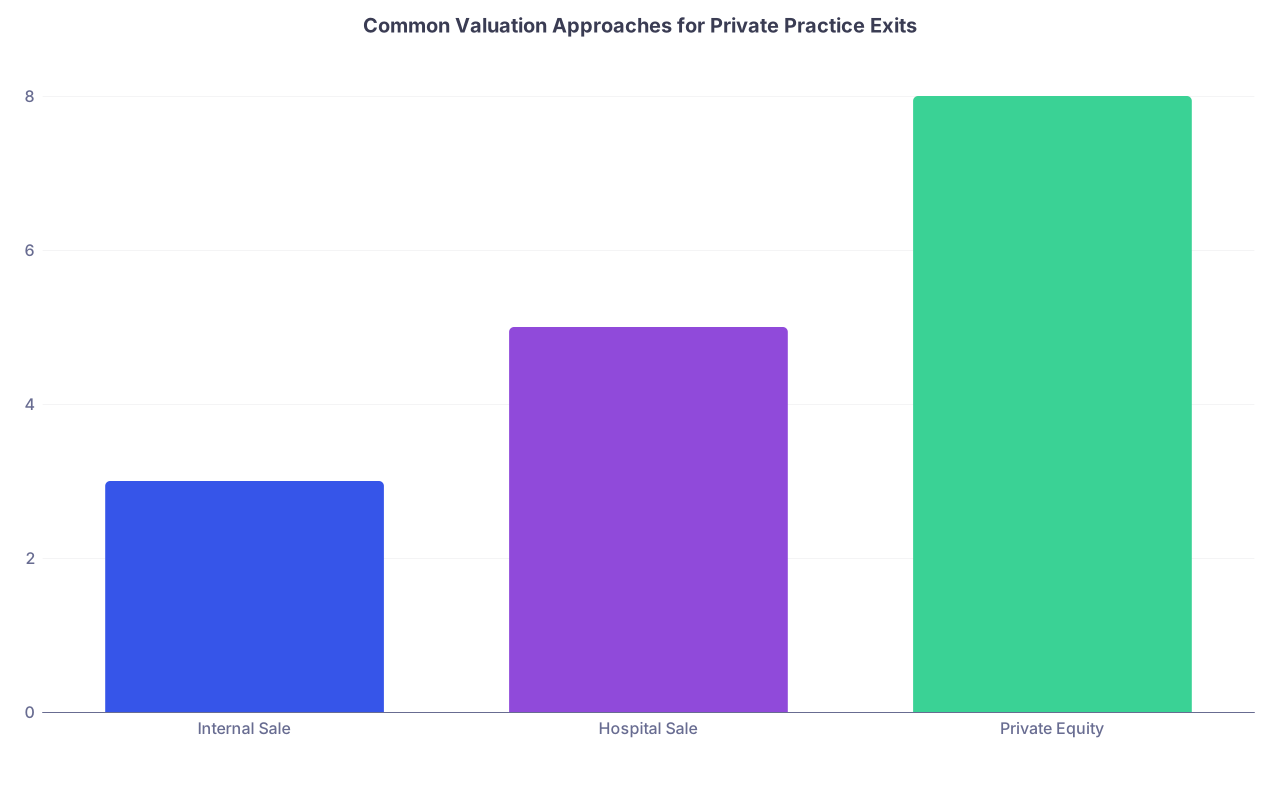
| Category | Value |
|---|---|
| Internal Sale | 3 |
| Hospital Sale | 5 |
| Private Equity | 8 |
(Think of these numbers as relative multiples, not exact.)
2.1 Asset-Based Valuation – The Floor
Internal exits and some hospital acquisitions still anchor heavily on asset-based thinking.
Typical components:
- Furniture, fixtures, equipment (FFE) – often at depreciated or “used market” value
- IT/EHR hardware and sometimes software licenses
- Accounts receivable (AR) – at some discount
- Leasehold improvements
This method massively undervalues many profitable practices because it barely credits:
- Established referral patterns
- Brand reputation in the community
- Efficient staff and workflows
- Favorable payer contracts
Asset-based valuation is fine as a floor. It is usually a terrible ceiling for a consistently profitable group.
2.2 Income / Cash Flow Valuation – Capitalizing Your Future Work
Serious buyers (PE and larger systems) look at your earnings power.
They ask:
- What is the normalized EBITDA of this practice?
- What happens if we optimize billing, centralize admin, improve purchasing?
- What is the risk that reimbursement or volumes drop?
For an independent group doing, say, $1.5M in EBITDA, the multiple might be:
- Internal sale: 2–4x EBITDA (often indirectly baked into a share formula)
- Hospital: effectively 3–5x, but disguised via asset payments and employment comp structure
- PE: 7–12x (sometimes more for platform assets), but not all in cash
Key concept: add-on vs platform.
- Platform practice: first acquisition in a region/specialty for that PE sponsor. Gets higher multiple because it is the base for further roll‑ups.
- Add-on: one of many folded in. Usually lower multiple.
If your group has scale (10+ providers, strong ancillaries, multiple sites), your platform potential matters hugely. I have seen two structurally similar practices get 6x vs 10x EBITDA solely because one was positioned as a true platform.
2.3 Revenue Multiples – Shortcut for Primary Care and Smaller Groups
Some buyers (especially hospitals) still use crude top-line revenue multiples:
- 0.3–0.8x annual collections for many primary care groups
- Sometimes more for specialties with strong ancillaries (endoscopy, imaging, ASC ownership)
This approach ignores cost structure nuances. A lean, well‑run practice gets punished relative to a bloated one with the same revenue.
If someone is valuing you purely on revenue, you should be asking: what does our normalized EBITDA look like, and what would a strategic buyer pay on that basis?
3. Payout Structures: Cash Today vs Money on a String
Headline purchase price is not your retirement plan. The structure of the payout often matters more than the number.
| Exit Type | Cash at Close | Earnout / Contingent | Equity Rollover |
|---|---|---|---|
| Internal Sale | 10–30% | Low | Little/None |
| Hospital Sale | 50–80% | Low–Moderate | None |
| Private Equity | 50–70% | Moderate–High | 10–30% |
3.1 Cash at Close
Best part. Clearest. Bankable.
What changes it:
- Negotiating leverage (size, specialty, local competition)
- Buyer risk tolerance
- Lender requirements (for PE-backed deals)
Do not be naive: asking for “all cash, no strings” in a PE roll‑up is usually fantasy unless your group is tiny (and even then, unlikely).
3.2 Earnouts and Performance-Based Payments
Earnouts can be:
- A fair bridge between optimistic projections and conservative buyers
- Or a weapon to claw back price when things are structured impossibly
Common PE construct: additional payments if EBITDA hits certain targets over 2–3 years. For physicians, practical translation:
- You need to maintain or grow volume
- RVU targets tighten
- Cost cuts you do not control can impact earnings (and therefore your earnout)
If more than ~25–30% of total consideration is tied to aggressive earnouts, you are not retiring soon. You are signing up for a multi‑year performance job with your money at risk.
3.3 Equity Rollover – Second Bite of the Apple, or Expensive Lottery Ticket?
In PE deals, you almost always roll some of your equity into the newco:
- Typical: 10–30% of your “proceeds” get converted into equity of the larger entity.
- This is sold as a “second bite at the apple” when the sponsor exits (usually 5–7 years).
Reality:
- If the platform grows and sells well? That rollover can equal or exceed your initial cash payout.
- If reimbursement headwinds hit, integration is messy, or management is poor? It can be nearly worthless.
You are trading guaranteed cash today for exposure to someone else’s operational decisions.
One practical rule: do not roll more than you can afford to mentally write to zero. Treat rollover equity as high‑risk capital, not core retirement funding.
4. The Hidden Income Consequences After You “Cash Out”
Most physicians obsess over the exit multiple and ignore the next 10–15 years of income. That is backwards. Your post‑exit earnings often dwarf the upfront check.
Let us break the consequences out clearly.
4.1 Compensation Model Shift – From Owner Economics to Producer Economics
As an owner, your compensation contains:
- Clinical pay (what you would earn as an employee)
- Plus profit share (your slice of practice/ancillary EBITDA)
- Plus asset appreciation (value of shares if practice grows)
After a sale:
- You become a producer.
- You usually lose most or all of the profit share.
- Your “ownership” may convert into small equity in a much larger entity where you are diluted.
Common patterns:
- RVU-based comp at 35–45% of collections equivalent, versus 45–60% effective rate you enjoyed as an owner when you factored in distributions.
- Productivity floors and higher thresholds for bonuses.
Outcome: your annual income can fall by $50k–$300k depending on specialty and structure.
4.2 Lifestyle and Control – The Subtle Income Killers
You will not see these on a term sheet, but they show up in your life:
- Less control over schedules, template density, call
- Centralized decisions on staffing (MAs, scribes, NPs/PAs), which affects throughput
- Pressure to use internal ancillaries/imaging/ASCs, sometimes at the expense of efficiency
That means fatigue, less flexibility in cutting back, and fewer levers to pull if you want to adjust income vs time later in your career.
Those qualitative hits compound with the quantitative comp changes.
4.3 Taxes – The Quiet 30–40% Haircut
Large one‑time payments are magnets for poor tax planning. Three recurring errors:
- Not separating capital gains from ordinary income properly in deal structure.
- Ignoring options for installment sales where appropriate.
- Failing to coordinate the sale year with retirement account maxing, defined benefit plans, or charitable planning.
In many deals:
- Equity sale proceeds can qualify for long‑term capital gains.
- Payouts tied to future work often end up as ordinary income.
- Poorly structured “goodwill” vs “personal goodwill” allocations can change your net by six figures.
If your accountant’s main business is 1040s and small business returns, they are probably not the right person to quarterback a multi‑million-dollar deal.
5. Comparing Exit Paths: A Simple Numerical Example
Let us run a simplified, but realistic, example for a mid‑size specialty group. Say:
- 6 physicians, equal owners
- Practice EBITDA: $2.4M per year (i.e., $400k per doc after reasonable comp)
- Each physician currently takes home: $650k (clinical comp) + $400k/6 ≈ $716k total
Now three exit options for a single physician planning to reduce clinical work over 5–7 years.
| Metric (Per Physician) | Internal Exit | Hospital Sale | PE Sale |
|---|---|---|---|
| Upfront Cash Proceeds | $400k | $800k | $1.4M |
| Average Annual Post-Exit Income | $600k | $550k | $500k |
| Rollover Equity Value (Year 7) | N/A | N/A | $700k* |
*Assumes successful second sale; could be far lower or higher.
If you model 10 years:
- Internal exit: Lower upfront, moderate reduction in annual income, but you maintain meaningful control.
- Hospital: Mid upfront, income drops more but risk is lower and benefits stronger.
- PE: Highest upfront + possible second liquidity, but annual comp usually hits hardest and risk of equity shortfall is real.
The point is not that one is “best” universally. It is that you must stop staring only at the check and start modeling the total 10–15-year economic picture.
6. Legal and Contract Traps That Blow Up Your Economics
Physicians often shrug and “let the lawyers handle it.” Bad idea. You do not need to become an M&A attorney, but you must understand the key economic levers in your contracts.
Here is where I have seen physicians get hurt most:
6.1 Noncompetes and Restrictive Covenants
Noncompetes move from “annoying” to “financially catastrophic” after a sale.
Common pattern:
- 10–25 mile radius
- 1–3 years
- Applies to you as an individual, even if the corporate structure changes
If the new environment is intolerable and you leave, your choices might be:
- Move your family or commute absurd distances
- Or leave clinical practice for the duration
From a pure financial lens, any noncompete longer than 18–24 months with a wide radius in a dense market deserves aggressive pushback. Carve‑outs (e.g., academic appointments, telemedicine, non‑clinical leadership roles) matter.
6.2 Post-Closing Adjustments and “True-Ups”
Some deals include mechanisms where purchase price is adjusted based on:
- Final AR reconciliation
- Working capital levels
- Future audits or recoupments
If the language is sloppy, you can see six‑figure “surprise” reductions months after closing. Make sure:
- There is a clear cap on negative adjustments.
- The time window for clawbacks is limited.
- Calculation formulas are unambiguous and exampled in the contract schedules.
6.3 Call Coverage and Workload Creep
You negotiate compensation and forget to pin down call and clinic expectations. After closing, administration:
- Increases call frequency
- Tightens clinic templates
- Cuts support staff
The economic effect is you are working 15–25% harder for the same pay, which is just a stealth pay cut on a per-hour basis.
Locking in:
- Max clinic sessions per week
- Max call shifts per month
- Clear compensation for additional call or administrative duties
…is not overkill. It is protecting the effective hourly rate you are selling your autonomy for.
6.4 Governance and Minority Protections
In PE roll‑ups, physicians often become minority shareholders in a management or holding company.
If you lack:
- Veto rights on major decisions
- Protection against disproportionate dilution
- Clear distribution policies
…you have “shadow equity” with minimal practical value.
Ask blunt questions:
- What decisions can be made without physician board consent?
- Can new equity classes be issued ahead of yours?
- What is the distribution policy versus reinvestment?
If the answers are fuzzy, your “second bite” is more marketing than substance.
7. How to Prepare Your Practice for a Better Exit (3–5 Years Out)
You do not “decide” to sell and close 90 days later on good terms. The practices that get the best economics usually started preparing years in advance.
7.1 Clean Financials and True EBITDA
Buyers pay for what they can see and believe.
You want:
- 3+ years of clean, accrual‑based financial statements
- Clearly delineated owner perks (so they can be added back to EBITDA)
- Minimal commingling of personal expenses through the business
If you have family on the payroll at inflated salaries, undocumented cash collections, or erratic distributions, your normalized EBITDA story becomes muddled and the buyer discounts.
7.2 Contract Review – Payers, Vendors, and Leases
Red flags that hurt valuation:
- Long‑term leases at above‑market rates with limited assignment rights
- Onerous payer contracts that are hard to renegotiate
- Equipment leases with early termination penalties
You want as much assignability and flexibility as possible so a buyer does not see “deal friction” everywhere they look.
7.3 Partner Alignment
The fastest way to kill value: internal partner fights.
Buyers hate:
- Unresolved disputes about ownership percentages
- Different groups of physicians wanting totally different outcomes
- Retirement timing all over the place
You need a coherent partnership position on:
- Whether you are open to PE vs hospital vs internal continuity
- What minimum economics each partner needs to consider a deal
- How retiring vs mid‑career partners will be treated
If you wait until the LOI stage to fight those out, you will get steamrolled.
8. A Simple Exit Decision Framework
Let me give you a blunt, high‑level framework. Not perfect, but directionally right.

| Step | Description |
|---|---|
| Step 1 | Start - Practice Owner |
| Step 2 | Explore PE Deals |
| Step 3 | Hospital Sale or Hybrid |
| Step 4 | Internal Buy Out Planning |
| Step 5 | Selective External Bids |
| Step 6 | Model 10 Year Income |
| Step 7 | Time Horizon < 5 years? |
| Step 8 | Maximize Cash Now? |
| Step 9 | Value Control/Autonomy Most? |
At every path, the commandment is the same: build a 10‑year personal financial model:
- Upfront proceeds (after tax)
- Expected annual income under new comp plan
- Reasonable scenarios (not fantasies) for any rollover equity or earnouts
- Lifestyle tolerances — how long you truly plan to work at new intensity
If the numbers only look good under the “best case” row, be careful.
FAQ (Exactly 4 Questions)
1. How many years before exit should a physician start planning a practice sale?
Ideally 3–5 years. That window lets you clean up financials, restructure unhelpful contracts, stabilize staffing, and demonstrate consistent EBITDA. You also have time to align partners on strategy and test the market with multiple buyer types. Trying to rush a sale because of burnout or sudden illness almost always hands leverage to the buyer and compresses your options to whatever is fastest, not what is most lucrative.
2. Are private equity deals always better financially than hospital or internal sales?
No. They often produce the highest headline valuations, especially for specialty platforms, but that is only one dimension. When you factor in reduced post‑sale income, loss of real control, and the risk that rollover equity underperforms, the net 10–15-year economic result can be similar to or even worse than a more modest hospital or internal exit. For a physician planning to work another 15 years, protecting annual income and autonomy sometimes outweighs the temptation of a high multiple.
3. What is a reasonable multiple of EBITDA for a private practice in a PE deal?
For a healthy specialty group, platform deals in recent years have often ranged from roughly 7–12x normalized EBITDA, with add‑on practices in the 5–8x range. Primary care or less scalable groups may trade lower. But remember: that multiple is usually on an adjusted EBITDA figure post-“synergies,” and not all of it is cash; some is in rollover equity and contingent payments. You should always push your advisor to reconcile the multiple to actual dollars in your bank account at closing.
4. Do I really need both a healthcare attorney and a financial advisor for an exit?
If the transaction is material to your net worth, yes. A general business attorney will miss healthcare-specific landmines around Stark, Anti‑Kickback, noncompetes, and compensation structuring. A pure investment advisor without deal experience can misunderstand how to treat rollover equity and payout timing in your financial plan. The ideal team: a healthcare M&A attorney, a CPA who understands deal structuring, and a fiduciary advisor who can model post‑exit cash flows and tax consequences. The cost of that team is small compared with the cost of one or two poorly negotiated clauses.
Key points:
- The labeled “purchase price” is only one variable; payout structure and post‑sale compensation often matter more to your lifetime economics.
- Different exit paths — internal, hospital, PE — embed distinct trade‑offs in control, risk, and long‑term income that you must model explicitly, not guess at.
- The practices that win big on exit usually start preparing years earlier, clean their numbers, align partners, and negotiate from a position of clarity, not desperation.