
Most academic physicians have no idea how their “incentive plan” actually pays them. That ignorance is expensive.
Let me walk you through how the money really moves when teaching, research, and RVUs get converted into dollars on an academic physician contract.
This is not theory. This is the actual logic buried in compensation PDFs and Excel sheets faculty never read, or read once and then shrug because the math looks awful. The people who understand it tend to be division chiefs and chairs. And they quietly do much better.
The Core Concept: Your “Salary” Is Usually Three Different Jobs Mashed Together
Most academic compensation plans are built from three buckets:
- Base salary (often tied to rank and AAMC percentiles)
- Clinical incentive (almost always RVU-based)
- Academic incentive (teaching, research, admin tasks)
The dysfunction comes from two places:
- The weights are wildly different by department and institution.
- The formulas for converting activity → dollars are opaque by design.
| Specialty | Base Salary | Clinical Incentive | Academic Incentive |
|---|---|---|---|
| General Internal Med | 70% | 20% | 10% |
| Cardiology | 50% | 45% | 5% |
| Surgery | 40% | 55% | 5% |
| Psychiatry | 75% | 15% | 10% |
| Pediatrics | 65% | 25% | 10% |
You should be able to answer, in writing, for your own job:
- What is my base?
- What are my RVU or clinical targets?
- What are my academic metrics and their dollar values?
- How often is the incentive calculated and paid?
If you cannot answer those in one paragraph, then you are flying blind.
How RVUs Actually Turn Into Dollars
Let me break down the RVU side first, because this is where most of the real money is.
Step 1: The Benchmark Games
Most institutions anchor to MGMA or AAMC benchmarks. You will hear phrases like:
- “Comp at 60th percentile with productivity expectation at 50th percentile.”
- “Target is 8,000 wRVUs for a 1.0 FTE.”
- “Conversion factor is $45 per wRVU above threshold.”
The game is in how those benchmarks are paired. I have seen:
- Compensation percentile > productivity percentile (very rare, and usually temporary)
- Compensation percentile = productivity percentile (common in average-paying systems)
- Compensation percentile < productivity percentile (increasingly common, especially in high-demand specialties)
Example:
Pulm/CC attending, 1.0 FTE.
- Base salary: tied to AAMC 50th percentile = $280,000
- Expected wRVUs: 75th percentile = 8,000 RVUs
- Conversion factor: $40 per RVU above 8,000
If you produce 9,000 RVUs:
- Incremental RVUs = 1,000
- Incentive = 1,000 × $40 = $40,000
- Total comp = $280,000 + $40,000 = $320,000
If you produce 7,500 RVUs:
- Below target; some institutions do nothing, others penalize.
- “Clawback” model: They might reduce next year’s base or pay a lower base for the next term.
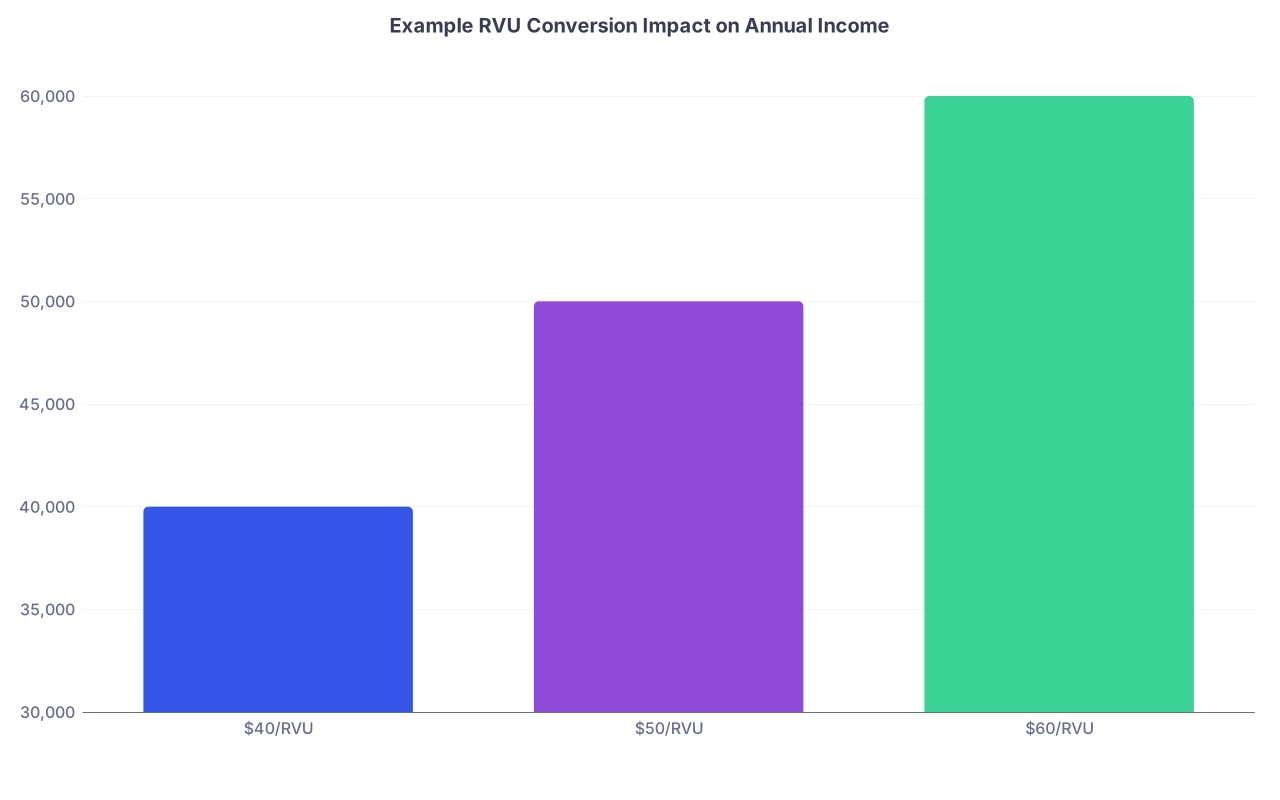
The crucial thing: the conversion factor is where they hide whether it is a good or bad deal.
| Category | Value |
|---|---|
| $40/RVU | 40000 |
| $50/RVU | 50000 |
| $60/RVU | 60000 |
That chart assumes 1,000 RVUs above threshold. Notice what happens when the institution quietly drops your conversion from $60 to $45 over a few years. Same work. Less money.
Step 2: Threshold vs Tiered Models
Two main patterns show up:
Simple threshold model
- Single target (e.g., 7,000 RVUs).
- Every RVU above = fixed rate.
Tiered model
- Multiple thresholds.
- Rate per RVU increases with higher production.
Example tiered model:
- 0–6,000 RVUs: base only
- 6,001–7,000: $20 per RVU
- 7,001–8,000: $30 per RVU
- 8,001+: $45 per RVU
If you produce 8,500 RVUs:
- 6,001–7,000 = 1,000 × $20 = $20,000
- 7,001–8,000 = 1,000 × $30 = $30,000
- 8,001–8,500 = 500 × $45 = $22,500
- Total clinical incentive = $72,500
Now compare that to a flat $35 per RVU above 7,000:
- 1,500 × $35 = $52,500
Tiered vs flat makes a very real difference. The problem is your “RVU tiers” are often buried in a PDF attachment to your offer that you never saved.
Step 3: Specialty-Specific RVU Realities
Some fields cannot realistically hit those benchmark numbers:
- Geriatrics with academic clinic: you will never see 9,000 RVUs without destroying care.
- Hem/Onc with heavy inpatient consults: outpatient RVU logic often ignores inpatient load.
- Surgical subspecialty with OR bottlenecks: your OR allocation controls your income, not your work ethic.
So if your plan says “target = 8,000” but your clinic templates and OR block only support 6,000 in reality, your incentive is fantasy. That is a structural problem, not a motivational one.
Teaching: Good for Promotion, Weak for Cash (Usually)
Teaching tends to be dramatically undervalued in dollar terms. That is not an opinion. I’ve literally seen plans where precepting 4 half-days per week for the whole year translated to under $10,000 of incentive.
There are three common models:
Token stipend – “Education role” add-on.
- Clerkship director: $10k–$30k
- Residency APD: $10k–$20k
- PD: $20k–$60k (sometimes more in big programs)
Point or “credits” system – Teaching activities earn points, points convert to dollars.
Protected time (FTE carve-out) – You get 0.2 FTE “education” with lower RVU expectations but same or slightly reduced base.
Point-Based Teaching Incentives
This is the version most faculty misunderstand.
Simple prototype:
- Each “teaching unit” (half-day clinic precepting, 1-hour didactic, mentoring longitudinally, etc.) = X points.
- At year’s end, total points × dollar/point = payout.
Example structure:
- 1 half-day clinic precepting = 2 points
- 1 hour lecture = 3 points
- Course director role = 30 points / year
- Dollar value = $50 per point
If you precept 1 half-day/week for 40 weeks:
- 40 × 2 = 80 points
- 80 × $50 = $4,000
Plus you give 4 didactics / year:
- 4 × 3 = 12 points
- 12 × $50 = $600
Total teaching incentive = $4,600
That is the part that shocks people. A full year of reliable teaching often equals well under one week of your clinical pay.
| Category | Value |
|---|---|
| Base Salary | 260000 |
| Clinical Incentive | 60000 |
| Teaching Incentive | 5000 |
| Research Incentive | 10000 |
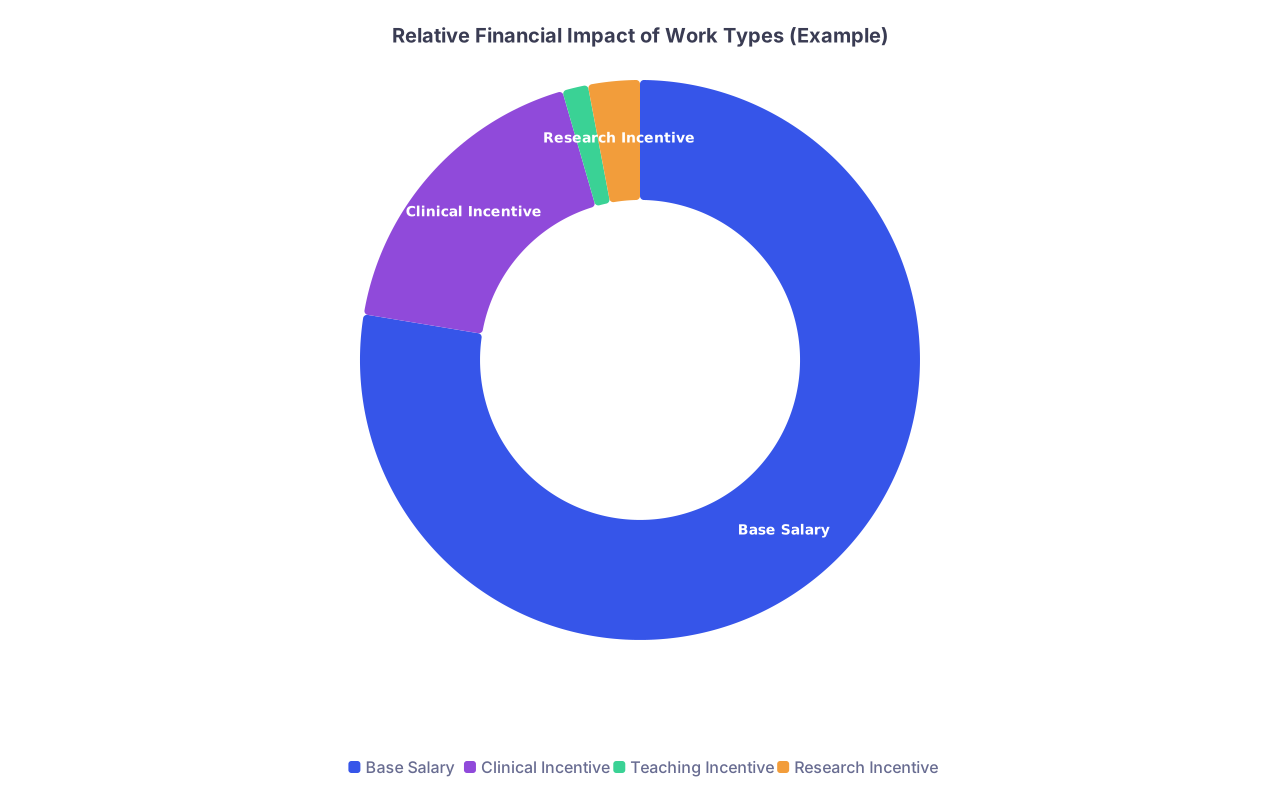
Look at that distribution. Teaching is almost symbolic.
FTE-Based Teaching Protection
The better way teaching is sometimes compensated:
- You are 0.8 clinical FTE, 0.2 education FTE.
- Your RVU target and/or base salary is adjusted accordingly.
Example:
- Full-time clinical faculty: target 7,000 RVUs, base $260k
- You have 0.2 FTE teaching: target now 5,600 RVUs (80% of 7,000)
- Your base might be 80–90% of full base depending on the system.
Here, teaching is not directly paid as a bonus. Instead, it functions by reducing the clinical bar you must clear to keep your full (or near-full) base.
Key question to ask:
“Is my RVU target adjusted for my teaching and admin FTE, or is it a full clinical target slapped onto a mixed job?”
Many institutions quietly do the latter.
Research: Soft-Money, Hard Lessons
Research incentives are the most variable. They depend heavily on your department culture and your ability to bring in grants.
Let me split it cleanly:
- Grant-funded salary support (“buying out”)
- Indirect cost (IDC) return incentives
- Pure “academic scorecard” bonuses
Grant-Funded Salary Support
Classic model:
- Your “institutional base salary” is X for a 1.0 FTE clinical job.
- You obtain a grant and budget, say, 30% of your effort to research.
- The grant pays 30% of your salary + fringe.
- In exchange, your expected clinical RVUs decrease by roughly 30%.
Two ways institutions handle the cash:
- Version A: You keep the same total salary; grant funds just replace institutional dollars.
- Version B: Institution allows you to “buy up” and earn more than base if you cover more of your own salary.
Version B is rarer in clinicians; more common in PhD-heavy environments.
Questions you must clarify:
- “If a grant covers 30% of my salary, does my clinical target decrease 30%? In writing?”
- “Do I share in any excess salary funds if the grant budget is higher than my true base?”
Nobody will hand you that; you have to ask.
Indirect Cost (IDC) Return
This is where real research money gets hidden—and usually kept at higher levels.
Example NIH R01 budget:
- Direct costs (personnel, supplies, etc.): $250,000
- Indirect costs (negotiated with institution, e.g., 55%): ~$137,500
- Total award: $387,500 / year
Institutions often keep most of the indirects. But some will:
- Return a fixed percentage (e.g., 10–20%) to the department or PI.
- Use that for discretionary accounts, bridge funding, or “bonus” pools.
A decent plan might say:
- “10% of IDC returned to PI’s academic fund to be used for salary supplementation, research expenses, or discretionary support, not to exceed X% of institutional base salary.”
That might mean an extra $10k–$30k per year in spendable funds if you are consistently funded. Not all of that is your personal income, but some plans allow part to be taken as compensation.
Academic Scorecard Bonuses
Some departments overlay all this with an “academic mission” bonus.
Typical components:
- Peer-reviewed publications (first/senior author weighted more)
- Grant submissions and awards
- National/international presentations
- Guideline authorship, leadership in societies
- Mentoring trainees who win awards or fellowships
Example scorecard:
- First-author paper in a Q1 journal: 15 points
- Co-author paper: 5 points
- New R01 as PI: 40 points
- New K award as PI: 30 points
- National talk: 5 points
- Dollar value per point: $200
You hit 80 points in a year:
80 × $200 = $16,000 academic incentive.
Sounds nice. But look closer: only a minority of faculty actually clear 50–60+ points. Most live in the 10–30 point range because research success is lumpy and slow. And the payout is often capped.
Ask: “Is this a capped pool divided among everyone, or a fixed doller-per-point structure with no cap?”
If it is capped, the headline numbers are mostly marketing.
The Blunt Reality: Academic Incentives Are Tiny Compared with RVU Money
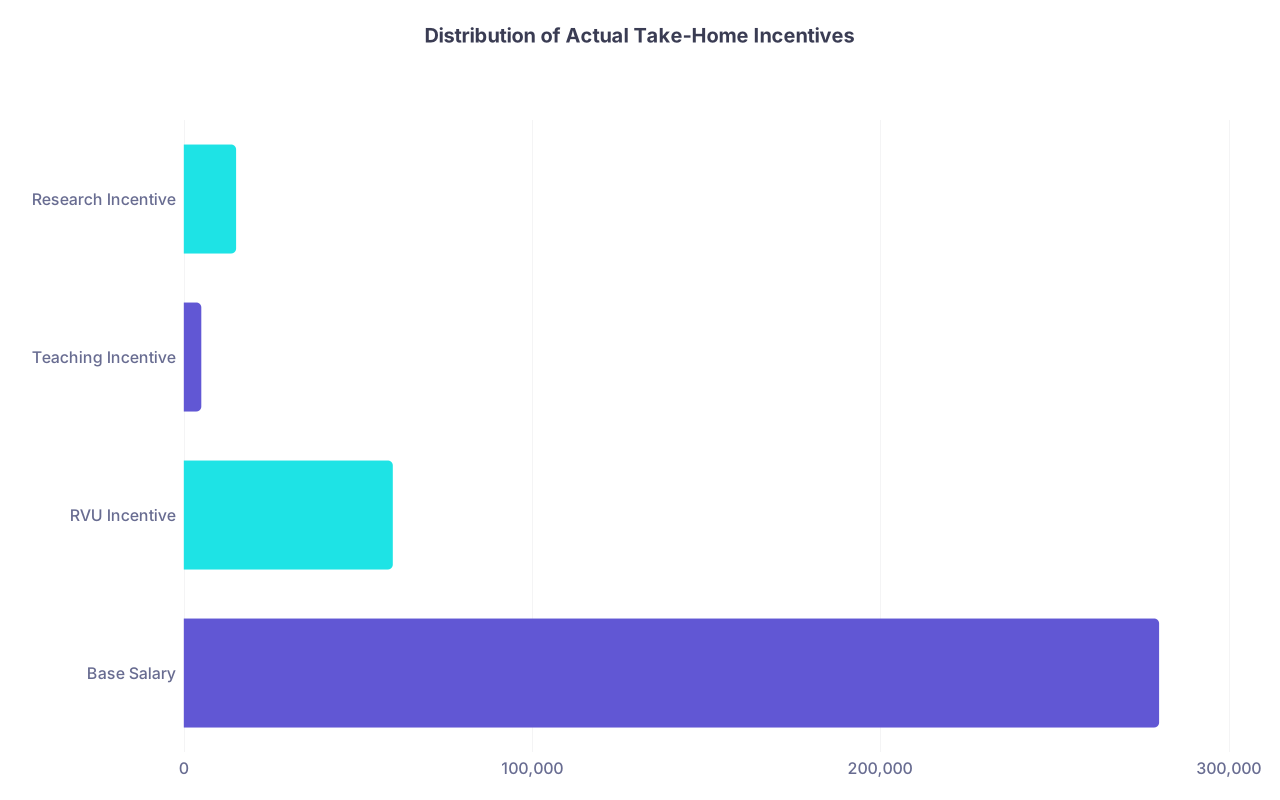
Let me put numbers side by side for a typical mid-career associate professor in a procedural field:
- Base salary: $280k
- Clinical RVU incentive: $0–$80k depending on productivity and OR time
- Teaching incentive: $0–$8k
- Research/academic incentive: $0–$20k (and only if you are actively funded)
| Category | Value |
|---|---|
| Base Salary | 280000 |
| RVU Incentive | 60000 |
| Teaching Incentive | 5000 |
| Research Incentive | 15000 |
You see the pattern:
- If you want to move your total compensation by 20–30%, you do it via clinical volume or big leadership roles.
- Teaching and small research incentives are usually <10% of your total.
This is why your colleague who “does no teaching and minimal committees” but crushes clinic often makes far more than the beloved educator. Not because the department does not value teaching rhetorically. Because they do not value it financially.
How to Decode Your Own Plan Step-by-Step
Stop relying on vague impressions. Here is how to dissect your actual job.

| Step | Description |
|---|---|
| Step 1 | Get Contract & Plan Docs |
| Step 2 | Identify Base Salary |
| Step 3 | Find RVU Target and Conversion |
| Step 4 | Clarify FTE Split - Clinical vs Academic |
| Step 5 | Locate Teaching and Research Incentives |
| Step 6 | Run 3 Realistic Scenarios |
| Step 7 | Compare to MGMA or AAMC Benchmarks |
| Step 8 | Decide If Plan Matches Your Career Priorities |
1. Get the full documentation
You want:
- Your actual offer letter or latest contract.
- The department or institution “Compensation Plan” document.
- Any division-specific policy addenda.
- AAMC/MGMA benchmark sheet if they use one (ask admin).
Do not trust verbal explanations. They are often incomplete or “aspirational.”
2. Isolate base vs incentive
Write it out plainly:
- My base salary is $____ tied to (rank? FTE? benchmarks?).
- My clinical incentive formula is: [target] RVUs → $[rate] per RVU above threshold (or tiered as follows…).
- My teaching incentive is: [points → $; flat stipend; or FTE adjustment].
- My research incentive is: [grant % salary support; IDC return; scorecard bonus].
If you cannot express it in that format, you do not actually understand it yet.
3. Run three scenarios
For your next contract year, estimate:
- “Low” productivity (e.g., 20% below target)
- “Expected” productivity (target)
- “High” productivity (20–30% above)
Then plug in:
- How many teaching days, lectures, or academic roles you realistically will handle.
- Whether you have, or may get, funded time from grants.
Use those to calculate:
- Total comp in low / expected / high clinical years.
- Sensitivity to teaching: How much does adding more teaching actually change your pay?
- Sensitivity to research: What happens if your K-to-R transition fails, or a grant term ends?
You will often discover something ugly like:
“An extra weekly clinic session is worth $30,000; an extra 20 hours of teaching is worth $1,000.”
That realization should heavily shape how you negotiate and how you say “yes” or “no” to new tasks.
Legal and Contractual Landmines
This is supposed to be the “financial and legal aspects” phase, so let us talk about where people get burned.
The Word “Discretionary”
If your plan says:
- “The Dean may adjust the compensation plan at any time.”
- “Incentive pools will be distributed at the discretion of the Chair.”
- “Academic incentive payments are not guaranteed and may be modified annually.”
Translation: you are not entitled to those incentives the way you are entitled to base salary. They can vanish. Mid-year. With a budget shortfall. And there is usually very little recourse.
Term vs At-Will Modifications
Check for:
- Does the plan reset every year with a new letter?
- Or is it attached to a multi-year term?
- Does it explicitly say “institution reserves the right to modify conversion factors, thresholds, and bonus criteria”?
If your RVU conversion factor is not contractually fixed for some period, do not treat it as a permanent number. It is a knob they can turn.
FTE and Duty Changes
You want clarity on:
- Who can change your FTE split (clinical vs teaching vs research), and how.
- Whether new admin roles come with formal FTE protection in writing or just “support”.
- Whether your RVU target automatically adjusts with any FTE change.
I have seen physicians “promoted” to program director, pick up 0.3 FTE in education, but nobody adjusted their RVU target in writing. Six months later, they were told they were “underperforming clinically.”
That is not a misunderstanding. That is a structural trap.
Strategic Takeaways: How to Make These Plans Work For You
Let me be uncomfortably direct.
If you mostly care about maximizing income → optimize clinical RVU productivity, negotiate better conversion factors, and secure leadership roles with real stipends. Do not rely on teaching points or small academic bonuses.
If you care about academic promotion and career satisfaction more than marginal dollars → push hard for FTE-protected time and realistic RVU targets. Your survival depends more on not being clinically overbooked than on scraping extra $5k teaching bonuses.
If you are planning a research-heavy career → your real “salary plan” is your grant pipeline. You must understand salary support rules, IDC sharing, and what happens in the “gap years” between grants.
Always get FTE splits, RVU targets, and incentive formulas written down, with clear terms on how and when they can change.
FAQ (Exactly 6 Questions)
1. How many RVUs is “normal” for a full-time academic physician?
Depends heavily on specialty and institution, but rough academic expectations often sit around:
- Outpatient cognitive fields (IM, Endo, Rheum): 4,500–7,000 RVUs
- Hospitalist: often non-RVU hospitalist models, but when tracked, 3,500–5,500 RVUs
- Procedural specialties: 7,000–12,000+ RVUs
- Surgical fields: huge range, 7,000–15,000+ depending on OR time and case mix
The key is not the raw number. It is how that number compares to the benchmark percentiles and whether your clinic/OR access makes it realistic.
2. Are academic incentive plans usually negotiable?
Parts of them are. The formal institutional plan is often non-negotiable, but you can usually negotiate:
- Your starting base relative to AAMC percentiles
- Your initial RVU target (especially if you are building a program or clinic from scratch)
- FTE allocation for teaching, research, or admin time
- Stipends for leadership roles (PD, APD, division director)
Do not expect to rewrite the entire incentive framework, but you can absolutely shape how it applies to you.
3. Do teaching and research incentives count toward retirement contributions?
Often yes, but not always. It depends on whether they are paid as:
- “Base salary” additions (usually retirement-eligible)
- “One-time bonuses” or off-cycle payments (sometimes not included in pension calculations)
Ask HR explicitly: “Are incentive payments subject to retirement contribution and counted in pension formulas?” Get the answer in writing if retirement is a major part of your decision.
4. How risky is it to rely on grant funding for a big chunk of my salary?
Very risky if you do not have:
- Multiple overlapping grants or a strong funding track record
- Departmental bridge funding mechanisms clearly spelled out
- A clear fallback clinical role if grants lapse
Grant-driven salary is inherently unstable. It can be lucrative and buy you time away from clinic, but it must be coupled with a real safety plan for lean years.
5. Is it ever rational to do a lot of teaching if it barely pays?
Yes—if you are playing the long game:
- Teaching and mentorship are critical for academic promotion dossiers.
- They build your reputation with trainees, which can translate into invitations, collaborations, and national roles.
- For some people, it is simply the part of the job that prevents burnout.
But you should make that choice consciously, not under the illusion that teaching will meaningfully boost your paycheck.
6. What one document should I insist on before signing an academic offer?
A written summary—one or two pages—that clearly lists:
- Your base salary and FTE split by mission area (clinical/teaching/research/admin)
- Your annual RVU target and the exact conversion formula, including tiers if any
- Specific stipends for any leadership or educational roles
- How and when these numbers can be revised
If they will not give you that, or they say “it is all kind of flexible; we will figure it out as we go,” treat that as a red flag, not a perk.
Three things to remember.
First, most of your actual money is tied to RVUs and leadership roles, not to teaching points or minor academic scorecards.
Second, FTE splits and RVU targets are more powerful than tiny bonuses; they determine whether your job is sustainable.
Third, if the plan is not crystal clear in writing, assume it will be interpreted in the institution’s favor, not yours.