
The mythology around “medical director stipends” is misleading a lot of physicians. Most of these roles do not pay what you think they do once you factor in opportunity cost, RVU loss, and the actual hours you will work.
Let me break this down specifically.
The Three Ways Medical Directorships Actually Pay You
Strip away the HR fluff and there are only three real economic levers in a medical directorship or admin role:
- A fixed stipend (monthly/quarterly/annual)
- Admin time (paid or “protected”) carved out of your clinical FTE
- Performance or quality incentives tied to metrics
Everything else is window dressing.
| Component | Typical Form | How It Really Functions |
|---|---|---|
| Stipend | Flat $/month | Pays for meetings, oversight |
| Admin Hours | % FTE or hrs/wk | Opportunity cost vs clinical pay |
| RVU Credit for Admin | RVUs/month | Partial backfill for lost RVUs |
| Quality Bonus | % of salary | Often small, hard to trigger |
| Equity/Profit Share | Ownership units | Mostly in private groups/MSOs |
The problem is that physicians often evaluate only the stipend and ignore the second part: what revenue am I giving up to do this?
Example: The deceptive $50,000 “leadership opportunity”
You are a hospital-employed cardiologist making $550,000 base with RVU-based bonus potential on top. Hospital offers you:
- Medical Director of Cardiology Service Line
- Stipend: $50,000/year
- Admin time: 0.15 FTE (about 6 hours/week)
- No change to base salary, RVU target “to be decided”
On paper: “Extra $50k to attend some meetings and lead the team.” That is how it is sold.
In reality:
- If your clinical work generates ~$600/hour in collections or comp value (very reasonable in cardiology), and you actually spend 8–10 hours/week on admin (which is common for a 0.15 FTE directorship), you are sacrificing $250k–$300k of billable time value for $50k in stipend and maybe a vague promise of “leadership advancement.”
That is the mismatch most people do not calculate.
How Admin Time Is Supposed To Work (And How It Usually Does)
Admin time is the most misunderstood piece of this whole puzzle.
You will see some flavor of one of these phrases in your contract or side-letter:
- “0.1 FTE administrative time”
- “4 hours per week protected admin time”
- “Up to 40 hours per month administrative duties”
If you do not translate that language into three concrete numbers, you will get burned:
- How many clinic sessions or OR blocks am I dropping?
- How is my RVU or productivity target adjusted?
- How are hours defined, captured, and enforced?
FTE math: what 0.1 FTE actually means
In most hospital systems:
- 1.0 FTE = 40 hours/wk = 2080 hours/yr
- 0.1 FTE = 4 hours/wk = ~208 hours/yr
Now look at how admin FTE is layered:
- Some systems: “0.8 clinical + 0.2 admin = 1.0 FTE”
- Others: “1.0 clinical FTE, plus 0.2 admin (total 1.2)” – this is where nights and weekends get swallowed
If you are not explicitly converting clinical FTE to admin FTE, you are just adding work, not rebalancing it.
The “protected time” lie
“Protected time” is often theoretical:
- They remove one half-day clinic on your template
- Then you get double-booked the remaining days
- Patients get squeezed into “admin blocks”
- Nurses and schedulers are told “Dr. X is flexible, we can use that admin slot if needed”
You end up with:
- Lost clinical time (and sometimes lost RVUs)
- Admin work creeping into nights and early mornings
- Meetings dropped into your remaining clinic, creating chaos
Unless your admin time is:
- Written as X half-days per week with no patient scheduling
- Supported by leadership when schedulers try to override it
- Tied to stable expectations for RVUs or panel size
…it is not “protected” in any meaningful way.
How Different Settings Pay for Medical Directorships
The structure changes a lot depending on employment model and specialty. So let’s get precise.
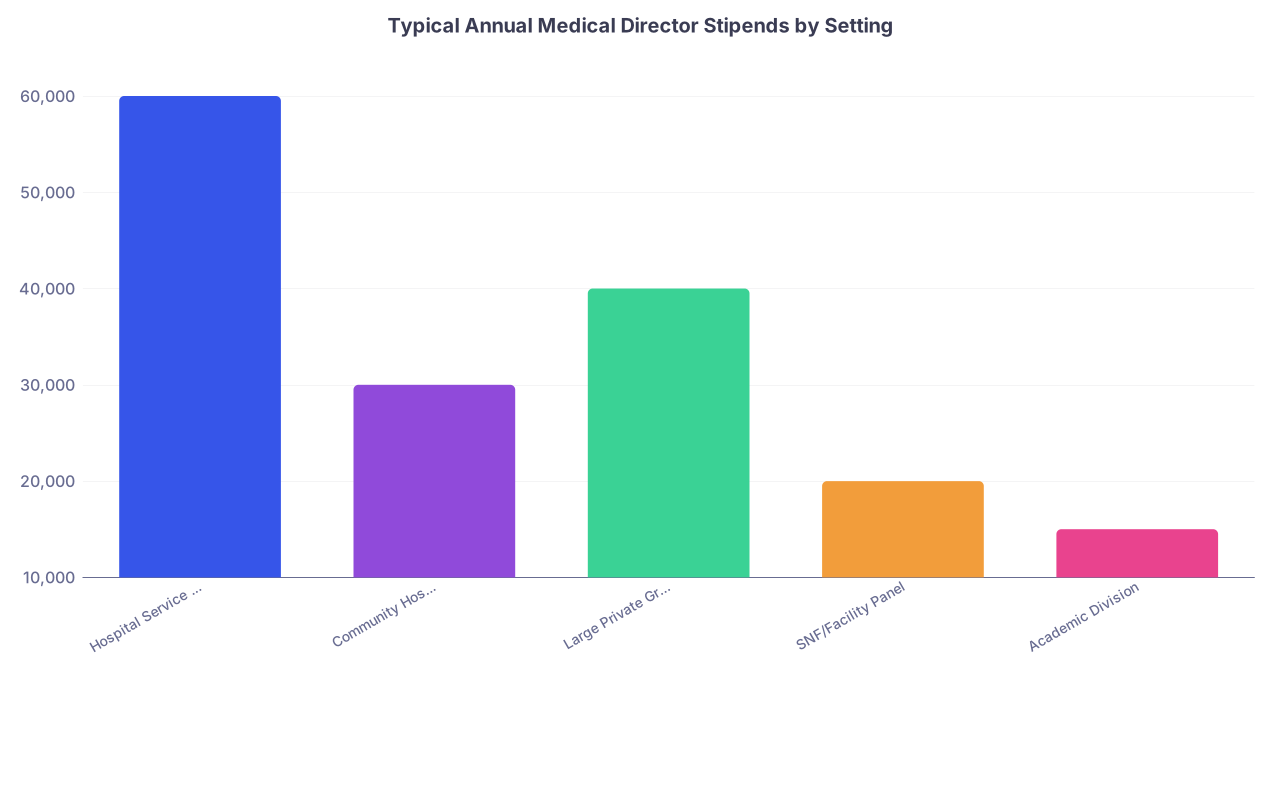
| Category | Value |
|---|---|
| Hospital Service Line | 60000 |
| Community Hospital Dept | 30000 |
| Large Private Group | 40000 |
| SNF/Facility Panel | 20000 |
| Academic Division | 15000 |
These are ballpark stipend ranges I have seen repeatedly in contracts and negotiations. The spread reflects both leverage and complexity.
1. Hospital-employed physicians
Classic example: Medical Director for ICU, ED, Hospitalist Program, Oncology Service Line.
Common structure:
- Stipend: $30,000–$120,000/year depending on:
- Scope (single unit vs system-wide)
- Size (number of beds, physicians, APPs)
- Call or availability expectations
- Admin FTE: 0.1–0.4 FTE
- RVU expectations:
- Sometimes proportionally reduced
- Sometimes absurdly unchanged (“you’ll be more efficient”)
Financial reality:
- For high-earning specialties (cardiology, GI, ortho), director stipends rarely match the opportunity cost of lost clinical time.
- For primary care, hospitalist, psychiatry, and EM, the math can work better, especially when paired with reduced nights/weekends.
2. Large private single-specialty groups
Think large anesthesia group, multi-site radiology group, big ortho practice.
Here you see a different stack:
- Stipend from hospital/entity to the group for “medical directorship”
- Group then pays an internal director stipend and/or reduces that physician’s share of overhead
- Sometimes the director gets:
- Reduced call
- Preferred OR days
- Larger say in new contracts and expansion
Money flow matters. Many physicians do not realize:
- Hospital may be paying the group $150,000/year for an anesthesia medical directorship
- The group in turn may pay the actual physician wearing the title only $40,000–$60,000 with vague “leadership credit” making up the difference
In these setups, you are not negotiating just with a hospital but with your own partners’ notion of “fairness.”
3. Academic medical centers
Academic directorships are a different beast:
- Titles: Division Chief, Section Head, Program Director, Vice Chair for Something
- Compensation is more blended:
- Base academic salary (often lower than private)
- “Admin supplement” or “stipend” of $10k–$50k
- Protected time as a percentage of effort (0.2–0.5 FTE)
- RVU expectations adjusted only partially, if at all
Here the selling points are:
- Influence, prestige, promotion to associate/full professor
- Control over staffing, fellowship, or residency programs
- Career capital for future Chair or Dean-type roles
Pure financial ROI? Usually modest. The upside is more about long-term trajectory and job security than direct monthly income.
4. SNF, hospice, and post-acute settings
These are often thrown at primary care, hospitalists, and geriatricians:
- “Medical Director” for a SNF, rehab facility, LTAC, hospice, assisted living
Structure:
- Flat monthly fee from facility: $1,500–$5,000/month (so $18k–$60k/year)
- Expectations:
- Monthly or quarterly Medical Staff meetings
- Policy reviews, QAPI, chart review, provider supervision
- Being “on paper” for regulatory requirements
If you are smart about patient panels and billing:
- You can stack multiple facilities and get both:
- Directorship stipends
- Clinical revenue from rounding and visits
This is one area where the math can be very favorable, if you:
- Minimize unpaid “political” time
- Build efficient rounding routes
- Are disciplined about documentation and billing codes (e.g., proper use of subsequent SNF visit codes, ACP, chronic care management)
The Real Hourly Rate of Your Medical Directorship
You should calculate one number before you ever say yes:
Effective hourly rate = (Stipend + incremental incentives + preserved clinical pay) ÷ actual admin hours worked
Let’s walk it with numbers.
Scenario A: Hospitalist Medical Director
- Hospitalist income: $300,000/year for ~15 shifts/month
- Offer:
- Medical Director for Hospitalist Program
- Stipend: $40,000/year
- Admin time: 0.2 FTE – reduces required shifts from 15 to 12/month
- Same base pay plus stipend; no RVU targets
Real impact:
- You drop 3 shifts/month (36/year)
- But salary remains $300k
- You get extra $40k
- Admin work realistically: 8–10 hours/week = 416–520 hours/year
Math:
- Extra money from directorship: $40,000
- Preserved pay for 36 fewer shifts? That is huge. If a shift is “worth” $2,000 clinically, you are effectively getting $72,000 of time preserved plus $40,000 stipend = $112,000 in value
- Total value: about $112,000
- Hourly rate: $112,000 ÷ ~468 hours (midpoint of 416–520) ≈ $239/hour
That is not bad, and it may come with better control over schedule and policies.
Scenario B: Non-adjusted RVU insanity
- Outpatient neurologist earning $400,000/year with RVUs
- Offer:
- Medical Director for Neurology Service Line
- Stipend: $30,000
- “Admin time: 4 hours/week – but RVU targets will remain the same”
So:
- You lose 4 clinical hours/week (call it 2 visits per hour × 4 hours × 48 weeks = 384 visits)
- If each visit generates 2 RVUs and you get $50/RVU, that is 1,536 RVUs = $76,800 in productivity value
Now you earn:
- $30k stipend
- Minus the opportunity cost of $76.8k lost or crammed into nights/weekends
You are effectively taking a pay cut to hold the title, unless you are willing to grind administrative work off the clock.
Effective hourly rate? Negative, realistically, because you will push those visits into “free time” to protect income.
That is how many physicians end up “volunteering” for leadership.
Admin Time vs Protected Time vs RVU Credits
Not all admin compensation shows up as stipend. Sometimes the real money is hidden in:
- Reduced RVU thresholds
- RVU credits for admin tasks
- Shift minimums that drop quietly

| Step | Description |
|---|---|
| Step 1 | Base Clinical Comp |
| Step 2 | Adjust Clinical FTE |
| Step 3 | New RVU Target |
| Step 4 | Admin Stipend |
| Step 5 | Performance Bonus |
| Step 6 | Protected Admin Time |
| Step 7 | Actual Hours Worked |
| Step 8 | Effective Hourly Rate |
You need to track all three layers:
- Direct dollars – stipend, bonus, call differential
- Indirect dollars – fewer shifts with same pay, lower RVU targets
- Hidden costs – extra hours, burned out time, reputation risk if metrics tank
Specific red flags I have repeatedly seen:
“We’ll figure out the RVU adjustment after we see how it goes”
Translation: you will keep your current target and do the admin on top.“The admin expectations are flexible”
Translation: when something breaks, you are the first phone call.“Quality improvement will be part of your director role; the team will help”
Translation: you will be chasing data, EMR reports, and compliance for months.
If it is not in writing, it does not exist.
Quality and Performance Bonuses: Low Probability Money
Hospitals love to sell admin roles with language like:
- “Up to 20% of your base salary in incentives”
- “Significant upside for hitting key metrics”
- “Shared savings when LOS and readmissions improve”
Most physicians never see the full number. Three reasons:
Metrics are compound and partly outside your control:
- LOS targets that rely on nursing, case management, and post-acute bottlenecks
- Readmission metrics heavily influenced by social determinants
- Patient satisfaction scores that tank because of parking and cafeteria issues
Weighting is tiny:
- 3% of comp for patient experience
- 5% for readmissions
- 5% for “organizational initiatives”
- Etc. Most individual levers are 1–3% of base each
Benchmarks move:
- Hit the target? Next year the bar moves up
- Medicare rules change, penalty thresholds adjust
So, treat performance pay as lottery money unless:
- You have seen 3–5 years of payout history for your department
- The exact metrics and thresholds are spelled out
- You control the inputs directly (e.g., physician completion of discharge summaries, order set usage)
Otherwise, your main reliable pay is stipend + FTE/RVU adjustments.
Non-Monetary “Pay” You Should Actually Value
Money is not the only currency here. Sometimes the non-cash returns are worth more than the stipend.
Real benefits of a well-structured directorship:
Control over your schedule:
- Fewer nights/weekends
- More predictable mornings
- Ability to block protected times for your kids’ events without begging
Strategic positioning:
- You become the person admin calls before they roll out a stupid policy
- You hear about new programs and expansion plans early
- You shape recruiting and composition of your team
Exit options:
- Documented leadership experience is leverage if you ever apply to:
- CMO
- VPMA
- System service line director
- Group managing partner
- It also helps with non-clinical transitions (insurance medical director roles, pharma, consulting)
- Documented leadership experience is leverage if you ever apply to:
There is also a darker “benefit”: defensive positioning.
If your service line is on the political chopping block, the physician with the director title and trusted relationship with the CMO tends to have more say. Or at least more warning.
How to Decide If a Directorship is Financially Worth It
Let me lay out a concrete decision framework. Not fluffy. Actual numbers and thresholds.
Step 1: Quantify your clinical hour value
If you are:
- Pure RVU compensated:
- Clinical revenue/hour = (Average RVUs/visit × visits/hour × $/RVU)
- Shift-based:
- $/shift ÷ average hours/shift
- Salary + bonus:
- Take total comp from last year ÷ approximate patient-facing hours
You need a number. Even if rough. E.g., “My clinical time is effectively $300/hour.”
Step 2: Estimate true admin hours
Ignore the rosy estimate. Use what actually happens in real programs:
- Take the formal FTE or “hours per week”
- Add 25–50% for:
- After-hours emails
- Urgent calls from nurse manager/CMO
- EMR work, protocol review, QI projects, hiring committees
If the contract says 8 hours/week, budget 10–12. If you are efficient and well-supported, you will come in under. Great. But do not budget the best-case scenario.
Step 3: Put everything in one equation
Value of role per year:
- Stipend
- Plus: any documented and guaranteed reductions in clinical work without pay cuts
- Plus: conservative estimate of recurring quality bonuses you have actually seen
- Minus: expected loss in RVU or moonlighting opportunities
Then divide by your admin hours.
If the effective hourly rate is:
- Less than 50–60% of your clinical rate and you do not care about leadership trajectory → probably not worth it
- Around 60–80% of your clinical rate → maybe, if you want the non-monetary benefits
- Comparable to your clinical rate or higher → financially strong, as long as role scope is tolerable
Step 4: Look hard at duration and exit
Two contract details matter more than people admit:
- Term (e.g., 1-year, 2-year, 3-year)
- Termination clause:
- “Without cause” with 60–90 days’ notice vs
- “For cause only” with defined triggers
You want the ability to step out without detonating your job:
- Ideally the directorship is a separate agreement from your base employment contract
- Ideally stepping down reverts you to a clear clinical FTE and comp model
If the only way out is to quit your whole job, you are handcuffing yourself.
The “Career Capital vs Cash” Tradeoff
Here is the uncomfortable truth: the best-paying director roles, in the short term, are often lousy for long-term career sanity.
- High-stipend, high-stress roles:
- ED director in a chaotic hospital
- ICU director in a system with toxic staffing politics
- Oncology service line director during a major EMR or accreditation overhaul
You will:
- Put out fires
- Take heat from both physicians and admin
- Be on call for everything that breaks
Short-term cash can be solid. Burnout risk is equally solid.
On the other hand:
- Lower-stipend, high-trajectory roles:
- Associate medical director in a well-run multispecialty group
- Small but growing service line at a stable system
- Assistant program director in a respected academic department
These often:
- Pay moderately
- Offer real mentoring from established leaders
- Give you experience with budgets, staffing models, quality committees
This is “career capital” – the stuff that lets you credibly step into a CMO or large system role later. That is where the real administrative money lives: not $30–50k stipends but $400–700k C-suite packages with bonus and LTIP.
So you need to decide:
- Am I treating this like a side hustle to patch income now?
- Or is this a deliberate move toward larger leadership?
The answer changes how you weigh the stipend vs the role content.
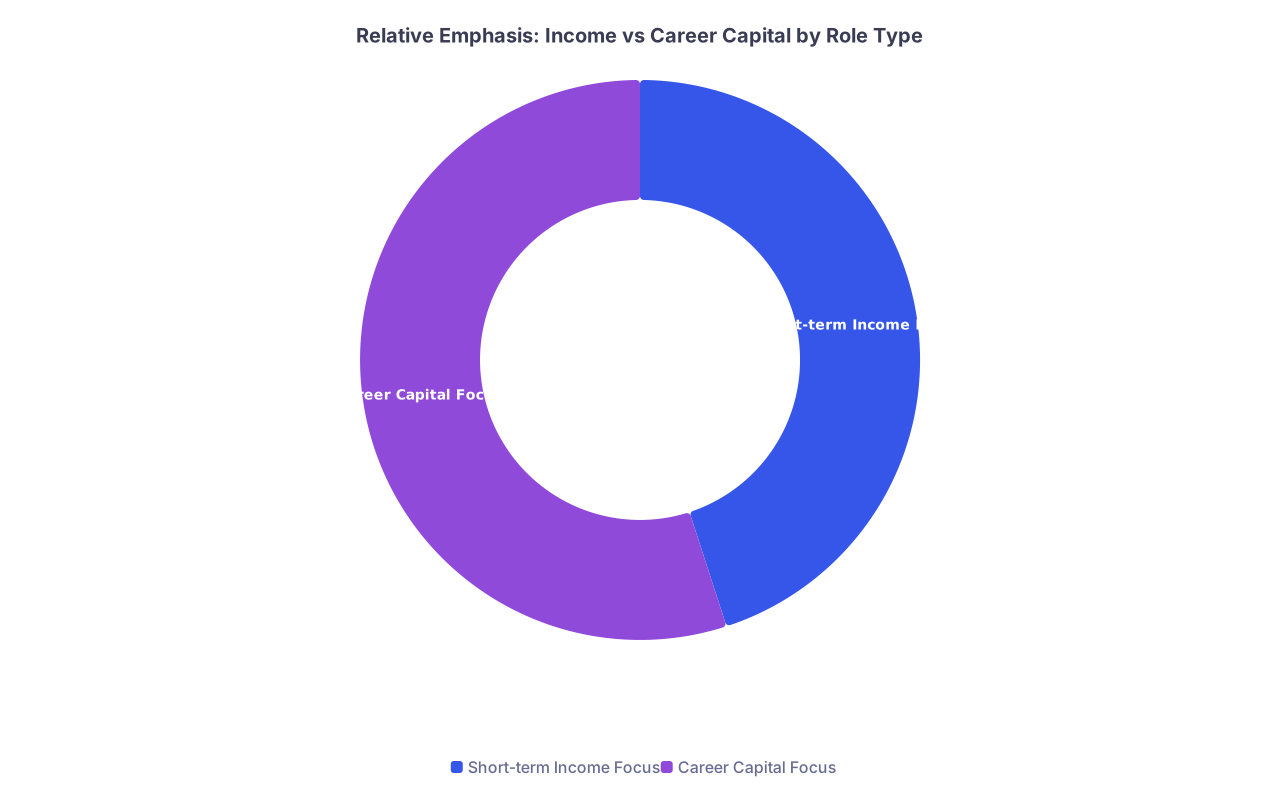
| Category | Value |
|---|---|
| Short-term Income Focus | 45 |
| Career Capital Focus | 55 |
For most physicians who ask me about this, they say they want both, but their decisions show a bias. You should be honest with yourself which side you are on.
Negotiation Points That Actually Move the Needle
You will not always move the stipend number much. Those budgets are often rigid. But you can move the structure around it and that is where many of the dollars live.
Practical asks that work:
- Tie FTE explicitly:
- “If I am 0.2 admin, my clinical FTE becomes 0.8. RVU target drops 20%.”
- Clarify expectations:
- “List the specific committees, meetings, and projects expected. Anything beyond that triggers a reconsideration of stipend/FTE.”
- Add administrative support:
- “I will need 0.2 FTE of coordinator/analyst support for data, scheduling, and follow-up. That comes out of the program budget, not my time.”
- Protect the calendar:
- “Two fixed half-days per week as admin time, non-clinical. Changes only by mutual agreement.”
You want the job to be:
- Structured
- Bounded
- Measurable
Vague “leadership opportunities” are where you end up doing everyone else’s slack work for free.
The Bottom Line
Three points to keep in your head when you evaluate any medical directorship or admin role:
- Calculate the effective hourly rate after accounting for admin hours and lost clinical income. If you are not doing that math, you are guessing.
- Admin time is only real if it is written, protected on your schedule, and paired with explicit RVU/FTE adjustments. Otherwise, it is just extra work layered on top.
- Decide upfront whether you are chasing short-term cash or long-term leadership capital. The “best” role looks very different depending on which game you are playing.