
The biggest mistake physicians make about pay is assuming, “A job is a job; the money will work itself out.” The data shows the employer type you choose – hospital, academic, or private group – changes your lifetime earnings by seven figures.
Below I am going to treat this the way I would any real comp analysis: by structure, numbers, risk, and long‑term consequences. Not vibes. Math.
1. The Baseline Numbers: How Employer Type Skews Pay
You cannot compare offers intelligently until you know the baseline differences by employer type. Broadly, for the same specialty and region:
- Academic salaries tend to sit at roughly 60–80% of equivalent private‑group offers.
- Hospital‑employed salaries typically cluster around the 25th–60th percentile of national MGMA‑type benchmarks, but with richer benefits and lower volatility.
- Independent private groups often push 75th–90th percentile earnings for productive physicians, with much wider variance.
To make this concrete, assume a mid‑career general internist in a medium‑cost region, full‑time clinical, no unusual call burden.
| Employer Type | Base Salary | Total Comp (Year 1–3 avg) | Typical RVU Target | Risk Level (Income Volatility) |
|---|---|---|---|---|
| Academic Center | $190,000 | $210,000–$230,000 | 4,000–4,500 | Low |
| Hospital‑Employed | $230,000 | $260,000–$300,000 | 4,500–5,500 | Low–Moderate |
| Private Group | $220,000 | $300,000–$400,000+ | 5,000–6,500 | Moderate–High |
These are directional, not gospel. But they mirror what I see repeatedly in offer letters and MGMA‑style survey pulls.
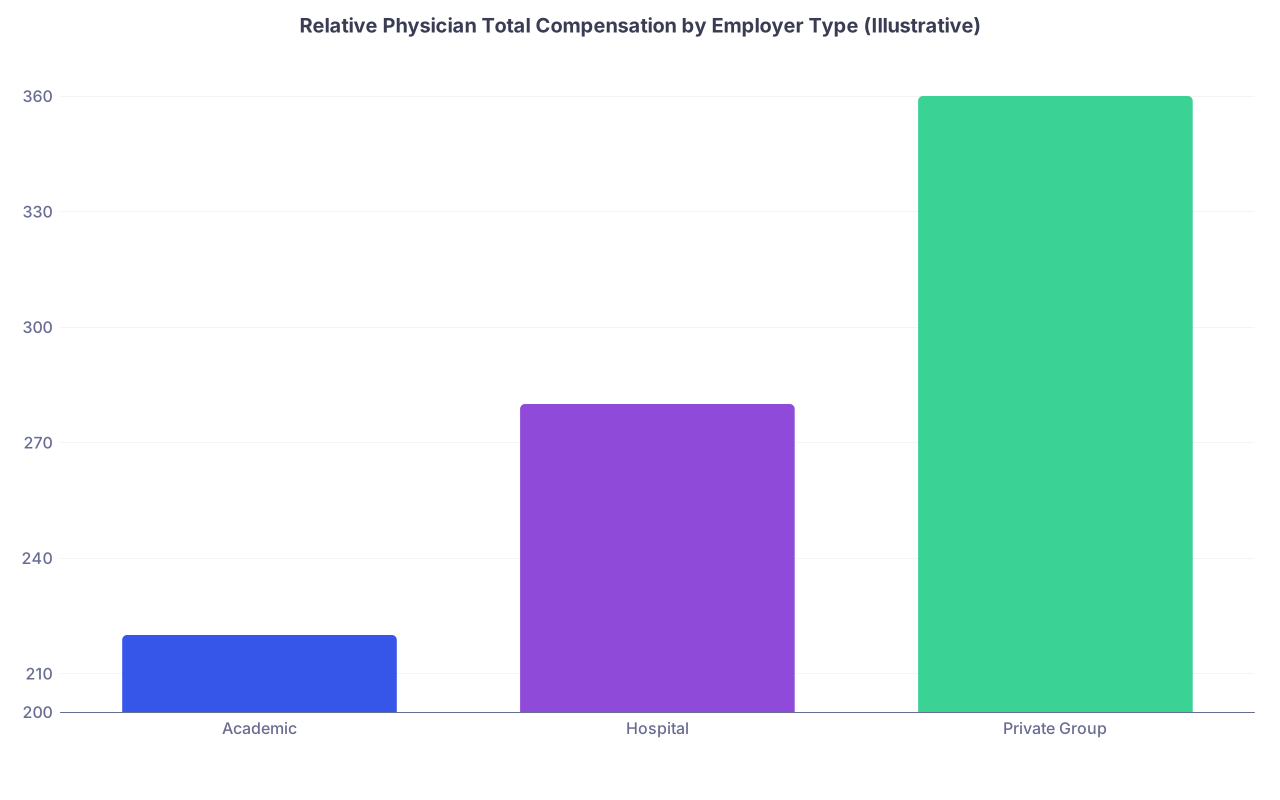
To visualize how sharply academic comp lags other settings:
| Category | Value |
|---|---|
| Academic | 220 |
| Hospital | 280 |
| Private Group | 360 |
Here, values approximate $220k, $280k, $360k average early‑career comp for the same specialty. The gap compounds brutally over a 20‑year horizon.
2. Academic Medical Centers: Prestige Discount and Protected Time
Academic compensation models are structured around one core fact: the institution monetizes your prestige and research output, not just your RVUs. The salary reflects that. And not in your favor.
Typical Academic Model Components
For most academic physicians, comp is built from:
- A base salary tied to “rank” (Assistant, Associate, Professor) and department scales.
- A smaller RVU or productivity incentive layered on top.
- Sometimes a quality/mission‑based bonus (citizenship, teaching, committee work).
Concrete example for an Assistant Professor in cardiology:
- Base: $260,000
- Incentive pool: 10–20% of base for productivity + quality + teaching metrics
- Total realistic range: $260,000–$320,000, even though community cardiologists nearby are at $450,000–$600,000.
The productivity piece in academics is often underweighted. I have seen models where the RVU threshold is set so high that “bonuses” are theoretical. Or the per‑RVU rate is intentionally low versus community benchmarks.
Time Allocation vs Pay
Academic centers sell you on protected time. The salary reflects that: they assume you are not 1.0 FTE clinical.
A common split for many faculty:
- 0.6–0.8 FTE clinical
- 0.2–0.4 FTE research/teaching/admin
The catch: the pay is often closer to 0.6–0.8 of private practice norms, not 0.6–0.8 of clinical time. In other words, you are discounting your hourly value.
If private‑group GI is earning $600,000 working 1.0 FTE clinical, and you take $360,000 as academic GI at 0.75 clinical FTE + 0.25 protected time, you are effectively pricing your nonclinical time at a steep discount.
Over 15 years, that difference can easily exceed $2–3 million pre‑tax.
3. Hospital‑Employed Models: Stability, RVUs, and Subtle Traps
Hospital employment has exploded. From a pure data perspective, hospital models sit in the middle: more money than academic, less upside than private groups, more downside protection than both.
Standard Hospital RVU Model Structure
The classic hospital offer has three pillars:
Base salary (often guaranteed for 1–3 years)
Frequently benchmarked to 50th percentile MGMA for your specialty and region. Sometimes 25th–35th percentile if supply is high.Work RVU target with conversion factor
- A yearly wRVU target (e.g., 5,000 RVUs for an internist, 7,000–8,000 for some surgeons).
- A dollar per RVU rate (e.g., $45–$55 for internal medicine; highly variable by specialty).
Quality/other incentives
Typically 5–10% of base tied to HCAHPS, readmission rates, panel size, documentation, etc.
An illustrative internal medicine hospital model:
- Base: $250,000
- wRVU target: 4,800
- Conversion: $50 per wRVU above target
- Max quality bonus: $20,000
So if you hit 5,800 wRVUs (1,000 above target), your productivity bonus is $50,000; you could land at $320,000 total. If you come in at 4,200 wRVUs, some contracts claw back after the guarantee period, dropping next year’s base.
The “Guarantee Cliff”
Years 1–2 often feel generous. Then year 3 hits, and the hospital “true‑ups” your pay to your actual wRVU production.
A common pattern I have seen:
- Year 1–2: $260k guaranteed, no downside.
- Year 3: Base recalculated based on your last 12–24 months wRVUs. You produced 4,000 vs 5,000 target. Now your new base is $210k–$220k. Surprising salary “cut” that is actually just the model functioning.
For physicians who overestimate how much volume they can or want to see, this is a rude awakening.
Employed Hospitalist Example
Let’s quantify a hospitalist model, since it is heavily standardized:
- 7-on/7-off, ~182 shifts/year
- $2,400/shift base
- Quality bonus potential: $15,000
Calculation:
- Base: 182 × $2,400 = $436,800
- At‑risk bonus: up to $15,000
- Realistic total: $420,000–$450,000
In a private group hospitalist model, I have seen the range more like:
- 182 shifts; per‑shift equivalent $2,700–$3,000 when profit distributed
- Total comp: $490,000–$540,000
- But with more volatility by census, payer mix, and group business decisions.
4. Private Groups: High Ceiling, Real Risk
Independent private practice and private specialty groups are where income distributions blow up. The 90th percentile incomes you see in surveys? Largely private practice/partnership track.
The data pattern is consistent:
- Early years (pre‑partner): Usually lower base than hospital/private, plus productivity.
- Post‑partner: Compensation often jumps 30–100% due to profit sharing, ancillaries, ownership.
Pre‑partner vs Partner Economics
A real‑world flavored example for a private orthopedics group:
Years 1–2 (associate):
- Base: $350,000
- Productivity bonus: 30% of collected professional fees above 3× base in collections
- Realistic total: $350,000–$450,000
Year 3+ (partner):
- No fixed base; eat‑what‑you‑kill
- 45–60% of collections as take‑home, plus share of imaging, PT, ASC profits
- Realistic total: $600,000–$1,000,000+ based on volume
Compared to a hospital‑employed ortho at $550,000–$650,000, the partner can make more, but the floor is lower during down years, and lifestyle tradeoffs are real.
Collections vs RVU
Hospital and academic models center on RVUs. Private groups care about collections. Different metric, different incentives.
- In an RVU model, pay is volume‑driven; payer mix is mostly the institution’s problem.
- In a collections model, payer mix hits you directly. A shift from 60% commercial to 40% commercial can take a visible bite out of your income even if your volume is identical.
Where I see physicians get burned: they look at top‑line “partners make $800k+” and ignore local payer mix. In an area with heavy Medicaid/uninsured, that $800k turns into $500k quickly.
5. Total Comp vs. Salary: You Are Underpricing Benefits
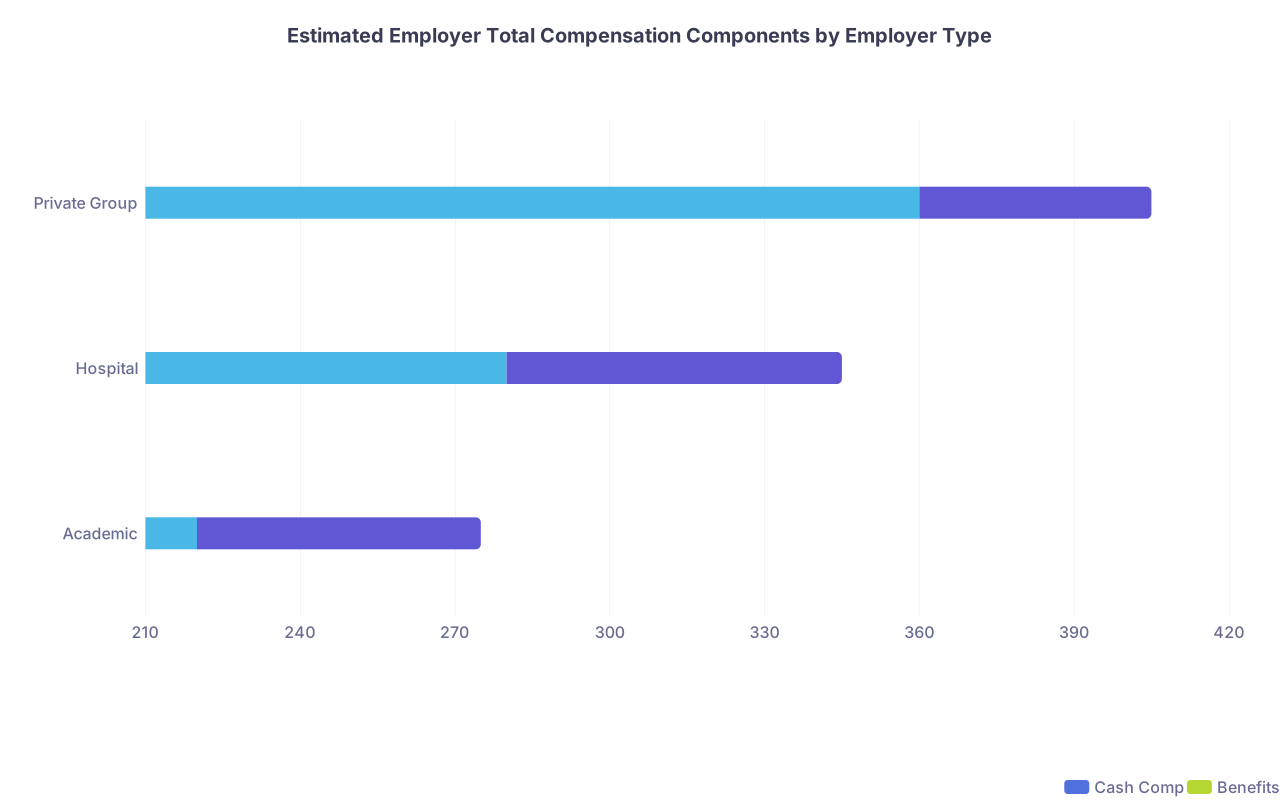
Comparing just base salary by employer type is lazy. The benefits delta is real and quantifiable. You should be doing actual arithmetic.
| Category | Cash Comp | Benefits |
|---|---|---|
| Academic | 220 | 55 |
| Hospital | 280 | 65 |
| Private Group | 360 | 45 |
Using rough averages in thousands:
- Academic: $220k cash + ~$55k benefits
- Hospital: $280k cash + ~$65k benefits
- Private group: $360k cash + ~$45k benefits
In dollar terms, benefits can easily add 20–30% on top of your “salary” for W‑2 employed positions, especially with defined contribution retirement plans, CME, and malpractice coverage.
Among these, hospital benefits are generally the richest:
- 401(k)/403(b) match + possibly 457(b).
- Generous CME, licensure, conference budgets.
- Health/dental/vision at large‑employer rates.
- Disability and life insurance often subsidized.
Academic centers often mirror hospital packages but with slightly weaker retirement matches and sometimes lower CME. Private groups vary wildly: some offer excellent retirement and health plans; others offer the bare legal minimum.
You should be modeling total comp, not just salary. A $260k academic job with $70k total benefits vs a $290k bare‑bones private associate job with $30k benefits? The academic job might be closer in total value than it appears.
6. Risk, Control, and Long‑Term Wealth
The math that actually matters is not “What is my PGY‑6 salary?” It is “What is my after‑tax net worth 10–20 years out under each model?”
Here the hierarchy is roughly:
- Academic: Lowest income, lowest volatility, lowest financial upside.
- Hospital‑employed: Moderate income, low–moderate volatility, limited upside unless you move into leadership.
- Private group: Highest upside, highest variance, highest dependence on your business acumen.
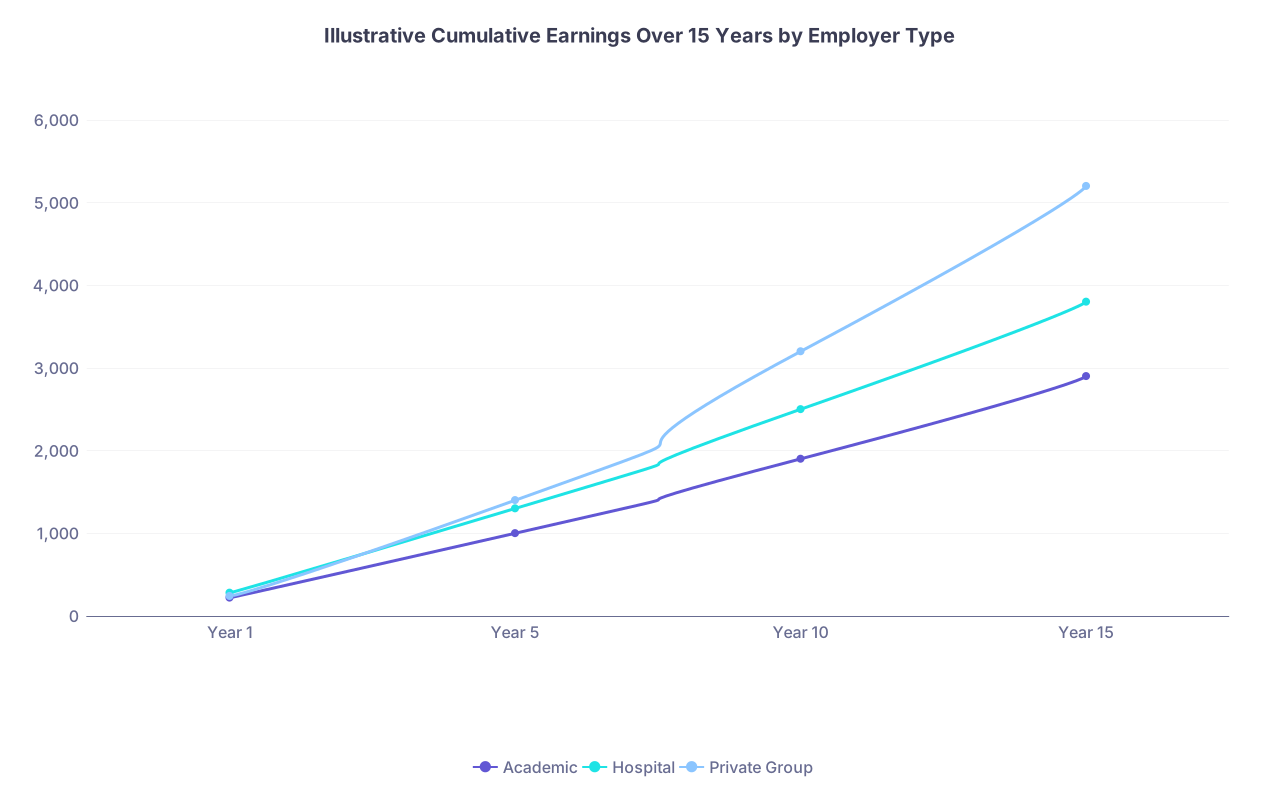
A simple 15‑year wealth projection is illuminating. Assume three physicians, same specialty, same region, all start at age 32, all invest 20% of after‑tax income and earn 5% real investment return. Extremely simplified but directionally useful.
- Academic: starts at $220k, grows to $280k over 15 years.
- Hospital: starts at $280k, grows to $350k.
- Private partner: starts at $240k as associate, reaches $500k by year 5, $650k by year 10.
| Category | Academic | Hospital | Private Group |
|---|---|---|---|
| Year 1 | 220 | 280 | 240 |
| Year 5 | 1000 | 1300 | 1400 |
| Year 10 | 1900 | 2500 | 3200 |
| Year 15 | 2900 | 3800 | 5200 |
Values are rough cumulative earnings in thousands. The delta between private group and academic by year 15 is on the order of $2–2.5 million in this simple model. Even if you haircut the private numbers for a down market or burnout, the gap remains substantial.
You can absolutely choose academics for mission, research, or lifestyle. Just do it with your eyes open about the compounding financial cost.
7. Legal and Contract Structure: Where the Money Hides
Most of the meaningful financial levers are buried in contract language, not the headline salary. Some high‑impact items vary by employer type.
Hospital and Academic Contracts
Typical features:
- Non‑competes: 5–15 miles, 1–2 years is common, sometimes looser for academic jobs.
- Termination without cause: 60–180 days notice.
- Malpractice tail: Often covered in W‑2 roles, especially academics and large hospital systems.
- RVU reset clauses: Often allow the employer to “rebase” your target and/or conversion factor every 1–2 years based on internal benchmarks.
That last point is underappreciated. If the hospital lowers the wRVU conversion factor from $52 to $46 after two years “to align with system standards,” a 7,000 wRVU surgeon just lost $42,000 annually without any change in work.
Private Group Agreements
Common items that move money:
- Buy‑in formula: What you pay (or forgo in salary) to become partner. I have seen buy‑ins range from $0 to $500,000+ (including ASC and real estate).
- Profit distribution rules: Equal split vs production‑weighted vs seniority‑weighted.
- Ancillary ownership: Imaging, labs, ASC, real estate entities often separate; your stake in these is where real wealth accumulates.
- Collections thresholds and overhead allocation: How much of every collected dollar goes to overhead versus you.
If a group keeps 55% of collections for overhead and you get 45% as comp, that is very different than a group at 35% overhead with 65% back to the producing physician. On $1.5 million in collections, that is a $300,000 annual swing.
8. How to Decide: A Data‑Driven Checklist
Here is how I would analyze offers by employer type, step by step. No fluff.
Normalize everything to effective dollars per clinical hour.
- Estimate true weekly clinical hours: clinic, OR, inpatient, call (including at‑home but working hours).
- Total comp ÷ annual clinical hours. Compare across offers. Academic will often look far worse once you do this.
Calculate total compensation, not just base.
- Include realistic bonuses (not maximums you will never hit), benefits, retirement contributions, CME, and malpractice.
Map 3 scenarios for each offer:
- Conservative (just below targets)
- Expected (historical average performance)
- Optimistic (if you are highly productive)
This is where private‑group offers typically outshine the rest at the optimistic end.
Stress‑test against productivity changes.
- What if your volume drops 15%?
- What if payers cut rates or RVU values shift?
Hospital and academic jobs usually soften the blow better than collections‑based private models.
Assign a risk score based on:
- Income volatility
- Business stability (employer finances, market consolidation)
- Your ability to walk away (non‑compete scope, local alternatives)

The “best” employer type is not universal. But the data is clear on tradeoffs:
- If you want stability and benefits with decent pay: hospital employment.
- If you want intellectual prestige and flexible nonclinical time and accept a financial haircut: academics.
- If you want maximum income and are willing to tolerate risk, complexity, and some business headaches: private group.
FAQ (3 Questions)
1. Are academic physician salaries ever financially “worth it”?
They can be, but usually only if you either: 1) truly value research/teaching and are not trying to maximize wealth, or 2) leverage academia into substantial external income (grants with salary support, consulting, speaking, industry collaborations). Pure W‑2 academic clinical income is almost always lower than what your skills are worth in the community. The trade‑off is protected time, prestige, and career pathways that do not exist in private practice.
2. How long should I accept a lower hospital or academic salary before moving to a higher‑paying setting?
Numerically, the longer you wait, the larger the opportunity cost. A 5‑year delay going from $260k to a $400k+ private model can cost over $700k in forgone earnings. That said, a few early years in an academic or hospital system can build your CV, refine your skills, and make you more attractive to top private groups. If money is a priority, I would treat 3–5 years as a rough upper bound before revisiting whether the financial tradeoffs still make sense.
3. How do I know if a private‑group partnership track is actually real or a bait‑and‑switch?
Look for data, not promises. Ask for: historical numbers on how many associates became partner in the last 10 years, the exact written buy‑in formula, sample partner K‑1s or anonymized income ranges, and the operating agreement spelling out ownership and voting rights. If they refuse basic transparency, or if the time‑to‑partner keeps “flexing” upward with each conversation, the probability of a real, equitable partnership is low. The pattern in the data is simple: real partnerships show their math. Fake ones talk in vague “upside” language and avoid specifics.