
The story your first contract tells about your future salary is louder than any recruiter’s promise. And most new physicians have no idea how to read it.
I’ve sat in rooms where practice partners and hospital execs dissected new-grad offers. I’ve heard the actual words: “If they’ll sign this, they’ll never push back on compensation,” and “We can always bump them a little later if they stay quiet.” Your first contract isn’t just a starting point. It’s a signal—to them and to you—about how your entire compensation trajectory will go.
Let me walk you through what your first deal really predicts about your income five and ten years out, and where people quietly lock in decades of under-earning without realizing it.
The Hidden “Trajectory Markers” in Your First Contract
You’re thinking: base salary, sign-on bonus, maybe relocation. That’s kindergarten-level analysis. Directors and practice owners look at different markers to predict whether you’ll be cheap labor for years or an expensive investment they’ll need to keep feeding.
There are a few clauses that tell the true story. I’ll break them down.
1. The Compensation Model: Fixed vs Production vs “Hybrid” Games
Here’s the hard truth: the more your income is tied to transparent, objective metrics you can influence, the better your long-term trajectory. The vaguer it is, the more your raises will depend on “politics and beg-for-mercy meetings.”
New grads get seduced by the guaranteed number, so they don’t ask what happens in years 2–5. Administrators absolutely bank on this.
Let’s call out the three main beasts.
Straight salary with vague “annual review”
This is sold heavily to residents because it feels safe. Behind closed doors, people describe these hires as “plug-and-play coverage.”
What it usually signals:
- You’re being hired to solve a coverage problem, not grown as a long-term asset.
- Raises are whatever the department can get away with: 1–3% “COLA” increases, occasionally a “market adjustment” when people start leaving.
- Your income trajectory is flat unless you threaten to leave or bring competing offers.
I’ve watched hospitalists start at $260k, still around $290k five years later, while new hires are coming in at $320k—because the new people are “market rate” and leadership assumes the old guard won’t walk.
Pure productivity (wRVU or collections)
This is where the upside lives. But only if the conversion factor is honest and the expectations are realistic.
What matters is not just “RVU model vs salary,” it’s how they structure it. If they’re already underpaying the wRVU, they’re telling you exactly how they’ll treat your future productivity.
Hybrid models
This is the favorite for large health systems: a base plus RVU bonus. The trick is always in the details:
- Where is the threshold set (wRVU target)?
- Is that target actually achievable with the schedule and support staff they’re offering?
- Does the target escalate every year faster than your capacity?
If your contract shows an escalating target that rises more than about 3–5% per year with no clear path to increased volume or efficiency, that’s your future salary cap disguised as “incentive structure.”
Here’s what administrators actually use behind closed doors: they model three or four years out and design the contract so that most physicians end up just above the target—enough to feel like they’re earning a bonus, but not enough to hit the theoretical top range they floated during recruiting.
The RVU Rate Tells You How They Value You—Long Term
This part almost nobody new out of residency understands. Your wRVU conversion factor (or your share of collections) isn’t just this year’s number. It defines your earning ceiling for years, sometimes a decade, if you stay in that system.
Let’s put some structure to it.
| Scenario | wRVU Rate | Year-3 Annual Comp (at 8,000 RVUs) |
|---|---|---|
| A | $40 | $320,000 |
| B | $48 | $384,000 |
| C | $55 | $440,000 |
Three people doing the same work, same RVUs. One is underpaid by more than $100k a year. Multiply that over 8–10 years and you’re looking at someone’s entire retirement nest egg.
Here’s the part nobody tells you:
Once you accept a low RVU rate in a large system, they will fight like hell internally to avoid resetting it to market rate. I’ve literally watched compensation committees say, “If we give her $54, we’ll have to adjust all the others at $46,” and choose to lose that physician instead.
So what does your first contract signal?
- Below-market RVU rate (e.g., $38–$42 in a region paying $48–$55): They’re signaling that physicians are interchangeable and they expect churn. Your raises will limp along.
- Market or slightly above rate: They see you as part of a long-term revenue engine, not disposable. Your future renegotiations will start from a higher baseline, and they’ll actually care if you walk.
If you do nothing else, benchmark your wRVU rate ruthlessly—MGMA, talking to recent graduates in your specialty, physician Facebook/Discord groups, not recruiter “averages.” Recruiters will happily quote 2–3 years old “market data” when they know full well things moved.
The Raise Clause: The Salary Trajectory Crystal Ball
The single most predictive line in your contract for long-term salary is usually buried in some bland sentence like:
“Compensation may be adjusted annually at the discretion of the Employer, based on market conditions, departmental performance, and individual performance.”
That line is admin-speak for: “We can keep you flat for years and you signed up for it.”
Contrast that with language like:
“Base salary will be adjusted annually by at least the percentage change in the Consumer Price Index (CPI), with additional merit-based increases at the discretion of the Employer.”
Is CPI perfect? No. But now your floor is tied to something objective. They’ve essentially committed to non-zero raises unless they are willing to break the contract.
The worst signal is total silence about how future compensation changes. That usually means:
- They’ve never seriously thought about a structured raise pathway.
- Or they have thought about it and prefer maximum flexibility (which means minimum raises).
I’ve seen plenty of “$280k starting salary!” offers that are still $280k in year 5, because the contract never said otherwise and the physician never pushed.
Bonuses and “Incentives”: Window Dressing or Real Leverage?
Let me tell you what most sign-on bonuses really are: golden handcuffs with cheap locks.
A $25k sign-on with a 3-year payback period is not a gift; it’s a loyalty tax masquerading as generosity. They’re raising your psychological barrier to leaving, which then lets them lowball your raises because “you’d have to pay back the bonus.”
Here’s how different bonus structures signal your future earnings:
Large sign-on, tiny or vague production incentives
They’re front-loading the shiny money because they don’t intend to pay you aggressively long-term. Very common in high-turnover service lines like ED and hospitalist medicine. Long-term trajectory: flat, with occasional “retention bonuses” thrown like breadcrumbs.Small sign-on, strong, transparent production bonus
This is what higher-earning physicians end up grateful they signed. Something like:
“wRVU target 6,500; $50 per wRVU above target; target based on average of current physicians; recalculated every two years.”
That’s a practice that expects high-performers to out-earn the base and has built a real upside.“Discretionary” quality / citizenship / leadership bonuses
Read this carefully. If hitting those metrics is totally at the mercy of a chair or VP who doesn’t like squeaky wheels, then those bonuses are leverage against you in future negotiations. They can quietly starve you out financially while saying, “We’re rewarding team players.”
Non-Competes and Portability: Your Leverage in 5 Years
Your future salary is not just about how high you can go where you are; it’s about whether you have realistic options if you walk away. This is where non-competes quietly sandbag people.
A wide, aggressive non-compete in your first job is a giant signal:
“We expect you not to have leverage in this town.”
That’s not my interpretation; that’s how it’s discussed in closed meetings. Someone will say, “We need at least a 25-mile radius or these folks will just hop to the competing group and undercut us.”
Look at three features:
Radius – 5–10 miles in a dense metro can be survivable. 25–50+ miles in a city or region where your family is rooted? They’ve just trapped you into either accepting whatever raises they give you or uprooting your entire life to negotiate.
Scope – Does it ban you from practicing any medicine, or just your subspecialty? Broad language is a red flag. It means they want maximum ability to punish you financially for leaving.
Duration – One year is annoying. Two is harmful. Three is them telling you they intend to own your next three years of negotiation power.
If your first contract has a brutal non-compete and you sign it, you’ve signaled something to future employers: you’re the kind of doctor who doesn’t push back on serious restrictions. That reputation travels informally, by the way; department chairs talk.
Partnership Tracks: Where the Real Money (and Traps) Live
In private groups, your long-term trajectory is dominated by one question: Is there a real, earning-partity partnership track, or are you a permanent workhorse?
I’ve sat through partner meetings where they literally said: “We’ll list partnership as 3 years, then keep extending buy-in requirements so we can milk a few more years at the employee rate.”
If your contract says:
“Partnership eligibility may be considered after 3 years at the discretion of the current partners.”
You’re being told nothing. They’ve reserved every right to move the goalposts.
Contrast with something like:
“Physician will be eligible for partnership consideration after 2 years, contingent on meeting objective productivity and professionalism criteria described in Exhibit B. Historical partner acceptance rate for eligible physicians exceeds 80%.”
Is that common? No. But when you see clarity and numbers, it’s a very different signal than “we’ll see.”
Here’s the money part: true partners don’t just get a higher RVU rate; they get profit distributions, ancillaries, real upside. Your long-term trajectory can literally double between “senior employee” and “full partner.”
So your first contract’s partnership language is a crystal ball:
- Vague, non-committal, no numbers? Assume you’re the margin.
- Clear timing, criteria, history of actually making partners? That’s where serious long-term income lives.
Workload and Staffing: The Quiet Cap on Your Future Income
This one’s not obvious, but insiders watch it carefully when projecting your future cost.
Every productivity model assumes a certain throughput. That throughput depends on staffing, clinic time, call burden, and support systems. If your first contract quietly locks you into a heavy, inflexible non-clinical burden with weak support, they’ve functionally capped how high your income can go—even under a generous RVU system.
I’ve seen contracts where new grads were guaranteed:
- “1.0 FTE, including 0.3 FTE administrative and committee responsibilities as assigned.”
Sounds prestigious. Leadership. In reality, that means 30% of your time is in meetings and nonsense. Administrators know: that’s 30% of your potential RVUs cut off. Long-term signal: you’re cheaper than a pure clinician by design, and your “leadership” stipend will be a rounding error compared to lost clinical productivity.
On the other hand, contracts that spell out minimum MA ratios, scribes, or dedicated OR block time are quietly writing your future ceiling higher. They’re admitting: “We want you to generate serious volume, and we’re going to feed you the infrastructure to do it.”
How They Handle Step-Down After Guarantees Ends
Residency-trained physicians get lured by 1–2 year guarantees like moths to a flame.
The real question isn’t “How high is the guarantee?” It’s: What exactly happens when it ends?
Look for language like:
“After the initial 2-year guarantee, Physician’s compensation will convert to the standard compensation plan applicable to physicians in the Department.”
That’s code for “We’ll pay you whatever everyone else is getting, and good luck finding out what that actually is.” It also lets them lower the effective RVU rate by padding in opaque ‘department overhead’ or mysterious deductions that weren’t there during the guarantee.
Stronger signal is when the contract spells out the post-guarantee numbers clearly:
- Target RVUs
- RVU conversion rate
- Any tiered bonus structures and thresholds
If they refuse to put post-guarantee details in writing, they’re telling you they want freedom to squeeze.
How to Actually Read Your First Contract as a Salary Trajectory Map
Let me pull this together into something practical. When I look at a first contract and try to predict a physician’s 5–10 year earnings, I’m asking:
- Are you being set up as replaceable coverage or long-term revenue?
- Is your pay tied to clear, controllable metrics or administrator mood?
- Do you have real leverage to leave if they underpay you?
- Are they structurally increasing or capping your capacity to generate value?
If you want a contrast, look at these two fictional—but very real-world—profiles.

Dr. A – The Flatliner
- Accepts $260k straight salary, “annual review,” zero guarantee of structured raises
- Non-compete of 25 miles, 2 years, broad scope
- Heavy call and committee work, little say in schedule
- Sign-on bonus $30k with 3-year clawback
- No clear pathway to partnership or production model
Five years later, Dr. A is making $285k, locked out of nearby competitors by the non-compete, and new hires are walking in at $310k because “market has shifted.” Admin’s view? “We’re already paying A above the old scale, so we’re generous.”
Dr. B – The Builder
- Accepts lower base, say $230k, but $52/wRVU after 6,000 RVUs
- Explicit clause: minimum CPI raise on base annually
- Non-compete 10 miles, 1 year, specialty-limited
- MA and scribe support written in, clinic template capped at 20 visits/day
- Partnership language: 2-year path, objective criteria, historical partner track record
Five years later, B is consistently hitting 8,000 RVUs, total comp in the mid-400s, now a partner with ancillary income. If the group underpays, B can realistically walk across town without detonating family life.
Same graduating class. Totally different trajectory. The difference was not work ethic; it was the story their first contract was already telling.
The Small Clause That Predicts Who Will Always Be Underpaid
There’s one more subtle signal that I see over and over: how the group or system treats transparency.
If you ask, “What are your current physicians actually taking home in this model?” and the answer is vague—“It really varies, people do fine, you’ll be comfortable”—that’s not an accident. It’s policy.
Groups that chronically underpay rely on opacity. They’re terrified of side-by-side comparisons.
By contrast, well-run, fair-paying practices will often show you anonymized ranges, share actual wRVU data, or at least say, “Our median full-time clinician in your specialty is around X, top performers around Y.”
Your first contract, paired with how they talk about it, is broadcasting whether they expect you to become a colleague with parallel earning power—or a warm body filling slots while they keep the margins.
Don’t Confuse “Nice” With “Well-Paid”
This is the last trap I’ll call out because it burns smart people every year.
Residents are exhausted. They show up to interviews and the bar is in hell. If people are kind, seem supportive, and don’t yell, the job feels like a dream. I get it. The problem is: your brain will quietly equate “good people” with “good compensation.”
I’ve seen some of the lowest-paying groups filled with genuinely kind, non-malicious people who just…never prioritize physician compensation. They’ll throw pizza parties instead of meaningful raises, and because everyone likes each other, no one pushes.
Your contract is the only objective piece of reality in that mix. Read what it actually says about:
- How your pay moves in years 3–7
- How you’re allowed to leave
- How (and if) you can reach true production or partnership upside
This is not about being greedy. It’s about refusing to quietly accept a 6–figure lifetime discount because you were too tired in PGY-3 to read past the sign-on bonus.
One Visual: How Early Contract Choices Compound
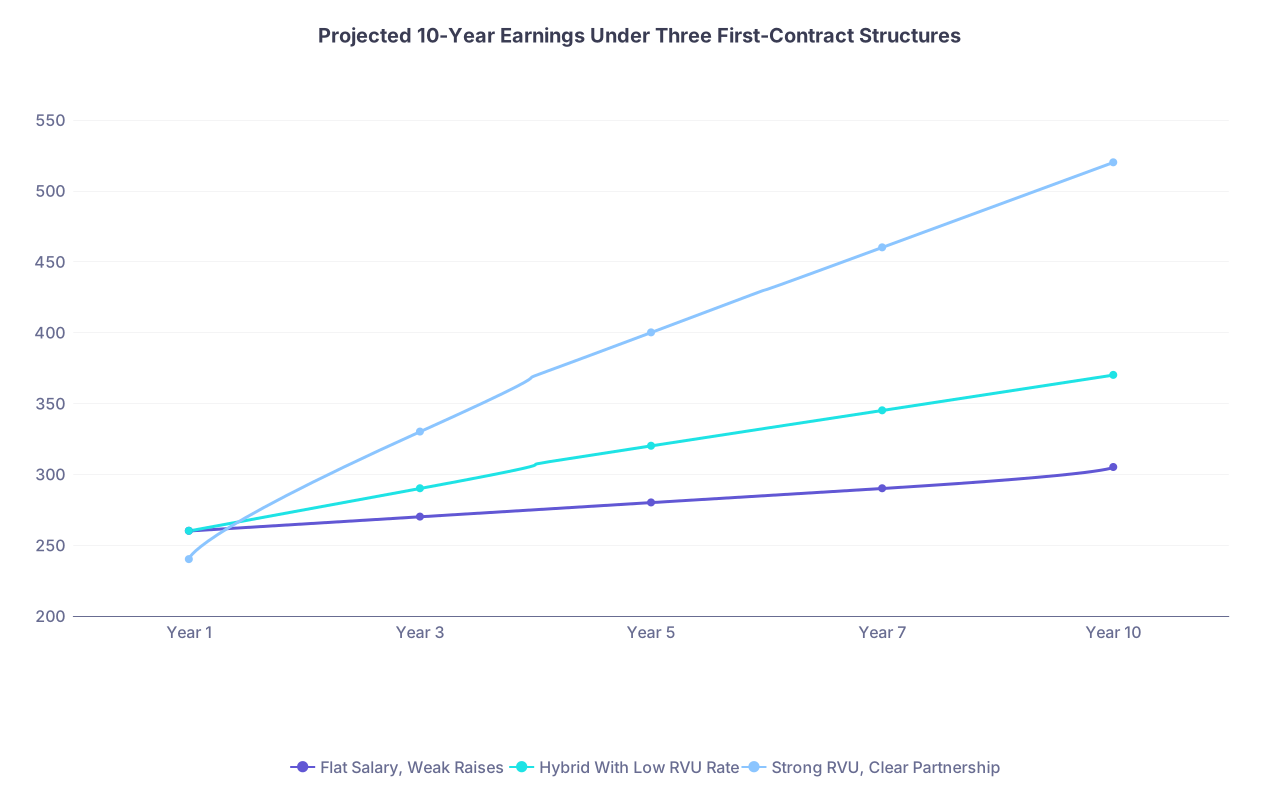
| Category | Flat Salary, Weak Raises | Hybrid With Low RVU Rate | Strong RVU, Clear Partnership |
|---|---|---|---|
| Year 1 | 260 | 260 | 240 |
| Year 3 | 270 | 290 | 330 |
| Year 5 | 280 | 320 | 400 |
| Year 7 | 290 | 345 | 460 |
| Year 10 | 305 | 370 | 520 |
Numbers are in thousands, but you get the point. The gap between a weak first contract and a strong one isn’t 10–20k a year. It’s hundreds of thousands over a decade.
The Bottom Line
Your first physician contract is not just about surviving your first year out of training. It’s a blueprint for:
- How much of your clinical value you’ll keep vs. give away
- How much leverage you’ll have when you finally decide you’re underpaid
- Whether your income climbs, plateaus, or explodes when everyone else’s does
Read it that way. And if the story it’s telling about your future salary trajectory is “stagnant, controlled, replaceable”—either change the story before you sign, or be very sure you’re willing to live with it.
You’ll feel the difference not next month, but ten years from now, when you look at your retirement account and realize your “just sign it, I’m tired” moment cost you an entire decade of compounding.