
What if the “extra” call pay you’re excited about actually drops your effective hourly rate below what a moonlighting PGY-3 makes?
That happens. A lot. And it’s usually because of bad assumptions about call.
You are not underpaid because hospitals are uniquely evil. You’re underpaid because the math and the legal terms around call are deliberately opaque, and physicians walk straight into the trap.
Let’s tear through the biggest mistakes before you sign something you’ll regret for 3+ years.
1. The First Lie You Tell Yourself: “It’s Just Every 4th Night”
This is the gateway mistake: assuming call frequency is a simple fraction and will stay that way.
You hear:
“Call is about Q4, shared among four physicians.”
Here’s what that actually turns into in real life:
- One partner leaves → suddenly Q3
- Somebody gets long COVID, pregnancy, FMLA, or burns out → you’re “helping out” at Q2 for 6–12 months
- Hospital adds a new service (stroke call, OB backup, trauma coverage) → your call count balloons but the “stipend” doesn’t
And you didn’t put any of that in writing.
The dangerous assumptions here:
Assuming call frequency is stable.
Unless your contract has a cap or a defined adjustment mechanism, “Q4” is marketing copy, not a promise.Assuming all call days are equal.
Friday night call vs Tuesday night call. Post‑call clinic vs protected post‑call. You know they aren’t equal. Your pay doesn’t care.Ignoring indirect call costs.
Post‑call fatigue. Reduced clinic efficiency. Less time for procedures (where you actually earn). Fewer moonlighting shifts.
You need this in your contract if you want to protect yourself:
- A maximum average call frequency, defined over a time window.
- A mechanism for compensation change if call frequency rises above that.
- Explicit language about additional stipends for new services or new hospitals.
If the group says, “We’d never do that to you,” that’s code for, “We don’t want to write it down because we might.”
2. The “Call is Just a Stipend” Trap
The most common way doctors get scammed by call: they think in dollars, not hours.
“I get $2,000 per 24‑hour call. That sounds great.”
Does it?
Let’s do the math.
Say your base salary is $350,000 for a 5‑day work week, no call. Decent for a non‑procedural specialty in many markets.
Now they add call:
- 1 in 4 nights + 1 in 4 weekends
- Call stipend: $1,500 per 24 hours, in‑house or home with high volume
- You take 7 calls per month (approx Q4 with mix of weekdays/weekends)
- Annual call pay: 7 × $1,500 × 12 = $126,000
You’re thinking: “Nice, that bumps me to $476k.”
Except your hourly rate probably just tanked.
Let’s be brutal with the numbers.
Step 1: Figure your base hourly rate (no call)
- 5 days/week clinical, 48 weeks/year → 240 days
- Assume 10-hour “normal” workday (patient care + charting) → 2,400 hours/year
Base hourly:
$350,000 / 2,400 ≈ $146/hour
Step 2: Add call hours
Call is not just the time you’re actively working.
For each 24‑hour call:
- 24 hours physically available
- Post‑call day you’re useless after noon? That’s lost productivity.
- Sleep disruption → your next clinic day is slower, you stay later, chart at home.
Realistically:
- Each 24‑hour call adds 18–24 additional work/availability hours when you count recovery.
- Let’s be conservative: 18 extra hours per call
You’re taking 7 calls/month → 7 × 18 = 126 extra hours/month
Annual: 126 × 12 = 1,512 extra hours/year
Total hours/year now:
2,400 (base) + 1,512 (call) = 3,912 hours
Total comp with call: $476,000
New effective hourly rate:
$476,000 / 3,912 ≈ $122/hour
You just dropped from $146/hr to $122/hr.
You gave up control of your nights, your weekends, and your sleep… to make less per hour than your base.
That’s the trap.
You didn’t ask: “What’s my effective hourly rate with call?”
You only asked: “What’s the stipend?”
3. The Fake “Protected Post‑Call” Protection
Another big lie: “You’ll have a protected post‑call day.”
What does that actually mean?
- No clinic?
- No elective procedures?
- No meetings?
- No expectation to “just finish your notes”?
Most contracts do not define this. They rely on culture. Culture changes the moment finances get tight.
Common ways “protected” gets watered down:
- You’re still expected to round post‑call “just on your own patients”
- You’re scheduled for meetings, committee work, teaching
- You’re told to “complete your documentation from home”
- They put a “half‑day” of clinic on your post‑call day because “everyone does fine with that”
Now you’ve:
- Lost the recovery time you thought you had
- Lost any chance to make call financially worthwhile
- Doubled your risk for burnout
If they push back on defining post‑call protections in writing, remember this:
They know post‑call is work. That’s why they don’t want to give it up.
You want contract language that’s painfully specific:
- “Post‑call day following 24‑hour in‑house call will have no scheduled clinical duties after 8 a.m.”
- “No outpatient clinic, elective procedures, or mandated committee meetings will be scheduled on post‑call days.”
- “Productivity expectations (RVUs, patient counts) will be pro‑rated to reflect removed post‑call time.”
If your RVU target doesn’t drop when post‑call clinic is removed, congratulations: you just volunteered to work extra evenings and weekends for free to “catch up.”
4. The RVU Mirage: When Call Destroys Your Bonus
A sneaky but devastating mistake: assuming call is “extra money” on top of RVU compensation.
I’ve watched this play out:
- Hospitalist: “I got $15k for night call coverage this year.”
- Same hospitalist: “Missed my RVU bonus by 1,200 RVUs because my daytime census dropped.”
Let’s translate that into money.
Say your plan pays:
- $50 per RVU over threshold
- You average 6 RVUs/day in clinic or on rounds
- You’re working 200 true clinical days/year (post‑call carving out)
Missing 1,200 RVUs = $60,000 in lost bonus.
Your night call stipend? $15,000.
You just traded $60k for $15k.
Why? Because:
- Nights destroy your daytime efficiency.
- You’re more likely to be sick, slow, or behind on notes.
- You decline optional add‑ons that actually pay RVUs (extra cases, extra patients) because you’re exhausted.
And the RVU threshold in your contract never changed when they added call.
This is one of the most toxic combinations:
- High RVU threshold
- Heavy call burden
- Weak or flat call compensation
You end up working more hours, earning less per hour, and missing your upside entirely.
Ask these questions before signing:
- “How many physicians in this practice actually hit the RVU bonus last year?”
- “Do the high-call docs hit it less often?”
- “If I take extra call, does my RVU target adjust down?”
- “Show me a sample schedule of a doctor with my expected call load who actually hits target.”
If they dance around this, they already know the answer: the call docs subsidize the clinic‑only docs.
5. Home Call vs In‑House Call: The Volume Lie
Another classic trap: assuming home call is somehow “lighter,” therefore cheaper, therefore fine.
That used to be true. It often isn’t now.
Home call + EMR + cell phones = you’re working. A lot.
Here’s the reality in many systems:
- Overnight admits via phone or remote orders
- Constant nursing calls because staffing is thin
- EMR messaging that they “just send you real quick” while you’re on call
- Remote review of images, labs, EKGs
If you’re expected to:
- Log into the EMR repeatedly
- Evaluate new patients by chart review
- Write notes or orders
- Bill for these encounters
That is not casual home call. That is remote in‑house call.
And it should be paid accordingly.
But physicians make two bad assumptions:
“Home call is supposed to pay less than in-house.”
Not when the burden is basically the same.“I can’t argue; everyone else accepts it.”
Everyone else accepting a bad deal doesn’t make it fair. It just makes it entrenched.
Do a simple test: for your current/expected home call:
- Track how many hours you’re actively working
- Count the number of logins, notes, orders
- Count how many times your sleep is meaningfully interrupted
If you’re hitting 5–8 hours of active work on “home” call, that is essentially a night shift. If they’re paying you like you’re just holding a pager, you’re subsidizing the hospital.
6. The Legal Landmines: Call Pay and Compliance
Here’s the part doctors conveniently ignore until the DOJ shows up: call pay is a legal issue, not just a financial one.
Hospitals know this. Their lawyers definitely know this.
Two main traps:
a) Call pay tied to referrals (illegal)
If you’re employed or aligned with a hospital, and you’re being paid above fair market value for call, and your contract even indirectly relies on referrals, your call pay can trip:
- Stark Law
- Anti‑Kickback Statute
No, you don’t need to be in brown envelopes territory. Something as simple as:
- “We’ll pay this high call stipend because you bring all your procedures here”
- “We’ll bump your call pay if you shift more of your cases from outpatient center to our hospital”
That’s dangerous.
You should never see contract language tying call pay explicitly to referrals or case volume directed to the hospital. Compensation must be:
- Commercially reasonable
- Within fair market value ranges
- Not contingent on the volume/value of referrals
If any admin says, “We can offer you more call pay if you commit to bringing all your cases here,” that’s a massive red flag. You need a healthcare attorney, not just good vibes.
b) Misclassification of call hours and overtime
This hits more in academic and employed models, especially for:
- Nocturnists
- Intensivists
- Hospitalists with “shift plus call” hybrids
If they pay you a flat salary and then stack on huge call requirements:
- 80+ hours/week routinely
- No proper tracking
- No meaningful distinction between “shift” and “call”
You’re now in the murky zone where they might be violating labor standards or, at minimum, hiding work hours to avoid raising comp.
You’re a physician, not an hourly employee under the FLSA, but that doesn’t mean they can pretend your 1.5 FTE of work is a single FTE just because the contract says so.
You need clear definitions:
- What counts as a “shift”?
- What counts as “call”?
- What’s the maximum number of hours or shifts per month?
- What happens if they exceed that? (Real money, not “we owe you a favor.”)
7. The “Everyone Else Does It” Myth
One of the most toxic assumptions in physician culture: “If all my colleagues accept this, it must be fair.”
No.
They might:
- Have signed 10 years ago when expectations were lower
- Be too burned out to renegotiate
- Be so entangled (partnership track, kids in school, mortgage) they can’t leave
- Not have done the math… at all
You’re not obligated to repeat their mistakes.
Look at the numbers compared to alternatives:
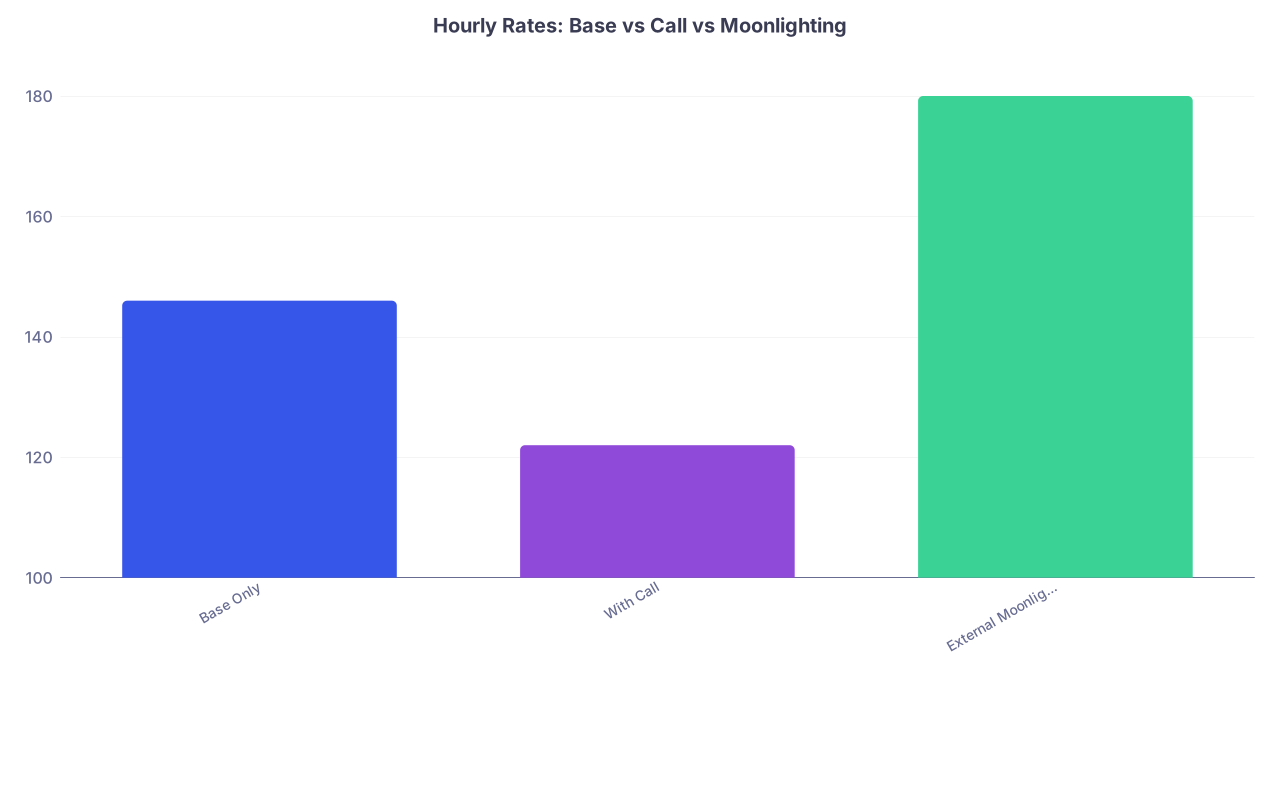
| Category | Value |
|---|---|
| Base Only | 146 |
| With Call | 122 |
| External Moonlighting | 180 |
If you can make $180/hour moonlighting in a nearby ED or telemedicine gig, and your employer is effectively paying you $110–130/hour when you include call, you’re donating money.
And time. And health.
Yet physicians keep accepting that all call in a certain market has to look the same. It doesn’t.
You can:
- Negotiate lower call expectations for the same salary.
- Negotiate a separate, higher call rate.
- Drop call entirely and adjust your base.
- Arrange call buy‑downs (you pay partners to take your call, or vice versa, at a transparent internal rate).
If your group treats call as sacred and fixed, what they really mean is: “We like the current subsidies and don’t want to change them.”
8. How to Actually Evaluate Call Pay (Without Lying to Yourself)
Let’s fix this.
Here’s a simple process that doesn’t require an MBA.
Step 1: Get the full call picture in writing
You want:
- Expected call frequency (weekday + weekend)
- In‑house vs home
- Typical call volume: admits, consults, calls per night
- Who covers backup, second call, and cross‑coverage
- Post‑call expectations (clinic, procedures, meetings)
Then assume it will get worse, not better, over a 3–5 year contract.
Step 2: Calculate your true call hours
Count:
- Each 24‑hour call as 18–24 effective hours (your judgment, not admin’s fantasy)
- Home call hours where you’re awake/working in EMR as real hours
- Recovery time that makes next‑day work slower or shorter
Be honest or you’re only lying to yourself.
Step 3: Compute your effective hourly rate with and without call
Use:
- Total annual compensation (base + bonus + call)
- Divided by total annual hours (base work hours + call + recovery)
Compare:
- Scenario A: With call
- Scenario B: Without call (assume base adjusts down or up)
| Scenario | Total Pay | Total Hours | Effective Hourly |
|---|---|---|---|
| Base No Call | $350,000 | 2,400 | $146/hr |
| Base + Call Stipend | $476,000 | 3,912 | $122/hr |
| External Moonlighting | $420,000 | 2,600 | $162/hr |
That third row? That’s you saying no to call and instead adding a few well‑paid external shifts.
Step 4: Put guardrails in your contract
Non‑negotiable protections:
- Maximum call frequency, defined precisely
- A call pay schedule that increases if volume or hours increase
- Clear post‑call protections
- RVU or productivity targets adjusted for call burden
- Language about new services requiring new compensation
Is it “hard” to negotiate this? Yes. But living with a bad call setup for three years is harder.
9. When to Walk Away
Sometimes the right move isn’t to negotiate. It’s to leave.
Red flags that should make you strongly consider walking:
- They refuse to quantify call expectations in writing.
- They won’t adjust RVU targets despite heavy call.
- They say, “Nobody else has complained.”
- They treat everything as “just how it is in this market.”
- Call burden has clearly crept up for existing physicians, and no one got a raise.
You don’t win by being the “team player” who silently absorbs a structurally bad deal. You win by aligning your time, risk, and compensation.
Physician time is finite. The hospital’s willingness to lean on it is not.

| Step | Description |
|---|---|
| Step 1 | Offer With Call |
| Step 2 | High Risk - Walk or renegotiate |
| Step 3 | Reject or demand better call pay |
| Step 4 | Add protections before signing |
| Step 5 | Reasonable to accept offer |
| Step 6 | Is call defined in contract |
| Step 7 | Effective hourly with call higher than alternatives |
| Step 8 | RVU and postcall protections clear |
FAQ (5 Questions)
1. Is it ever reasonable to accept low call pay if my base salary is high?
Sometimes, but only if your effective hourly rate with call stays competitive. If your all‑in hourly remains solid compared to peers and alternatives and call frequency is tightly capped, it can be acceptable. Just don’t get dazzled by a big base that hides unpaid nights and weekends.
2. What’s a “fair” rate for 24‑hour call?
There’s no universal number, but red flag territory is anything that drops your hourly rate below comparable moonlighting or locums rates for similar work. In many specialties, 24‑hour call that’s busy enough to require you to stay nearby or wake repeatedly should often be valued similarly to a 12‑hour night shift, not a token stipend.
3. How do I bring this up without sounding “difficult” in negotiations?
You frame it as alignment, not greed. For example: “Given the expected call volume, I want to be sure the structure is sustainable long term. Can we run through how this impacts my effective hours and RVU expectations?” If they react badly to reasonable questions, that’s diagnostic. Of them, not you.
4. Should I ever do call for free as a new partner to ‘show commitment’?
No. That’s how you train a system to exploit you. If there’s a defined, temporary structure (e.g., reduced partnership buy‑in in exchange for more call for 6–12 months, in writing), maybe. But vague promises of “we’ll take care of you later” are how people end up bitter and burned out.
5. Do I really need a healthcare attorney to review call terms?
If call is a significant part of your workload or pay, yes, it’s smart. A competent healthcare attorney will spot:
- Illegal referral‑contingent structures
- Missing protections that will hurt you later
- One‑way “flexibility” that only benefits the employer
That review costs a fraction of what you can lose in a single bad year of call.
Key points to remember:
- Always convert call into hours and recalculate your true hourly rate; stipends alone are meaningless.
- Get call expectations, post‑call protections, and RVU adjustments in writing with specific caps and triggers.
- If taking call makes your effective hourly rate worse than reasonable alternatives, you’re subsidizing the system, not winning.